

Aug
The Wealth Strategy Framework: A Fiduciary Approach to Sophisticated Financial Evolution
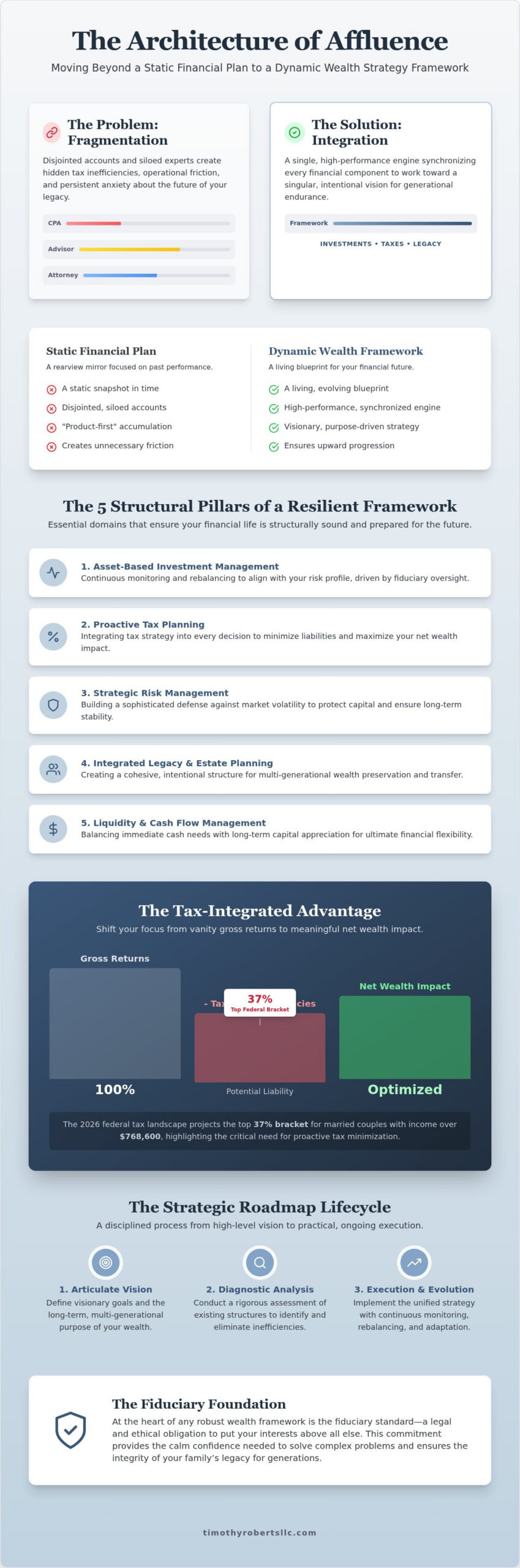
What if your financial life wasn’t a collection of disjointed accounts, but a single, high-performance engine designed for generational endurance? Most high-net-worth individuals find themselves managing a friction-filled existence where the CPA, the investment advisor, and the estate attorney operate in silos. This fragmentation often leads to hidden tax inefficiencies and a persistent anxiety that your legacy lacks a cohesive structure. Adopting a sophisticated wealth strategy framework is the only way to silence the noise and ensure every dollar is working toward a singular, intentional vision.
You likely recognize that true prosperity requires more than just picking the right stocks; it demands a synthesis of tactical tax planning and proactive risk management. We’ll show you how to master the architectural principles of a high-level strategy to synchronize your investments and legacy goals. By examining the 2026 federal tax landscape, where the top 37% bracket now applies to income over $768,600 for married couples, we’ll outline how to minimize liabilities through intentional structure. This guide provides a steady, logical path from high-level vision to the practicalities of execution, ensuring your financial evolution is guided by a fiduciary standard that is both stable and profound.
Key Takeaways
- Learn how to transition from a static financial plan to a dynamic wealth strategy framework that synchronizes your investments, taxes, and legacy goals.
- Identify the five essential structural pillars required to balance immediate liquidity needs with long-term capital appreciation.
- Shift your focus from vanity gross returns to net wealth impact by integrating proactive tax advising into your investment management.
- Understand the lifecycle of a strategic roadmap, moving from the initial articulation of visionary goals to rigorous diagnostic analysis.
- Discover the value of a fiduciary-led partnership that merges individual creative vision with sophisticated corporate capabilities for lasting financial evolution.
The Architecture of Affluence: Defining the Wealth Strategy Framework
A standard financial plan often acts as a static snapshot, a map of where you’ve been rather than where you’re going. In contrast, a wealth strategy framework is a living blueprint for sophisticated organizational evolution. It represents the difference between owning a collection of high-end parts and commanding a finely tuned, high-performance engine. When assets are managed in silos, structural inefficiencies inevitably creep in and erode your capital. Your CPA might optimize for last year’s tax liabilities, while your investment advisor chases next quarter’s returns, often working at cross-purposes. This fragmentation creates unnecessary friction that slows your upward progression and complicates your legacy.
To better understand the underlying components of successful asset allocation, watch this helpful video:
Moving Beyond Portfolio Management
Many investors mistakenly believe that a well-diversified portfolio is the same thing as a comprehensive strategy. It isn’t. A portfolio is merely a tool, whereas the strategy is the engine that drives it toward a specific, visionary destination. High-net-worth individuals often fall into the trap of “product-first” thinking, where they accumulate individual financial instruments without a central architectural logic. A visionary strategist looks past the immediate ticker symbols to synthesize your individual creative vision with structured corporate capabilities. This approach ensures that every investment decision serves a larger, intentional purpose. It treats wealth development as a journey of upward progression rather than a series of isolated transactions.
The Fiduciary Standard as a Foundation
At the heart of any robust Wealth management approach is the fiduciary standard. This isn’t just a professional courtesy; it’s a legal and ethical obligation to put your interests above all else. Traditional brokerage models often operate on a transaction-based logic, which can prioritize product sales over long-term stability. A fiduciary model provides a higher level of oversight, acting as a guardian for the integrity of your wealth strategy framework. This partnership creates a narrative of shared success, where the advisor’s primary goal is the preservation and growth of your family’s legacy. It provides the calm confidence needed to solve complex problems with professional rigor rather than rushing toward generic, off-the-shelf conclusions. By bridging individual creative vision with structured corporate capabilities, this foundation ensures your financial roadmap remains structurally sound for generations.
The Structural Pillars: Beyond Simple Portfolio Management
A sophisticated wealth strategy framework isn’t built on a single foundation; it’s supported by five essential domains that ensure your financial life remains structurally sound. These pillars go beyond the superficial metrics of market performance to address the intersection of personal aesthetics and functional planning. By balancing the immediate requirement for liquidity with the aspirational pull of capital appreciation, you create a roadmap that is both resilient and progressive. This disciplined approach serves as a defense against market volatility, allowing you to focus on your long-term vision rather than short-term noise.
Asset-Based Investment Management
Strategic investment portfolio management requires more than just asset allocation. It demands continuous monitoring and rebalancing as a core intervention to maintain your desired risk profile. Fiduciary oversight is vital here, especially within brokerage and retirement accounts, to ensure that every investment decision is made with your best interests as the primary driver. This level of professional rigor transforms a collection of stocks and bonds into a purposeful engine for growth.
Retirement Income and Cash Flow Strategy
Constructing retirement income planning that survives various market cycles involves organizing capital with specific intent. Many successful strategies utilize a “bucket” approach, where assets are segmented by time horizon to ensure near-term needs don’t compromise long-term potential. For 2026, maximizing contributions is a key tactic; the employee limit for 401(k) plans is $24,500, while individuals aged 60 to 63 can take advantage of a catch-up contribution of up to $11,250 if the plan allows. Optimizing these vehicles, alongside Roth and SEP IRAs, ensures your cash flow remains steady and efficient.
Estate and Legacy Coordination
A truly visionary legacy reflects your personal values and intellectual curiosity. Sophisticated estate planning focuses on structuring your assets to avoid probate and minimize the friction of multi-generational transfer. With the 2026 federal estate tax exemption set at $15 million per individual, or $30 million for married couples, the structural integrity of your trusts and wills is paramount. Ensuring these documents are synthesized with your broader financial goals allows for a seamless transition of both wealth and wisdom. If you’re seeking a partner to help design this level of architectural depth, consulting with a visionary strategist is the next logical step in your journey.
The Tax-Integrated Advantage: Optimizing for Net Wealth Impact
Gross returns are often treated as a scoreboard for success, yet they represent a vanity metric if they don’t account for the erosion caused by tax liabilities. For the sophisticated investor, the only figure that truly matters is net wealth impact. A robust wealth strategy framework treats tax efficiency not as an afterthought, but as a primary architectural component of the portfolio. When investment advisory and tax advising operate in a vacuum, the resulting friction can cost families a significant portion of their purchasing power over decades.
Proactive Tax Compliance and Strategy
Most individuals view taxes as a seasonal obligation, a backward-looking exercise in data entry. A visionary strategist reframes this as a year-round intervention. Proactive compliance involves analyzing the tax implications of every trade, distribution, and corporate action before it occurs. In the 2026 fiscal environment, where the 37% federal income tax bracket applies to married couples filing jointly with income over $768,600, the margin for error is thin. Professional fees for integrated strategy are an investment in liability minimization. This is especially true for complex portfolios containing alternative investments or private credit, where the timing of income recognition is critical for retirement stability.
Advanced Tax Interventions
Managing capital gains requires a disciplined approach to thresholds and timing. In 2026, the 20% long-term capital gains rate triggers for married filers once taxable income exceeds $613,700. A strategic framework uses tax-loss harvesting and charitable giving to navigate these levels with precision. Charitable tools, such as donor-advised funds or charitable trusts, serve a dual purpose; they cement a family’s legacy while providing immediate structural relief.
For small business owners, the intersection of corporate and personal wealth is the most common site of structural inefficiency within a wealth strategy framework. Coordinating business tax returns with personal wealth goals ensures that corporate profits are extracted or reinvested in a way that maximizes net household wealth. It’s about more than just checking boxes. It’s about ensuring the personal and professional work in harmony. This synthesis creates a human-led, results-driven identity for your wealth that distinguishes it from a simple collection of assets.
Execution and Evolution: The Lifecycle of a Strategic Financial Roadmap
Implementation is where vision meets reality. Without a structured lifecycle, even the most sophisticated wealth strategy framework risks becoming an archival document rather than a functional engine. This process isn’t a linear checklist. It’s a continuous loop of organizational evolution that ensures your assets remain aligned with your values as markets shift. By following a phase-based implementation cycle, you move away from reactionary decision-making toward a state of calm, strategic confidence.
- Phase 1: Discovery. This stage focuses on the articulation of visionary goals. It’s about uncovering the personal “why” behind your capital.
- Phase 2: Diagnostic Analysis. We perform a rigorous evaluation of your current resources and time horizons. This provides a data-driven foundation for your roadmap.
- Phase 3: Implementation. This phase involves the deployment of carefully crafted interventions. Every strategy is executed with architectural precision.
- Phase 4: Continuous Evolution. A rhythmic review of the framework ensures it stays resilient. We adjust the strategy to reflect new opportunities and mitigate emerging risks.
Setting the Strategic Vision
Defining your vision is an exercise in intellectual curiosity. It requires you to look beyond the immediate performance of a brokerage account to the long-term impact of your legacy. We use sophisticated technology to model different outcomes, allowing you to visualize how specific decisions today will echo through future generations. This establishes a decision-making framework that doesn’t break when life events occur. It bends and adapts. This ensures your upward progression remains steady regardless of external noise.
Rhythmic Monitoring and Adjustment
Financial development is a journey, not a transaction. Maintaining the integrity of your wealth strategy framework requires a steady, logical communication rhythm with your advisor. This isn’t about frantic reactions to market volatility; it’s about disciplined adjustments that keep you on the path. We treat every review as an opportunity for refinement. This ensures that your individual creative vision stays synthesized with structured corporate capabilities. If you’re ready to move beyond fragmented advice, it’s time to secure personalized wealth management that prioritizes your success.
Partnering with a Visionary Strategist: The Timothy Roberts Difference
Sophisticated clients don’t seek a vendor; they seek a partner for organizational evolution. Timothy Roberts & Associates, LLC brings over 25 years of experience to the table, having navigated complex financial shifts since 1998. This deep history allows us to maintain a steady hand in volatile times. We offer a rare synthesis of high-level tax expertise and investment management, ensuring your wealth strategy framework is structurally sound from every angle. It’s a specialized approach where personal attention isn’t a luxury but a fundamental requirement for success. By choosing a firm where the personal and professional are deeply synthesized, you’re investing in a relationship that prioritizes your long-term stability over short-term transactions.
Tailored Interventions for Unique Goals
We move away from the off-the-shelf solutions that define larger, more anonymous institutions. Instead, we act as expert craftsmen, treating your financial future as a unique project that requires both aesthetic vision and business-minded rigor. By synthesizing your individual creative vision with structured corporate capabilities, we build a strategy that is as functional as it is ambitious. These carefully crafted interventions ensure that your portfolio isn’t just growing, but evolving in a way that reflects your specific values and intellectual curiosity. Whether it involves complex estate and legacy planning or refined risk management, every decision is an intentional step toward your desired outcome. It’s about building a high-performance engine that works for you, not the other way around.
Taking the First Step Toward Upward Progression
The journey begins with a comprehensive financial planning consultation. This isn’t a generic sales pitch; it’s a deep dive into the diagnostic analysis of your current resources and visionary goals. During your initial wealth strategy framework review, we’ll examine the structural integrity of your assets, from retirement income planning to sophisticated tax strategies. We prioritize a communication rhythm that is steady and logical, guiding you from high-level vision down to the practicalities of execution. This partnership is built on a foundation of calm confidence and aspirational growth. It’s an invitation to those who value quality and depth over superficiality. We take the time to understand the complex problems you face, ensuring that your path toward upward progression is clear, intentional, and enduring. You’ll leave the initial review with a sense of quiet ambition, knowing your legacy is in the hands of a reliable business advisor.
Securing Your Financial Legacy Through Architectural Precision
Transitioning from fragmented financial advice to a unified wealth strategy framework is the defining step in your organizational evolution. You’ve seen how the synthesis of tax advising and investment management protects your capital from structural erosion. By treating your assets as a high-performance engine rather than a static collection of accounts, you ensure your legacy remains resilient across generations. This journey requires a partner who values depth over superficiality and understands that your creative vision deserves a rigorous foundation.
Schedule your comprehensive wealth strategy consultation with Timothy Roberts & Associates, LLC to begin this transformation. Our fiduciary advisors bring over 25 years of experience to every intervention, offering personalized strategies tailored to your unique risk tolerance. We bridge the gap between individual ambition and corporate capability. Your path to upward progression is a journey we share, and it’s one we approach with calm confidence. We look forward to helping you build a future that is both structurally sound and profoundly impactful.
Frequently Asked Questions
What exactly is a wealth strategy framework?
It’s an integrated architectural blueprint. This system synchronizes investments, tax liabilities, and legacy goals into a single, high-performance engine. Unlike a simple plan, the wealth strategy framework operates as a dynamic environment for organizational evolution. It ensures every financial component works in harmony to support a visionary destination. This structure transforms disjointed accounts into a cohesive roadmap for lasting prosperity and growth.
How does a wealth strategy differ from traditional financial planning?
Traditional planning is often a static snapshot, whereas this approach represents a living lifecycle of continuous evolution. It moves beyond simple portfolio management to synthesize individual creative vision with structured corporate capabilities. This eliminates the friction of fragmented advice from separate specialists. You gain a unified roadmap that prioritizes long-term stability over short-term ticker symbols and isolated transactions.
Why is tax integration so critical for high-net-worth individuals?
Tax integration shifts the focus from vanity gross returns to actual net wealth impact. In 2026, with the top 37% bracket applying to income over $768,600 for married couples, proactive tax advising is a necessity. Integrated planning ensures that withdrawals and investment decisions don’t trigger unnecessary liabilities. It turns tax compliance into a strategic advantage for your portfolio.
What does it mean to have a fiduciary advisor manage my framework?
A fiduciary advisor is legally and ethically bound to prioritize your interests above all else. This model provides an air of professional stability and trust that traditional brokerage models often lack. It ensures that every intervention within your financial framework is crafted to serve your long-term stability rather than product sales. You receive personal attention from an expert strategist.
How often should a wealth strategy framework be reviewed or updated?
We recommend a steady, logical communication rhythm that includes a comprehensive review at least annually or when significant life events occur. This isn’t a one-time transaction but a journey of upward progression. Rhythmic adjustments allow us to navigate market volatility and regulatory changes without compromising your structural integrity. It ensures your roadmap stays aligned with your evolving visionary goals.
Can a wealth strategy framework help with business succession planning?
The framework synthesizes personal wealth goals with structured corporate capabilities to ensure a seamless transition of power and assets. It addresses the intersection of aesthetics and functionality in your business legacy. By coordinating business tax returns with estate and legacy planning, we minimize friction for the next generation. This process ensures your corporate evolution reflects your intellectual curiosity and professional values.
What are the common mistakes people make without a unified framework?
Most individuals suffer from fragmented advice, where their CPA and investment advisor operate in silos. This lack of coordination leads to hidden tax inefficiencies and structural instability in their legacy. Without a unified wealth strategy framework, capital is often misaligned with the individual’s visionary goals. This results in unnecessary anxiety about the complexity of multi-generational wealth transfer and long-term appreciation.
How do I know if I have enough wealth to require a formal strategy?
If you face complex problems like multi-generational wealth transfer or high tax liabilities, a formal strategy is essential. Sophisticated clients value depth and customization over superficiality. If your financial life feels cluttered or disjointed, it’s time to adopt a professional framework for your organizational evolution. We provide the expertise needed to navigate the $15 million estate tax exemption thresholds of 2026.
