

May
Strategic Legacy Management: Avoiding Common Estate Planning Mistakes in 2026
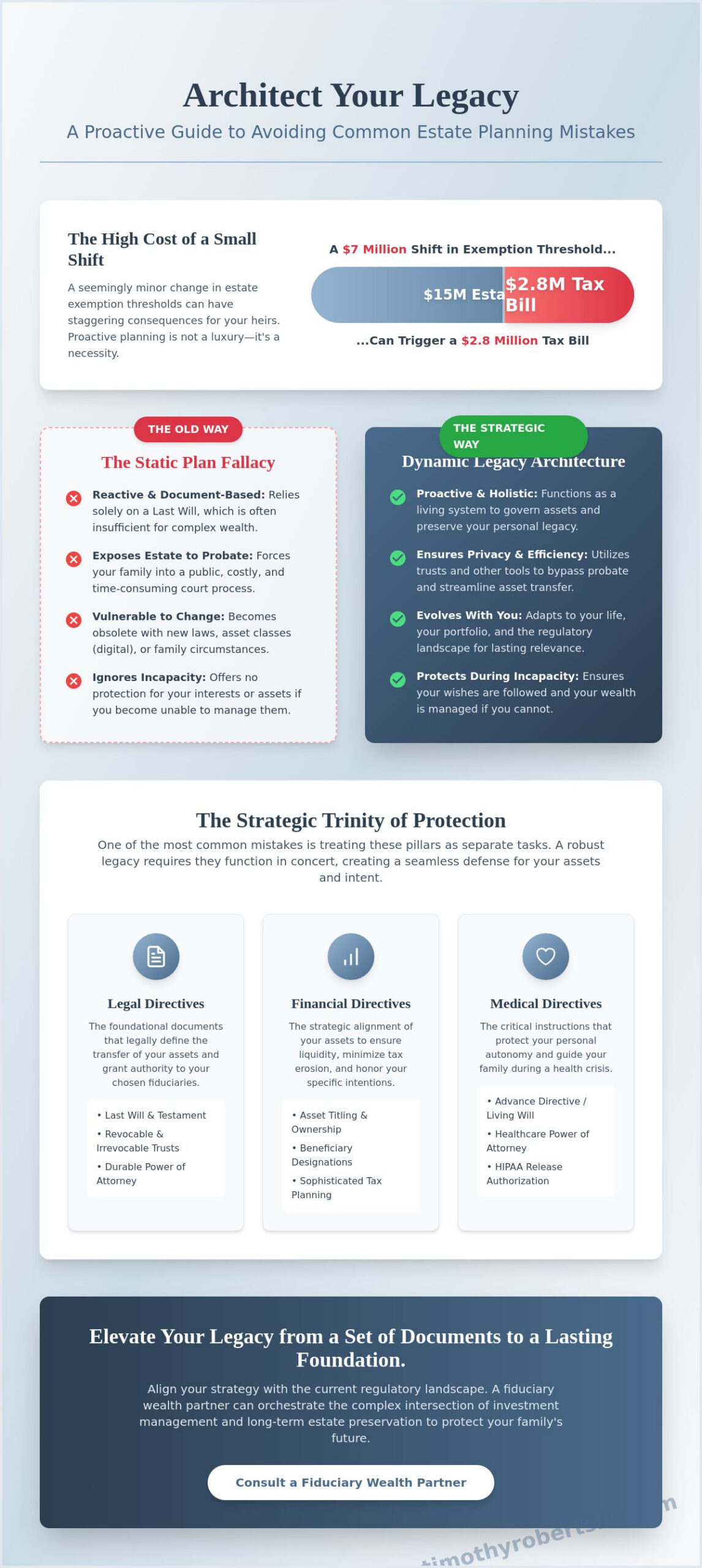
A simple $7 million shift in your estate’s exemption threshold can result in a staggering $2.8 million tax bill for your family. You’ve worked with intentionality to build your portfolio, and it’s understandable to expect that your legacy will remain intact. Yet, the permanence of the $15 million federal exemption under the One Big Beautiful Bill Act has created a false sense of security for many. Without a proactive review, common estate planning mistakes like failing to account for state-specific tax cliffs or neglecting state-level inheritance taxes can quietly dismantle decades of growth.
Discover how to navigate the complexities of wealth transfer by avoiding the strategic oversights that derail even the most sophisticated estate plans. We’ll explore the essential adjustments required to minimize tax liabilities, bypass unnecessary probate costs, and ensure a seamless transition of assets across generations. This is about more than just documentation; it’s about architecting a future that reflects your values and protects your family’s upward progression. By aligning your strategy with the current regulatory landscape, you can transform your wealth into a lasting foundation for those who follow.
Key Takeaways
- Transition from static legal documents to a dynamic legacy architecture that grows alongside your wealth and the changing regulatory environment.
- Identify and neutralize common estate planning mistakes by aligning your financial and medical directives into a cohesive, strategic trinity.
- Safeguard your family’s inheritance from tax erosion by optimizing the distribution of diverse asset classes through sophisticated tax planning strategies.
- Apply a disciplined framework to inventory your global assets and define your charitable legacy with intentional precision.
- Recognize the value of a fiduciary wealth partner in orchestrating the complex intersection of investment management and long-term estate preservation.
The Fallacy of the Static Plan: Why Legacy Architecture Requires Strategic Vision
A sophisticated estate plan is far more than a set of documents stored in a vault. It’s a dynamic architecture designed to govern asset oversight while preserving your personal legacy. In 2026, the complexity of wealth has evolved to include global investments and digital property, making a static approach obsolete. True legacy management functions as a tool for both current lifestyle protection and the intentional success of future generations. It’s a proactive stance against the erosion of what you’ve built.
Relying solely on a Last Will and Testament is a frequent oversight. While a comprehensive guide to estate planning will list a will as a foundational element, it’s often insufficient for sophisticated wealth structures. A will only governs the distribution of assets after death. It offers no protection for your interests during potential incapacity, nor does it address the complexities of modern, multi-jurisdictional holdings. For those with intricate portfolios, this narrow focus represents a significant strategic vulnerability.
To gain deeper insight into the pitfalls of a reactive approach, watch this analysis of the most frequent oversights:
The Risks of Intestacy and Passive Planning
When directives are absent, state-mandated distribution laws take control. These laws are blunt instruments. They ignore specific family nuances and personal intentions, often distributing assets in ways that don’t reflect your wishes. Passive planning also forces your estate into the public eye through the probate process. This administrative burden is often accompanied by significant emotional and financial strain for heirs who are left to navigate a system without a map. Clear, private directives are the only way to bypass this public scrutiny.
Estate Planning as a Pillar of Wealth Management
Legacy goals must be synthesized with retirement income planning to create a cohesive financial trajectory. This synergy ensures that your current tax strategies align with future estate liabilities, preventing unnecessary erosion of wealth. By viewing your estate plan as a living document, you allow for the artisan-level customization required to address common estate planning mistakes before they manifest. It’s not a transaction; it’s a journey of upward progression. A well-crafted plan evolves in rhythm with your life, ensuring that your vision remains the primary driver of your family’s future success.
Structural Vulnerabilities: Misaligned Directives and the Risks of DIY Documentation
A robust legacy isn’t built on a single document but on a Strategic Trinity: legal, financial, and medical directives that function in concert. One of the most common estate planning mistakes involves treating these pillars as isolated tasks rather than a unified defense. When these directives are misaligned, the resulting structural vulnerabilities can lead to expensive litigation or administrative paralysis. A visionary strategy requires that every directive reinforces the others, creating a seamless envelope of protection around your assets and your intent.
Generic online templates represent a significant risk for complex estates. While they offer a veneer of organization, they lack the artisan-level customization required to navigate high-net-worth tax environments or non-traditional asset classes. These off-the-shelf solutions often fail to account for specific state statutes, such as the unique estate tax “cliff” in New York. Professional oversight ensures that your legal instruments are not just filled out but strategically orchestrated to survive rigorous scrutiny. Without this business-minded rigor, a DIY plan may become an expensive lesson in the administration phase.
The Interplay of Financial and Legal Directives
A Durable Power of Attorney serves as a critical bridge, ensuring continuity in wealth management should you become unable to direct your affairs. This instrument must be paired with specialized vehicles, such as revocable living trusts, which offer privacy and control that a simple Last Will cannot provide. By employing a precise, artisan approach to drafting, you define exactly how assets are managed and protected. This specificity is essential for preventing the vague directives that often invite family discord or future litigation. It’s about creating a stable foundation that supports your broader financial roadmap.
Advanced Healthcare Directives and End-of-Life Clarity
Clarity in medical directives is an act of leadership for your family. A Living Will specifies your preferences regarding life-sustaining interventions, while a Healthcare Proxy designates a trusted voice to speak when you cannot. These documents remove the burden of guesswork from your loved ones during high-stress transitions. This level of intentionality protects family harmony as much as it protects your personal dignity. It ensures that your values remain the guiding force, even in moments of crisis, providing a sense of calm confidence for those you care for most.
Maintaining this alignment requires a rhythmic review process, as laws and family dynamics are rarely static. Engaging in comprehensive estate and legacy planning allows you to identify gaps in your Strategic Trinity before they become liabilities. This proactive oversight is the hallmark of a sophisticated wealth strategy, ensuring your plan remains legally enforceable and strategically sound across every generation.
The Liquidity and Tax Trap: Optimizing Asset Distribution for Heirs
Wealth preservation is a delicate balance of growth and accessibility. Effective investment portfolio management does more than chase returns; it ensures your estate remains liquid enough to meet obligations without dismantling your legacy. One of the most common estate planning mistakes is failing to forecast the cash flow required to cover estate taxes, debts, and administrative fees. When an estate is heavy on illiquid assets like real estate or private equity, heirs often fall into the “Liquidity Trap.” They’re forced to sell cherished assets at a discount just to satisfy the tax authorities during an already stressful transition.
The 2026 regulatory environment adds a layer of urgency to this calculation. While the federal exemption has stabilized at $15 million per individual, the top marginal tax rate remains a steep 40%. For those in states like New York, where the exemption is a lower $7,350,000, exceeding the threshold by even 5% triggers a tax on the entire estate value. This “cliff” makes strategic asset distribution essential. Without a plan that accounts for these specific thresholds, your heirs could face a tax bill that reaches into the millions, significantly eroding the inheritance you intended to pass down.
Revocable vs. Irrevocable Trust Structures
Choosing between trust structures is an exercise in balancing control against tax efficiency. Revocable trusts offer flexibility, allowing you to alter terms as your life evolves, but they provide limited protection from estate taxes. In contrast, irrevocable trusts serve as sophisticated interventions that remove assets from your taxable estate entirely. This artisan approach to structuring can significantly mitigate the impact of federal and state taxes. It creates a stable framework where assets are preserved for multi-generational goals rather than being treated as off-the-shelf solutions that fail under pressure.
The Conflict of Beneficiary Designations
A frequent point of failure occurs when legal instruments and account titles operate in silos. Beneficiary designations on life insurance and retirement accounts carry a legal weight that overrides your will. If a designation is outdated or conflicts with trust instructions, your assets may bypass your intended legacy structure entirely. Identifying these common estate planning mistakes requires a meticulous audit of all Transfer-on-Death (TOD) accounts. Aligning every account title with your broader financial roadmap is the only way to guarantee your directives are honored and to prevent the family discord that arises from vague or contradictory instructions.
A Disciplined Framework: 5 Steps to Avoiding Common Mistakes
Legacy architecture isn’t a singular event; it’s a continuous, disciplined process. To move beyond the reach of common estate planning mistakes, you must adopt a framework that prioritizes precision over convenience. This isn’t about checking boxes. It’s about an intentional journey toward multi-generational stability that requires a blend of creative passion and business-minded rigor. By following a structured sequence, you ensure that no detail is left to chance and that your wealth remains a catalyst for your family’s upward progression.
The first step involves conducting a comprehensive inventory of your physical, financial, and digital property. Second, you must define your legacy objectives and charitable aspirations with strategic precision, ensuring your wealth serves a purpose beyond mere accumulation. Third, select your “Legacy Team,” which includes the executors, trustees, and fiduciaries whose values mirror your own. Fourth, formalize your legal instruments with a specific focus on tax optimization and probate avoidance. Finally, implement a rhythmic review schedule to account for life transitions and the frequent legislative shifts that characterize the current regulatory environment.
Comprehensive Asset Valuation
A visionary strategy requires a deep understanding of your global footprint. This includes identifying and valuing business interests, intellectual property, and often-overlooked digital assets like cryptocurrency or monetized online platforms. Documenting these “hidden” assets prevents heirs from overlooking significant value during the administration phase. Net estate value is the total fair market value of all assets minus liabilities. By establishing this baseline, you can accurately forecast tax liabilities and ensure your distribution strategy remains mathematically sound and strategically aligned.
Fiduciary Selection: Integrity Meets Acumen
The selection of fiduciaries is a critical decision in the architecture of your legacy. You need individuals who possess both unshakeable integrity and the financial literacy required to manage complex estates. One of the common estate planning mistakes is choosing a family member based on proximity rather than professional acumen. For high-value or complex estates, professional corporate trustees offer a level of stability and expertise that individuals may lack. Always appoint successor fiduciaries to ensure long-term continuity, protecting your vision across several decades regardless of individual circumstances.
This disciplined approach transforms your estate plan from a static document into a resilient wealth strategy. If you’re ready to move toward a more sophisticated model of preservation, our team specializes in comprehensive estate and legacy planning designed for high-net-worth individuals who value quality and personal attention.
Elevating Your Legacy: The Role of a Fiduciary Wealth Partner
True legacy architecture requires a synthesis of legal, tax, and financial expertise that goes beyond the capabilities of a single professional. While a lawyer may draft the instruments, a sophisticated financial advisor serves as the orchestrator of your legacy team. This partnership ensures that your investment momentum remains aligned with your long-term directives. One of the most common estate planning mistakes is allowing these disciplines to operate in silos. When your financial roadmap and legal structure aren’t in constant dialogue, even the most robust portfolios can face unnecessary friction during a transition.
A visionary strategist treats your estate as a living entity that requires ongoing evolution. This isn’t a transactional service; it’s a commitment to your family’s upward progression. By centering your strategy on the fiduciary standard, you protect multi-generational wealth from the conflicts of interest that often plague generic wealth management. This high-end partnership moves away from aggressive sales tactics toward a narrative of shared success, ensuring that your legacy is preserved with the same intentionality you used to build it.
Integrating Tax Planning and Legacy Strategy
Precision in tax advising is the silent engine of wealth preservation. It minimizes the fiscal impact on your beneficiaries by anticipating liabilities long before they manifest. Year-round tax planning ensures that the core value of your estate isn’t eroded by avoidable tax burdens, especially as we navigate the permanent shifts of the 2026 regulatory landscape. We take an artisan approach to crafting bespoke inheritance strategies. These interventions aren’t off-the-shelf solutions; they’re carefully crafted maneuvers designed to reflect your personal values while maximizing the tangible impact of your wealth for those who follow.
The Fiduciary Difference in Estate Coordination
The fiduciary duty is the gold standard for estate management because it mandates a level of loyalty and transparency that is absolute. It’s a promise that every decision is made solely in the interest of your legacy’s health. Personalized, high-level strategies outperform generic legal kits because they account for the unique aesthetics and functionality of your specific wealth structure. This level of professional stability provides a sense of calm confidence, knowing that your intellectual and financial capital is being managed with intellectual curiosity and business-minded rigor. We invite you to engage in a strategic consultation to refine your financial trajectory and ensure your legacy remains a resilient foundation for generations to come.
Securing Your Vision Through Strategic Intent
Your legacy is a dynamic narrative that requires more than just legal compliance. It demands a rhythmic alignment of your legal instruments, tax strategies, and investment objectives. By moving past a reactive mindset and identifying common estate planning mistakes early, you transform potential liabilities into a stable foundation for your heirs. This shift from static documentation to a comprehensive legacy architecture ensures that your wealth serves as a lasting catalyst for upward progression. It’s about protecting the tangible impact of your work through every generation.
We provide over 25 years of fiduciary expertise to help you navigate these complexities with an artisan approach to wealth management. Our focus remains on the seamless coordination of tax and estate strategies, ensuring every intervention is as unique as the legacy it protects. We invite you to Schedule a Strategic Consultation to Elevate Your Legacy and refine your financial trajectory. With the right partnership, you can move forward with calm confidence, knowing your vision is secured by a strategy built for longevity and growth.
Frequently Asked Questions
What is the primary difference between a will and a revocable living trust?
A will is a public document that only takes effect upon death and requires court supervision through probate. In contrast, a revocable living trust is a private instrument that manages assets during your lifetime and provides continuity if you become incapacitated. While a will is a foundational tool, a trust allows for the immediate, private transfer of assets to your heirs without the delays and costs of the probate system.
Do I need an estate plan if my assets fall below the federal tax threshold?
You absolutely need a plan even if your estate is below the $15 million federal threshold. State-level taxes, such as New York’s $7,350,000 exemption, can still trigger significant liabilities. Beyond taxes, estate planning is a strategic framework for naming guardians, making healthcare decisions, and ensuring your assets are distributed according to your specific values rather than generic state laws that ignore family nuances.
How often should I review or update my estate planning documents?
You should conduct a professional review of your documents every three to five years to account for legislative shifts and personal evolution. Major life events like marriage, the birth of a child, or a significant change in asset value require immediate updates. Rhythmic audits ensure that your directives remain legally enforceable and aligned with your current financial roadmap, preventing the common estate planning mistakes that arise from outdated information.
What happens to my digital assets and social media accounts after I pass away?
Digital assets like cryptocurrency, intellectual property, and monetized social accounts require specific language in your legal instruments to grant fiduciaries access. Without these explicit directives, strict privacy laws often prevent heirs from accessing your digital footprint. Including a digital asset provision ensures these holdings are identified, valued, and transferred according to your wishes rather than being lost in the digital void after you pass.
Can I name a professional entity as my executor instead of a family member?
Naming a professional corporate trustee or entity as your executor is often a superior strategy for complex or high-value estates. This choice ensures that your affairs are managed with professional acumen and absolute objectivity. Professional fiduciaries possess the specialized financial literacy required to navigate intricate tax filings and distribution schedules, which removes a significant emotional and administrative burden from your family members during a time of grief.
How does estate planning help minimize the burden of the probate process?
Estate planning minimizes probate by utilizing trusts and Transfer-on-Death designations to move assets outside of the court’s jurisdiction. Probate is a public and often expensive process that can stall the distribution of your wealth for months or even years. By architecting a plan that prioritizes private transfers, you ensure a seamless transition of assets and protect your family from the scrutiny and costs associated with public court proceedings.
What is the role of a power of attorney in a comprehensive estate plan?
A Durable Power of Attorney is a critical directive that designates a trusted individual to manage your financial affairs if you become unable to do so. This instrument ensures that your investment portfolio management and daily obligations continue without interruption. Without this document, your family might be forced to seek a court-appointed guardianship, which is a restrictive and costly process that can disrupt your long-term financial trajectory.
How do beneficiary designations on my retirement accounts interact with my will?
Beneficiary designations on life insurance and retirement accounts carry a legal weight that completely overrides the instructions in your will. One of the most common estate planning mistakes is failing to align these designations with your broader trust structure. If your account titles conflict with your will, the assets will be distributed based on the account paperwork, potentially bypassing your intended legacy architecture and leading to unintended tax consequences for your heirs.
