

Jul
Managing Required Minimum Distributions in Michigan: Strategic Guidance for 2026
A 25% excise tax on your retirement capital is more than a penalty; it is a significant and avoidable erosion of your family’s legacy. You’ve spent decades diligently building your wealth, and the prospect of being forced to withdraw funds you don’t yet need can feel like a direct challenge to your financial autonomy. It’s common to feel frustrated as complex federal mandates collide with Michigan’s evolving tax landscape, often leaving retirees feeling more like a target for the IRS than a steward of their own success. Effectively managing required minimum distributions michigan requires a blend of foresight and technical precision to ensure you aren’t overpaying the state or the federal government.
This guide will show you how to satisfy these IRS mandates while simultaneously minimizing your tax liabilities and securing your long-term estate goals. We’ll explore the 2026 Michigan retirement income deductions, strategic withdrawal timelines, and the sophisticated use of Qualified Charitable Distributions to protect your capital. By moving beyond simple compliance, you can transform these required withdrawals into a strategic tool for upward wealth progression. We’ll provide the clarity you need to align your distribution schedule with a comprehensive financial roadmap that values depth and personal vision over generic solutions.
Key Takeaways
- Identify your precise distribution threshold under SECURE Act 2.0 to safeguard your portfolio from the 25% federal excise tax penalty.
- Leverage Michigan’s 2026 retirement income deduction to shield significant portions of your distributions from state income tax.
- Master the process of managing required minimum distributions michigan by using Qualified Charitable Distributions to satisfy mandates without inflating your taxable income.
- Coordinate your withdrawal strategy with estate planning goals to mitigate the impact of the 10-year rule on non-spouse beneficiaries.
- Evolve your approach from simple compliance to an integrated financial roadmap that pairs tax-aware strategies with fiduciary investment management.
Navigating the RMD Landscape: SECURE Act 2.0 and 2026 Mandates
For high-net-worth individuals, tax-deferred accounts represent a decades-long exercise in disciplined growth. Eventually, every investor reaches the IRS-mandated ‘pay the piper’ moment known as Required Minimum Distributions (RMDs). These mandatory withdrawals ensure the government finally collects the taxes deferred during your earning years. Successfully managing required minimum distributions michigan requires a nuanced understanding of how recent federal shifts interact with your personal financial roadmap. It’s no longer a matter of simply checking a box; it’s about precision-engineered timing to prevent your hard-earned capital from being unnecessarily depleted by avoidable levies.
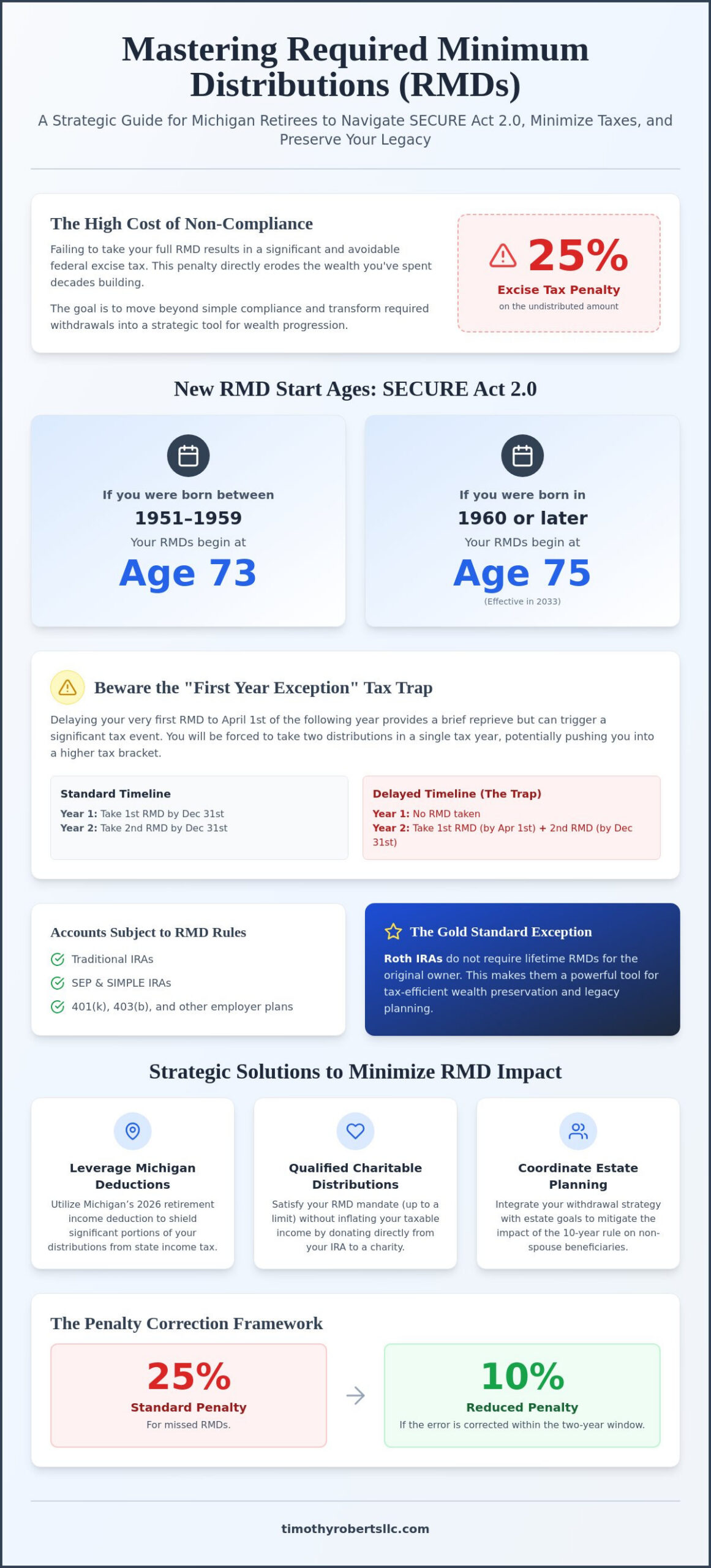
The SECURE 2.0 Act has fundamentally reshaped the timeline for these distributions, moving the starting age from 72 to 73 for most current retirees. Specifically, if you were born between 1951 and 1959, your RMD obligations begin at age 73. For younger individuals born in 1960 or later, the threshold extends to age 75, a change that won’t take effect until 2033 but remains a critical component of long-term legacy planning. This staggered implementation allows for more flexibility in your early retirement years, yet it demands a more sophisticated approach to cash flow management as you approach these milestones.
To better understand this concept, watch this helpful video:
Delaying your first distribution until the ‘First Year Exception’ deadline of April 1st can be a double-edged sword. While it offers a brief reprieve, it often triggers a significant tax trap. By pushing your first RMD into the following calendar year, you’re still required to take your second RMD by December 31st of that same year. This results in two large distributions hitting your taxable income in a single twelve-month period. For many Michigan retirees, this surge in income can inadvertently push them into a higher federal tax bracket and impact the taxation of their Social Security benefits.
Accounts Subject to Distribution Rules
The IRS cast a wide net when defining which accounts must adhere to these rules. Traditional IRAs, SEP IRAs, and SIMPLE IRAs all fall under the RMD umbrella. Employer-sponsored plans like 401(k) and 403(b) accounts are also subject to mandates, though they often include a ‘still-working’ exception. If you’re still employed and don’t own more than 5% of the company, you may be able to delay distributions from that specific plan. Conversely, Roth IRAs remain the gold standard for tax efficiency; they don’t require lifetime RMDs for the original owner, making them an unparalleled tool for managing required minimum distributions michigan and preserving wealth for heirs.
The 2026 Penalty Framework
Failing to meet your distribution requirement carries a steep price. The standard penalty is a 25% excise tax on the amount that should have been withdrawn but wasn’t. However, the IRS offers a path for correction. If you identify the error and rectify it within a timely window, typically two years, the penalty may be reduced to 10%. The SECURE 2.0 Act provides a new layer of protection by establishing that the statute of limitations for RMD-related penalties begins on the date you file your Form 1040 for the year the error occurred. This shift brings a level of professional stability to tax compliance that was previously lacking.
Calculating Your Distribution: The Mechanics of Compliance
Precise financial stewardship begins with an accurate valuation of your assets at a specific moment in time. For your 2026 mandates, the IRS dictates that the calculation must be based on your account balances as of December 31, 2025. This year-end snapshot serves as the foundational numerator for your distribution equation. Most retirees will utilize the IRS Uniform Lifetime Table to determine their distribution period. This standardized tool is designed to pace your withdrawals over a projected life expectancy, ensuring your capital remains functional throughout your retirement years. It’s a structured approach that provides professional stability while satisfying federal tax requirements.
There’s a strategic exception to this standard calculation that can significantly impact your tax-deferred growth. If your spouse is the sole beneficiary of your account and is more than 10 years younger than you, the IRS allows the use of the Joint Life and Last Survivor Expectancy Table. This alternative table typically results in a smaller required withdrawal, effectively lowering your taxable income for the year. For those managing required minimum distributions michigan, this nuance is particularly valuable when seeking to keep total income within the state’s generous retirement deduction limits. For a deeper dive into these technicalities, the IRS RMD FAQs provide the definitive regulatory framework for these calculations.
While you must calculate the RMD for every individual account you own, the rules for withdrawal vary by account type. For IRAs, you have the flexibility to aggregate the total required amount and withdraw it from a single IRA or any combination of your choosing. Employer-sponsored plans, such as 401(k) or 403(b) accounts, don’t offer this convenience; each plan must satisfy its own RMD independently. Developing a personalized financial roadmap helps ensure these disparate requirements are synthesized into a single, cohesive strategy that respects both your cash flow needs and your tax obligations.
Step-by-Step Calculation Guide
- Step 1: Aggregate all eligible account balances as of December 31, 2025. Ensure you include all Traditional, SEP, and SIMPLE IRAs, along with relevant employer plans.
- Step 2: Locate your distribution period factor based on your age in 2026 using the appropriate IRS table. For example, the factor for age 73 is 26.5.
- Step 3: Divide your total year-end balance by your distribution period factor to determine your 2026 mandate.
Common Calculation Pitfalls to Avoid
Inherited IRAs represent a frequent source of compliance errors. These accounts typically follow ‘Single Life’ tables, which often require faster depletion than your own retirement assets. Relying exclusively on automated custodian calculations is another risk; custodians often lack the full context of your external holdings, which can lead to under-distribution. Additionally, mid-year rollovers require careful tracking. If funds are in transit during a rollover, they must still be accounted for in the year-end balance to ensure you aren’t underestimating your total obligation for managing required minimum distributions michigan.
Strategic Tax Mitigation: Michigan Nuances and Federal Opportunities
Effective wealth management transcends simple compliance; it requires the active exploitation of favorable tax shifts. In 2026, Michigan retirees encounter a unique opportunity as the “Lowering MI Costs Plan” reaches its full implementation. This legislative evolution allows for a 100% deduction of eligible retirement and pension income up to projected limits of approximately $69,896 for single filers and $139,792 for those filing jointly. For those managing required minimum distributions michigan, this means a significant portion of your mandatory withdrawals may be shielded from the state’s 4.25% flat income tax. This alignment of federal mandates and state-level relief creates a rare window for tax-efficient capital preservation.
When your RMD exceeds your lifestyle needs, the Qualified Charitable Distribution (QCD) remains the premier strategy for mitigating tax exposure. A QCD allows you to transfer up to $111,000 in 2026 directly from your IRA to a qualified 501(c)(3) organization. This maneuver satisfies your RMD mandate while keeping the funds entirely out of your Adjusted Gross Income (AGI). By suppressing your AGI, you don’t just reduce your immediate tax bill; you potentially lower your Medicare Part B and D premiums by avoiding high-income surcharges. It’s a sophisticated intervention that synthesizes philanthropic intent with rigorous financial logic, ensuring your legacy is defined by your values rather than your tax liabilities.
The period between your retirement date and the age 73 RMD threshold offers a strategic “Roth Conversion Window.” During these low-income years, converting portions of your traditional IRA into a Roth IRA can permanently reduce the size of your future RMDs. While you’ll pay taxes on the converted amount today, the long-term benefit is a portfolio that grows tax-free and remains exempt from lifetime distribution requirements. Adhering to the foundational IRS RMD rules while executing these conversions requires a high-level perspective that views tax planning as a journey of upward progression.
Michigan State Tax Treatment of RMDs
Navigating the Michigan pension and retirement subtraction requires more than a casual understanding of the law. While the 100% deduction is a powerful tool, it applies specifically to qualified sources and is subject to the aforementioned inflation-adjusted caps. For high-net-worth households in Washtenaw County, securing professional tax advising in Ann Arbor is essential for ensuring that every distribution is coded correctly to maximize state-level subtractions. This localized expertise ensures your strategy remains compliant with the Michigan Department of Treasury’s specific 2026 reporting requirements.
Advanced Federal Tax Reduction Tactics
Beyond charitable giving, other federal levers can help manage the RMD burden. If you’re still employed past age 73, you may utilize the “still working” exception to defer distributions from your current employer’s 401(k) or 403(b) plan. Another specialized tool is the Qualified Longevity Allowance Contract (QLAC), which allows you to move a portion of your IRA balance into a deferred annuity, effectively pushing the RMD for those funds out to age 85. Coordinating these tactics with your Social Security timing is vital for managing required minimum distributions michigan, as it prevents a “tax cliff” where multiple income streams converge to trigger higher federal brackets.
RMDs and Estate Planning: Preserving Your Strategic Legacy
The SECURE Act fundamentally altered the cadence of multi-generational wealth transfer by effectively ending the era of the “Stretch IRA” for most heirs. Prior to this shift, beneficiaries could often extend distributions over their own lifetimes, allowing for decades of continued tax-deferred growth. Today, most non-spouse heirs are bound by the “10-year rule,” which mandates that the entire account balance be distributed by the end of the tenth year following the original owner’s death. If your children are currently in their peak earning years, these forced withdrawals can create a significant “tax bomb,” pushing their income into the highest federal brackets and eroding the value of your gift. Successfully managing required minimum distributions michigan involves looking beyond your own lifetime to consider the tax burdens your loved ones will eventually shoulder.
Integrating these considerations into a comprehensive estate planning strategy in Farmington Hills ensures that your legacy isn’t consumed by avoidable liabilities. By strategically accelerating your own RMDs or performing Roth conversions during your lifetime, you can proactively reduce the future tax pressure on your heirs. This is not merely a compliance task; it’s a sophisticated intervention that aligns your current distribution needs with the long-term prosperity of your family. It’s about ensuring that the capital you’ve spent a lifetime building remains a source of opportunity rather than a fiscal burden for the next generation.
To ensure your assets are distributed in the most tax-efficient manner possible, you should consult with a fiduciary advisor to review your current beneficiary designations.
Beneficiary Designations and RMD Nuances
The IRS distinguishes between “Eligible Designated Beneficiaries” and standard beneficiaries. Spouses, disabled individuals, and those who are chronically ill still retain the ability to stretch distributions over their life expectancy. However, naming a trust as a beneficiary requires meticulous RMD coordination to ensure the trust’s language doesn’t inadvertently trigger a five-year payout requirement. In some cases, disclaiming an RMD-eligible account in favor of a lower-bracket heir can be a highly effective way to keep more wealth within the family unit.
Charitable Remainder Trusts (CRTs)
A Charitable Remainder Trust (CRT) has emerged as a premier alternative for those seeking to mimic the benefits of the lost Stretch IRA. By naming a CRT as the beneficiary of your IRA, the trust receives the assets tax-free upon your passing and provides a steady income stream to your heirs for a set term or their entire lives. A CRT provides a consistent income stream for your heirs while mitigating the immediate tax hits associated with large RMDs. This strategy perfectly synthesizes charitable intent with the rigorous logic of legacy preservation, allowing you to support a cause you value while protecting your family’s financial interests.
The Fiduciary Advantage: Why Professional Management Matters
The technical complexity of managing required minimum distributions michigan demands a partnership grounded in absolute transparency and a legal obligation to your success. At Timothy Roberts & Associates, LLC, we operate under the fiduciary standard. This ensures every strategic intervention we propose is designed solely to advance your best interests, moving far beyond the transactional nature of generic financial services. It is a sophisticated approach that prioritizes your long-term upward progression and provides the intellectual rigor necessary for complex wealth preservation.
True financial stewardship requires a seamless synthesis of investment portfolio management and proactive tax advising. While many firms provide fragmented advice, we offer an integrated perspective that treats your RMDs as a vital lever within your broader wealth strategy. We develop a ‘Comprehensive Financial Roadmap’ for each client, anticipating distribution requirements and tax liabilities years in advance. This foresight allows for intentional rebalancing and tax-loss harvesting, ensuring your capital remains resilient and aligned with your progressive financial journey.
Personalized Financial Planning vs. Generic Calculators
Automated tools frequently fail to account for the specific intricacies of Michigan’s shifting tax landscape, such as the 2026 pension deduction limits. Professional compliance monitoring offers a layer of stability and precision that algorithms simply cannot replicate. To move beyond surface-level estimates, explore our specialized retirement income planning in Ann Arbor. We focus on crafting customized roadmaps that respect your unique vision and the practicalities of execution.
Next Steps: Your RMD Audit
Securing your 2026 distributions begins with a methodical audit of your year-end statements and beneficiary designations. A strategic review helps determine if your current withdrawal cadence supports your aspirational growth or if adjustments are required to mitigate unnecessary tax exposure. When you are ready to align your distributions with a vision of shared success, contact Timothy Roberts & Associates, LLC for a strategic consultation. We will work together to ensure your RMDs serve as a foundation for your continued financial evolution.
Mastering the Strategic Evolution of Your Capital
Success in managing required minimum distributions michigan is defined by your ability to transform a mandatory withdrawal into a purposeful act of wealth stewardship. You now understand that the intersection of SECURE Act 2.0 timing and Michigan’s 2026 tax repeal offers a unique window to optimize your cash flow while protecting your heirs from future liabilities. By aligning your distribution schedule with a comprehensive financial roadmap, you ensure that federal compliance never comes at the expense of your personal vision or your family’s long-term prosperity. It is a shift from merely following rules to actively directing your legacy.
This level of precision requires a partner who treats your financial evolution as a craft rather than a transaction. Timothy Roberts & Associates, LLC brings over 25 years of fiduciary expertise to every engagement, offering a rare blend of integrated tax preparation and wealth management. Our boutique model ensures you receive the high-level attention necessary to solve complex problems with intentionality and rigor. Secure your retirement legacy with a personalized RMD strategy from Timothy Roberts & Associates, LLC. We are here to help you navigate the path ahead with calm confidence and a focus on your continued growth.
Frequently Asked Questions
What is the penalty for not taking an RMD in 2026?
The penalty for failing to take a required distribution in 2026 is a 25% excise tax on the amount that was not withdrawn. This penalty can be reduced to 10% if you identify the error and rectify it within a timely window, which is usually two years. It’s a substantial levy that reinforces the importance of professional compliance monitoring to protect your retirement capital from avoidable erosion.
Can I take more than the required minimum distribution?
You are permitted to withdraw more than the required minimum amount from your retirement accounts at any time. While the IRS mandates a minimum floor for withdrawals, there’s no ceiling on how much you can access. It’s important to remember that excess withdrawals don’t count toward your RMD obligations for future years, so these distributions should be strategically coordinated with your broader tax planning goals.
How do Michigan’s state taxes affect my RMD withdrawals?
Michigan’s 2026 tax laws allow for a 100% deduction of eligible retirement income up to approximately $69,896 for single filers and $139,792 for joint filers. Any distribution exceeding these limits is typically subject to the state’s flat 4.25% income tax rate. Successfully managing required minimum distributions michigan involves timing your withdrawals to maximize these state-level subtractions and minimize your overall tax liability.
Does a Roth IRA have required minimum distributions?
Roth IRAs do not require minimum distributions for the original account owner during their lifetime. This exemption makes the Roth IRA a premier tool for tax-free growth and flexible legacy planning. As of 2024, the IRS also eliminated RMD requirements for Roth accounts within employer-sponsored plans, such as a Roth 401(k), for the original owner, further enhancing the appeal of these tax-advantaged vehicles.
Can I use my RMD to make a charitable donation?
You can satisfy your RMD mandate by making a direct donation to a qualified charity through a Qualified Charitable Distribution (QCD). In 2026, the limit for these transfers is $111,000 per individual. Because the funds move directly from your IRA to the charity, the distribution is excluded from your Adjusted Gross Income, providing a sophisticated way to support your values while reducing your federal tax burden.
What happens to my RMD if I am still working at age 73?
If you’re still employed at age 73, you may be able to delay RMDs from your current employer’s 401(k) or 403(b) plan. This “still working” exception is generally available if you don’t own more than 5% of the company. However, this exception doesn’t apply to traditional IRAs or retirement plans from previous employers, which still require mandatory distributions once you reach the age threshold.
How are RMDs calculated for inherited IRAs in 2026?
Inherited IRA RMDs are calculated using the IRS Single Life Table, which generally requires faster distributions than the tables used for your own retirement assets. Most non-spouse beneficiaries are now subject to the 10-year rule, requiring the account to be fully depleted by the end of the tenth year following the owner’s death. This creates a complex environment for managing required minimum distributions michigan across multiple generations.
Do I have to take RMDs from all my retirement accounts separately?
You must calculate the RMD for each account separately, but the rules for withdrawal depend on the account type. For traditional IRAs, you can aggregate the total required amount and withdraw it from a single IRA or any combination of your choosing. However, RMDs for employer-sponsored plans like 401(k) and 403(b) accounts must be taken from each specific plan individually to maintain compliance.
