

May
Trusts vs. Wills: A Strategic Comparison for Your 2026 Legacy Plan
While the federal estate tax exemption has climbed to a historic $15 million per individual in 2026, only 11% of Americans have utilized a trust to safeguard their assets. This disparity highlights a significant gap in legacy preservation. It often leaves families vulnerable to the public and expensive probate process. You likely believe that your life’s work deserves a transition that is both private and efficient; however, it is natural to feel overwhelmed by the perceived complexity of high-end estate vehicles. Understanding trusts vs wills what’s the difference is the first step in evolving your financial plan from a simple set of instructions into a robust strategy for generational growth.
This exploration provides the critical functional differences between these tools to help you determine which vehicle best secures your family’s future and minimizes tax exposure. We provide a clear framework for discussing your estate strategy with a professional advisor. This ensures your legacy is structured with the same rigor you applied to building your wealth. From avoiding probate costs that can reach 8% of an estate’s value to protecting inheritances from external creditors, we examine the strategic interventions necessary for a sophisticated 2026 legacy plan.
Key Takeaways
- Distinguish between a final set of instructions and a living fiduciary relationship to clearly understand trusts vs wills what’s the difference in your legacy plan.
- Discover how to bypass the public and costly probate process to ensure your family’s financial affairs remain private and efficient.
- Evaluate the critical role of trusts in providing seamless asset management during periods of incapacity, a protection that a simple will does not offer.
- Identify the strategic indicators, such as complex asset structures or multi-state real estate, that require a more robust legacy vehicle.
- Learn to integrate your estate choices with comprehensive wealth management and retirement income planning for a unified financial future.
Defining the Pillars: The Fundamental Nature of Wills and Trusts
Building a legacy requires more than just good intentions; it demands a deliberate selection of legal frameworks. At the most fundamental level, understanding trusts vs wills what’s the difference involves a shift from viewing documents as static instructions to seeing them as strategic vehicles. A will is a stationary declaration of intent, whereas a trust is a dynamic, living arrangement. Both serve as essential components of your Estate & Legacy Planning, yet they offer vastly different degrees of control and privacy.
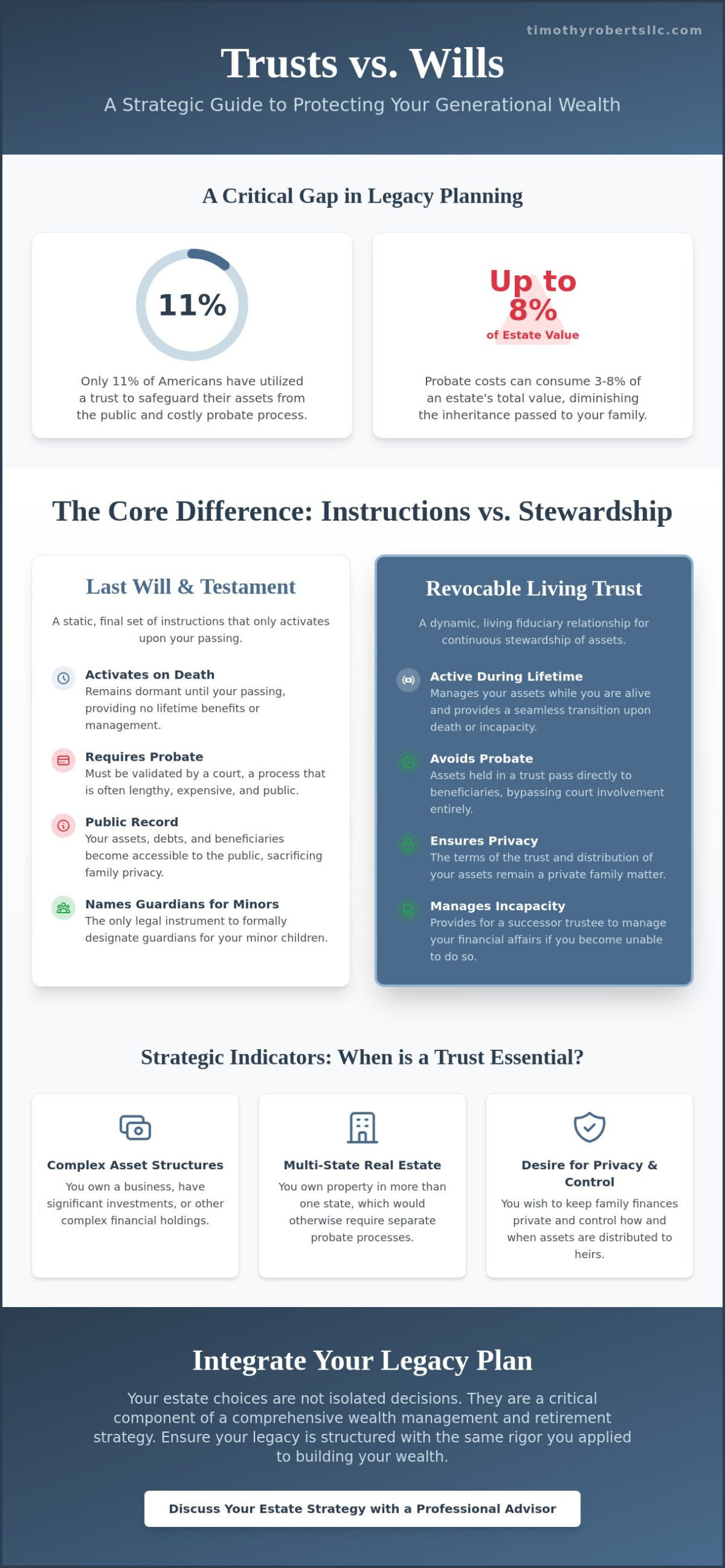
To visualize how these two structures interact with your financial goals, consider this professional overview:
The core distinction between these pillars lies in the timing of authority and the method of asset transfer. A will remains dormant until death, acting as a final script for the court to follow. A trust, conversely, can manage your assets while you’re still alive, providing a seamless transition of stewardship if your circumstances change. This proactive nature is why many families use trusts as the foundation of their Wealth Management strategy, ensuring that their financial roadmap remains intact regardless of life’s transitions.
The Will: A Public Roadmap for Asset Distribution
A last will and testament functions as a definitive set of instructions that only activates upon your passing. It outlines your specific beneficiaries and appoints an executor to settle outstanding debts and taxes. For many, its most vital role is naming guardians for minor children, a task that trusts cannot legally perform. However, once a will enters the court system for validation, it becomes a public record. This exposure can be a significant drawback for families seeking to keep their financial details private, as anyone can access the filings to see the value of the estate and the identity of the heirs.
The Trust: A Private Vehicle for Continuous Stewardship
A trust operates according to your precise terms during your lifetime and after you pass. When you examine what is a trust, you discover a fiduciary relationship that allows for the immediate transfer of assets without court-mandated delays. This tool provides a structured evolution for your wealth. It’s an intervention designed for those who value discretion and want to avoid the probate costs that often range from 3% to 8% of an estate’s total value. By utilizing a trust, you ensure that your legacy is managed with the same rigor you applied to building your wealth.
The primary difference isn’t just about who gets what; it’s about when and how they receive it. A will requires a court’s permission to act. A trust empowers your chosen successor to step in immediately. This distinction is critical for maintaining the momentum of your financial plan and ensuring your family’s future is secured without unnecessary interference.
Navigating Probate: Privacy and Efficiency in Asset Transfer
While a will is a standard entry point for many, the public nature of the probate process often surprises families during an already difficult time. When considering trusts vs wills what’s the difference, the most immediate impact is felt in the courtroom. Probate is the formal, court-supervised authentication of a will. It serves as a gateway for asset distribution; however, it also mandates a full public disclosure of your financial legacy. For those who value a polished and intentional approach to wealth, the transparency of probate can feel like an unnecessary intrusion.
The Cost of Public Disclosure
High-net-worth individuals often prioritize the confidentiality of a trust structure to protect their heirs from unwanted scrutiny. Because probate is a matter of public record, anyone can access documents detailing your assets, debts, and the specific identities of your beneficiaries. This exposure can invite solicitations or family disputes that might otherwise remain private. According to the Illinois State Bar Association’s Guide to Estate Planning, a trust functions as a private contract, allowing your heirs to avoid the administrative burden and costs of the court system. Maintaining the quiet ambition of your family legacy requires a vehicle that operates behind closed doors, ensuring that your financial evolution remains a private family matter.
Timeline Efficiency: Immediate vs. Delayed Access
Understanding trusts vs wills what’s the difference is not just about asset titles; it is about the speed of execution. Probate-induced delays can freeze assets for six months to two years, depending on the complexity of the estate and the court’s schedule. During this time, heirs may have limited access to the funds they need. In contrast, trustees can often distribute funds or manage assets within days of a passing. This rapid transition is vital for maintaining liquidity, which is necessary for settling estate taxes and meeting immediate family needs. Strategic avoidance of probate through a trust ensures that your wealth continues to work for your family without a court-mandated pause.
The administrative burden of probate can be significant, with costs often ranging from 3% to 8% of an estate’s total value. By choosing a more efficient transfer vehicle, you preserve more of your capital for the next generation. Aligning your transfer method with your broader goals is a hallmark of sophisticated Estate & Legacy Planning. This deliberate pacing reinforces the idea that your plan is a carefully crafted intervention rather than a generic solution. Moving away from the delays of the court system allows your family to focus on growth and partnership rather than legal hurdles.
Beyond the Bequest: Managing Incapacity and Lifetime Control
A legacy is often viewed through the lens of finality, yet the most critical phase of wealth stewardship occurs while you are still here. When evaluating trusts vs wills what’s the difference, one must look at the protection of the person, not just the distribution of the property. A will offers zero utility if you become physically or mentally incapacitated. It sits idle, waiting for a death certificate to activate its provisions. In contrast, a trust provides a seamless bridge for your financial affairs, ensuring that your vision remains the guiding force even when you cannot personally direct it. This distinction transforms your estate plan from a static document into a dynamic instrument of control.
Incapacity: The Often-Overlooked Risk
Many high-net-worth individuals rely on a Power of Attorney, assuming it provides sufficient coverage during a medical crisis. However, financial institutions often scrutinize these documents, leading to delays that can paralyze an Investment Portfolio Management strategy. A revocable living trust eliminates this friction. By appointing a successor trustee, you ensure that your bills are paid and your standard of living is maintained without court intervention. This continuity is essential for protecting your assets from stagnation during periods of illness. It serves as a sophisticated form of risk management, ensuring that your Financial Planning goals aren’t derailed by temporary or permanent incapacity.
Conditional Distribution and Legacy Protection
The strategic evolution of your wealth should mirror your personal values. Trusts allow for “incentivized distributions,” where heirs receive assets based on specific milestones, such as completing an education or reaching a certain age. This approach treats wealth as a journey rather than a one-time transaction. It also provides a critical layer of protection for your children’s inheritance. A growing trend in 2026 involves using trusts to “divorce-proof” assets, shielding them from potential future lawsuits or creditors. By structuring wealth this way, you ensure that your hard-earned capital remains within the family line. This level of control must be coordinated with your Retirement Income Planning to ensure that lifetime distributions remain tax-efficient and aligned with your long-term vision for generational growth.
Choosing between these vehicles is a decision on the timeline of your authority. While a will relinquishes control to the court at the moment of passing, a trust extends your influence. It provides a structured framework that adapts to your needs today and your family’s needs tomorrow. This deliberate pacing reinforces the idea that your plan is a carefully crafted intervention, designed to solve complex problems before they arise. By prioritizing lifetime control, you project the image of a visionary strategist who values depth and precision in every aspect of wealth management.
Strategic Selection: Identifying the Right Vehicle for Your Wealth
Selecting the appropriate vehicle for your legacy is a nuanced exercise in risk management. It isn’t merely about choosing a document; it’s about matching a legal structure to the complexity of your life. When clients ask about trusts vs wills what’s the difference, they are often seeking a framework to justify the initial investment in a trust. While a will serves as a foundational tool, its utility has limits. A trust, by comparison, is a sophisticated intervention designed to eliminate friction for complex estates and ensure a seamless transition of stewardship.
When a Will May Suffice
A will might be the appropriate choice for individuals with straightforward asset structures and fewer privacy concerns. If your primary objective is naming guardians for minor children, a will is the only instrument capable of this specific task. In addition, for those whose wealth is primarily held in accounts with direct beneficiary designations, such as life insurance or 401k plans, a will acts as a secondary safety net. Remember that even with a trust, you’ll still require a “Pour-Over Will.” This document ensures that any assets inadvertently left outside the trust are captured and transferred into the trust upon your passing.
When a Trust Becomes Essential
For families with multi-state real estate holdings or private business interests, a trust is not a luxury; it’s a necessity. Managing property across different jurisdictions without a trust often triggers multiple probate proceedings, which significantly increases administrative costs and legal delays. High-net-worth families also leverage trusts to implement sophisticated tax planning strategies. This is particularly relevant in 2026, as the federal exemption has reached $15 million per individual. A trust allows for the precise orchestration of asset growth while minimizing the tax burden on your heirs through carefully timed distributions.
The perceived high cost of a trust is often a misunderstanding of timing. A will is a back-loaded expense. While the setup is inexpensive, the eventual probate fees, which can consume up to 8% of an estate’s total value, represent a significant loss of capital. A trust is a front-loaded investment in privacy and administrative ease. It secures your family’s future by solving problems before they manifest in a courtroom. To determine which structure aligns with your upward progression, consider a personalized review of your Estate & Legacy Planning. This proactive step ensures your wealth remains a source of opportunity rather than a logistical burden for your heirs.
Integrating Estate Vehicles into a Comprehensive Financial Strategy
Estate planning is not an isolated legal task; it is a fundamental pillar of wealth management and long-term retirement security. Too often, individuals treat the creation of a will or trust as a standalone checkbox. In reality, these vehicles must function in perfect harmony with your broader financial roadmap. When you evaluate trusts vs wills what’s the difference, you are ultimately deciding how your legacy interacts with your cash flow, tax obligations, and philanthropic goals. A truly sophisticated plan ensures that your assets aren’t just distributed, but are transitioned with strategic precision.
The efficacy of your legacy plan depends heavily on its alignment with your retirement income planning. For example, the way you title assets within a trust can significantly impact the tax liabilities your heirs face. With the federal estate tax exemption now at $15 million per individual in 2026, the focus has shifted toward high-level income tax planning and managing ongoing tax exposure. We act as the visionary strategist in this process. By coordinating with legal experts, we ensure that the technical execution of your documents mirrors the creative vision of your financial life.
The Fiduciary Perspective on Legacy
A financial advisor should lead the estate strategy conversation to ensure your investment portfolio management remains consistent with your trust terms. It’s common to find a disconnect where a trust exists, but the underlying accounts haven’t been properly funded or titled. This oversight can render even the most complex trust ineffective. As fiduciaries, we prioritize your interests across your entire lifespan. We look beyond the documents to ensure that your risk management and insurance analysis are structured to provide the liquidity your estate might need to settle taxes or provide for heirs without liquidating core investments.
Next Steps: From Vision to Execution
Moving from a high-level vision to practical execution requires a meticulous review of your current standing. Wealth is a journey, and your strategy must evolve as your portfolio grows. To secure your family’s future, start with these essential actions:
- Review all current beneficiary designations on retirement accounts and insurance policies for consistency with your will or trust.
- Analyze the potential tax impact of your current estate structure under the 2026 tax laws, including the $19,000 annual gift tax exclusion.
- Evaluate whether your current plan provides for incapacity, ensuring a successor trustee is prepared to manage your affairs seamlessly.
Refining your legacy roadmap is a deliberate process that requires personal attention and high-level expertise. We invite you to schedule a strategic consultation to discuss how these interventions can protect your capital and inspire trust across generations. By treating your estate plan as a carefully crafted intervention, you ensure that your upward progression continues long after the transition of your assets. This professional partnership turns a complex problem into a structured, reliable success story.
Securing Your Generational Momentum
Developing a legacy is a journey that moves from mere asset accumulation to intentional stewardship. By now, you understand that identifying trusts vs wills what’s the difference is about selecting the right timeline for control and privacy. While a will provides a roadmap for the court, a trust offers a private, living vehicle that protects your family from the delays of probate and the risks of incapacity. This choice represents a critical intervention in your broader financial evolution. It ensures your assets remain a source of opportunity rather than a logistical burden.
Our firm brings over 25 years of fiduciary expertise to this complex landscape. We specialize in comprehensive wealth and tax integration, ensuring your estate plan isn’t a standalone document but a sophisticated, personalized legacy roadmap. We take the time to understand your unique vision, crafting a strategy that aligns your portfolio with your generational goals. This deliberate pacing reinforces our commitment to your long-term success.
Take the next step in your financial progression. Schedule a Strategic Estate Coordination Consultation to refine your 2026 plan with confidence. Precision matters. Your family’s future deserves a structure as resilient and visionary as the wealth you’ve built.
Frequently Asked Questions
Is a trust better than a will for avoiding taxes?
Neither a trust nor a will automatically eliminates estate taxes; however, trusts provide more sophisticated mechanisms for high-level tax planning. With the 2026 federal exemption at $15 million per individual, a trust allows you to manage asset growth and utilize specialized strategies to minimize the tax burden on your heirs. While a will is a static document, a trust is a dynamic tool that can be structured to leverage the annual $19,000 gift tax exclusion and other tax-efficient transfer methods.
Can I have both a will and a trust in my estate plan?
Yes, and integrating both is a standard practice for a comprehensive legacy strategy. Most professionals recommend a “pour-over will” to accompany a trust. This document acts as a safety net, capturing any assets that weren’t officially titled in the trust’s name during your lifetime and moving them into the trust upon your passing. This coordination is essential for maintaining the integrity of your financial roadmap and ensuring no asset is left to the discretion of the court.
What happens if I die without a will or a trust?
Dying without an estate plan means your assets will be distributed according to state intestacy laws, which rarely align with a personalized vision for wealth. Statistics show that 55% of Americans have no estate plan, often leaving their families to navigate a rigid and public court process. This lack of structure can lead to family disputes and significant administrative costs that deplete the capital you worked to build. It essentially removes your voice from the future of your legacy.
How much does it cost to set up a trust versus a will?
A trust requires a higher initial investment in administrative setup compared to a simple will, but it often represents a lower total cost over time. When analyzing trusts vs wills what’s the difference in value, you must consider that probate costs for a will can range from 3% to 8% of an estate’s total value. A trust is a front-loaded investment that preserves your capital by bypassing these expensive court fees and legal delays, ultimately delivering more wealth to your beneficiaries.
Does a trust protect my assets from creditors or lawsuits?
Irrevocable trusts can provide robust asset protection, whereas standard revocable living trusts typically do not offer shield from your own creditors. However, a revocable trust can be structured to protect your children’s inheritance from their future divorces or lawsuits. This “divorce-proofing” strategy is a growing trend in 2026 as families seek to secure their legacy against external risks. It ensures that your hard-earned wealth remains a stable foundation for future generations.
Do I need to update my will or trust if I move to a different state?
Yes, you should review your plan after a move because state laws regarding probate and inheritance taxes vary significantly. For example, Oregon’s exemption remains at $1 million in 2026, while New York’s exclusion is $7.35 million. A strategy that is tax-efficient in one state might trigger unnecessary liabilities in another. Updating your plan ensures that your legacy vehicle remains compliant with local regulations and continues to perform as intended within your broader financial strategy.
Can a will override a named beneficiary on a life insurance policy?
No, a beneficiary designation on a life insurance policy or a retirement plan almost always supersedes the instructions in a will. This is a common pitfall that can derail even the most meticulously crafted estate plan. It’s vital to coordinate your beneficiary designations with your trust or will to ensure your assets flow according to your current intentions. Regular reviews of these designations are a key component of effective risk management and legacy planning.
