

Jun
Financial Planning for Small Business Owners: A Strategic Blueprint for 2026
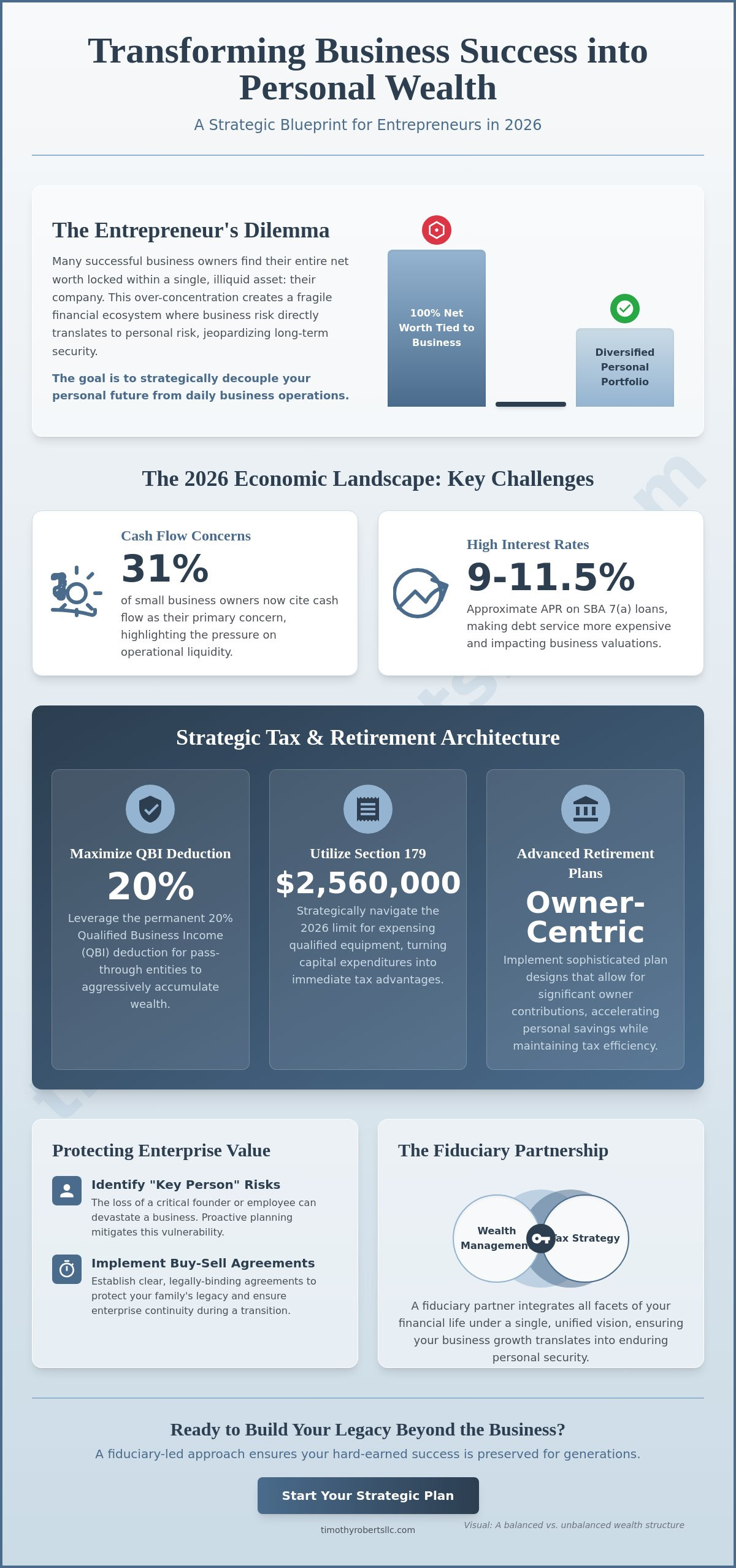
Your business is a sophisticated engine for wealth creation, but it was never meant to be the final destination. Many entrepreneurs find themselves in a precarious position where their entire net worth is locked within a single, illiquid entity. It’s a common paradox; the more successful the enterprise becomes, the more the owner’s personal financial security depends on a single point of failure. You’ve likely felt the weight of complex tax liabilities eroding your hard earned profits, even as you strive to reach the next milestone of growth. Effective financial planning for small business owners requires more than just managing cash flow; it demands a strategic decoupling of your personal future from your professional daily operations.
We understand that your company is your legacy, yet true freedom comes from a diversified portfolio that stands strong regardless of market shifts. This guide provides a strategic blueprint for 2026, focusing on fiduciary-led strategies to transform business success into enduring personal wealth. We’ll examine how to maximize the permanent 20% QBI deduction, navigate the $2,560,000 Section 179 limit, and implement tax efficient retirement income streams that protect your family for generations to come.
Key Takeaways
- Master the art of diversifying your net worth outside of your business to ensure your personal lifestyle is never tethered to a single illiquid asset.
- Explore advanced retirement plan designs that allow for significant owner-centric contributions while maintaining corporate agility and tax efficiency.
- Identify hidden “Key Person” risks and implement strategic buy-sell agreements to protect both your family’s legacy and your enterprise’s continuity.
- Understand why sophisticated financial planning for small business owners requires a fiduciary partner who integrates wealth management and tax strategy under a single vision.
- Prepare for a high-value evolution by mastering the critical distinction between paper business valuation and actual liquid monetization.
The Symbiosis of Business Growth and Personal Wealth
For the modern entrepreneur, the boundary between the boardroom and the living room is often non-existent. Your business represents your ambition, your time, and, for many, the vast majority of your net worth. This interdependence creates a fragile ecosystem where a downturn in the market or a shift in consumer behavior doesn’t just threaten your quarterly profits; it threatens your family’s future. True financial planning for small business owners begins by acknowledging that while your enterprise is a vehicle for wealth, it shouldn’t be the vault where all your capital is locked away.
Many founders fall into the Entrepreneur Trap, a psychological bias where they assume their business equity is a guaranteed ticket to retirement. They reinvest every dollar of profit back into operations, ignoring the fundamental Corporate Finance Principles that suggest a balanced capital structure. This over-concentration makes you vulnerable to illiquidity. If you can’t sell the business on your own timeline, your retirement plans evaporate. Shifting toward a wealth preservation framework means treating your business as one component of a broader, more resilient strategy.
To better understand this concept, watch this helpful video:
A fiduciary plays a critical role in this transition. Unlike a broker who might focus on individual transactions, a fiduciary acts as a strategic partner to align your immediate operational needs with long term security. They help you navigate the tension between scaling your vision and securing your legacy. It’s about moving from a mindset of accidental wealth to one of intentional, structured growth. This partnership ensures that your personal financial health isn’t sacrificed at the altar of business expansion.
Decoupling Your Identity from Your Balance Sheet
Establishing clear boundaries between corporate and personal cash flow is the first step in protecting your lifestyle. You shouldn’t be your business’s only bank. By implementing a disciplined investment portfolio management strategy, you create a secondary engine for growth that operates independently of your industry’s cycles. Strategic asset allocation allows you to mitigate concentration risk, ensuring that a bad year for the company doesn’t result in a bad year for your household. It’s a sophisticated intervention that turns your business from a liability into a true wealth generator.
The 2026 Economic Landscape for Business Owners
Strategic Tax and Retirement Architecture for Entrepreneurs
Efficiency in wealth management isn’t found in a single tax season. It’s built through a meticulous architecture that synchronizes your corporate entity with your personal aspirations. For many, financial planning for small business owners often stops at basic compliance, yet the most successful founders treat tax strategy as a core business function. In 2026, the permanent status of the 20% Qualified Business Income (QBI) deduction provides a stable foundation for pass-through entities, allowing for a more aggressive approach to wealth accumulation. This structural calibration ensures that your business serves as a catalyst for personal net worth rather than a drain on it. Choosing the right entity structure, whether a C-corporation with its flat 21% tax rate or an S-corporation, is not a one-time decision but a continuous process of optimization. It requires a visionary approach that looks beyond the current fiscal year to anticipate how changes in the Social Security wage base, now at $184,500, will impact your self-employment tax liabilities. By designing a system where corporate profits and personal savings work in harmony, you create a resilient financial legacy that transcends the daily operations of your company.
Advanced Retirement Plan Design
Selecting the right vehicle requires deep understanding of your growth trajectory. For 2026, the 401(k) employee contribution limit is $24,500, with an additional $8,000 catch-up for those over 50, allowing a total contribution of $72,000. While Solo 401(k)s offer high ceilings, high-earning owners nearing retirement often find Defined Benefit plans more transformative. Resources like the FDIC Money Smart for Small Business curriculum help founders master these foundational concepts. Roth conversion strategies also provide opportunities during fluctuating income years to secure tax-free growth and long-term flexibility.
Integrating Tax Preparation with Planning
True wealth elevation requires strategic tax advising to identify hidden liabilities before they erode annual profits. This proactive approach ensures every deduction, from the $2,560,000 Section 179 limit to the 72.5 cents per mile mileage rate, aligns with your broader investment goals. Holistic financial planning for small business owners treats the tax return as a strategic document rather than a historical record. If you’re ready to move beyond basic filing, it’s time to refine your wealth strategy with a partner who understands the nuance of entrepreneurial finance.
Protecting Enterprise Value through Risk Mitigation
Enterprise value is a delicate construct. It’s often built on the specialized knowledge, relationships, and vision of a single individual. When you are the “Key Person,” your personal health and presence are the business’s greatest assets and its most significant liabilities. Identifying this risk is a fundamental pillar of financial planning for small business owners. Without a clear mitigation strategy, the family’s financial stability remains tethered to the owner’s daily performance. This vulnerability is not just theoretical; with 43% of cyberattacks now targeting small businesses and the increasing complexity of 2026 operations, the margin for error has never been thinner.
Many founders resist complex planning, believing it’s a task reserved for the eve of a sale. This is a strategic oversight. Buyers pay a premium for businesses that can thrive without their original creator. By engaging in a comprehensive financial advisor partnership, you transform your company from a job you own into a resilient, transferable asset. This shift in perspective ensures that you aren’t just building a company, but an enduring legacy that can survive the unexpected. It’s the difference between owning an income stream and controlling a lasting institution.
Business Continuity and Succession Frameworks
A robust succession framework ensures that an unplanned transition doesn’t result in a fire sale. Buy-sell agreements, funded by tax-efficient insurance structures, provide the liquidity necessary for partners to buy out heirs or for heirs to receive fair value without draining the company’s coffers. While the U.S. government guide to starting a business provides the basics of legal formation, a sophisticated risk plan requires active coordination between your financial advisor and your legal counsel. This alignment ensures that your corporate documents and your wealth strategy speak the same language, preventing costly disputes during emotional times.
Personal Asset Protection for the Business Owner
Protecting your personal net worth from professional exposure is non-negotiable. As litigation and regulatory scrutiny increase, separating personal liability from business operations becomes a critical intervention. Utilizing trusts within a sophisticated estate planning strategy allows you to shield assets and control the distribution of wealth across generations. A rigorous risk analysis prevents the catastrophic loss of enterprise value by ensuring the business remains a functional, sellable asset even in the owner’s absence. This deliberate layering of protection allows you to pursue aggressive growth with the confidence that your family’s foundation is secure.
Succession and Exit Strategies: Designing Your Evolution
The culmination of your professional journey isn’t just a transaction; it’s a profound evolution. Many founders mistake a high paper valuation for actual liquid wealth, yet the two are rarely identical without a rigorous monetization strategy. Moving from “Owner” to “Investor” requires a psychological shift that many find challenging. You’re no longer the driver of operational growth. You’re the steward of a diversified capital base. Comprehensive financial planning for small business owners must address the tax “cliff” that occurs when years of sweat equity are suddenly realized as a massive capital gain. Without pre-sale planning, a significant portion of your life’s work could be lost to avoidable liabilities before the check even reaches your account.
The Mechanics of a Strategic Exit
Post-Exit Portfolio Management
The day the check clears is often the most overwhelming moment in an entrepreneur’s life. Transitioning a large lump sum into a sustainable, multi-generational income stream is a distinct discipline from running a company. You need a retirement income planning roadmap that accounts for your new, post-business risk profile. Your visionary investment strategy shouldn’t end when your daily operations do; it simply evolves to focus on wealth preservation and legacy. This transition ensures the business’s success fuels your family’s future for decades, rather than being depleted by short-term spending or inflation. If you’re ready to design your professional evolution, partner with a strategist who can help you navigate the complexities of a high-value exit and the life that follows.
The Fiduciary Partnership: Elevating Your Vision
The journey of entrepreneurship is rarely a straight line. It’s a series of pivots, expansions, and calculated risks that require a steady hand and a clear perspective. Navigating these complexities requires more than just a financial professional; it requires a visionary strategist who operates under a strict fiduciary standard. For many, financial planning for small business owners is often treated as a secondary concern to operational growth. However, the most effective strategies emerge when your business goals and personal wealth are managed as a single, integrated vision. This model moves beyond the transactional nature of traditional brokerage, offering a partnership built on shared success and intellectual rigor.
The value of having integrated wealth management and tax preparation under one roof cannot be overstated. When your advisory team has visibility into both your corporate balance sheet and your personal tax return, they can identify opportunities that a siloed approach would miss. It creates a rhythmic, logical communication flow that ensures every decision, from a capital expenditure to a retirement contribution, is optimized for your total net worth. A fiduciary is legally bound to manage the inherent conflict between reinvesting in your business and diversifying your personal assets, ensuring your long-term security is never sacrificed for short-term gains.
Selecting a Partner for Organizational and Personal Evolution
Selecting the right partner is an exercise in organizational evolution. You should ask potential advisors about their specific experience with illiquid assets and business valuation cycles. Fee transparency is the hallmark of asset-based management; it aligns the advisor’s incentives with your growth rather than commission-based sales. A custom-crafted intervention is far superior to off-the-shelf financial products because it accounts for the unique volatility and opportunity of your specific industry. Your advisor should act as an expert craftsman, tailoring strategies that reflect your personal values and professional ambitions.
The Continuous Monitoring and Rebalancing Cycle
Your financial roadmap must be as dynamic as your business. As you scale or pivot, your fiduciary provides year-round oversight of both your personal brokerage accounts and your corporate cash flow. This continuous monitoring ensures that your strategy remains aligned with your evolving goals, providing the calm confidence needed to lead with ambition. This isn’t a set-and-forget transaction but a journey of upward progression. Discover how we elevate the financial futures of small business owners through a partnership that values depth over superficiality and results over rhetoric.
Securing Your Legacy through Strategic Evolution
Your business is a testament to your vision and grit, but your ultimate success is measured by the life it enables outside the office. Sophisticated financial planning for small business owners requires more than just balancing books; it demands the intentional decoupling of your personal future from your professional assets. By integrating high-level tax strategy with proactive risk management, you transform a successful enterprise into a resilient, multi-generational legacy. This evolution ensures that your hard work translates into sustainable, liquid wealth that serves your family for decades.
Achieving this level of coordination requires a partner who understands the unique intersection of corporate growth and personal wealth. With over 25 years of specialized wealth management experience, we provide the integrated tax preparation and fiduciary advisory services necessary to navigate the complexities of 2026. We craft personalized financial roadmaps that reflect your specific ambitions and protect the value you’ve created. Partner with a fiduciary strategist to secure your legacy and begin the next chapter of your journey with calm confidence. Your greatest achievements are still ahead of you.
Frequently Asked Questions
Is financial planning for small business owners different from individual planning?
Financial planning for small business owners is uniquely complex because it must account for the interdependence of personal net worth and enterprise value. While individual planning typically focuses on liquid public market assets, owner centric strategies address entity specific risks, complex tax liabilities, and the eventual monetization of the business. It’s a holistic approach that ensures your professional success translates into personal financial security through a diversified portfolio.
How can I minimize taxes when selling my small business in 2026?
Minimizing taxes requires a multi year strategy that begins long before the letter of intent is signed. In 2026, owners should focus on maximizing the permanent 20% QBI deduction and utilizing installment sales to spread out capital gains liabilities over multiple tax years. Pre sale estate planning can also move significant equity into trusts, shielding it from the high valuations that occur during a successful acquisition.
What is the best retirement plan for a self-employed business owner?
The optimal plan depends on your income level and staffing goals. For 2026, a Solo 401(k) allows for total contributions up to $72,000, while a SIMPLE IRA has a more modest contribution limit of $17,000. High income owners nearing retirement often find that Defined Benefit plans provide the most significant tax advantaged savings, allowing for much larger annual contributions than traditional defined contribution plans.
Can a financial advisor help with business valuation and exit strategies?
A specialized advisor bridges the gap between your paper valuation and actual liquid monetization. They provide the objective oversight necessary to prepare for a high value exit by coordinating with valuation experts and cleaning up historical financials. This proactive approach ensures your business is attractive to buyers while protecting your family’s post exit income needs through a structured transition plan.
How do I protect my personal assets from my business liabilities?
Effective protection requires a combination of proper entity selection and sophisticated risk management. You should utilize insurance analysis to shield personal accounts from professional exposure and maintain a rigorous separation between corporate and personal cash flows. Incorporating asset protection trusts into your estate strategy provides an additional layer of security, ensuring your family’s foundation remains untouched by business related litigation or debt.
Should I reinvest profits into my business or my personal investment portfolio?
The decision hinges on your current concentration risk and the expected return on internal growth versus market diversification. While internal reinvestment can fuel rapid expansion, it also increases the risk of having your entire net worth in one illiquid asset. Allocating a portion of profits to a personal investment portfolio creates a secondary wealth engine that provides liquidity and protection against industry specific volatility.
What role does a fiduciary play in small business financial planning?
A fiduciary serves as a visionary strategist who is legally required to prioritize your interests over their own. In the context of financial planning for small business owners, this means providing unbiased advice on whether to reinvest in your company or diversify into personal assets. It moves the relationship from a simple transaction to a long term partnership focused on your total financial evolution and legacy protection.
How do I balance funding my children’s education with my own retirement as an owner?
Balancing these goals requires a rhythmic approach to cash flow management where retirement security is treated as the primary objective. Since you can’t borrow for retirement, it’s essential to maximize your own tax advantaged savings first. We design education funding strategies that utilize 529 plans and other vehicles as part of a broader estate plan, ensuring you support the next generation without compromising your independence.
