

Jun
Creating a Retirement Income Strategy in Michigan: A Strategic Framework for 2026
What if the greatest risk to your financial legacy isn’t a market downturn, but the quiet erosion of an outdated plan? For many, creating a retirement income strategy in Michigan has felt like shooting at a moving target, especially with the complexities of evolving financial regulations. You’ve likely felt the weight of confusion over recent tax shifts or the nagging fear that your assets might not sustain the lifestyle you’ve meticulously built. It’s a common anxiety, yet it’s one that a truly strategic architecture can solve.
We understand that you’re looking for more than just a portfolio; you’re seeking a partnership that values depth and precision. In the current financial climate, staying abreast of tax laws and maximizing available deductions is crucial for securing your future. This article, brought to you by Timothy Roberts & Associates, LLC, provides the sophisticated framework you need to transform these legislative shifts into a personal advantage. You’ll discover how to integrate current deduction opportunities with a clear, written roadmap that protects your estate and minimizes liabilities. We’ll explore the intersection of market resilience and tax efficiency, ensuring your wealth remains a source of growth rather than a cause for concern.
Key Takeaways
- Shift your perspective from emotional security to structural readiness by aligning mathematical clarity with deep strategic preparation.
- Discover how creating a retirement income strategy in Michigan involves moving beyond basic savings toward sophisticated wealth allocation and tax-efficient portfolio management.
- Learn to safeguard your future against sequence of returns risk while using strategic estate planning to ensure your legacy remains protected.
- Identify the critical steps for translating your vision into execution, starting with a comprehensive audit of current assets and tax buckets.
- Understand why a fiduciary partnership is the essential standard for elevating your financial trajectory and ensuring your best interests remain the priority.
Redefining Financial Confidence: From Emotional State to Strategic Asset
Financial confidence is frequently mistaken for a vague feeling of security. In reality, it’s a strategic asset built at the intersection of mathematical clarity and rigorous preparation. For those creating a retirement income strategy in Michigan, true confidence doesn’t stem from a favorable market cycle; it arises from a structural framework designed to withstand volatility. It’s the difference between hoping your numbers work and knowing they will. Feeling secure is secondary to being structurally prepared for the unexpected shifts of the global economy.
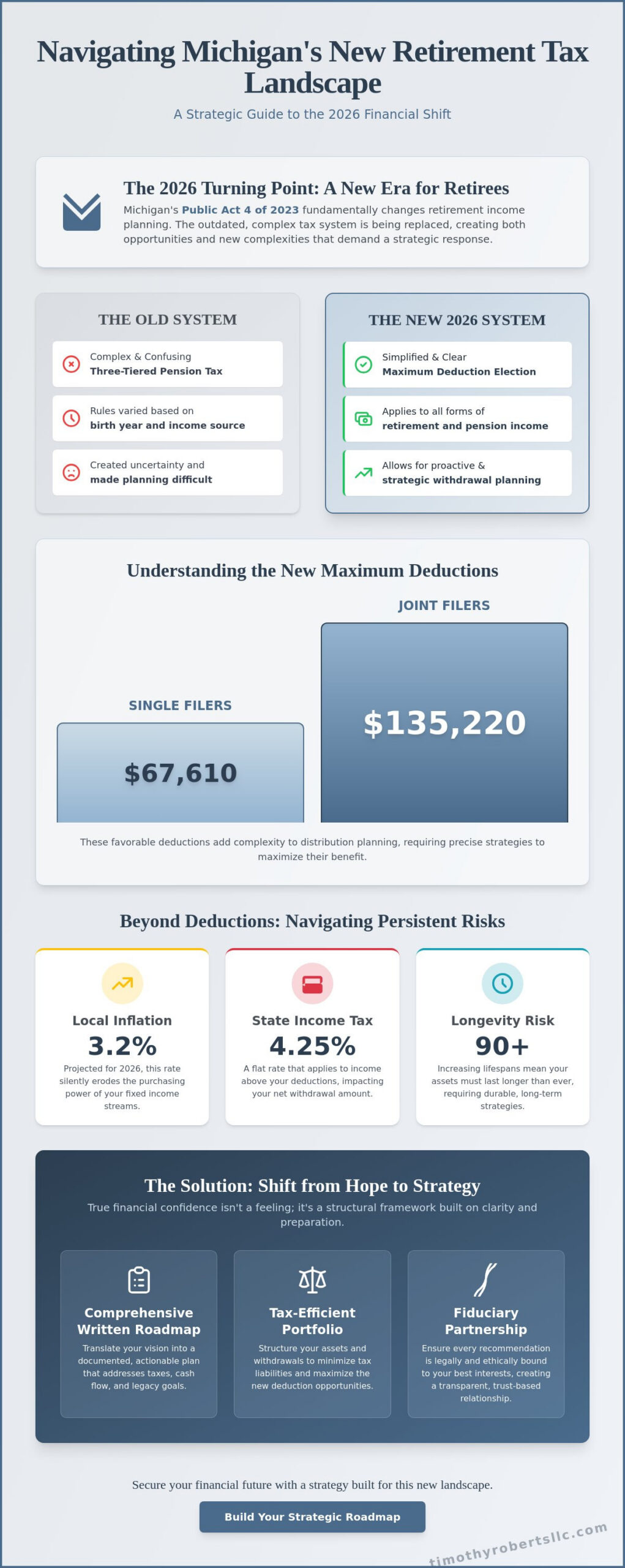
Relying on the traditional 60/40 portfolio model has become a precarious bet. As we look at the 2026 economic environment, with local inflation projected at 3.2%, the old “set it and forget it” mindset serves as a liability. Trust in this journey is anchored by the Fiduciary Standard, a commitment that ensures every recommendation is made solely in your best interest. This standard transforms the complex process of retirement planning into a transparent partnership focused on long-term evolution rather than transactional sales.
To gain a deeper understanding of how to transition from accumulation to a sustainable income stream, watch this expert analysis:
The Knowledge Gap vs. The Action Gap
High-net-worth individuals often experience a unique form of anxiety. Despite having significant assets, they feel a persistent sense of unease regarding the future. This happens because surface-level awareness of one’s net worth is not the same as a deep strategic understanding of cash flow. The Confidence Gap is the distance between your current assets and a documented, actionable plan. Bridging this gap requires moving beyond generic advice toward customized interventions that address your specific legacy goals. It’s about turning passive wealth into an active, managed resource.
Why 2026 Demands a New Financial Perspective
The 2026 tax year marks a significant shift for Michigan residents. With the full implementation of Public Act 4 of 2023, the state’s previous three-tiered pension tax system is gone. Retirees can now elect a maximum deduction of $67,610 for single filers or $135,220 for joint filers. While these changes are favorable, they add a layer of complexity to distribution planning. Longevity risk and a 4.25% state income tax rate mean that your withdrawal strategy must be as precise as your investment strategy. Success in this new landscape requires a dynamic approach that accounts for property tax inflation multipliers and shifting economic growth. Creating a retirement income strategy in Michigan today means accounting for these specific legislative nuances to prevent the erosion of your purchasing power.
The Architecture of Wealth: Beyond Basic Budgeting and Savings
Many retirees approach their finances with a restrictive mindset, focusing solely on tracking expenses. While understanding cash flow is helpful, creating a retirement income strategy in Michigan requires a more sophisticated wealth allocation framework. Instead of asking how much you can spend, we ask how your assets should be structured to support a life of upward progression. This involves a shift from defensive budgeting to an offensive strategy where every dollar has a specific, intentional purpose. It’s about building a foundation that allows for aspirational growth rather than mere survival.
A robust architecture often utilizes a “Bucket Strategy” to manage varying time horizons. This framework divides wealth into three distinct segments: Liquidity for immediate needs, Income for the near term, and Growth for long-term legacy protection. By segregating assets this way, you maintain the discipline needed to weather short-term market fluctuations without compromising your future security. Professional asset-based management ensures these buckets are rebalanced with precision, preventing emotional reactions from derailing your trajectory. While U.S. government retirement planning resources provide a baseline for understanding benefits, a truly elevated plan requires a deeper level of strategic rigor.
Optimization of Cash Flow and Asset Location
Strategic success depends heavily on the distinction between asset allocation and asset location. Allocation refers to what you own; location refers to where you hold it. Asset location is a primary driver of net-after-tax income. By placing tax-inefficient assets in tax-advantaged accounts and growth-oriented assets in taxable ones, you maximize the efficiency of your investment portfolio management. Knowing exactly where your next dollar of income comes from reduces the psychological burden of uncertainty. This level of detail transforms a generic plan into a carefully crafted intervention.
The Role of Customization in Financial Design
Off-the-shelf investment products are often too generic to solve complex problems. A specialized firm provides carefully crafted interventions that align your risk tolerance with your actual risk capacity. This synthesis of personal vision and corporate capability ensures your strategy isn’t just a transaction, but a journey toward shared success. If you’re ready to move beyond the superficial, discussing your wealth allocation with a strategist can reveal the tangible impact of a customized plan. This deliberate approach mirrors a professional consultancy, valuing intellectual curiosity over generic conclusions.
Strategic Risk Mitigation: Safeguarding Your Future Against the Unknown
True wealth preservation is an exercise in foresight. While the accumulation phase of your journey focused on growth, the distribution phase demands a transition toward strategic risk mitigation. Creating a retirement income strategy in Michigan involves identifying the silent predators of wealth, from legislative shifts to systemic market volatility. It’s not enough to simply have assets; you must have a shield that protects those assets from the variables you cannot control. This architecture ensures that your lifestyle remains consistent, regardless of external economic pressures.
Risk management must extend beyond traditional insurance products. It involves diversifying against political and systemic shifts that could impact your net-after-tax income. Sophisticated tax planning strategies work to minimize the impact of inflation and the 4.25% state income tax rate. This level of planning treats your finances as a cohesive ecosystem where every element supports the whole. It’s a narrative of partnership and shared success, moving away from aggressive sales toward a polished, intentional framework for stability.
Sequence of Returns: The Hidden Threat to Retirement
Sequence of returns risk refers to the timing of market withdrawals, where a downturn in the early years of retirement can disproportionately deplete a portfolio’s longevity. This hidden threat can turn a mathematically sound plan into a precarious situation if not addressed with structural rigor. A tactical cash reserve serves as a vital buffer, allowing you to meet lifestyle needs without being forced to liquidate equities during a market correction. In 2026, a dynamic withdrawal strategy is essential to maintain your financial trajectory amidst a 3.2% projected inflation rate. It’s a proactive adjustment that ensures your portfolio remains a source of strength rather than a point of vulnerability.
Estate and Legacy Coordination
A will alone is an insufficient tool for those who value true peace of mind. Comprehensive strategic estate planning acts as a tool for legacy confidence, ensuring your vision for the future is legally and financially sound. This process requires the careful synthesis of tax advising and estate transfer to maximize multi-generational wealth. By coordinating these disciplines, you protect your estate from unnecessary litigation and excessive taxation. It’s a journey from a simple transaction to a lasting legacy, built on a foundation of intellectual curiosity and professional stability. This deliberate pacing reinforces the idea that your legacy deserves more than a generic conclusion.
The Financial Roadmap: Translating Vision into Actionable Execution
A strategy without execution is merely a wish. Creating a retirement income strategy in Michigan requires a steady, logical progression from high-level vision to the practicalities of execution. This process begins with a meticulous audit of your financial ecosystem. You must categorize every asset, liability, and tax bucket to account for Michigan’s 2026 tax landscape, including the $135,220 joint deduction limit. Once the inventory is clear, you must define your non-negotiable life goals. Whether it’s a specific retirement age or complex legacy desires, these objectives serve as the North Star for your financial journey. It’s a journey of upward progression where your assets are prepared for the worst while positioned for the best.
Precision is the hallmark of a high-end partner. After defining your goals, the next phase involves stress-testing the framework against historical market crashes and high-inflation scenarios. This ensures that your retirement income planning isn’t just a theoretical exercise but a resilient engine for cash flow. Aligning your portfolio with actual withdrawal needs prevents the friction of selling assets at the wrong time. Finally, establishing a steady rhythm of monitoring and rebalancing with a professional advisor ensures that your plan evolves as the world changes. This deliberate pacing reinforces the idea that we take the time to solve complex problems rather than rushing to generic conclusions.
Stress-Testing Your Assumptions
Monte Carlo simulations provide the mathematical clarity needed to move from anxiety to confidence. By running thousands of potential market paths, we determine the probability of your strategy’s success. This isn’t about predicting the future; it’s about being structurally prepared for a variety of outcomes. We integrate what-if scenarios, such as sudden long-term care needs or unexpected legislative shifts, to ensure your wealth remains a source of stability. It feels polished and intentional, aiming to inspire trust through a blend of creative passion and business-minded rigor. This level of detail transforms a generic plan into a carefully crafted intervention.
The Power of Written Documentation
A plan that exists only in conversation is susceptible to the whims of emotion. A strategy isn’t real until it’s documented and shared with your primary stakeholders. This written roadmap serves as an emotional anchor during periods of market volatility. It prevents frantic decision-making by reminding you of the deliberate logic used to build your architecture. It feels exclusive yet accessible to those who value quality. If you’re ready to move from a high-level vision to a tangible reality, developing your personal roadmap is the next logical step in your financial evolution.
Fiduciary Partnership: Elevating Your Financial Trajectory
The final pillar of a resilient financial architecture is the standard of care by which it’s managed. Creating a retirement income strategy in Michigan requires more than technical proficiency; it demands a fiduciary partnership built on unwavering trust. While many financial interactions are transactional, a fiduciary relationship is rooted in a legal and ethical obligation to act solely in your best interest. This isn’t a standard of “suitability” where a product is simply good enough; it’s a standard of excellence where every recommendation is a carefully crafted intervention designed for your specific evolution.
Timothy Roberts & Associates, LLC serves as the visionary strategist for this journey. We bridge your individual creative vision with structured corporate capabilities to ensure your wealth remains a source of aspirational growth. In an economic environment defined by shifting tax codes and fluctuating employment rates, the value of a steady partner cannot be overstated. This partnership provides “Calm Confidence,” a psychological and strategic buffer that prevents emotional decision-making during market dips. It’s about having a craftsman by your side who values depth over superficiality, guiding you from a high-level vision down to the practicalities of execution.
The Fiduciary Advantage
The distinction between a fiduciary and a traditional broker is fundamental to your peace of mind. Brokers often operate under a suitability standard, which may allow for products that carry higher commissions or hidden costs. In contrast, the fiduciary standard demands total transparency. Fee transparency eliminates the anxiety of hidden costs, allowing you to see the tangible impact of your wealth management. This clarity is the bedrock of investor trust. It ensures that your portfolio discipline is maintained through logic and evidence rather than sales-driven narratives. By choosing a fiduciary, you’re opting for a professional consultancy model that prioritizes your results over transactional volume.
A Partnership for Evolution
We view the ongoing relationship as a journey of upward progression, not a simple transaction. As your life evolves and the legislative environment shifts, your strategy must remain dynamic. This isn’t a “set it and forget it” arrangement. It’s a human-led, results-driven identity that distinguishes our firm from larger, more anonymous entities. We invite you to experience the peace that comes from a professionally crafted, fiduciary-led strategy. Creating a retirement income strategy in Michigan should be a path toward shared success and intellectual curiosity. By aligning with a reliable business advisor who acts as an expert craftsman, you ensure that your financial trajectory remains on a path of growth and security for decades to come.
Securing Your Legacy Through Strategic Architecture
True financial confidence is a structural reality, not a fleeting emotion. We’ve explored how navigating the 2026 tax landscape requires more than a standard portfolio; it demands a meticulous audit and a documented roadmap. By shifting from defensive budgeting to a sophisticated wealth allocation framework, you ensure your assets are positioned for both aspirational growth and long-term resilience. Creating a retirement income strategy in Michigan is a journey that transforms legislative complexity into a structured, actionable advantage for your family.
With over 25 years of fiduciary expertise, our firm specializes in comprehensive wealth and tax integration. We provide the sophisticated, personalized financial roadmaps necessary to protect your estate and elevate your trajectory. If you’re ready to move from a high-level vision to a tangible reality, schedule your strategic consultation with Timothy Roberts & Associates, LLC. Your future isn’t a generic outcome; it’s a carefully crafted legacy waiting to be built. We look forward to partnering with you on this path of upward progression and shared success.
Frequently Asked Questions
What is the first step to creating a retirement income strategy in Michigan?
The first step is a comprehensive audit of all current assets, liabilities, and tax buckets. This baseline allows you to see the raw materials available for creating a retirement income strategy in Michigan. Without this mathematical clarity, any future planning remains speculative rather than strategic. It’s about establishing a foundation of truth before building the architecture of your future.
How much do I really need to save to retire comfortably in 2026?
Comfort in retirement is subjective, but it requires matching your assets to your non-negotiable life goals while accounting for a 3.2% projected local inflation rate in 2026. A personalized stress-test is the only way to determine your specific number. We focus on risk capacity rather than generic savings targets to ensure your lifestyle remains consistent throughout your journey of upward progression.
Why does having a documented financial plan reduce anxiety more than just having assets?
Assets represent potential, but a documented plan represents execution and security. Having significant wealth without a roadmap often leads to the Confidence Gap, where the fear of the unknown outweighs the value of the portfolio. Documentation serves as a strategic anchor, translating vague possibilities into a definitive, actionable trajectory that you can trust during market cycles.
What is the difference between a broker and a fiduciary financial advisor?
A fiduciary advisor is legally bound to act in your best interest, whereas a broker often operates under a lower suitability standard. This distinction is the difference between a partnership for evolution and a transactional sales relationship. Fiduciaries offer fee transparency and unbiased interventions, ensuring your strategy is never compromised by hidden incentives or off-the-shelf solutions.
Is it too late to start a comprehensive financial plan if I am over 50?
It’s never too late to refine your trajectory, and the years following age 50 are often the most critical for strategic intervention. This period allows for the optimization of asset location and the finalization of legacy desires. Starting a comprehensive plan now ensures that your transition from accumulation to distribution is handled with professional stability and intellectual curiosity.
How does Michigan’s tax environment impact my retirement income strategy?
Michigan’s tax environment is a primary factor in creating a retirement income strategy in Michigan, especially with the 2026 deduction limits of $135,220 for joint filers. The 4.25% flat income tax and the full implementation of Public Act 4 of 2023 require precise distribution planning. We integrate these legislative nuances to minimize your liabilities and protect your net-after-tax income from unnecessary erosion.
What should I do if I feel overwhelmed by current market volatility?
When market volatility creates anxiety, you should return to the logic of your documented financial roadmap. Your strategy should already include tactical cash reserves and a bucket framework to insulate your immediate income from short-term fluctuations. This structural readiness allows you to maintain calm confidence while the market finds its equilibrium, knowing your long-term vision remains intact.
How often should I review my financial roadmap with a fiduciary advisor?
You should review your financial roadmap at least once a year or whenever a significant legislative or personal change occurs. These sessions aren’t just check-ins; they are opportunities for rebalancing and refining your strategy to match your evolving vision. Consistent monitoring ensures your plan remains a living document that grows alongside your ambitions and the shifting economic landscape.
