

Jun
The Strategic Architect’s Guide to Retirement Plans for Self-Employed Individuals (2026)
What if your business was more than just a source of income, but a meticulously engineered vehicle for generational wealth? Many high-performing founders mistakenly believe that leaving the corporate world means leaving behind high-limit contribution structures. This misconception often leads to a reliance on basic savings accounts rather than the sophisticated retirement plans for self-employed individuals that the 2026 tax code actually encourages. You’ve likely felt the frustration of opaque IRS regulations or the fear that a chosen plan will lack the agility your business demands.
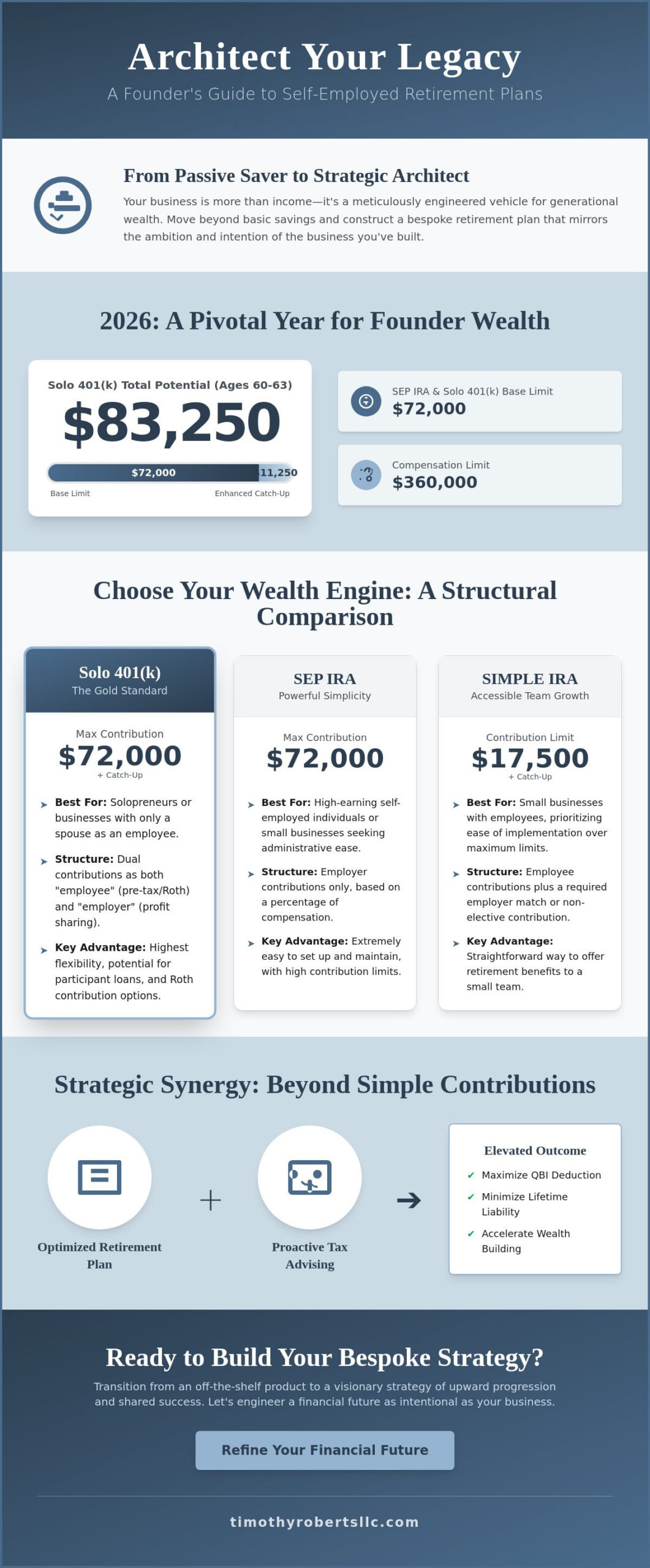
It’s time to move beyond passive saving. You’ll discover how to transform your current status into a high-octane wealth engine by utilizing the latest 2026 contribution limits, such as the $72,000 cap for SEP IRAs or the enhanced $83,250 total limit for Solo 401(k) participants aged 60 to 63. We’ll provide a clear decision-making framework that treats your retirement strategy as a bespoke architectural project rather than an off-the-shelf product. This guide explores the intersection of tax-deferred growth and professional legacy, ensuring your financial future is as intentional as the business you’ve built.
Key Takeaways
- Identify how the 2026 regulatory landscape offers high-earning founders unprecedented opportunities to scale wealth through elevated contribution limits.
- Evaluate the structural advantages of the Solo 401(k) versus the SEP IRA to determine which vehicle best aligns with your business’s unique operational complexity.
- Utilize a strategic framework for selecting retirement plans for self-employed individuals that ensures your choice remains agile as your organization evolves.
- Discover the synergy between retirement planning and tax advising to maximize your Qualified Business Income (QBI) deduction and minimize lifetime liability.
- Learn how to transition from a transactional savings mindset to a visionary strategy of upward progression and shared success.
Beyond the Basics: Why Self-Employed Retirement Planning Requires a Visionary Approach
Retirement planning for the self-employed isn’t just about replacing a corporate paycheck; it’s about designing a personal financial infrastructure. While traditional employees are confined by the architecture of their employer’s benefits, you possess the unique power to build a custom solution. These U.S. retirement plans represent a canvas for strategic interventions. For many, the transition from an accidental saver to a strategic architect marks the moment their business becomes a true wealth-building engine. You aren’t just saving for a date on a calendar; you’re constructing a legacy that reflects your professional rigor.
To better understand this concept, watch this helpful video:
The landscape of retirement plans for self-employed individuals has evolved beyond simple IRA contributions. You now have access to high-contribution vehicles that rival or exceed corporate offerings. The “Big Three” tools, the Solo 401(k), the SEP IRA, and the SIMPLE IRA, serve as the primary levers for this evolution. Choosing between them requires more than a cursory glance at a tax table; it demands a vision for where your business is going. A strategic architect doesn’t settle for off-the-shelf products but instead selects the vehicle that optimizes both current cash flow and long-term growth.
The Shift from Employee to Architect
Why 2026 is a Pivotal Year for Self-Employed Wealth
The current fiscal year represents a high-water mark for strategic saving. The 2026 contribution limit for both SEP IRAs and Solo 401(k) plans has scaled to $72,000, offering a significant runway for tax-deferred growth. Provisions from the SECURE 2.0 Act have further refined this landscape, particularly for those entering their peak earning years. Individuals aged 60 to 63 can now leverage an enhanced catch-up contribution of $11,250, bringing their total Solo 401(k) potential to $83,250. This is calculated against an increased compensation limit of $360,000. The Self-Employed Retirement Advantage is the fusion of high limits and tax flexibility that allows founders to accelerate wealth.
Evaluating the Core Vehicles: Solo 401(k), SEP IRA, and SIMPLE IRA
Selecting the right vehicle is a matter of matching your business’s cash flow velocity with your long-term wealth objectives. Among the various retirement plans for self-employed individuals, three primary structures dominate the conversation, each offering a different balance of contribution power and administrative ease. These frameworks, detailed within the IRS retirement plan options for the self-employed, allow you to bypass the limitations of standard consumer accounts. While a SIMPLE IRA might serve a growing team, high-earning solopreneurs often find the greatest leverage within the Solo 401(k) or SEP IRA environments.
The Solo 401(k): Maximum Leverage for the Solopreneur
The Solo 401(k) remains the gold standard for those operating without employees, other than perhaps a spouse. Its primary advantage lies in the double contribution structure. You act as both employee and employer, allowing you to defer $24,500 as a salary deferral in 2026, while the business contributes up to 25% of compensation, provided the total doesn’t exceed $72,000. This plan also supports a Roth component, enabling you to build a reservoir of tax-free growth. Beyond the numbers, the Solo 401(k) provides a unique safety net through loan provisions, allowing participants to access up to $50,000 or 50% of the account balance for business pivots or personal needs without triggering a taxable event.
The SEP IRA: Sophisticated Simplicity
If your priority is administrative efficiency without sacrificing high contribution limits, the SEP IRA is an elegant choice. It requires minimal IRS reporting and is often easier to establish than a 401(k) platform. Contributions are strictly employer-funded, capped at the lesser of $72,000 or 25% of your net earnings for 2026. This vehicle is particularly valuable for businesses with fluctuating revenue. You have the flexibility to skip contributions entirely during lean years or maximize them when profits soar, all without the risk of plan termination. It’s a responsive tool that adapts to your fiscal reality.
For those anticipating a transition from solopreneurship to a small team, the SIMPLE IRA offers a middle ground with a $17,000 deferral limit for 2026. Additionally, sophisticated architects often incorporate a Health Savings Account (HSA) as a secondary retirement tool. With its triple-tax advantage, it allows for tax-deductible contributions, tax-free growth, and tax-free withdrawals for healthcare, effectively serving as a specialized retirement bucket. Refining these choices requires a deep understanding of your current trajectory, which is why integrated financial planning is essential for long-term clarity.
Strategic Selection: Matching Your Business Structure to the Optimal Plan
Choosing among retirement plans for self-employed individuals is an exercise in business architecture. Your selection must align with your current tax status while remaining agile enough to support your future trajectory. The decision often hinges on your legal entity. If you operate as an S-Corporation, your contributions are strictly tied to your W-2 wages. Conversely, sole proprietors and single-member LLCs calculate their limits based on Schedule C net profit after deducting one half of the self-employment tax. This distinction is vital because it determines the ceiling of your wealth-building engine.
One of the most frequent concerns for founders is the transition from solopreneurship to leadership. If you hire employees who meet certain age and service requirements, a Solo 401(k) can no longer remain “solo.” You’ll be required to extend the plan to your staff, which significantly increases administrative oversight and testing requirements. In these instances, pivoting to a SEP or SIMPLE IRA may be the more efficient strategic intervention. This level of foresight is why a comprehensive financial plan is indispensable for aligning your business structure with your personal legacy.
The High-Income Solopreneur Framework
For individuals earning over $200,000 annually, the Solo 401(k) typically offers the highest leverage. While it carries more administrative weight than a SEP IRA, the ability to contribute as both employer and employee allows for faster capital accumulation. High earners may also explore “Mega Backdoor Roth” strategies. If your plan document is meticulously crafted, you can make after-tax contributions beyond the standard deferral limit and convert them to a Roth account. This creates a reservoir of tax-free growth that standard off-the-shelf products simply cannot match. The break-even point occurs when the tax savings and contribution power exceed the modest costs of professional plan maintenance.
The Growth-Oriented Partnership or Small Team
Tax Optimization and Wealth Elevation: Moving Beyond Simple Contributions
Sophisticated savers understand that retirement plans for self-employed individuals aren’t isolated silos. They are integral components of a larger fiscal architecture. By integrating professional tax advising into your selection process, you ensure every dollar contributed serves a dual purpose: building future capital and reducing current liability. This approach treats tax mitigation as a proactive intervention rather than a reactive chore. It’s about optimizing the intersection of your business’s profitability and your personal net worth.
Asset location is another vital lever for wealth elevation. You should strategically place tax-inefficient investments, such as high-yield bonds or actively managed funds, within tax-advantaged accounts like a Solo 401(k). Conversely, assets that benefit from long-term capital gains rates often perform better in taxable brokerage accounts. This balance maximizes your after-tax return. It ensures your portfolio’s growth isn’t eroded by avoidable fiscal friction. Refined wealth management allows you to align these complex variables into a cohesive strategy.
The QBI Deduction Synergy
The Section 199A Qualified Business Income (QBI) deduction offers a substantial 20% tax break for eligible self-employed individuals. However, this deduction is subject to complex phase-out limits based on total taxable income. Strategic retirement contributions can lower your taxable income just enough to stay within the eligibility threshold, effectively unlocking the full deduction. For high-earning service providers, this sweet spot calculation can result in five-figure annual tax savings. Proactive tax planning is the difference between saving and building wealth. It transforms a standard deduction into a high-level strategic advantage.
Legacy and Estate Considerations
Your retirement strategy must eventually converge with your estate planning goals. Unlike assets held in a personal name, retirement accounts with valid beneficiary designations bypass the public and often lengthy probate process. This ensures a seamless transition of wealth to your heirs. You must also account for the SECURE Act’s 10-year rule, which requires most non-spouse beneficiaries to fully distribute the account within a decade. For those over age 70.5, utilizing Qualified Charitable Distributions (QCDs) allows you to satisfy required minimum distributions while supporting philanthropic causes tax-free. These interventions ensure your wealth serves your vision long after your active participation in the business ends.
Partnering for Progression: How Timothy Roberts & Associates Refines Your Strategy
Navigating the complexities of retirement plans for self-employed individuals requires more than just a provider; it demands a visionary strategist. Timothy Roberts & Associates serves as a fiduciary partner for those who view their business as a catalyst for organizational and personal evolution. We don’t just facilitate account openings. We craft carefully calibrated interventions that align your daily professional output with your ultimate legacy goals. This partnership is built on a foundation of shared success and intellectual curiosity, ensuring your wealth strategy is as dynamic as the enterprise you lead.
With over 25 years of experience in investment portfolio management, our firm provides the business-minded rigor necessary to solve complex problems. We understand that a high-earning solopreneur’s needs differ significantly from those of a corporate executive. Our role is to bridge that gap, bringing structured corporate capabilities to your individual creative vision. We take the time to understand the nuances of your cash flow and tax situation, moving beyond off-the-shelf solutions to create a truly bespoke experience.
A Fiduciary Standard of Care
Working with a fiduciary means your interests are the only priority. This legal obligation forms the basis of our relationship, providing a sense of calm confidence even when markets become volatile. We employ structured portfolio rebalancing and risk management to protect your capital while pursuing aspirational growth. By synthesizing your personal vision with rigorous financial standards, we create a stable environment for your wealth to flourish. It’s a human-led, results-driven identity that distinguishes our specialized firm from anonymous, larger entities.
Your Strategic Roadmap to 2026 and Beyond
Our process begins with the creation of a Personalized Roadmap. This step-by-step framework integrates tax planning, investment management, and estate strategy into a single, cohesive journey. As your business scales or your personal goals shift, we monitor and adjust your plan with meticulous attention to detail. This steady, logical rhythm guides you from high-level vision down to the practicalities of execution. We invite you to a strategic consultation to refine your trajectory and ensure your retirement strategy is a masterpiece of intentional design.
Elevate your retirement strategy with a personalized financial roadmap.
Architecting Your Financial Legacy
The transition from a high-earning founder to a visionary wealth architect requires a fundamental shift in perspective. You’ve explored how the current fiscal landscape offers unprecedented opportunities through sophisticated retirement plans for self-employed individuals. By aligning your business structure with high-contribution vehicles and integrating proactive tax interventions, you transform a standard savings account into a powerful wealth-building engine. This journey isn’t just about reaching a destination; it’s about building a legacy that reflects the same rigor you apply to your professional work.
Success in this arena demands more than a generic solution. It requires a partner who understands the intersection of aesthetics and functionality in financial design. With over 25 years of fiduciary expertise, Timothy Roberts & Associates specializes in comprehensive wealth and tax integration for high-net-worth solopreneurs. We invite you to request a strategic consultation with Timothy Roberts & Associates to refine your personalized roadmap. It’s time to ensure your financial future is as intentional and progressive as the business you’ve built. Your path toward upward progression starts with a single, strategic decision.
Frequently Asked Questions
What is the best retirement plan for a one-person business in 2026?
The Solo 401(k) is widely considered the gold standard for high-earning solopreneurs due to its dual contribution structure. It allows you to maximize your savings at lower income levels compared to other retirement plans for self-employed individuals. This vehicle provides the highest level of leverage for those who don’t intend to hire employees other than a spouse.
How much can a self-employed person contribute to a 401(k) in 2026?
For 2026, a self-employed individual under age 50 can contribute a total of $72,000 to a Solo 401(k). This figure is a combination of a $24,500 employee salary deferral and an employer contribution of up to 25% of compensation. These limits scale higher for those eligible for catch-up contributions, providing a robust engine for capital accumulation.
Can I have both a SEP IRA and a Traditional or Roth IRA?
You can absolutely fund both a SEP IRA and a personal Traditional or Roth IRA in the same tax year. While the SEP IRA is a business-funded vehicle, your personal IRA is an individual account. It’s vital to monitor your modified adjusted gross income, as it may limit the deductibility of Traditional IRA contributions or your eligibility to contribute directly to a Roth IRA.
Is a Solo 401(k) better than a SEP IRA for tax savings?
A Solo 401(k) often provides superior tax savings because it allows for larger contributions at moderate income levels. While a SEP IRA limits you to 25% of your net earnings, the Solo 401(k) lets you defer $24,500 as an employee before the employer percentage is even calculated. This structural advantage makes it one of the most effective retirement plans for self-employed individuals seeking immediate tax relief.
What happens to my self-employed retirement plan if I hire employees?
Hiring non-spouse employees who meet IRS eligibility criteria requires an organizational evolution of your retirement strategy. A Solo 401(k) must either be converted into a full-scale corporate 401(k) or replaced with a plan like a SEP or SIMPLE IRA that includes your staff. This transition ensures your business remains compliant with ERISA regulations while continuing to support your personal wealth goals.
Are contributions to self-employed retirement plans tax-deductible?
Contributions to traditional self-employed plans are typically tax-deductible, serving as a powerful tool for reducing your annual tax burden. Employer contributions are treated as a business expense, while employee deferrals reduce your total taxable income. This dual benefit ensures that your growth is fueled by dollars that would otherwise be lost to current taxation.
Can I use a self-employed retirement plan to invest in real estate or alternatives?
You can invest in real estate, private equity, or other alternative assets if you utilize a self-directed custodian. This sophisticated intervention allows you to diversify your portfolio beyond traditional stocks and bonds. It requires a meticulous understanding of prohibited transactions to ensure your bespoke investment strategy remains compliant with IRS mandates.
How do catch-up contributions work for self-employed individuals over 50?
Catch-up provisions allow individuals over 50 to accelerate their savings with higher limits. In 2026, those aged 50 to 59 or 64 and older can add $8,000 to their Solo 401(k) deferrals. Under the SECURE 2.0 Act, a specialized catch-up limit of $11,250 is available for those aged 60 to 63, creating a pivotal window for final wealth elevation before retirement.
