

Jun
Strategic Business Succession Planning: A Guide to Enterprise Evolution
What if your departure wasn’t the end of your company’s story, but its most sophisticated evolution? You’ve spent decades crafting an enterprise that reflects your personal values; it’s only natural to feel a quiet anxiety about what happens when you finally step away. Many founders worry that a lifetime of work could dissolve into unnecessary tax liabilities or a leadership vacuum that threatens the brand’s stability. Business succession planning is not merely a transaction. It’s the final, most intentional act of stewardship for the visionary leader.
We understand that you seek more than just an exit; you want a seamless transition that preserves your company legacy while maximizing financial liquidity for your next chapter. This guide will show you how to navigate the complexities of the current landscape, including the permanent 15 million dollar estate tax exemption established by the One Big Beautiful Bill Act of 2025. We’ll examine how to adapt to the recent Supreme Court ruling on buy-sell agreements and use strategic valuation to ensure you capture the true worth of your enterprise. By the end, you’ll have a clear roadmap for a fiduciary-led transition that turns your professional success into a lasting personal legacy.
Key Takeaways
- Reframe your departure as a sophisticated evolution rather than a final exit to ensure the enduring continuity of your enterprise.
- Evaluate the distinct advantages of internal management buyouts and ESOPs against external strategic partnerships to determine your most effective transition pathway.
- Navigate the complexities of business succession planning by capturing the true strategic worth of your intellectual capital and operational excellence.
- Implement advanced tax mitigation strategies to minimize capital gains and secure maximum liquidity for your retirement.
- Synchronize your individual vision with a robust estate plan to transform your professional success into a lasting personal legacy.
Defining Business Succession Planning as a Strategic Evolution
Business is a living legacy. It’s the physical manifestation of a founder’s vision, grit, and intellectual capital. When we discuss what is succession planning, we aren’t talking about a simple HR checklist for filling vacancies. We’re describing the intentional, phased transfer of leadership and ownership to ensure enterprise continuity. It’s a journey from being the central engine of the firm to becoming its enduring architect. A successful transition doesn’t just happen; it’s designed with the same business-minded rigor that built the company in the first place.
The year 2026 represents a pivotal moment for these transitions. With the One Big Beautiful Bill Act (OBBBA) making the $15 million individual estate tax exemption permanent, the fiscal fog has finally lifted. This clarity allows for deeper, more strategic interventions that were previously hindered by legislative uncertainty. A sudden exit often leaves significant value on the table. A phased evolution, however, captures that value by aligning the organization’s trajectory with the founder’s personal goals. It’s about moving toward growth, not just away from a desk.
To better understand how these plans take shape within a family dynamic, watch this helpful video:
The Fiduciary Advantage in Succession
Traditional exit strategies often suffer from the friction of commission-based advice. A fiduciary-led approach removes these conflicts of interest, ensuring every structural change serves the founder’s long-term retirement income planning. This objective oversight is vital during emotional family transitions. It provides a steady hand when personal dynamics threaten to cloud professional judgment. Fiduciaries prioritize the health of the organization and the security of the owner, treating business succession planning as a crafted intervention rather than a generic transaction.
Succession vs. Exit Strategy: A Vital Distinction
It’s easy to conflate an exit strategy with a succession plan, but their objectives are fundamentally different. Exit strategies focus on the “out,” prioritizing immediate liquidity and the cessation of involvement. Succession focuses on the “future,” balancing your need for liquidity with the company’s long-term operational health. One is a conclusion; the other is a new chapter. We favor a philosophy of quiet ambition. By planning with meticulous detail today, you ensure the transition’s impact is heard loudly by the market tomorrow. This distinction protects your brand’s aesthetics and functionality long after you’ve moved to your next endeavor.
Evaluating Internal vs. External Transition Pathways
The selection of a transition pathway is perhaps the most defining decision in the lifecycle of an enterprise. It’s a choice between the familiar continuity of internal leadership and the expansive potential of an external market. Internal transitions, such as family successions or management buyouts (MBOs), prioritize the preservation of institutional knowledge and corporate culture. Conversely, external sales to private equity or strategic partners often focus on maximizing immediate liquidity. Each path significantly alters the future architecture of your investment portfolio management, shifting your primary asset from an active business to a diversified capital base.
Employee Stock Ownership Plans (ESOPs) have gained traction as a sophisticated hybrid solution; however, the regulatory landscape has shifted recently. Since November 25, 2025, the tax benefits for sales to Employee Ownership Trusts (EOTs) have changed significantly, with only 50% of the gain now potentially exempt. This highlights why business succession planning requires constant vigilance regarding fiscal policy. Whether you choose a hybrid model that allows you to retain equity while stepping back from day-to-day operations or opt for a complete divestment, the strategy must be intentional and meticulously crafted.
The Nuances of Family and Management Buyouts
Structuring an internal buyout requires a delicate balance. You must secure a reliable income stream without suffocating the company’s operational cash flow. With SBA 7(a) fixed interest rates ranging between 11.75% and 14.75% as of June 2026, the cost of financing an MBO is a critical variable. Success depends on preparing the next generation through structured governance and mentorship. It’s not just about who takes the chair. It’s about who is ready to lead the evolution. Addressing the “fairness vs. equality” debate early prevents the personal from undermining the professional.
External Sales and Strategic Acquisitions
An external sale often represents the highest valuation potential, but it demands rigorous due diligence. High-end partners look for resilience, documented processes, and a leadership team that can thrive without the founder. Identifying a buyer who respects your corporate culture is essential for preserving your legacy. Many external deals include “earn-outs,” where a portion of the sale price is contingent on future performance. These structures require careful integration into your broader wealth strategy. If you’re weighing these complex options, a tailored financial planning session can help clarify which pathway aligns with your ultimate vision.
Optimizing Fiscal Value: Valuation and Tax Mitigation
A sophisticated transition requires early intervention to identify hidden liabilities. Our approach to tax advising uncovers potential fiscal friction points long before the first letter of intent is signed. By coordinating your business valuation with your broader estate and legacy goals, we ensure that the liquidity generated from a sale isn’t eroded by avoidable taxes. It’s about creating a seamless bridge between your corporate success and your personal wealth.
Sophisticated Valuation Methodologies
Determining the right methodology depends heavily on your industry and growth trajectory. For a software firm with recurring revenue, we might see EBITDA multiples ranging from 8 to 15x in 2026. A manufacturing entity, however, typically commands between 7 and 11x. We often utilize Discounted Cash Flow (DCF) analysis for established firms with predictable margins, while market multiples provide a reality check against current lower-middle-market trends. To maximize this value, you must escape the “Owner Trap” by reducing founder dependency. Strategic Value is the premium an acquirer pays for the synergistic potential and operational fit beyond the standalone enterprise worth.
Tax-Efficient Transfer Strategies
The fiscal landscape of 2026 offers unique opportunities for the prepared. With the One Big Beautiful Bill Act (OBBBA) making the 15 million dollar individual estate tax exemption permanent, the focus has shifted toward long-term strategic gifting. Utilizing irrevocable trusts can remove future appreciation from your taxable estate while maintaining a degree of control. You must also navigate the 2026 Supreme Court ruling in Connelly v. United States, which changed how life insurance proceeds fund buy-sell agreements. To avoid inflating your company’s value for estate tax purposes, many firms are moving toward cross-purchase arrangements. For gains qualifying for Business Asset Disposal Relief (BADR), the 18% tax rate remains a vital tool for preserving your hard-earned capital. We integrate these proceeds into a tax-optimized retirement income stream, ensuring your legacy is as financially resilient as it is personally meaningful.
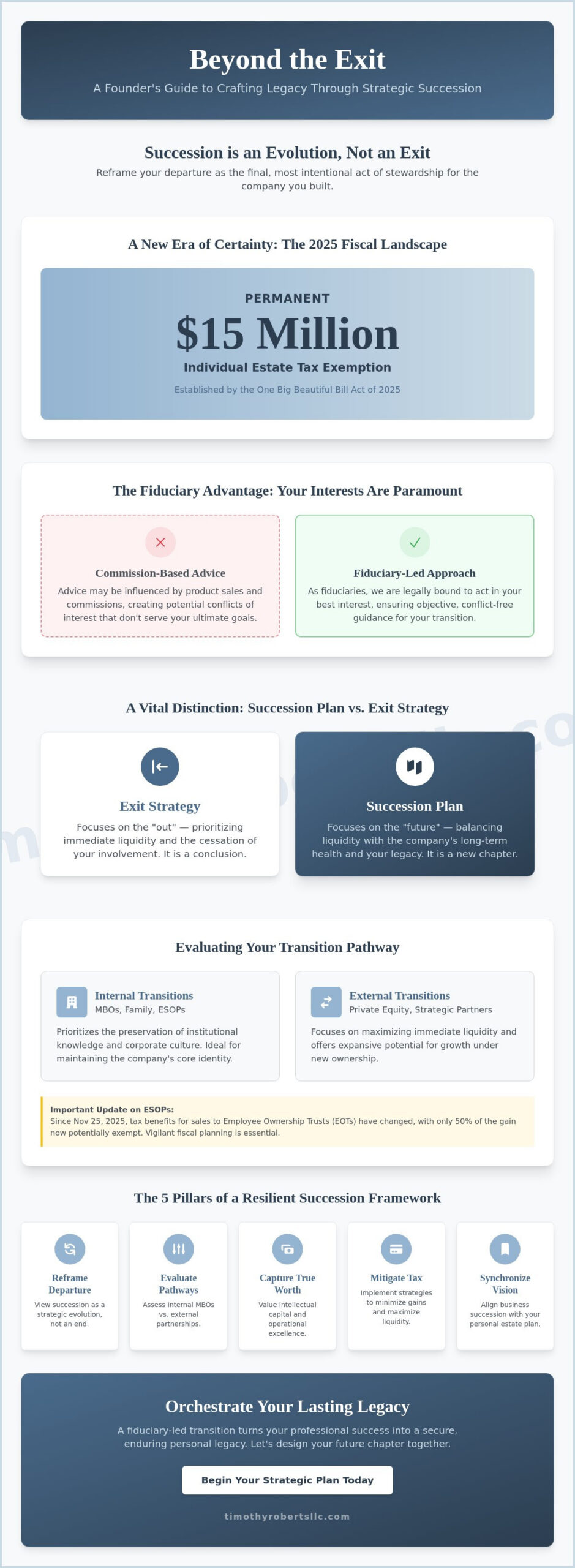
The Five Pillars of a Resilient Succession Framework
Excellence in business succession planning demands a structural integrity that mirrors the enterprise it protects. It isn’t a singular event but a multi-phased architecture designed to withstand the pressures of transition. We view this framework through five distinct pillars that guide a firm from founder-centric operations to institutional endurance. This process begins with Vision Alignment, where you define exactly what success looks like for both your family and the firm’s future. It’s the moment where creative passion meets business-minded rigor to set the trajectory for the entire evolution.
Once the vision is clear, we establish the Financial Foundation. This phase involves integrating the business asset into a comprehensive estate plan, ensuring that your personal wealth strategy is synchronized with the company’s transfer. The third pillar, Operational Independence, focuses on developing the systems and leadership necessary for the company to thrive without your daily presence. This is followed by Structural Design, where we draft the legal and tax frameworks that govern the transfer. Finally, we move into Execution and Monitoring, a rhythmic transition of control and capital that ensures stability during the handoff.
Building Your Professional Advisory Team
A sophisticated succession requires a symphony of legal, tax, and financial experts. No single professional can navigate the multifaceted complexities of a high-end transition alone. In this arrangement, the fiduciary acts as the conductor, ensuring that every specialist’s contribution aligns with your overarching goals. You should seek advisors who value depth over superficial transactions; partners who treat your enterprise as a crafted legacy rather than a mere SKU. This collaborative approach prevents the fragmented advice that often leads to fiscal leakage or cultural erosion during a sale.
Risk Management and Contingency Planning
A resilient framework must also account for the unthinkable. While we plan for a phased evolution, we must prepare for sudden departures due to disability or unforeseen events. This involves the strategic use of key-person insurance and meticulously drafted buy-sell agreements. A buy-sell agreement acts as a business will, providing a clear roadmap for ownership transfer if a partner can no longer serve the enterprise. These protections ensure that the company’s value remains intact even during periods of personal volatility. To begin building your own resilient framework, consider an initial wealth management consultation to align your business assets with your long-term legacy.
Orchestrating the Transition: Your Partnership with Timothy Roberts & Associates, LLC
Navigating the final evolution of your enterprise requires more than a broker; it demands a partner who understands the deep synthesis of personal ambition and corporate capability. For 25 years, Timothy Roberts & Associates, LLC has guided small businesses through the intricate layers of organizational evolution. We don’t view business succession planning as a simple exit. It’s a crafted intervention designed to bridge your creative legacy with a future of financial independence. Our role is to ensure that the transition feels as polished and intentional as the company you’ve spent a lifetime building.
We adopt the identity of the Visionary Strategist. This means we treat your business as a unique artifact, applying rigorous financial planning and strategic valuation to protect its core essence. By aligning your corporate structure with your individual creative vision, we move beyond the superficial. We create a steady, logical progression that guides you from the high-level vision of your departure down to the practicalities of capital transfer. This deliberate pacing mirrors a high-end consultancy, ensuring every complex problem receives a customized solution rather than a generic conclusion.
A Personalized Roadmap for Your Legacy
Your journey is unique. Off-the-shelf solutions fail to account for the nuanced dynamics of family legacies or the specific market position of a specialized firm. Our team provides the personal attention required to navigate these complexities, integrating sophisticated financial planning with a craftsman’s eye for detail. We treat development as a journey rather than a transaction. By focusing on the concept of upward progression, we help you transform your business assets into a diversified, resilient wealth structure that supports your aspirational growth for years to come.
Initiating Your Strategic Consultation
The first step toward an intentional future is a discovery session. During this initial high-level review, we’ll examine your current business structure, your vision for the firm’s continuity, and your personal liquidity needs. We ask that you prepare your recent financial statements and any existing governance documents for a strategic review. This allows us to identify immediate opportunities for tax optimization and valuation improvement. It’s time to move toward a future defined by quiet ambition and intellectual curiosity. Schedule a strategic consultation to begin your enterprise evolution.
Architecting Your Final Enterprise Evolution
The transition of your business is the ultimate act of leadership and stewardship. It’s the moment where years of grit and creative vision are distilled into a lasting personal legacy. By framing business succession planning as a strategic evolution rather than a simple exit, you protect the cultural and financial integrity of the organization you’ve built. Success in this final chapter requires a meticulous blend of operational independence and sophisticated tax mitigation, ensuring that your departure strengthens the firm rather than destabilizes it. For industry-specific examples of these successful transitions, particularly in the architecture and engineering sectors, check out Significant Business Results.
Timothy Roberts & Associates, LLC provides the high-level expertise necessary to navigate these complex family and corporate dynamics. With over 25 years of fiduciary experience, we specialize in the unique requirements of high-net-worth business owners. Our approach integrates comprehensive wealth management with deep tax strategy to create a seamless path toward your next chapter. Your enterprise deserves a transition that is as polished and intentional as its founding. Take the first step toward a secure and sophisticated future today.
Secure Your Business Legacy with a Strategic Consultation
Frequently Asked Questions
When is the ideal time to start business succession planning?
The ideal timeline for business succession planning begins three to five years before your anticipated departure. This window provides the necessary duration to cultivate operational independence and groom a leadership team capable of sustaining the firm’s trajectory without your daily presence. Starting early allows you to address structural weaknesses and enhance the enterprise value long before you enter formal negotiations.
What are the tax implications of selling my business for retirement?
Selling your enterprise involves navigating capital gains and estate tax liabilities that can significantly erode your net liquidity. As of April 2026, gains qualifying for Business Asset Disposal Relief (BADR) are taxed at 18%, while non-qualifying gains face a 24% rate. Strategic intervention ensures that your exit is structured to utilize these reliefs effectively while staying within the permanent 15 million dollar federal estate tax exemption established by the OBBBA.
How can I determine the true market value of my company in 2026?
True market value is determined by applying industry-specific EBITDA multiples to your sustainable earnings while accounting for strategic synergies. In the 2026 lower middle market, manufacturing firms typically command multiples between 7 and 11x, while software companies with recurring revenue can reach 8 to 15x. We move beyond simple book value to capture the premium a buyer pays for your intellectual capital and operational resilience.
Can a fiduciary advisor help with both my business and personal finances?
A fiduciary advisor serves as the strategic bridge between your corporate assets and your personal wealth objectives. By synthesizing business succession planning with your broader investment portfolio management, we ensure that the liquidity generated from your exit supports your long-term retirement income planning. This holistic approach prevents the fragmented advice that often leads to fiscal leakage during complex transitions.
What happens if I don’t have a clear successor within my company?
If an internal successor isn’t available, we pivot toward external transition pathways such as strategic acquisitions or Employee Stock Ownership Plans (ESOPs). While the tax benefits for Employee Ownership Trusts (EOTs) changed after November 25, 2025, with only 50% of the gain now potentially exempt, these models still offer powerful legacy preservation. An external sale to a competitor or private equity firm remains a primary route for maximizing immediate financial liquidity.
How do buy-sell agreements protect my business partners and family?
A buy-sell agreement acts as a “business will,” establishing a clear, legally binding roadmap for the transfer of ownership interests upon specific triggering events. Following the 2026 Connelly ruling, it’s vital to structure these agreements carefully to ensure life insurance proceeds don’t inadvertently inflate the company’s value for estate tax purposes. These documents provide your family with guaranteed liquidity and protect your partners from unauthorized or unqualified new owners.
What is the difference between a management buyout and an external sale?
A management buyout (MBO) involves selling the company to your existing leadership team, prioritizing cultural continuity and institutional knowledge. An external sale targets third-party buyers, often resulting in a higher valuation multiple but requiring more rigorous due diligence. MBOs frequently rely on SBA 7(a) financing, which carries variable rates between 9.75% and 13.25% as of June 2026, making the cost of capital a significant factor in the deal structure.
How does succession planning affect my current estate plan?
Succession planning transforms your most concentrated and illiquid asset into a diversified capital base that must be reintegrated into your estate plan. It requires updating your gifting strategies and trust structures to reflect your new liquidity position and the permanent 15 million dollar individual exemption. This alignment ensures that your professional success translates into a resilient personal legacy that provides for future generations without excessive tax friction.
