

Jun
Legacy Planning for Grandchildren in Michigan: A Strategic 2026 Guide
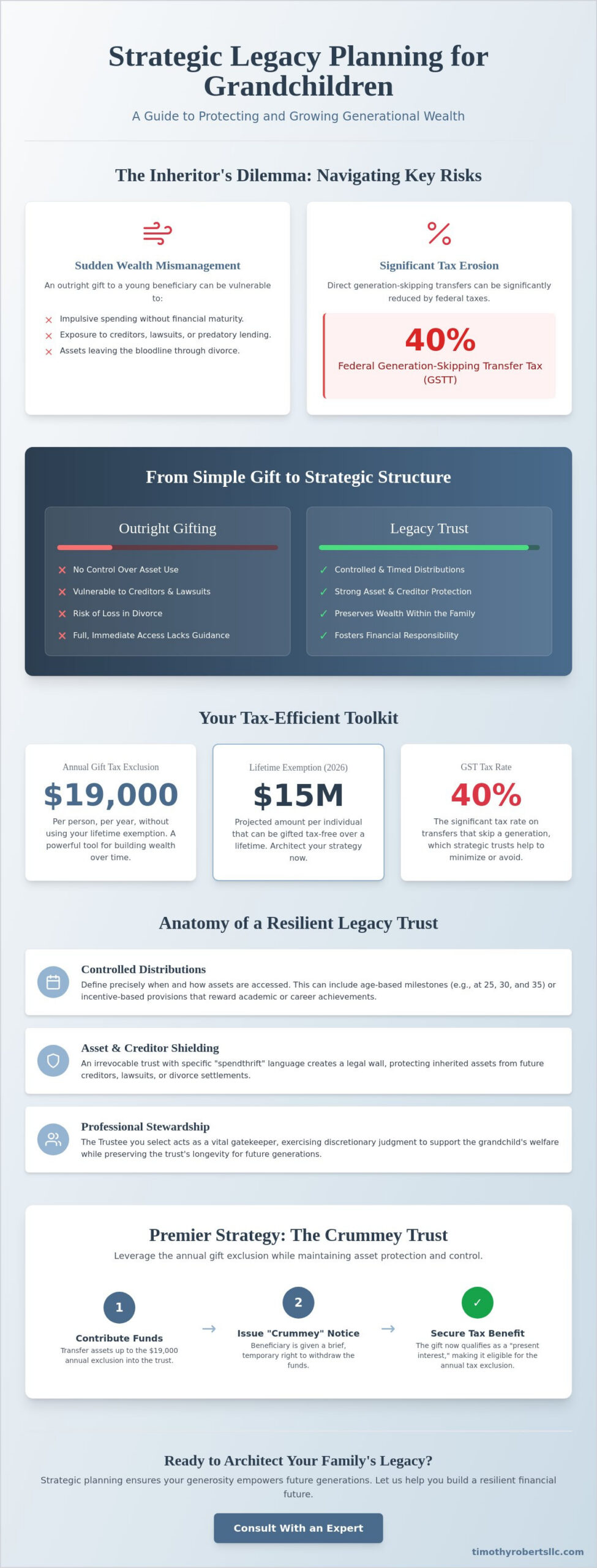
A grandchild’s trust is far more than a simple financial transfer. It’s a strategic vessel for intentional stewardship, designed to withstand the pressures of time and the complexities of federal taxation. You likely worry that a sudden influx of wealth could be mismanaged or significantly eroded by the 40% federal tax rate on generation-skipping transfers. It’s a natural concern for families who value the long-term impact of their hard-earned success and want to ensure their gifts remain intact for the next generation.
At Timothy Roberts & Associates, LLC, we understand the nuances of strategic wealth transfer. This guide offers a sophisticated roadmap for legacy planning for grandchildren in Michigan, designed to ensure your wealth serves as a catalyst for growth rather than a source of confusion. We’ll architect a plan that leverages the 2026 lifetime exemption of $15,000,000 per individual while protecting assets from creditors and mismanagement. You’ll gain a clear understanding of how to use incentive trusts and 529 plans to foster financial responsibility and purpose. We’ll also examine how to utilize the $19,000 annual gift tax exclusion to build a tax-efficient foundation that secures your grandchildren’s aspirations for decades to come.
Key Takeaways
- Shift from simple gifting to strategic trust structures to ensure assets are managed with intention and protected from external risks.
- Compare specialized trust architectures to find the ideal balance between tax-efficient gifting and the long-term financial security of your heirs.
- Architect a multi-generational strategy for legacy planning for grandchildren michigan that utilizes the 2026 federal exemptions to minimize tax erosion.
- Identify the optimal funding strategies and trustee selections that align with your family’s specific values and educational goals.
- Integrate your legacy objectives with comprehensive wealth management to ensure your generosity does not compromise your own retirement income security.
Beyond Outright Gifting: Why Michigan Families Choose Legacy Trusts
Legacy planning for grandchildren michigan represents a shift from simple generosity to strategic architecture. An outright gift, while well-intentioned, often lacks the structural integrity needed to survive the complexities of modern life. A legacy trust serves as a sophisticated fiduciary arrangement, positioning you as the visionary architect of your family’s future. By moving beyond simple cash transfers, you ensure that wealth remains a tool for empowerment rather than a catalyst for financial indiscretion. It’s a partnership between your current success and their future potential.
To visualize how these structures integrate with your broader family goals, consider this perspective:
The inherent risk of outright gifting is the total loss of control. Once assets are in the hands of a young adult, they are vulnerable to impulsive decisions or external pressures. Common limitations of outright gifting include:
- Immediate access to substantial funds without the requisite financial maturity.
- Exposure to creditors, legal judgments, and predatory lending.
- The potential for assets to leave the family bloodline through divorce settlements.
Michigan families often choose legacy trusts to maintain a guiding hand across generations. This isn’t about restriction; it’s about providing a curated path toward financial maturity and professional achievement.
Control and Timing of Distributions
Strategic trusts allow you to define exactly when and how assets are accessed. You might establish age-based milestones, releasing portions of the principal at ages 25 and 30 to prevent youthful indiscretion. You can also incorporate incentive provisions that reward academic or career milestones, such as graduating from a premier university. Many families utilize a Crummey trust to leverage annual gift tax exclusions while keeping the underlying capital under professional management. The trustee acts as a vital gatekeeper, exercising discretionary judgment to support the grandchild’s welfare while preserving the fund’s longevity.
Asset Protection and Creditor Shielding
Beyond internal mismanagement, your family’s wealth faces external threats. Irrevocable trust structures create a robust legal wall around inherited assets. This shielding is essential in an era where litigation and divorce settlements are common. By using specific spendthrift language allowed under Michigan law, you protect your grandchild’s inheritance from future creditors or bankruptcy proceedings. These provisions ensure that the capital stays within the bloodline, serving your descendants rather than being diverted to third-party litigants. It’s a method of securing a legacy that remains resilient against the unpredictable nature of the future.
Selecting the Optimal Trust Architecture: Crummey vs. Minor’s Trusts
Choosing the right fiduciary vehicle is a critical step in legacy planning for grandchildren michigan. It requires a delicate balance between maximizing tax benefits today and ensuring the capital remains protected for decades. While many local practitioners might suggest a basic custodial account, sophisticated families require irrevocable structures that provide both control and significant tax advantages. These interventions aren’t merely legal documents; they’re strategic tools designed to foster long-term growth and family stability.
The Crummey Trust: Leveraging the Annual Exclusion
The Crummey trust is a premier choice for families who value flexibility over statutory rigidity. Its primary advantage lies in the “Crummey power,” a technical provision that grants beneficiaries a temporary right to withdraw contributed funds. This right transforms what would be a future interest into a present interest, allowing the gift to qualify for the annual gift tax exclusion. In 2026, this exclusion allows you to transfer up to $19,000 per grandchild without depleting your lifetime exemption. Administrative precision is vital here. You must issue formal notices to beneficiaries whenever a contribution is made to maintain the trust’s tax-exempt status. This structure is particularly effective when used to fund permanent life insurance or diversified investment portfolios that you intend to grow for decades.
2503(c) Minor’s Trusts: Simplicity and Statutory Compliance
A Section 2503(c) trust offers a more streamlined path to tax-efficient gifting. Unlike the Crummey trust, it doesn’t require periodic notices to qualify for the annual exclusion. However, it comes with a significant statutory requirement: the beneficiary must have the right to receive all trust assets at age 21. For some, this age is too young for the stewardship of substantial wealth. For others, it serves as a perfect vehicle for funding undergraduate education or a first home purchase. This structure is often preferable when the total value of the gift is smaller or when the family’s strategic vision involves a complete transfer of assets by early adulthood. As you refine your estate & legacy planning strategy, the choice between these vehicles becomes a matter of aligning your financial goals with your grandchildren’s expected maturity levels.
Selecting the right trustee is just as important as the trust architecture itself. Whether you choose a trusted family member or a professional corporate fiduciary, they must understand the nuances of your family’s vision. A discretionary trust allows a trustee to distribute funds based on specific needs, such as health or education, rather than adhering to a rigid schedule. This adaptability ensures that your legacy remains a supportive force, evolving alongside the changing needs of your descendants. This nuanced approach to legacy planning for grandchildren michigan ensures that your wealth serves its intended purpose without compromising the financial integrity of the next generation.
Navigating the 2026 Tax Landscape: GSTT and Annual Exclusions
The 2026 fiscal year marks a significant elevation in the federal tax landscape, offering a unique window for legacy planning for grandchildren michigan. With the lifetime gift and estate tax exemption rising to $15,000,000 per individual, families have an unprecedented opportunity to shield assets from future erosion. This isn’t just about moving money; it’s about strategic timing. By acting now, you can lock in these higher limits before potential legislative shifts or sunset provisions alter the playing field. It’s a calculated move for those who view wealth as a multi-generational legacy rather than a static balance sheet.
The 2026 annual gift tax exclusion provides a powerful, repetitive tool for wealth transfer. At $19,000 per recipient, a married couple can contribute $38,000 annually to each grandchild without touching their lifetime exemption. When applied across multiple grandchildren over several years, this creates a compounding effect that significantly reduces the taxable estate. Some families choose to super-fund these transfers, particularly through 529 plans, where five years of contributions can be front-loaded into a single year. In 2026, an individual can contribute up to $95,000, or $190,000 for a married couple, accelerating the time assets spend in tax-advantaged environments.
The Generation-Skipping Transfer Tax (GSTT) Explained
The federal government implemented the GSTT to prevent families from avoiding estate taxes by skipping a generation. Without this provision, wealth could pass from grandparents to grandchildren without being taxed at the parent level. Transfers exceeding the exemption are subject to a flat 40% tax rate, making strategic allocation essential for high-net-worth families. The federal GSTT exemption for 2026 is $15,000,000 per individual and $30,000,000 for a married couple. Utilizing this exemption allows you to move substantial wealth tax-free, ensuring the full value of your success reaches your descendants. Professional tax compliance is non-negotiable; filing IRS Form 709 is required to document these transfers and allocate your exemption correctly.
Income Tax Implications for Trust Assets
Beyond transfer taxes, you must consider how trust assets are taxed annually. When you set up a family trust, you must decide between a grantor or non-grantor structure. In a grantor trust, the creator remains responsible for the income tax, allowing the trust principal to grow undiminished by annual tax obligations. Conversely, non-grantor trusts are separate taxpayers. These entities face compressed tax brackets, reaching the top rate much faster than individuals. Managing these brackets requires a sophisticated approach to distributions and investment strategy. Aligning your investment portfolio management with the trust’s specific tax profile ensures your legacy planning for grandchildren michigan remains as efficient as possible. It’s about maximizing net growth while minimizing the friction of annual taxation.
The Stewardship Blueprint: Establishing and Funding the Grandchild’s Trust
Constructing a trust is the moment where visionary intent meets functional reality. It’s the stage of legacy planning for grandchildren michigan where you define the specific purpose of your wealth, whether it’s for education, a first home, or general welfare. This blueprint serves as a guide for future generations, ensuring your resources are utilized as a catalyst for their growth rather than a source of complacency. It requires a meticulous approach to asset selection and a clear definition of the trust’s primary objectives. This process involves collaborating with legal counsel to ensure every provision remains in strict compliance with federal law, providing a secure foundation for your descendants.
The funding process itself is a strategic exercise. While cash is the most straightforward asset to transfer, contributing highly appreciated stocks or real estate can offer superior long-term advantages. By transferring these assets into an irrevocable structure, you allow them to compound in a protected environment, potentially removing future appreciation from your taxable estate. This is a core component of sophisticated estate & legacy planning, where every contribution is calculated for maximum impact and tax efficiency. Selecting the right asset mix is essential for maintaining the trust’s purchasing power over time.
Designing the Distribution Schedule
A well-crafted distribution schedule balances the need for immediate support with the goal of long-term capital preservation. Most modern trusts utilize the HEMS standard, which stands for Health, Education, Maintenance, and Support. This provides the trustee with a clear framework for making distributions while maintaining the trust’s integrity. You can also build in flexibility, allowing the trustee to adapt to unforeseen family circumstances or changes in federal tax law. This adaptability is what distinguishes a custom legacy trust from a generic, off-the-shelf solution.
Selecting and Empowering Your Trustee
Your trustee is the steward of your family’s financial future. This individual or entity holds a profound fiduciary responsibility to manage investments and execute distributions according to your wishes. For smaller trusts, a trusted family member may suffice. However, as the complexity and size of the assets grow, a professional corporate fiduciary often becomes necessary. These entities provide objective oversight, professional investment management, and a level of continuity that individuals cannot match. Succession planning is equally vital. You must establish a clear line of successor trustees to ensure the trust remains functional across multiple generations without interruption. This level of foresight ensures that legacy planning for grandchildren michigan remains a source of strength for your family for years to come.
Integrating Legacy Trusts with Comprehensive Retirement Income Planning
Legacy planning for grandchildren michigan is not a static transaction; it is a vital component of a broader financial ecosystem. True stewardship requires a harmonious relationship between your multi-generational ambitions and your personal financial longevity. It’s a delicate calibration that ensures your success today empowers your descendants tomorrow. By viewing your estate as a living structure, you can architect a legacy that evolves alongside your family’s needs and the shifting economic landscape. This integrated approach moves away from isolated gifting toward a narrative of partnership and shared success.
The synergy between your trust funding and your lifestyle is paramount. Every dollar committed to an irrevocable trust is a dollar removed from your immediate liquidity. Therefore, it’s essential to coordinate your estate documents with your active investment portfolio management. This alignment ensures that your legacy objectives do not create friction with your daily operational needs. It’s about maintaining the intersection of aesthetics and functionality within your financial life, where your generosity is supported by business-minded rigor and professional stability.
Balancing Gifting with Retirement Security
You shouldn’t have to choose between your current standard of living and your grandchildren’s future security. We utilize sophisticated cash flow modeling to determine sustainable gifting levels that won’t compromise your retirement trajectory. This data-driven process identifies the optimal amount to transfer into trust without introducing risk to your personal income stream. This philosophy is a core pillar of our retirement income planning ann arbor strategy, where we prioritize your financial independence while facilitating your aspirational growth. It ensures your legacy remains a source of pride rather than a source of personal financial stress.
The Fiduciary Advantage in Estate Coordination
Effective legacy management requires an advisor who acts as both a visionary strategist and a reliable business partner. Working with a fiduciary ensures that your investment strategy is perfectly synchronized with the trust’s specific objectives and the beneficiaries’ time horizons. This level of coordination prevents the misalignment of risk that often plagues generic estate plans. Our approach to estate planning farmington hills focuses on this holistic management, bridging individual creative vision with structured corporate capabilities. We ensure every asset is positioned for maximum efficiency within the trust structure.
Tax advising serves as the diagnostic tool for your legacy’s long-term health. Without regular intervention, even the most meticulously crafted trust can lose its efficiency due to legislative changes or inflationary pressures. Fiduciary review is the mechanism for this ongoing refinement. It allows for the recalibration of distribution schedules and investment strategies, keeping your vision on its intended trajectory. This commitment to depth over superficiality distinguishes a truly strategic partnership. This proactive stance ensures that legacy planning for grandchildren michigan remains a tangible and progressive force in your family’s history for decades to come.
Architecting a Multi-Generational Legacy
The transition from simple gifting to intentional stewardship is the hallmark of a well-crafted estate. You’ve explored how to navigate the 2026 tax landscape by utilizing Crummey powers and strategic GSTT exemptions to protect your family’s wealth from erosion. By integrating these structures with your broader retirement goals, you ensure your generosity remains sustainable without compromising your own financial independence. Effective legacy planning for grandchildren michigan isn’t a one-time event; it’s a dynamic journey that requires constant refinement and intellectual curiosity.
Our firm brings over 25 years of fiduciary expertise to every partnership, crafting personalized wealth management roadmaps that bridge individual vision with structured corporate capabilities. We specialize in multi-generational tax strategies designed to preserve your impact for decades. Now is the time to move from high-level vision to practical execution. Schedule a consultation to design your strategic legacy plan with Timothy Roberts & Associates, LLC. Your family’s upward progression begins with a single, deliberate step.
Frequently Asked Questions
Can I be the trustee of a trust I set up for my grandchildren?
You can legally serve as the trustee, but it’s often strategically disadvantageous for irrevocable structures. If you retain too much control over the assets, the IRS may include the trust’s value in your taxable estate, defeating the purpose of tax-efficient wealth transfer. Most families opt for a professional fiduciary or a co-trustee to ensure the trust achieves its long-term objectives while maintaining a clear legal separation from your personal estate.
How much money can I put into a trust for my grandchildren without paying gift tax?
In 2026, you can contribute up to $19,000 per grandchild annually under the federal gift tax exclusion. Married couples can jointly contribute $38,000 per recipient without filing a gift tax return or depleting their lifetime exemption. For more substantial transfers, you can utilize your lifetime gift and estate tax exemption, which has increased to $15,000,000 per individual for the 2026 tax year. This flexibility is a cornerstone of sophisticated legacy planning for grandchildren michigan.
What is the difference between a 529 plan and a trust for grandchildren?
A 529 plan is a specialized vehicle restricted to qualified educational expenses, whereas a trust offers broad flexibility for various life milestones like buying a home or starting a business. Trusts provide robust asset protection through spendthrift provisions that 529 plans lack. However, 529 plans offer a unique “super-funding” option, allowing you to front-load five years of annual exclusions into a single contribution of $95,000 per individual in 2026.
Can a trust for grandchildren be changed or revoked once it is established?
It depends entirely on whether the trust is structured as revocable or irrevocable. Most strategic legacy plans utilize irrevocable trusts to secure permanent tax benefits and protection from future creditors, meaning they cannot be easily altered. Some modern irrevocable trusts include “trust protector” provisions, which allow for limited administrative adjustments if federal tax laws or family circumstances shift significantly after the document is signed.
What happens to the trust if the grandchild dies before the distribution age?
The trust document should define a clear succession plan, often directing assets to the grandchild’s siblings or their own descendants. If no specific contingent beneficiaries are named, the assets might be governed by a “power of appointment” granted to the grandchild or revert to a general family fund. Defining these contingencies is a vital part of the stewardship blueprint to ensure family wealth remains within the bloodline and avoids the probate process.
Do grandchildren have to pay taxes on the money they receive from a trust?
Grandchildren generally don’t pay income tax on the principal distributions they receive, but they are typically responsible for taxes on the trust’s accumulated earnings. When a trust distributes income, that tax liability often shifts from the trust’s compressed tax bracket to the grandchild’s individual rate, which is frequently lower. This strategic shift can preserve the overall purchasing power of the legacy while fulfilling the trust’s primary purpose.
How much does it typically cost to maintain a trust for grandchildren?
Maintenance costs are influenced by the complexity of the investment portfolio and the choice between a family or corporate trustee. Annual expenses generally include professional tax preparation and fiduciary management fees if you select a corporate trustee. These costs are an investment in the structural integrity of your legacy, ensuring that the trust remains compliant with evolving regulations and continues to grow according to your visionary intent.
Can I use a trust to pay for my grandchild’s private school tuition?
You can use trust assets for private school tuition, and making direct payments to the educational institution is a highly tax-efficient strategy. Direct payments for tuition don’t count against your $19,000 annual exclusion or your lifetime exemption, allowing you to provide for education while preserving your other gifting limits. This makes educational funding a powerful and progressive element of legacy planning for grandchildren michigan.
