

Jun
How to Build Generational Wealth: A Strategic Guide to Lasting Legacies
Why do most family legacies vanish by the third generation, despite the most meticulous financial planning? It’s a quiet anxiety that haunts many successful families. You’ve spent a career mastering the art of accumulation, yet the fear of the “shirtsleeves to shirtsleeves” cycle remains a persistent shadow. You understand that true prosperity isn’t just about the numbers on a balance sheet today. It’s about the endurance of your values and the stability of your descendants. Understanding how to build generational wealth requires moving beyond simple savings toward a sophisticated architecture of asset protection and intentional stewardship.
You likely feel the weight of this responsibility. It’s natural to worry about estate taxes eroding the principal or whether the next generation possesses the financial literacy to manage a significant inheritance. We promise to provide the strategic clarity you need. This guide reveals the high level investment, tax, and estate strategies required to build, protect, and transfer a legacy that thrives across multiple decades. We will explore a roadmap for long term growth, methods to minimize tax liability during wealth transfer, and proven ways to ensure your heirs are prepared for the mantle of stewardship.
Key Takeaways
- Define wealth as a century-long legacy that sustains both lifestyle and values, leveraging the wealth snowball for multi-generational growth.
- Master how to build generational wealth by transitioning from speculative growth to a fiduciary-led investment strategy designed for long-horizon stability.
- Protect your legacy through advanced estate planning and risk mitigation strategies that move beyond simple wills to safeguard the principal from excessive taxation.
- Cultivate the pillar of stewardship by aligning heirs with a formal family mission statement, ensuring the next generation is equipped with the wisdom to manage their inheritance.
- Coordinate your financial evolution by partnering with a fiduciary advisor who synchronizes tax planning, investment management, and legacy objectives into a single roadmap.
Defining Generational Wealth: Beyond the Balance Sheet
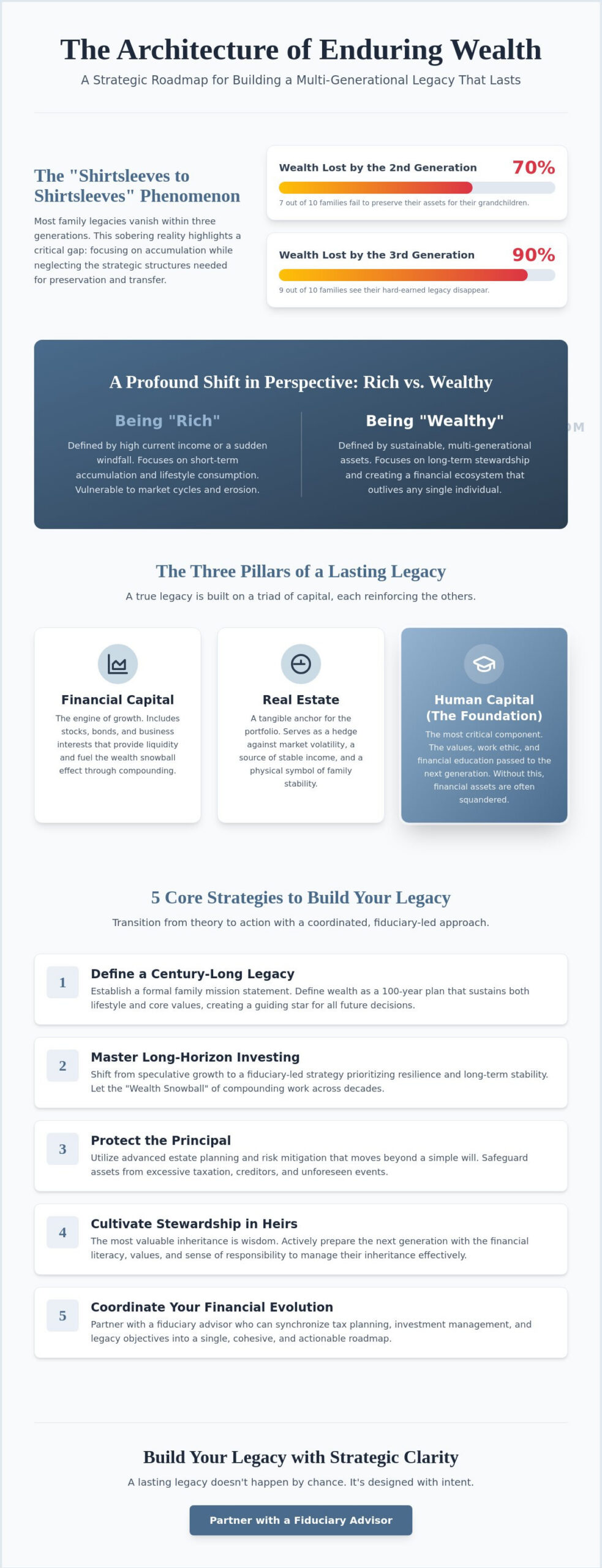
Generational wealth is an architectural achievement. It represents assets designed to sustain a family’s lifestyle and core values for 100 years or more. While being “rich” often refers to a high current income or a sudden windfall, being truly “wealthy” implies the possession of sustainable, multi-generational assets that survive the test of time. Understanding how to build generational wealth requires a profound shift in perspective. You must move from a mindset of short-term accumulation to one of long-term stewardship. It’s about creating a financial ecosystem that operates independently of any single individual’s career.
Historical context helps in Defining Generational Wealth as a persistent force that transcends individual lifespans. Unfortunately, the statistics are sobering. Research suggests that 70% of families lose their wealth by the second generation, and 90% lose it by the third. This “shirtsleeves to shirtsleeves” phenomenon occurs because families often focus on the liquid capital while neglecting the strategic structures and education required to protect it. To ensure your legacy isn’t another statistic, you must treat your family’s finances with the same rigor as a high-performing corporation.
To better understand this concept, watch this helpful video:
The Multiplier Effect of Compounded Assets
Compounding is the silent engine of a legacy. Over a 50 year horizon, a portfolio under consistent fiduciary management can experience exponential growth that transforms a modest principal into a multi-generational foundation. This “Wealth Snowball” effect thrives because gains are reinvested rather than consumed. It’s the ultimate reward for patience. However, inflation acts as a persistent thief of value. Without a disciplined “buy and hold” foundation and active management, the actual purchasing power of your legacy will slowly dissolve, leaving your heirs with less than you intended. Mastering the mechanics of how to build generational wealth means staying ahead of this erosion through strategic asset allocation.
Identifying the Core Components of a Lasting Legacy
Strategic Accumulation: Portfolio Management for the Long Horizon
Building a legacy requires a deliberate departure from the high-stakes volatility of speculative growth. While aggressive tactics might build a fortune, they rarely preserve one across a century. Realizing how to build generational wealth involves a transition toward a structured, fiduciary-led asset allocation that prioritizes resilience over rapid, short-term gains. This approach ensures that your capital isn’t just growing; it’s strategically positioned to withstand the inevitable cycles of the global market. Professional investment portfolio management detroit provides the necessary oversight for legacy growth by synchronizing individual asset performance with the broader family mission.
Patience is the primary currency of the generational investor. Diversification across non-correlated asset classes is essential to survive various market cycles, from inflationary periods to recessionary contractions. Rebalancing strategies must prioritize long-term stability. This means occasionally trimming high-performing assets to reinvest in undervalued sectors, a counterintuitive move for the speculative mind but a foundational one for the strategist. It’s about maintaining the structural integrity of the portfolio so it can serve as a reliable engine for the “Wealth Snowball” mentioned previously.
Fiduciary Asset Allocation vs. Speculative Growth
A fiduciary standard of care is the bedrock of multi-generational planning. Unlike traditional brokers, a fiduciary is legally bound to act in your best interest, a critical distinction when planning for decades rather than quarters. This partnership balances aggressive growth in the early stages of accumulation with a gradual shift toward capital preservation as the legacy matures. One of the most significant threats to long-term stability is concentration risk. Many families tie their entire identity to a single family-owned business or a concentrated stock position. While this concentration may have created the initial wealth, diversification is what keeps it. A strategic advisor helps untangle these risks, spreading assets across diverse classes to ensure one market downturn doesn’t derail a century of progress.
Tax-Efficient Wealth Building Strategies
The true measure of growth isn’t your gross return; it’s what remains after the fiscal authorities take their share. Most investors focus on picking winners while ignoring the quiet erosion caused by taxes. Utilizing tax-advantaged accounts like Roth IRAs allows for decades of tax-free compounding, a powerful tool in the arsenal of anyone looking at how to build generational wealth. Additionally, rigorous tax-loss harvesting can turn market volatility into a strategic advantage, offsetting gains and maximizing your net returns. Engaging in professional tax advising ann arbor ensures more of your growth stays within the family, protecting the principal from unnecessary depletion.
A coordinated approach turns a collection of accounts into a unified engine for progression. If you’re ready to move beyond basic savings toward a more sophisticated model, exploring dedicated wealth management services is the logical next step in your journey toward a lasting legacy.
Protecting the Principal: Estate Planning and Risk Mitigation
Accumulating assets is a feat of financial engineering; protecting them is a feat of strategic governance. Many families focus exclusively on the “how” of growth while neglecting the “why” of preservation. True mastery of how to build generational wealth requires a transition from simple accumulation to rigorous asset protection. This involves shielding your principal from creditors, litigation, and the corrosive effects of excessive taxation. Integrating professional estate planning farmington hills into your broader financial roadmap ensures that your legacy remains intact regardless of external volatility.
Liquidity is often the missing piece in legacy preservation. When a significant estate is transferred, heirs may find themselves asset-rich but cash-poor, forced to sell cherished family assets to cover immediate tax obligations. Strategically structured life insurance serves as a critical tool here. It provides the necessary liquidity to settle estate taxes and other liabilities without liquidating the core portfolio. This ensures the engine of your wealth continues to hum, undisturbed by the transition between generations.
Advanced Estate Coordination: Trusts vs. Wills
Relying solely on a will is a precarious strategy for a multi-generational legacy. Wills must pass through probate, a process that is often public, costly, and time-consuming. It invites scrutiny and potential conflict. In contrast, trusts offer a private and seamless transition of assets. Revocable Living Trusts allow you to maintain control during your lifetime while ensuring an efficient transfer upon your passing. For those with more complex needs, Irrevocable Trusts can remove assets from your taxable estate entirely. This sophisticated coordination is a hallmark of those who truly understand how to build generational wealth, as it prioritizes privacy and structural stability over simple documentation.
Shielding Assets from Taxes and Volatility
The fiscal landscape is constantly shifting. For 2026, the federal estate tax exemption is $15 million per individual, allowing a married couple to transfer up to $30 million without incurring federal estate tax. However, these thresholds are subject to change, and proactive planning is required to navigate potential sunset provisions. Beyond exemptions, the “step-up in basis” remains one of the most powerful tools in your arsenal. It allows you to transfer appreciated assets to heirs who then receive them at their current fair market value, effectively eliminating capital gains taxes on decades of growth. Risk management also extends to personal liability. Utilizing umbrella insurance and sophisticated entity structuring adds layers of defense, ensuring that a single legal challenge doesn’t compromise the work of a lifetime.
The Stewardship Pillar: Preparing the Next Generation
A sophisticated estate plan remains vulnerable if the human element is neglected. Wealth without wisdom is almost always lost within two generations. While earlier sections focused on the mechanics of accumulation and protection, this pillar addresses the individuals who will eventually inherit the mantle. Understanding how to build generational wealth requires a commitment to developing the intellectual capital of your heirs. It’s about moving from a culture of consumption to one of stewardship. Leveraging education funding strategies michigan ensures that your descendants possess the academic and financial foundation necessary to manage a complex legacy. This proactive approach transforms wealth from a potential burden into a powerful tool for progression.
Transparency is the antidote to entitlement. Many families fear that revealing the extent of their wealth will demotivate their children, but silence often breeds anxiety or mismanagement. Gradual financial responsibility is essential. By slowly introducing heirs to the family’s financial realities, you provide them with the context needed for mature decision making. Creating a formal Family Mission Statement helps align every member with the wealth’s purpose, ensuring that the capital serves a vision larger than any individual’s immediate desires.
Cultivating Financial Literacy in Heirs
Financial literacy is a practiced skill, not an inherited trait. It begins by moving children from a simple allowance to active participation in investment discussions. Involving them in portfolio reviews demystifies the “Wealth Snowball” and teaches the discipline required for long term growth. A critical lesson is the distinction between stewardship and ownership. Stewardship involves managing assets for the benefit of future generations, while ownership often focuses on personal spending. You can reinforce these values through incentive trusts. These structures reward educational milestones or professional achievements, ensuring that the distribution of wealth remains tied to the development of character and capability.
Formalizing Family Governance and Values
Governance provides the structure that maintains family unity across decades. Regular family meetings establish a cadence of communication, preventing the misunderstandings that often lead to litigation. These gatherings are an ideal time to document the “Family Story,” providing heirs with a sense of pride in the legacy they are joining. Philanthropy serves as an excellent training ground for collective decision making. By using donor-advised funds, you can teach heirs how to evaluate opportunities and allocate capital toward shared goals. This collaborative giving builds the muscles of stewardship before they are required to manage the core estate. If you’re ready to secure your family’s future through strategic foresight, our wealth management experts can help you design a governance framework that lasts.
Partnering for Progression: The Role of a Fiduciary Advisor
Success at this level is rarely a solitary achievement. It’s an orchestration of diverse expertise. While retail banks offer generic products and transactional interactions, a fiduciary wealth advisor provides a strategic partnership focused on your family’s upward progression. This professional acts as the “Quarterback” for your financial team, ensuring that your tax, investment, and estate advisors aren’t working in silos but are moving toward a unified objective. Understanding how to build generational wealth means recognizing that your financial interests are inextricably linked. A single oversight in tax planning can derail a decades-long investment strategy.
Personalized retirement income planning ann arbor serves as the essential bridge between your current lifestyle and your future legacy. It’s the mechanism that secures your personal independence while simultaneously preparing the principal for its eventual transfer. By coordinating these efforts, you ensure that the transition of wealth is a seamless evolution rather than a disruptive event. To begin this journey, you can schedule a consultation with a financial advisor bloomfield hills who can help you craft a roadmap tailored to your specific vision.
Customizing Your Multi-Generational Roadmap
Off-the-shelf financial plans are designed for the average investor, but your family dynamics are anything but average. A truly strategic roadmap begins with a rigorous audit of your current assets to identify legacy gaps. This process accounts for the unique personalities, goals, and values of your heirs. With the federal estate tax exemption set at $15 million per individual for 2026, the window for high-level planning is both specific and significant. Continuous monitoring is required as tax laws evolve and family needs shift. It’s not a static document; it’s a living strategy that adapts to ensure your legacy remains on its intended path.
Executing a Coordinated Financial and Tax Strategy
The most effective wealth management occurs when tax planning and portfolio oversight exist under one roof. This integration allows for proactive, year-round tax strategies rather than reactive filing after the year has ended. It’s the difference between merely recording history and actively shaping your financial future. Timothy Roberts & Associates, LLC integrates 25 years of fiduciary expertise into legacy execution. By combining deep technical knowledge with a commitment to personal stewardship, we help families master how to build generational wealth through every stage of the journey. This coordinated approach maximizes your bottom line and provides the calm confidence that your legacy is in expert hands.
Securing the Century Ahead
True prosperity isn’t measured by a single lifetime. It’s found in the endurance of your family’s values and the stability of the assets you leave behind. You’ve explored the architecture of accumulation, the necessity of rigorous protection, and the critical role of heir stewardship. Each element is a vital component of a resilient legacy. Knowing how to build generational wealth is just the beginning. The real work lies in the continuous, strategic execution of a plan that evolves with the world around you.
Your journey toward a lasting legacy deserves a partner who values depth over superficiality. With over 25 years of fiduciary expertise, Timothy Roberts & Associates, LLC provides the comprehensive tax and investment integration required for sophisticated financial evolution. We specialize in personalized legacy planning strategies that transform complex challenges into clear roadmaps for growth. Secure your family’s future with a personalized wealth strategy from Timothy Roberts & Associates, LLC. Your vision is the foundation; our expertise is the framework. Together, we can ensure your family’s story continues for generations to come.
Frequently Asked Questions
What is the fastest way to start building generational wealth if I’m starting late?
The fastest way to accelerate your progress is to maximize tax-advantaged contributions. For 2026, the employee limit for 401(k) plans is $24,500. If you’re over 50, you can contribute an additional $8,000 catch-up. This aggressive accumulation strategy is a primary step in how to build generational wealth when time is a critical factor. Focus on high-quality, diversified assets that prioritize long-term stability over speculative gains.
How much money do you actually need to consider it ‘generational wealth’?
Generational wealth is defined more by its duration than a specific dollar amount. It’s the point where your principal generates enough income to sustain your family’s lifestyle and values for over 100 years. While the 2026 estate exemption of $15 million provides a strategic benchmark, true success is measured by the portfolio’s ability to survive inflation and market cycles across three generations without depleting the core assets.
Is it better to leave my heirs a lump sum or a trust?
A trust is significantly more effective than a lump sum for preserving a legacy. Trusts provide privacy and allow you to bypass the public, costly probate process. They also offer structural protection against creditors and litigation. By using an irrevocable trust, you can remove assets from your taxable estate, ensuring that the next generation receives their inheritance with minimized tax erosion and clear governance.
What are the biggest mistakes families make that destroy their wealth?
The most frequent failure is a lack of family governance and communication. Wealth without wisdom is often squandered because heirs aren’t prepared for the responsibility of stewardship. Another critical error is ignoring the impact of taxes on the transfer process. Failing to coordinate your tax planning with your estate strategy can lead to unnecessary erosion of the principal, making it much harder to sustain the legacy.
How do estate taxes work in 2026 and what should I prepare for?
The federal estate tax exemption for 2026 is $15 million per individual. For a married couple, this exemption is portable, allowing for a combined $30 million transfer without federal estate tax. You should also utilize the annual gift tax exclusion, which is $19,000 per recipient in 2026. Proactive planning is essential to navigate potential sunset provisions that could lower these thresholds in the coming years.
Can I build generational wealth without owning a business or real estate?
Building a legacy is entirely possible through a disciplined equity portfolio. While real estate and business ownership are common paths, a well-managed portfolio of stocks and bonds can provide the necessary compounding for long-term growth. Diversification across non-correlated asset classes is the key. This approach allows you to participate in global growth while maintaining the liquidity required to fund other family objectives or education funding strategies.
How do I teach my children about money without making them entitled?
Transparency and stewardship are the foundations of financial education. Start by involving your children in family meetings and discussing the purpose behind the wealth. Use donor-advised funds as a training ground for collective giving, teaching them how to allocate capital toward shared goals. This process shifts the focus from personal ownership to the responsibility of managing a legacy for the benefit of future generations.
What is the difference between a financial planner and a legacy advisor?
A financial planner often focuses on individual retirement goals or transactional advice. A legacy advisor acts as a strategic quarterback for your entire family’s financial evolution. This role involves a deeper level of coordination between tax, investment, and estate planning. They provide a sophisticated roadmap for how to build generational wealth by ensuring every aspect of your financial architecture works toward a century-long vision.
