

Jul
DIY Financial Planning vs. Hiring a Professional: Choosing Your Path in 2026
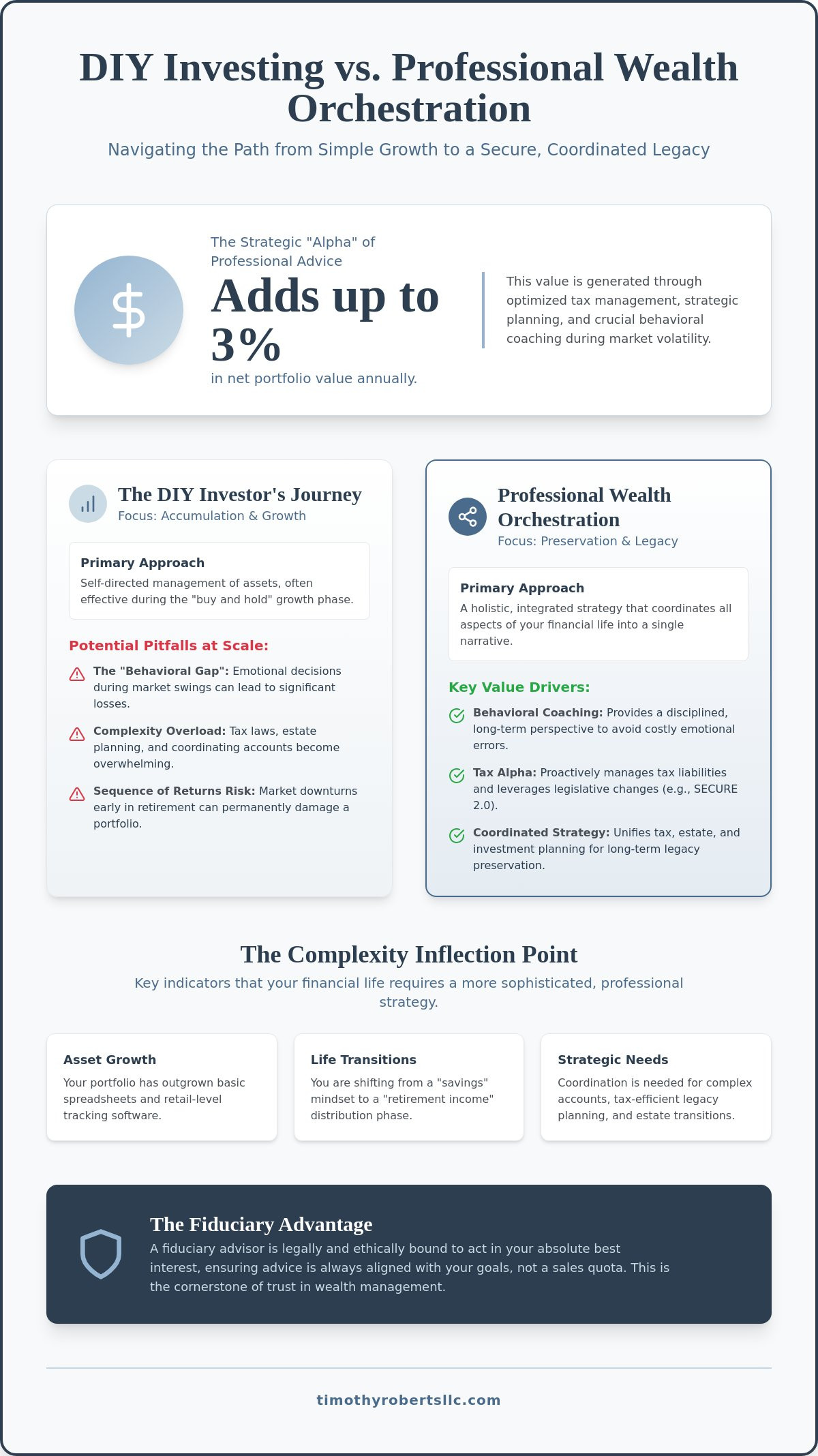
Did you know that the strategic “Alpha” of professional advice can potentially add 3% in net value to your portfolio annually through optimized tax management and behavioral coaching? While the sophisticated digital tools available in 2026 make it easier than ever to monitor your accounts, the gap between basic asset tracking and true wealth orchestration has never been wider. You likely value the autonomy of managing your own trades and take pride in the diligence that built your current holdings. It’s natural to feel protective of your progress and skeptical of fees that might erode your hard earned gains.
This analysis explores the critical choice between DIY financial planning vs hiring a professional to ensure your strategy matches the complexity of your life. We will examine how to navigate the 2026 tax brackets, coordinate intricate estate transitions, and determine if your current path truly secures a sustainable retirement income stream. You will discover the strategic differences between managing your own wealth and partnering with a fiduciary advisor to preserve your long term legacy. We provide a steady, logical framework to help you move from a high level vision to the practicalities of execution with calm confidence and aspirational growth.
Key Takeaways
- Recognize the transition from simple wealth accumulation to a sophisticated orchestration of assets that secures your long-term legacy.
- Quantify the “Value of Advice” by understanding how behavioral coaching and strategic tax-alpha protect your returns during periods of market volatility.
- Navigate the decision of DIY financial planning vs hiring a professional by evaluating specific indicators that your financial complexity has exceeded a self-directed approach.
- Distinguish the fiduciary standard from generic financial services to ensure your advisor is legally and ethically bound to act in your absolute best interest.
- Discover how a coordinated strategy for tax and estate planning transforms disparate accounts into a unified narrative of shared success and upward progression.
The Evolution of Financial Planning: From DIY Growth to Professional Strategy
DIY financial planning is the self-directed management of assets, where individuals take full responsibility for their investment choices and long term goals. During the “Accumulation Phase,” this approach often yields positive results. When you’re focused on building a nest egg, the primary drivers are time, consistent contributions, and broad market exposure. It’s a period defined by growth, where the simplicity of a “buy and hold” strategy can be highly effective for many investors.
To gain perspective on when your portfolio might require a more structured approach, watch this discussion on the timing of professional partnership:
However, most investors eventually reach a “Complexity Inflection Point.” This occurs when your assets outgrow the capabilities of basic spreadsheets or retail level software. Managing a 401(k) with a $24,500 contribution limit is one thing; coordinating that with deferred compensation, tax efficient legacy planning, and a fluctuating market is another. Understanding what a financial planner does helps clarify why a holistic strategy is necessary. Professional oversight integrates tax advising and estate planning into a single, cohesive narrative. The debate over DIY financial planning vs hiring a professional often centers on this transition from simple growth to strategic orchestration.
The Shifting Goalposts of Retirement
The strategy that builds wealth isn’t the same one that sustains it. Growth oriented DIY models often struggle during the decumulation phase because they don’t account for sequence of returns risk. A market downturn early in retirement can permanently damage a portfolio’s longevity if you’re withdrawing funds simultaneously. Shifting from a “savings” mindset to a “retirement income” mindset requires a sophisticated understanding of how to draw down assets without depleting the core.
The Limitations of Financial Software
While modern algorithms are impressive, they’re inherently rigid. Software can’t sense the nuance of family dynamics or the emotional weight of a legacy. DIY projections are also vulnerable to data entry errors that can lead to massive tax miscalculations. With the SECURE 2.0 Act introducing enhanced catch up contributions of $11,250 for those aged 60 to 63 in 2026, a “set it and forget it” approach ignores the legislative shifts that could optimize your wealth management strategy.
The True Cost of DIY: Evaluating Behavioral and Tax-Alpha
The true expense of a self-managed portfolio isn’t found on a brokerage statement. It’s found in the “Behavioral Gap.” This represents the distance between an investment’s potential return and the actual return an investor captures after emotional interference. While the choice between DIY financial planning vs hiring a professional is often framed around management fees, the real cost is often the Alpha left on the table. Professional intervention seeks to reclaim this value through the meticulous orchestration of every moving part, ensuring that your capital works as hard as you do.
Research from Vanguard suggests that a qualified advisor can add approximately 3% in net value annually through services like tax management and behavioral coaching. This isn’t about picking the next hot stock. It’s about the disciplined application of a proven process. When you manage your own wealth, you’re not just the investor; you’re also the person who has to stay calm when the market drops 10% in a week. That’s a heavy emotional burden that often leads to expensive errors.
The Behavioral Coach Advantage
Behavioral Alpha is the quantified benefit of avoiding emotional investment errors. Maintaining a long term perspective requires more than just willpower. It requires a structured process. A fiduciary advisor acts as a strategic buffer between you and the market’s noise. During market corrections, the natural instinct is to preserve capital by exiting the market. However, this often leads to missing the inevitable recovery. By enforcing a disciplined rebalancing schedule, an advisor ensures you sell assets that have appreciated and buy those that are undervalued. This is a progressive approach that turns volatility into an opportunity for growth rather than a source of anxiety.
Strategic Tax Coordination
Effective wealth management requires a shift from simple tax preparation to strategic tax advising. Most DIY investors focus on the current year’s filing. In contrast, a professional focuses on minimizing your total lifetime tax liability. This involves carefully crafted interventions like asset location, where high growth assets are placed in tax-advantaged accounts while income producing assets are strategically positioned elsewhere.
Consider the 2026 tax environment. Married couples filing jointly with incomes over $211,400 face a 24% federal bracket. Without a coordinated withdrawal strategy, you might inadvertently push yourself into a higher tier through poorly timed distributions. A professional advisor coordinates these variables to ensure your income stream is both sustainable and tax efficient. Understanding when to hire a financial professional becomes vital when the complexity of your holdings creates a significant opportunity cost. If you’re ready to move toward a more coordinated strategy, exploring wealth management with a dedicated partner can provide the clarity you need.
The Fiduciary Advantage: Evaluating Specialized Expertise vs. DIY
A fiduciary advisor operates within a legal and ethical framework that mandates putting your interests first. In the current 2026 regulatory environment, where the Department of Labor has restored the 1975 five part test for fiduciary status, the distinction between a salesperson and a true advisor is critical. While a DIY investor might successfully navigate individual stock picks, they often lack access to the institutional grade research and private markets that professional firms leverage to diversify risk and capture unique growth opportunities. These private market interventions, once reserved for the ultra wealthy, are increasingly vital for those seeking to outpace standard benchmarks.
The core difference in the debate of DIY financial planning vs hiring a professional lies in the scope of oversight. A self-directed approach is often a series of isolated decisions. A professional partnership, however, functions as a centralized hub for your entire financial life. Your advisor acts as a “Financial Quarterback,” coordinating with your CPA on tax advising and your attorney on legacy documents. This synthesis ensures that a decision made in your brokerage account doesn’t create an unintended tax liability or an estate planning conflict elsewhere. It’s about moving from a collection of accounts to a unified strategy.
Investment Management vs. Financial Planning
It’s a common misconception that wealth management is purely about picking winners. In reality, professional investment portfolio management is only one element of a much larger architecture. A comprehensive strategy must integrate risk management and insurance analysis to protect against the unforeseen. This level of coordination is especially vital when developing strategic estate planning, where the goal is to transition wealth to the next generation with minimal friction and maximum impact. A DIYer might have a great portfolio but lack the protective shell of a well structured estate plan.
Fiduciary Duty vs. Suitability Standards
The fiduciary standard remains the gold standard because it eliminates the conflicts of interest inherent in commission based models. While some brokers only need to meet a “suitability” standard, a fiduciary must provide advice that is objectively best for your specific situation. This transparency is often reflected in fee structures. With average Assets Under Management (AUM) fees hovering around 0.96% in 2026, the cost is clear and aligned with your success. You can verify an advisor’s regulatory history through public filings to ensure their track record matches their promises. This rigorous vetting is a step many DIYers skip, yet it’s the foundation of a reliable, long term partnership built on intellectual curiosity and professional stability.
Identifying Your Complexity Threshold: When to Transition
The transition from a self-directed approach to a professional partnership rarely happens overnight. It’s usually triggered by a realization that the intellectual curiosity of managing one’s own wealth has been replaced by the weight of administrative burden. This is the complexity threshold. When you’re evaluating DIY financial planning vs hiring a professional, the decision often rests on whether you’re still playing the game or simply managing the equipment. A sophisticated portfolio requires more than just maintenance; it requires a visionary strategist to ensure every component aligns with your long term evolution.
There’s also the “Joy Factor” to consider. Many high net worth individuals build wealth because they enjoy the tactical nature of the markets. However, as you approach the decumulation phase, the stakes change. Retirement should be a period of aspirational growth and shared success, not a full time job auditing spreadsheets and tracking 2026 tax bracket shifts. If the process of DIY management has become a source of anxiety rather than engagement, you’ve likely crossed your threshold. The risk of “what you don’t know” in estate and tax law can lead to expensive errors that far outweigh the cost of professional intervention.
Triggers for Professional Intervention
Specific milestones often demand a more structured corporate capability. If you’re within five years of retirement, the margin for error shrinks significantly. The need for a sustainable income stream requires a level of precision that basic software cannot provide. Other critical triggers include:
- Receiving a significant inheritance or a windfall from a business sale.
- Navigating complex family situations, such as blended families or multi-generational legacy goals.
- Moving into higher tax tiers, such as married couples filing jointly who exceed the $403,550 threshold for the 32% bracket in 2026.
- Coordinating multiple 401(k) and IRA accounts with diverse contribution limits and catch up provisions.
The Audit Approach
For those not yet ready for a full time partnership, a middle ground exists. A one time comprehensive retirement income planning review can serve as a professional “second opinion.” This audit validates your current DIY strategy while identifying potential blind spots in your tax and estate projections. It’s a logical way to develop a roadmap for a phased transition to professional management. If you’re questioning whether your current path is truly optimized for the 2026 landscape, consider a professional wealth management consultation to gain the clarity you deserve.
Partnering for Longevity: The Timothy Roberts & Associates, LLC Approach
True wealth management transcends the simple mechanics of asset allocation. It’s a narrative of partnership and shared success that requires a visionary strategist to navigate. While the debate over DIY financial planning vs hiring a professional often focuses on immediate costs, the long term value lies in the synthesis of your personal creative vision with our structured corporate capabilities. We don’t offer off the shelf solutions. Instead, we provide carefully crafted interventions designed to align your financial architecture with your most ambitious life goals.
Our firm operates at the intersection of aesthetics and functionality. We treat your financial evolution as a journey rather than a series of transactions. This approach ensures that every decision, from tax advising to investment management, serves the broader objective of upward progression. By acting as both an expert craftsman and a reliable business advisor, we help you design a bespoke roadmap that reflects your unique legacy. This level of customization is what distinguishes a specialized firm from larger, more anonymous entities.
A Legacy-First Perspective
Upward progression requires a journey based approach to wealth. In a world increasingly dominated by automated advice and rigid algorithms, the value of personal attention remains the premium standard. We prioritize a legacy first perspective that looks beyond your own retirement to the preservation of multi-generational family wealth. This involves a coordinated strategy for estate and legacy planning that ensures your values are passed down alongside your assets. We focus on building a protective shell around your life’s work through rigorous risk management and insurance analysis, treating development as a lifelong evolution.
Next Steps for Your Strategic Evolution
Choosing to move from a self directed model to a professional partnership is a significant milestone in your financial development. The decision between DIY financial planning vs hiring a professional ultimately comes down to the value you place on your time and the security of your legacy. We invite you to initiate a professional consultation to explore how our specialized expertise can elevate your current strategy. During the initial discovery and alignment phase, we take the time to understand your complex problems rather than rushing to generic conclusions. This deliberate pacing reinforces our commitment to quality and intellectual curiosity. If you’re ready to secure your long term legacy with a dedicated partner, you can schedule a consultation with Timothy Roberts & Associates, LLC to begin your evolution.
Orchestrating Your Financial Evolution
The choice between DIY financial planning vs hiring a professional is the final step in your strategic evolution. While the tools of 2026 offer transparency, they don’t provide the wisdom required to coordinate a multi-generational legacy. You’ve reached a point where the value of your time outpaces the cost of professional guidance. Transitioning to a partnership allows you to focus on the life you’ve built while a dedicated strategist secures the transition from wealth accumulation to a sustainable, lifelong income stream.
With over 25 years of fiduciary expertise, Timothy Roberts & Associates, LLC provides comprehensive wealth and tax preparation solutions that go beyond simple asset management. We design personalized strategies for retirement income planning that prioritize your long term stability and aspirational growth. Elevate your wealth strategy with a professional consultation and secure your future with calm confidence. It’s time to transform your financial vision into a lasting legacy of shared success and upward progression.
Strategic Insights: Frequently Asked Questions
Is it worth paying a 1% fee for a financial advisor?
Paying a 1% fee is often justified when the advisor delivers strategic value that outpaces the direct cost of management. This value frequently manifests as professional intervention that prevents emotional selling during market volatility and optimizes your total net return. While the fee represents a clear expense, the hidden cost of unoptimized tax strategies and missed market opportunities can be significantly higher for those without professional oversight.
What is the biggest risk of DIY financial planning?
The most significant risk is the “Coordination Gap,” where isolated financial decisions lead to unintended tax or estate consequences. Without a centralized strategist, a DIY investor might miss critical legislative shifts or fail to align their asset location with their long term legacy goals. These uncoordinated actions often result in higher lifetime tax liabilities and increased exposure to market volatility during the sensitive transition into retirement.
Can I hire a financial advisor for a one-time plan?
You can certainly engage an advisor for a one-time comprehensive plan, which serves as a strategic roadmap for your future. This approach is ideal for those who prefer to execute the daily management themselves but want a professional “second opinion” on their financial trajectory. A standalone plan provides clarity on estate coordination and tax efficient withdrawal strategies without the requirement for ongoing asset management or portfolio oversight.
How do I know if I have enough money to hire a professional planner?
Complexity is a more reliable indicator than a specific net worth when deciding to hire a professional. If you’re coordinating multiple retirement accounts, navigating high tax brackets, or managing a business sale, you likely have the complexity that warrants professional intervention. When the potential for tax savings and risk mitigation exceeds the cost of advice, the investment in a professional planner pays for itself through enhanced security.
What is the difference between a financial planner and a wealth manager?
A financial planner focuses on the roadmap of goals and savings, while a wealth manager orchestrates a comprehensive ecosystem including investments, taxes, and estate strategy. Wealth management is a more holistic approach designed for individuals with intricate needs that go beyond basic retirement projections. This model synthesizes individual creative vision with structured corporate capabilities to ensure every moving part of a legacy is perfectly aligned and protected.
Does DIY financial planning save money in the long run?
While DIY financial planning saves on management fees, it often results in higher long term costs due to unoptimized tax strategies and emotional investment errors. The debate of DIY financial planning vs hiring a professional hinges on the value of your time and the cost of “what you don’t know.” A professional strategy seeks to maximize net returns after all fees and taxes, which often leads to greater wealth preservation.
What should I look for in a fiduciary financial advisor?
You should prioritize a “fee-only” advisor who adheres to the fiduciary standard, ensuring they are legally bound to act in your best interest. Transparency in compensation models and a history of specialized expertise are essential markers of a reliable partner. Verify their regulatory history and ensure their investment philosophy aligns with your goals for upward progression and multi-generational wealth preservation through a disciplined, journey based approach.
Can a financial advisor help with my taxes and estate planning?
A comprehensive advisor is essential for coordinating tax advising and estate planning into a unified narrative of success. While they don’t replace the need for specialized legal drafting, they serve as the “Financial Quarterback” who ensures your investment choices don’t conflict with your legacy goals. This level of DIY financial planning vs hiring a professional oversight prevents the fragmented decision making that often leads to excessive tax liabilities and estate friction.
