

Jul
Wealth Preservation Strategies in Michigan: A Strategic Guide for 2026
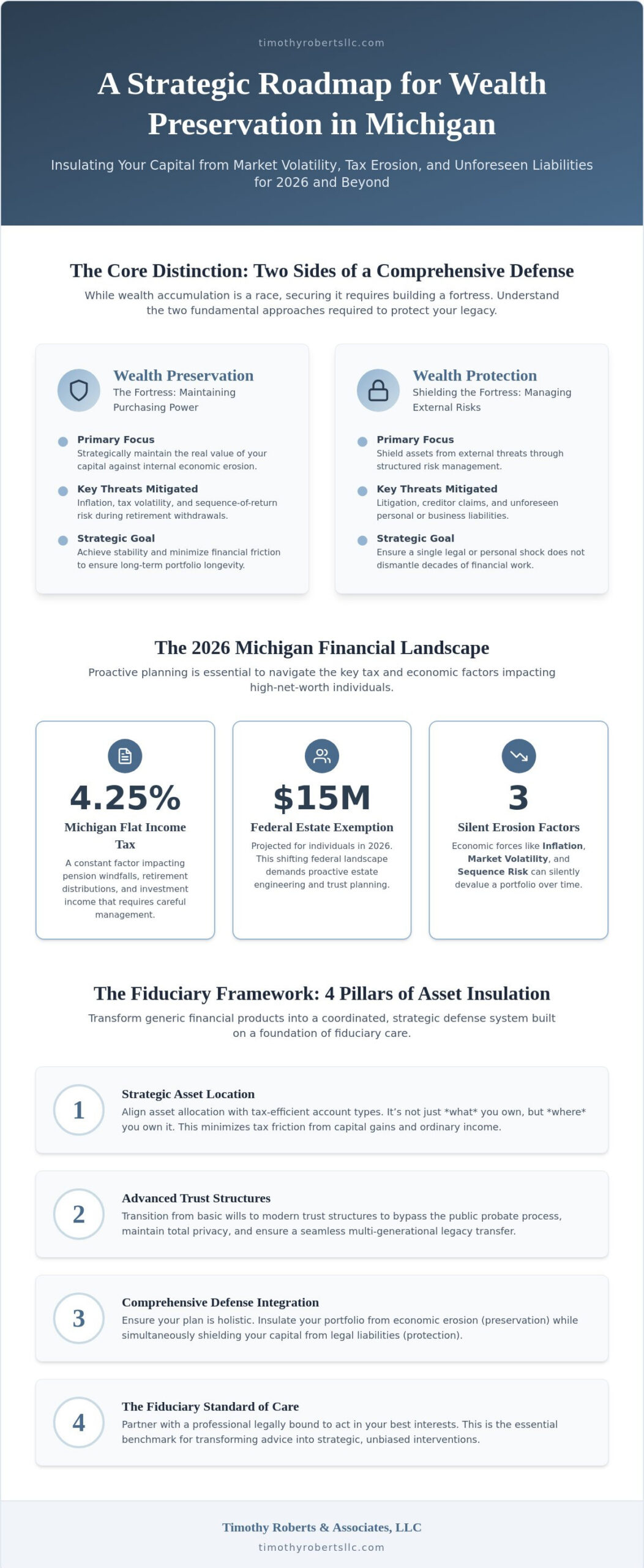
What if the greatest threat to your legacy isn’t a sudden market downturn, but the silent, compounding erosion of purchasing power and tax inefficiency? You’ve spent decades meticulously building a portfolio; yet, the transition into retirement often introduces complexities that can dismantle even the most robust financial foundations. It’s natural to feel a sense of unease as you face Michigan’s 4.25% flat income tax and the shifting landscape of federal estate exemptions, which sit at $15 million for individuals in 2026. Implementing sophisticated wealth preservation strategies michigan residents can trust is no longer optional for those seeking true financial sovereignty.
We’ll show you how to insulate your capital from market volatility, tax erosion, and unforeseen liabilities through a refined fiduciary framework. This guide provides a strategic roadmap for 2026, detailing how to shield your assets from legal shocks while securing a legacy that remains intact across generations. From optimizing your retirement income to leveraging Michigan’s modern trust laws, we’ll explore the path toward tax-efficient growth and permanent protection.
Key Takeaways
- Distinguish between insulating your portfolio from economic erosion and shielding your capital from legal liabilities to ensure a comprehensive defense.
- Implement sophisticated wealth preservation strategies michigan professionals use to align asset allocation with tax-efficient location, reducing long-term financial friction.
- Navigate the 2026 Michigan tax landscape by proactively managing pension windfalls and minimizing state-level liabilities on high-net-worth distributions.
- Transition from basic wills to advanced trust structures that bypass the probate process while maintaining total privacy for your multi-generational legacy.
- Identify why a fiduciary standard of care is the essential benchmark for transforming generic financial products into carefully crafted, strategic interventions.
Defining Wealth Preservation vs. Wealth Protection
Wealth accumulation is a race; wealth preservation is a fortress. The two stages of financial development require fundamentally different psychological and technical approaches. While accumulation thrives on risk and market capture, preservation demands a focus on stability and the mitigation of friction. Wealth preservation is the strategic maintenance of real purchasing power against inflation and tax volatility. For high-net-worth families, the most effective wealth preservation strategies michigan offers are those that treat capital as a living legacy rather than just a balance sheet.
This evolution requires a sophisticated partner. A fiduciary standard of care ensures that every decision aligns with your best interests, moving away from the transaction-heavy models of traditional brokerage. Professional Wealth management is not an off-the-shelf solution. It is a carefully crafted intervention designed to bridge the gap between your personal vision and complex corporate capabilities. A visionary strategist understands that as your net worth increases, the complexity of maintaining it grows exponentially. They guide you through the shift from a growth-focused mindset to a legacy-focused one, ensuring your capital remains resilient against both economic and legal pressures.
To better understand the foundational principles of this transition, watch this helpful video:
The Erosion Factors: Inflation, Volatility, and Taxes
Economic stability is rarely a steady state. Inflation and tax volatility act as silent friction, potentially devaluing a portfolio by significant margins over a single decade. For those entering retirement in 2026, sequence-of-return risk poses a distinct threat. A market downturn in the early years of withdrawals can permanently impair the longevity of a portfolio, even if the market eventually recovers. Relying on a static investment strategy is a significant vulnerability. It ignores the reality that market conditions and tax codes, such as Michigan’s 4.25% flat tax, are constantly in flux. Effective wealth preservation strategies michigan residents utilize must account for these hidden economic factors to prevent the slow decay of their purchasing power.
Wealth Protection: Shielding the Fortress
Protection focuses on the external. It is the practice of shielding your fortress from litigation, creditor claims, or unforeseen liabilities. This isn’t about hiding assets; it’s about structured risk management and insurance analysis. High-net-worth individuals often face unique exposure that standard policies cannot address. You require bespoke interventions that coordinate your legal structures with your financial goals. This is particularly true for business owners, where firms like 41 Legacy specialize in helping them understand and protect the enterprise value of their companies. By integrating these protections into a comprehensive plan, you ensure that a single legal shock doesn’t unravel decades of disciplined saving. This proactive stance transforms wealth from a target into a protected legacy, providing the calm confidence needed to focus on aspirational growth.
The Pillars of Asset Insulation in Michigan
Auditing your current holdings is the first step toward fortification. This isn’t a surface-level review but a deep-dive into the vulnerabilities of your financial architecture. Consider this framework for a preservation audit:
- Quantify Tax Friction: Identify assets held in accounts that trigger unnecessary capital gains or ordinary income taxes.
- Map Asset Location: Ensure high-growth assets are shielded in tax-deferred vehicles while maintaining accessible liquidity in taxable accounts.
- Stress Test for Sequence Risk: Model how a market downturn in early retirement would impact your long-term purchasing power.
- Validate Beneficiary Designations: Cross-reference all accounts with your current Michigan estate planning tools to ensure privacy and avoid the probate process.
Refining these pillars allows you to move from a defensive posture to one of calm confidence. If you’re ready to evolve your current plan, a strategic review of your financial roadmap can reveal where your insulation may be thinning.
Strategic Diversification Beyond Basic Equities
Resilience is found in variety. In a landscape where traditional equity markets face increasing volatility, incorporating alternative asset classes and sophisticated fixed-income strategies is essential. Our approach to investment portfolio management detroit professionals trust emphasizes the balance between immediate liquidity and multi-generational legacy objectives. By diversifying into non-correlated assets, you reduce the impact of market shocks, ensuring that your core capital remains intact even when specific sectors falter.
Risk Management and Insurance Synthesis
Protection is the cornerstone of any preservation strategy. A comprehensive plan requires a deep-dive insurance analysis to identify gaps in personal or business liability that could leave you exposed to litigation or creditor claims. Permanent life insurance often serves as a multi-functional tool in this context, providing both immediate protection and a tax-efficient vehicle for legacy transfer. Coordinating these risk management tools with your broader financial roadmap ensures that your insurance coverage isn’t just a safety net, but a strategic component of your upward progression.
Navigating the Michigan Tax Landscape: Preservation Strategies
Michigan’s tax environment is often misunderstood as a static landscape. While the 4.25% flat income tax provides a baseline of predictability, the true complexity lies in the shifting thresholds for retirement deductions and the nuances of city-level levies. For the 2026 tax year, eligible retirees can deduct up to $67,610 of qualifying pension income for single filers, or $135,220 for married couples filing jointly. Navigating these limits requires more than just compliance; it demands a proactive stance. Implementing tax advising in Ann Arbor allows high-net-worth individuals to synchronize their state-level benefits with federal strategies, ensuring that every deduction is maximized to protect the net value of their estate.
Sophisticated investors often look toward specialized vehicles to manage long-term friction. The adoption of Michigan Domestic Asset Protection Trusts has revolutionized how residents shield capital from both legal reach and tax erosion, providing a level of security that aligns with a high-end fiduciary framework. By leveraging these state-specific tools, you can insulate your capital from the volatile shifts of fiscal policy while maintaining a trajectory of aspirational growth. Every wealth preservation strategies michigan professional recommends must account for this intersection of legal protection and tax efficiency.
Tax-Efficient Retirement Income Streams
Generating income in retirement is an exercise in precision. Coordinating Roth conversions with traditional IRA withdrawals allows you to manage your effective tax bracket with surgical accuracy. This level of planning is vital for avoiding the ‘tax torpedo’ effect, where poorly timed distributions trigger higher federal taxes on Social Security benefits, even though Michigan doesn’t tax those benefits at the state level. Year-round tax planning is superior to reactive April filing because it allows for adjustments in real-time as market conditions shift. This steady, logical rhythm ensures your distributions remain optimized for preservation rather than just consumption.
Michigan Pension and Windfall Optimization
Sudden capital influxes, whether from a corporate buyout or a Michigan teacher’s pension windfall, require immediate strategic intervention. A sudden increase in liquidity can lead to significant tax erosion if not managed through a sophisticated fiduciary lens. We focus on insulating these windfalls by placing them within structures that minimize immediate liabilities while preparing for future shifts in state-level fiscal policy. Whether you’re managing a professional windfall or a multi-generational legacy, the goal is to transform a single event into a sustainable, tax-efficient engine for your long-term roadmap. This deliberate pacing reinforces the idea that wealth preservation strategies michigan residents rely on are about depth, not just superficial gains.
Estate Engineering and Multi-Generational Legacy Planning
Legacy is about more than a transfer of title; it’s the preservation of a vision. While a basic will might suffice for simple distributions, high-net-worth families require sophisticated trust structures to ensure their intent survives the complexities of the 2026 legal landscape. Effective estate planning in Farmington Hills focuses on bypassing the public scrutiny of probate while maintaining the utmost privacy for your family affairs. This strategic engineering is the cornerstone of the wealth preservation strategies michigan residents utilize to protect their capital from the friction of administrative delays and unnecessary legal exposure.
Integrating charitable giving serves a dual purpose. It creates a lasting social impact while functioning as a powerful tool for tax mitigation. By utilizing donor-advised funds or charitable remainder trusts, you can reduce your taxable estate while fostering a culture of philanthropy within your family. These interventions ensure your capital serves your values long after the initial accumulation phase is complete.
Trust Coordination and Asset Titling
Legal documents are only as effective as the titling of the assets they’re meant to govern. A common vulnerability in even the most expensive plans is the failure to properly fund the trust. Whether you’re exploring revocable trusts for flexibility or irrevocable structures for permanent asset insulation, the technical precision of asset titling is paramount. A fiduciary plays a vital role here, coordinating with your legal professionals to ensure that every account, deed, and beneficiary designation is aligned with your overarching wealth preservation strategies michigan plan.
Legacy Engineering: Preparing the Next Generation
True wealth isn’t just financial capital; it’s the human and intellectual capital of your heirs. Communicating your values without creating a sense of dependency is a delicate balance. We emphasize the use of education funding strategies in Michigan to secure the family’s intellectual foundation, ensuring that the next generation is prepared for the responsibilities of stewardship. Establishing a family mission statement can guide future financial decisions, transforming a simple inheritance into a purposeful, multi-generational legacy.
If you’re ready to architect a plan that transcends generations, our specialists can help you refine your Estate & Legacy Planning framework today.
The Fiduciary Advantage: Partnering for Wealth Elevation
Choosing a partner for your financial journey is a critical pivot point. A fiduciary standard of care isn’t just a legal requirement; it’s the only logical framework for high-level wealth preservation. Unlike transaction-based models that prioritize product sales, a fiduciary relationship centers entirely on your best interest. This distinction becomes vital when deploying wealth preservation strategies michigan families rely on to navigate the complexities of 2026. You aren’t seeking a broker. You’re seeking a visionary strategist who understands that your legacy is a living entity requiring constant, expert stewardship.
At Timothy Roberts & Associates, LLC, we synthesize your personal creative vision with our structured corporate capabilities. This approach transforms the traditional client-advisor dynamic into a long-term strategic partnership. We don’t offer off-the-shelf solutions. Instead, we craft carefully designed interventions that reflect your unique risk tolerance and aspirational goals. By moving away from generic financial products, we ensure your capital is positioned for upward progression rather than simple maintenance. It’s a blend of creative passion and business-minded rigor that inspires trust through every stage of your financial evolution.
Customization vs. Commoditization
Generic investment advice often fails high-net-worth individuals during periods of economic friction. When market volatility or tax shifts occur, “one-size-fits-all” models lack the agility to protect your purchasing power. The value of a financial advisor in Bloomfield Hills lies in their ability to act as an expert craftsman of your financial roadmap. Our firm guides you from a high-level vision down to the practicalities of execution, ensuring that every tactical move supports your overarching legacy. We prioritize depth over superficiality, treating your development as a journey rather than a series of transactions. This steady, logical rhythm avoids a cluttered feel, opting instead for a deliberate flow that mirrors a professional consultancy.
Taking the Next Step in Your Financial Evolution
Identifying the red flags in your current plan is the first step toward true insulation. Are your assets improperly titled? Is your tax strategy reactive rather than proactive? A comprehensive wealth strategy review provides the clarity needed to address these vulnerabilities before they become liabilities. During this process, we analyze your current holdings through a fiduciary lens to ensure every component of your plan is optimized for the 2026 landscape. We look for gaps in risk management and opportunities for tax-efficient income streams that others might overlook.
The transition to sophisticated capital management begins with a single, intentional conversation. Schedule a consultation with Timothy Roberts & Associates, LLC to begin your wealth elevation journey and secure the legacy you’ve worked decades to build. Our team is ready to provide the personal attention and high-level expertise required to solve your most complex financial problems.
Securing the Next Chapter of Your Financial Legacy
The transition from wealth accumulation to enduring preservation is a journey of refinement. It requires moving beyond broad market exposure toward a fortress of asset insulation and sophisticated estate engineering. By synchronizing your retirement income with Michigan’s specific tax landscape and leveraging robust trust structures, you ensure your capital remains a source of strength for generations. Mastering these wealth preservation strategies michigan residents utilize is about more than just numbers; it’s about the intentional stewardship of your life’s work.
True elevation requires a partner who shares your vision for excellence. With over 25 years of fiduciary expertise, our firm specializes in sophisticated, tax-integrated wealth management that addresses the unique needs of Michigan professionals and families. We invite you to move from a defensive posture to one of calm confidence. Secure your legacy with a strategic wealth preservation review from Timothy Roberts & Associates, LLC. Your future is not a transaction; it’s a legacy waiting to be protected.
Frequently Asked Questions
What is the difference between wealth preservation and wealth protection?
Wealth preservation focuses on the internal economic health of your portfolio by maintaining real purchasing power against inflation and tax erosion. Wealth protection focuses on the external legal safety of your capital, utilizing structures to shield assets from litigation or creditor claims. Both are essential components of a robust fiduciary framework designed to ensure your legacy remains resilient against diverse threats.
How do Michigan tax laws affect my wealth preservation strategy in 2026?
Michigan’s 4.25% flat income tax and specific retirement deductions significantly influence the net value of your distributions. In 2026, eligible retirees can deduct up to $67,610 for single filers or $135,220 for married couples from qualifying pension income. These state-level nuances, combined with federal estate exemptions, make sophisticated wealth preservation strategies michigan residents trust vital for minimizing long-term financial friction.
Is a fiduciary advisor necessary for wealth preservation?
A fiduciary advisor is essential because they are legally bound to act in your best interest, ensuring total alignment between your legacy goals and their strategic recommendations. This standard of care moves away from transaction-based models toward a partnership of shared success. It’s the only logical choice for implementing the complex wealth preservation strategies michigan families need to navigate volatile markets and evolving fiscal policies.
Can I preserve my wealth while still generating retirement income?
You can generate sustainable income while preserving principal by implementing a sophisticated asset location strategy that minimizes tax friction. This involves placing income-generating assets in tax-advantaged accounts while keeping growth-oriented assets in taxable ones. By precisely coordinating Roth conversions and traditional withdrawals, you create a tax-efficient income stream that supports your lifestyle without compromising the multi-generational integrity of your capital.
What are the best asset classes for capital preservation in a volatile market?
Capital preservation relies on a blend of non-correlated asset classes and high-quality fixed-income strategies that provide stability when equity markets falter. Alternatives like private credit or strategic real estate holdings often offer resilience against market shocks. Additionally, permanent life insurance can function as a multi-purpose tool for both protection and liquidity, serving as a carefully crafted intervention within a broader financial roadmap.
How can I protect my Michigan estate from the probate process?
Utilizing a trust is the most effective method to shield your estate from the public and often lengthy probate process. Ensuring correct asset titling and maintaining updated beneficiary designations allows your capital to transfer directly to heirs according to your intent. This strategic engineering maintains total family privacy and avoids the administrative delays and legal costs associated with settling an estate through the court system.
What is the impact of inflation on a long-term preservation plan?
Inflation acts as a silent tax that compounding devalues your real purchasing power over several decades. A preservation plan that is too conservative may fail to keep pace with rising costs, leading to a slow erosion of your standard of living. Effective strategies must balance capital safety with enough growth-oriented exposure to ensure your legacy maintains its functional value and sustains your family’s future needs.
How often should I review my wealth preservation strategy?
You should review your strategy at least annually or whenever a significant life event or regulatory change occurs. The shifting landscape of 2026 tax laws and federal estate exemptions demonstrates why a static plan is a significant vulnerability. Regular reviews allow for proactive rebalancing and continuous risk monitoring, ensuring your financial roadmap remains aligned with your vision for aspirational growth and legacy integrity.
