

Jul
Inheritance Tax Rules in Michigan: A Strategic Guide for 2026
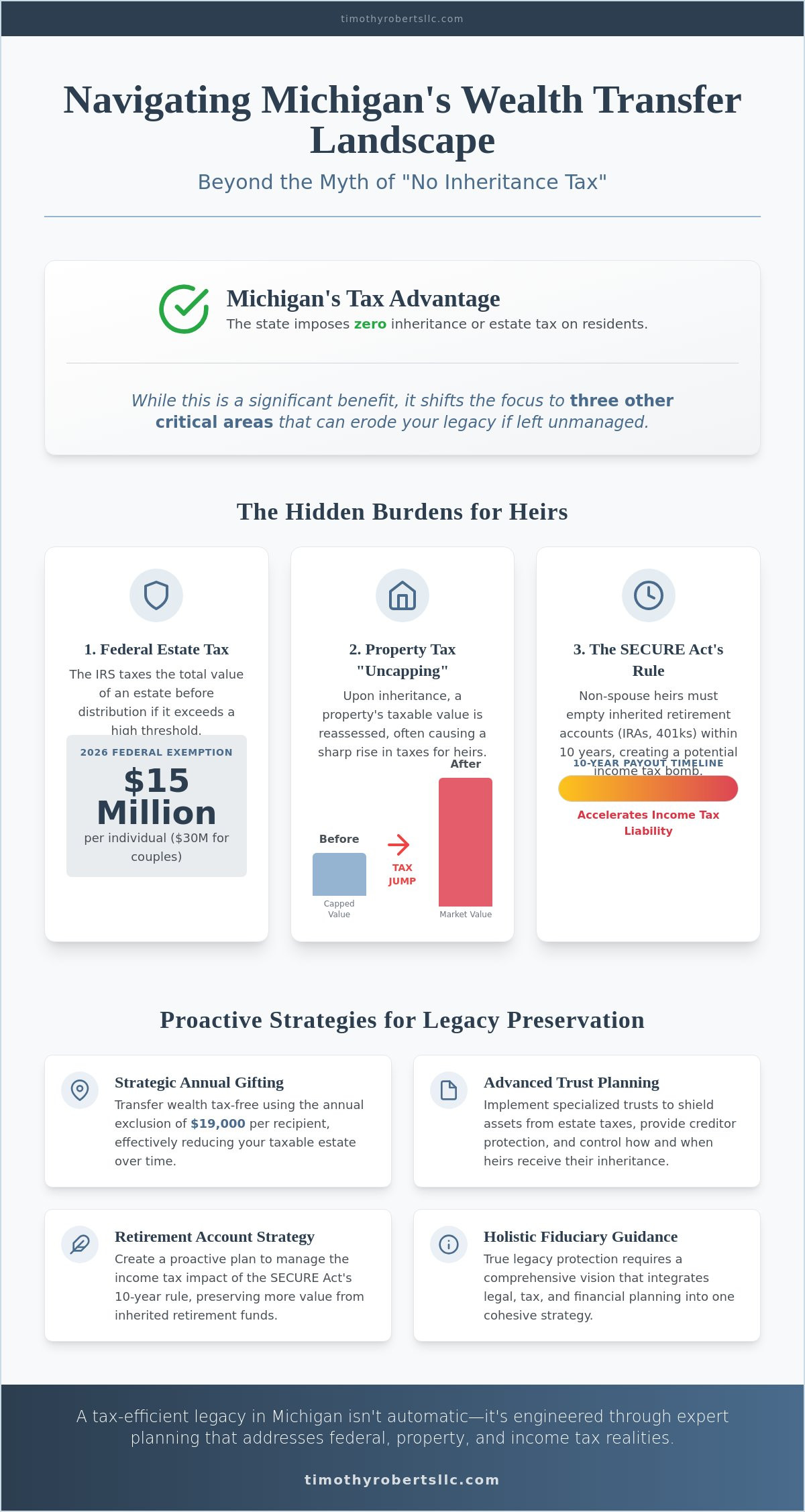
Michigan’s lack of a formal inheritance tax is a strategic distraction that often leaves high-net-worth families vulnerable to far more aggressive fiscal pressures. While it’s true the state doesn’t levy a traditional death tax, the actual inheritance tax rules michigan families must navigate are defined by federal shifts and local property reassessments. You likely recognize that true wealth preservation requires more than just avoiding a single line item on a tax return. It demands a visionary approach to the $15 million federal exemption and the SECURE Act’s 10-year rule. These regulations aren’t just obstacles; they’re the parameters within which your legacy must be carefully crafted.
The anxiety you may feel regarding the 2026 federal sunset is a rational response to a complex landscape. This guide serves as a sophisticated partner in your estate’s evolution, offering the strategic rigor needed to protect multi-generational prosperity. We will explore how to mitigate federal estate taxes through annual gifting and specialized trusts, manage the “uncapping” of inherited property values, and implement crafted interventions to shield your retirement accounts from unnecessary erosion. This journey from high-level vision to practical execution ensures your legacy remains a source of aspirational growth for the next generation.
Key Takeaways
- Michigan currently imposes no state-level inheritance or estate tax, allowing the focus to shift toward more complex federal and property-based liabilities.
- The federal estate tax exemption stands at $15 million per individual for 2026, offering a stable and permanent framework for high-level legacy planning.
- Understanding the inheritance tax rules michigan property owners face is vital, as the “uncapping” of taxable value can lead to a substantial increase in annual property taxes for heirs.
- The SECURE Act’s 10-year rule requires non-spouse beneficiaries to liquidate inherited retirement accounts, necessitating proactive income tax strategies to preserve account value.
- Strategic gifting, utilizing the $19,000 annual exclusion, remains a powerful tool for transferring wealth while maintaining your estate’s upward progression.
The Current Landscape: Does Michigan Have an Inheritance Tax in 2026?
Michigan remains a sanctuary for those concerned about death taxes at the state level. In 2026, Michigan does not impose an inheritance tax or an estate tax. This policy applies to individuals who passed away after September 30, 1993. For many high-net-worth families, this status provides a sense of relief, but it’s vital to understand the inheritance tax rules michigan follows within the broader context of national and local obligations. Your strategy must account for the fact that a lack of state-level tax doesn’t equate to a total absence of liability.
Distinguishing between these two concepts is essential for strategic clarity. An inheritance tax is typically paid by the heirs on the value of what they receive. Conversely, the Federal Estate Tax is levied against the total value of the deceased person’s assets before anything is distributed. Michigan’s decision to eschew both creates a competitive advantage for retirees, yet it doesn’t eliminate the need for a meticulously crafted plan to address federal mandates and local property reassessments.
To better understand how these different tax types interact with your legacy, watch this helpful overview:
Relying solely on the “no state tax” headline can be a dangerous oversight for families with significant assets. While the state treasury won’t take a direct percentage of your legacy through a death tax, other fiscal pressures often emerge. For example, the Michigan Department of Treasury still requires a final individual income tax return and potentially a fiduciary return for the estate. These filings ensure that any income generated by assets after death is properly accounted for at the state’s flat 4.25% rate. This highlights the importance of integrated tax and wealth management.
The History of Michigan’s Tax Repeal
Michigan’s path to its current status began with the 1993 repeal of its inheritance tax. Before this shift, the state utilized a “pick-up tax,” which was essentially a credit against the federal liability. When federal law changed, this state-level revenue stream vanished. Today, the inheritance tax rules michigan residents follow are governed by Department of Treasury guidelines that focus on final income reporting rather than taxing the transfer of wealth itself. This historical context reinforces the state’s commitment to remaining a hospitable environment for wealth accumulation.
Comparing Michigan to Neighboring States
Michigan’s tax-friendly posture stands in contrast to several other regions that still maintain state-level levies. This distinction makes the state an attractive hub for multi-generational wealth preservation. However, residency status is a critical factor for multi-state families. If you own property in states with active inheritance taxes, your heirs could still face liabilities there. We view this geographical advantage not as a reason for complacency, but as a foundation for more sophisticated legacy planning. Strategic planning must account for these jurisdictional overlaps to ensure that assets held outside of Michigan don’t compromise your overall goals.
For families whose portfolios include residential property in other regions, such as the UK, utilizing specialists like taylorsestate.agency for accurate valuations and sales support is a vital component of managing those jurisdictional complexities and protecting the total value of the estate.
Federal Estate Tax Thresholds and the 2026 Sunset Provisions
While Michigan provides a hospitable environment for wealth accumulation, the federal landscape is where the most significant fiscal interventions occur. Many residents have spent years anticipating a drastic reduction in the federal estate tax exemption, fearing a return to much lower thresholds. However, as of July 2026, the strategic reality has stabilized. The federal estate tax exemption is now established at $15 million per individual and $30 million for married couples. This baseline was made permanent by the One Big Beautiful Bill Act (OBBBA), effectively superseding previous concerns about a sharp decline in the exemption amount. Understanding these inheritance tax rules michigan residents must follow is the first step in moving from reactive avoidance to intentional legacy construction.
Despite this generous exemption, the cost of exceeding the threshold remains steep. The federal government applies a flat 40 percent tax rate to any estate value that surpasses the $15 million limit. This high rate makes sophisticated IRS guidelines on estate taxes a vital component of your broader financial roadmap. To ensure your wealth transfer remains efficient, it’s essential to integrate these federal mandates with your local Michigan strategy. A partnership with a visionary advisor can help you orchestrate a plan that respects both jurisdictional boundaries and your personal creative vision.
Why 2026 Is a Critical Pivot Point for Estates
The transition into 2026 marked a shift from urgent, last-minute tax maneuvers to a more disciplined, long-term approach to wealth progression. The One Big Beautiful Bill Act officially ended the era of “sunset anxiety” by providing a permanent $15 million exemption baseline. This certainty allows affluent families to utilize sophisticated trusts and gifting strategies without the looming fear of a “clawback,” where the IRS might tax gifts made under previously higher limits. For those seeking to optimize their transfer strategies, a focus on Estate & Legacy Planning ensures that your assets are positioned for maximum impact rather than being eroded by avoidable tax triggers.
Step-Up in Basis: A Critical Planning Tool
The “step-up in basis” rule remains one of the most powerful interventions available for capital gains mitigation. When an heir receives an asset upon the owner’s death, the cost basis is “stepped up” to the current market value, potentially eliminating decades of built-up capital gains tax. This rule often makes holding highly appreciated assets until death a more strategic choice than lifetime gifting. While gifting can reduce the size of a taxable estate, it often forces the recipient to inherit the original, lower cost basis. Balancing these inheritance tax rules michigan families navigate requires a meticulous analysis of which assets should be transferred now and which should be preserved for the future.
The “Hidden” Inheritance Tax: Income Liabilities on Retirement Assets
Michigan’s lack of a state death tax is a welcome reprieve, but it often masks a more insidious fiscal threat. While the Michigan Department of Treasury confirms that no inheritance tax is due for deaths after 1993, your heirs may still face a “hidden” tax through their income tax returns. This liability stems from the SECURE Act 2.0, which transformed traditional retirement accounts into deferred tax burdens for the next generation. Understanding the inheritance tax rules michigan families encounter requires looking past the estate tax and focusing on the income tax consequences of inherited wealth.
The SECURE Act 2.0 serves as the primary architect of this new tax landscape. It mandates that most non-spouse beneficiaries of qualified plans, such as 401(k)s and traditional IRAs, must withdraw the entire balance within a strict ten-year window. This compressed timeline often forces heirs to take substantial distributions during their highest-earning years. Consequently, these distributions can push beneficiaries into much higher tax brackets, effectively acting as a steep tax on the inheritance itself. We view these accounts as deferred tax bombs that require careful defusing through integrated tax and estate planning.
The SECURE Act 2.0 and the 10-Year Rule
Certain individuals are classified as Eligible Designated Beneficiaries and remain exempt from this ten-year mandate. This group includes surviving spouses, chronically ill or disabled individuals, and minor children of the account owner. For everyone else, the requirement for annual Required Minimum Distributions (RMDs) within that window can complicate an already stressful transition. Managing the inheritance tax rules michigan heirs must follow requires a deep understanding of how federal income tax interacts with state-level exemptions. The ten-year rule effectively forces a decade of deferred income into a single, high-tax window for your beneficiaries.
Roth Conversions as a Legacy Strategy
Roth conversions represent a sophisticated intervention for those seeking to protect their heirs from this income tax trap. By converting traditional assets into a Roth IRA now, you choose to pay taxes at current rates rather than leaving that burden to your children. This strategy allows you to bequeath a tax-free asset that can continue to grow for a decade after your passing without triggering a massive tax bill for the recipient. Executing these conversions before the 2026 tax rate increases ensures you’re leveraging the most favorable fiscal environment possible for your family’s upward progression.
Strategic Preservation: Techniques for Tax-Efficient Wealth Transfer
Proactive wealth transfer is an exercise in both aesthetics and functionality. While the baseline inheritance tax rules michigan residents face are lenient, high-net-worth families must still address the 40% federal rate on assets exceeding $15 million. Strategic gifting serves as a primary intervention. In 2026, the annual gift tax exclusion has risen to $19,000 per recipient. This allows an individual to transfer significant value to any number of people without exhausting their lifetime exemption. For those with complex estates, sophisticated vehicles like Irrevocable Life Insurance Trusts (ILITs) provide essential liquidity, ensuring that heirs don’t have to sell prized assets to settle tax obligations. Similarly, Grantor Retained Annuity Trusts (GRATs) allow you to shift future appreciation out of your taxable estate, locking in current valuations for the benefit of the next generation. Coordinating these efforts requires a refined approach to estate planning that looks beyond simple document drafting toward true legacy elevation.
The Power of Annual Gifting
Utilizing Trusts for Control and Protection
The distinction between revocable and irrevocable structures is a cornerstone of strategic preservation. While a revocable living trust offers privacy and avoids probate, it doesn’t shield assets from federal estate taxes. In contrast, irrevocable trusts serve as a carefully crafted shield against creditors, divorce, and the 40% federal levy. This level of protection requires ongoing, professional tax advising to ensure the trust’s activities remain compliant with evolving federal and inheritance tax rules michigan families must navigate. We view these structures not as off-the-shelf solutions, but as personalized frameworks for long-term stability.
To begin crafting a personalized strategy that protects your multi-generational wealth, explore our approach to Estate & Legacy Planning.
Securing Your Legacy with Expert Fiduciary Guidance
Understanding the technicalities of inheritance tax rules michigan residents encounter is merely the first step in a much larger journey of wealth evolution. While the lack of a state-level death tax provides a favorable foundation, the complexity of federal mandates and the income tax liabilities of retirement accounts require more than just knowledge. They require a visionary partner who can synthesize these disparate elements into a cohesive, high-level strategy. Moving from a reactive posture to one of intentional growth ensures that your legacy isn’t left to the whims of shifting political winds. It’s about crafting a stable financial roadmap that respects your personal creative vision while utilizing the most sophisticated tools of modern wealth management.
Timothy Roberts & Associates, LLC approaches estate coordination as an expert craftsman would approach a fine intervention. We don’t offer off-the-shelf solutions; instead, we provide integrated Tax Planning Strategies and Wealth Management designed to evolve alongside your family’s needs. With over 25 years of experience, our firm acts as a reliable business advisor, helping you navigate the transition into the 2026 tax landscape with calm confidence. This partnership approach ensures that every facet of your estate, from your investment portfolio to your multi-generational tax exposure, is monitored with meticulous rigor.
The Fiduciary Advantage in Estate Coordination
The fiduciary standard is the cornerstone of the Timothy Roberts & Associates, LLC advisory model. It’s a commitment to acting exclusively in your best interest, a sharp contrast to transactional models that often prioritize product sales over strategic outcomes. In the context of estate management, this means your Investment Portfolio Management is directly linked to your legacy goals. Our asset-based management approach ensures that your portfolios are constantly monitored for estate-linked risks and opportunities. This creates a rhythmic experience where your wealth is not just preserved, but actively positioned for upward progression regardless of market or tax shifts.
Next Steps: Your Strategic Estate Review
Securing long-term financial stability requires a proactive evaluation of your existing plans. A comprehensive financial roadmap review allows us to identify potential vulnerabilities in your current structures, such as outdated trust provisions or unoptimized gifting schedules. Our process moves you from a high-level vision down to the practicalities of execution, ensuring your inheritance tax rules michigan strategy is fully integrated with federal requirements. We invite you to begin this journey of organizational and personal evolution by partnering with a firm that values depth over superficiality. By taking the time to understand your unique objectives, we can solve complex problems and craft a legacy that inspires trust and success for generations to come.
To secure your family’s financial future and begin your personalized legacy review, explore our Estate & Legacy Planning services today.
Orchestrating a Future of Financial Stability
True wealth preservation is a journey of continuous evolution rather than a simple transaction. While the baseline inheritance tax rules michigan residents navigate remain favorable at the state level, your long-term success depends on a sophisticated response to federal mandates and income tax liabilities. You’ve seen how the SECURE Act’s withdrawal requirements and the $15 million federal exemption define the new parameters of legacy planning. These factors aren’t merely obstacles; they’re the structural elements within which your family’s future must be carefully crafted.
Navigating this landscape requires a partner who brings intellectual curiosity and business-minded rigor to the table. Timothy Roberts & Associates provides the fiduciary expertise and integrated tax coordination necessary to move from a high-level vision to the practicalities of execution. With over 25 years of experience, our firm offers the personalized attention and specialized strategies needed to protect your assets from unnecessary erosion. Secure your legacy with a personalized financial strategy from Timothy Roberts & Associates, LLC. Your vision for the future deserves the stability and growth that only a dedicated strategist can provide.
Strategic Insights: Frequently Asked Questions
Does Michigan have an inheritance tax in 2026?
Michigan does not impose an inheritance tax or an estate tax in 2026. This has been the state’s standard policy since the 1993 repeal for all deaths occurring after September 30 of that year. While this makes Michigan a hospitable environment for legacy preservation, residents must still account for federal obligations and local property tax reassessments that can impact the total value of a transfer.
What is the federal estate tax exemption for 2026?
The federal estate tax exemption for 2026 is $15 million per individual and $30 million for married couples filing jointly. This permanent baseline was established by the One Big Beautiful Bill Act (OBBBA), providing a stable framework for high-level estate coordination. Any estate value that exceeds these thresholds is subject to a flat 40 percent federal tax rate, necessitating sophisticated planning for affluent families.
Will I have to pay taxes on an inherited IRA in Michigan?
Yes, you’ll likely owe ordinary income tax on distributions from an inherited traditional IRA. Michigan’s flat income tax rate of 4.25% applies to these distributions, and federal law generally requires most non-spouse beneficiaries to withdraw all funds within ten years. Understanding the inheritance tax rules michigan heirs must navigate is essential for avoiding a sudden tax bracket “bump” during those mandatory withdrawal years.
What is the difference between inheritance tax and estate tax?
The primary distinction lies in who is responsible for the fiscal liability. An inheritance tax is a levy paid by the beneficiary upon receiving assets, whereas an estate tax is subtracted from the total value of the deceased person’s property before any distribution occurs. Michigan currently utilizes neither, though federal estate taxes remain a critical consideration for estates valued above the $15 million threshold.
How does the 2026 sunset affect my current estate plan?
The 2026 sunset provisions originally associated with the Tax Cuts and Jobs Act were superseded by newer legislation that stabilized federal exemptions at a higher baseline. Instead of preparing for a sharp drop in thresholds, your plan should now focus on the long-term impact of the SECURE Act and the potential “uncapping” of property taxes. This shift allows for a more steady and logical progression in how you approach inheritance tax rules michigan families follow.
Can I give money to my children tax-free in 2026?
You can give up to $19,000 to any number of individuals tax-free in 2026. This annual exclusion allows you to reduce the size of your taxable estate without utilizing any of your $15 million lifetime federal exemption. For married couples, this amount effectively doubles to $38,000 per recipient, serving as a powerful tool for transferring wealth while maintaining your estate’s upward progression.
Does Michigan have a gift tax?
Michigan does not have a state-level gift tax. You can transfer assets during your lifetime without incurring a state tax penalty. However, any gifts exceeding the $19,000 annual federal limit must be reported to the IRS on Form 709 and will count against your lifetime federal exemption of $15 million.
What happens if I inherit property in Michigan?
Inheriting property in Michigan triggers a “reset” of the home’s taxable value, a process known as uncapping. The taxable value will adjust to the State Equalized Value, which is 50% of the property’s current market value, often resulting in a substantial and unexpected increase in annual property tax bills. Careful legacy coordination is necessary to manage this fiscal impact and ensure the home remains affordable for your heirs.
