

Sep
College Savings for Grandparents: 2026 Investment Options
Your legacy isn’t merely a transfer of assets; it’s the intentional orchestration of opportunity for the next generation. While the desire to fund a grandchild’s education is a noble pursuit, it often comes with complex questions about retirement security and the potential for overfunding. You’ve spent decades building your wealth, and you shouldn’t have to choose between your own stability and their academic success. At Timothy Roberts & Associates, LLC, we specialize in helping you achieve both.
We understand that navigating college savings plans for grandparents requires more than just a basic account. It demands a strategic approach that accounts for the 2026 FAFSA changes, which now allow grandparent-owned assets to be deployed without impacting student aid eligibility. You’ll discover how to build a tax-efficient framework that provides both growth and the flexibility to redirect funds if plans change. This guide explores the intersection of education funding and estate planning, ensuring your contribution is a catalyst for their growth rather than a burden on your portfolio. We will examine the latest investment options and tax-advantaged strategies to help you craft a legacy that is as resilient as it is generous.
Key Takeaways
- Discover how to hedge against 2026 tuition inflation by moving beyond basic accounts toward sophisticated investment frameworks that preserve your legacy’s purchasing power.
- Maximize tax-deferred growth through college savings plans for grandparents michigan while navigating the latest FAFSA rules that now favor grandparent-owned assets.
- Evaluate the strategic advantages of Roth IRAs and UTMA accounts to maintain asset flexibility if your grandchild’s educational path shifts.
- Learn to apply the “Oxygen Mask” principle, ensuring your retirement security is never compromised while you fund the next generation’s success.
- Establish a structured roadmap for your legacy through a comprehensive tax and asset location audit tailored to your unique estate plan.
Beyond the Savings Account: A Strategic Framework for Education Funding
In 2026, the financial commitment required for a four-year degree has reached levels that demand more than just passive accumulation. Traditional bank accounts, while providing a sense of security, often fail to keep pace with tuition inflation that routinely outstrips the Consumer Price Index. For families exploring college savings plans for grandparents michigan, the objective has evolved from simple saving to sophisticated wealth orchestration. This transition requires a visionary strategist who understands that education funding is a journey of upward progression; it’s a carefully crafted intervention designed to preserve the purchasing power of your legacy. Utilizing a structured 529 plan as a foundational tool allows you to leverage market growth while maintaining a clear focus on the ultimate goal.
To better understand how ownership structure impacts your strategy and potential aid eligibility, watch this helpful video:
The Opportunity Cost of Unoptimized Strategies
Standard interest rates rarely provide the necessary lift to fund a modern education. When you factor in the “tax drag” on non-qualified investment accounts over an 18-year horizon, the erosion of potential capital becomes stark. Early intervention acts as a powerful catalyst for growth. By utilizing market-based strategies rather than static savings, you allow compounding to perform the heavy lifting. This proactive stance ensures that your contribution remains a significant pillar of your grandchild’s future rather than a depreciating asset. We prioritize depth over superficiality, analyzing how varied asset classes can outpace rising costs without exposing your principal to unnecessary risk.
Education Funding as an Asset Orchestration Maneuver
Strategic education funding isn’t an isolated transaction. It’s an integral component of investment portfolio management. We view these contributions as part of a larger narrative of multi-generational partnership. This approach ensures that your desire to help doesn’t conflict with your own retirement income planning. High-net-worth strategies prioritize asset location and tax-aware distributions, turning a simple gift into a structured corporate-level capability. This alignment protects your lifestyle while securing their academic trajectory. By coordinating college savings plans for grandparents michigan with your broader estate plan, you create a seamless transition of wealth that honors your past while fueling their future.
The 529 Plan: Navigating Michigan’s Premier Education Investment Vehicle
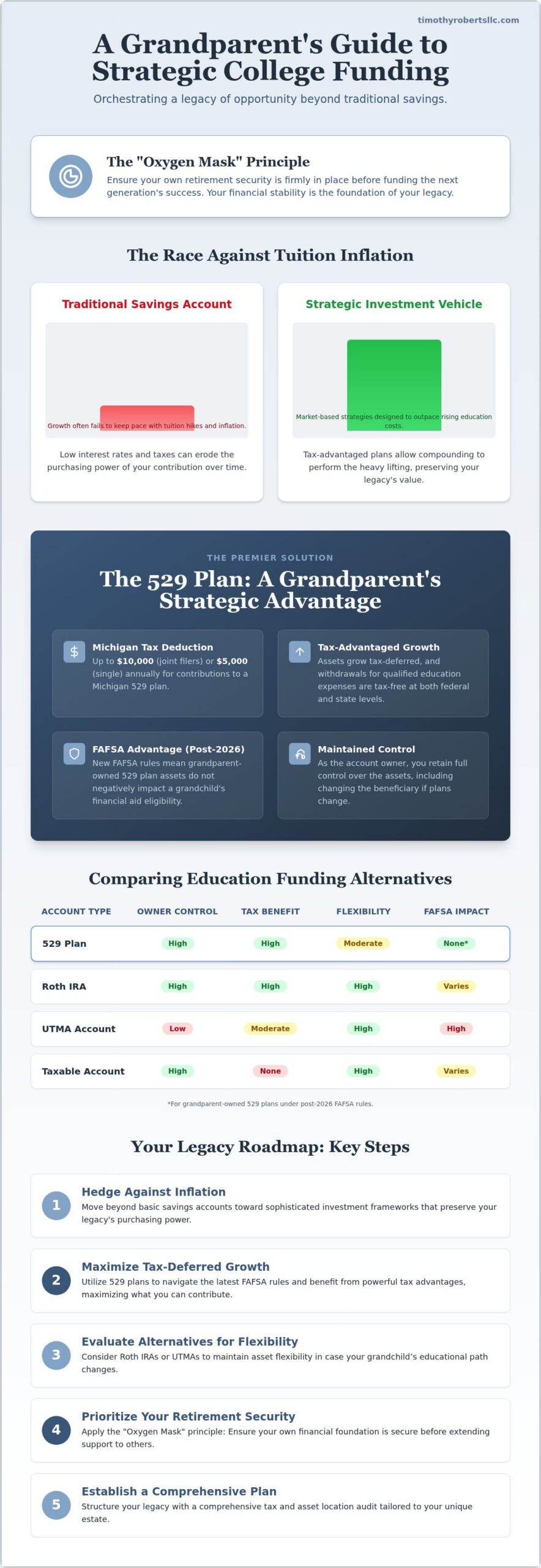
A 529 plan serves as a cornerstone of education tax-efficiency, offering a sophisticated blend of growth and protection. For those evaluating college savings plans for grandparents michigan, these accounts represent a highly intentional way to transfer wealth while maintaining absolute control over the assets. In 2026, the state tax benefits remain a compelling incentive for residents. Michigan taxpayers can deduct up to $5,000 for single filers or $10,000 for those filing jointly for contributions made to Michigan’s 529 Savings Programs. This deduction effectively lowers the net cost of your legacy, allowing more capital to remain within your family’s ecosystem rather than being lost to state taxation.
The primary power of the 529 lies in its tax-deferred growth and tax-free withdrawals for qualified education expenses. This includes tuition, fees, and even up to $20,000 per year for K-12 expenses in 2026. It’s a journey of upward progression where every dollar saved is shielded from the friction of annual taxation, allowing for a more robust accumulation of capital over time.
Mitigating Overfunding Risk with Roth Rollovers
A common fear among grandparents is the possibility of overfunding a plan if a grandchild chooses a different path or receives a full scholarship. The SECURE Act 2.0 has transformed this concern into a strategic opportunity. As of 2026, you can roll over unused funds into the beneficiary’s Roth IRA, provided the account has been open for at least 15 years. This rollover is subject to a $35,000 lifetime limit. This intervention turns leftover education capital into a jumpstart for your grandchild’s retirement, ensuring no contribution goes to waste. It’s a masterful way to pivot assets from one success metric to another without incurring penalties or tax liabilities.
Grandparent Ownership and the FAFSA Advantage
The 2026-27 FAFSA rules have significantly enhanced the appeal of grandparent-owned accounts. Distributions from these plans are no longer reported as student income. This change removes a long-standing barrier, allowing you to deploy funds without diminishing the student’s eligibility for federal aid. Maintaining ownership ensures you retain the power to change beneficiaries or reclaim funds if your own financial situation shifts unexpectedly. By integrating these education funding strategies into your broader plan, you protect your grandchild’s aid potential while securing your own financial boundaries. If you’re looking for a partner to help calibrate these complex variables, our team can help you build a strategy that prioritizes both your legacy and your security.
Sophisticated Alternatives: Roth IRAs, UTMAs, and Taxable Accounts
While 529 plans represent the primary vehicle for many, a truly customized roadmap often incorporates a synthesis of various asset classes. High-net-worth investors frequently look beyond the standard mandates of college savings plans for grandparents michigan to find vehicles that offer a blend of educational support and personal retirement security. This strategic diversification ensures that your legacy isn’t tethered to a single outcome, providing the agility needed to respond to changing family dynamics or market shifts. It’s about moving from simple transactions to a narrative of shared success.
The Roth IRA “Backdoor” for Education
A Roth IRA serves as a powerful dual-purpose intervention. Unlike traditional retirement accounts, you can withdraw your original principal contributions at any time, tax- and penalty-free, to fund a grandchild’s tuition. This provides a safety net; if the funds aren’t needed for education, they remain a robust component of your own tax-free retirement income. However, high-income grandparents must be mindful of contribution limits and the potential impact on their long-term wealth trajectory. Executing this strategy effectively requires meticulous tax advising to avoid unintended consequences and ensure the “backdoor” pathways are navigated with business-minded rigor.
UTMA Accounts and the “Kiddie Tax” Trap
Uniform Transfers to Minors Act (UTMA) accounts offer a different flavor of flexibility, allowing for the transfer of almost any asset class, including real estate or fine art. While this promotes a sense of early wealth evolution for the grandchild, it comes with specific structural risks. In 2026, the “Kiddie Tax” remains a critical consideration, as unearned income over specific thresholds is taxed at the parents’ higher marginal rate. Crucially, unlike the 529 plans we discussed previously, UTMA assets are considered the student’s legal property. This weights them heavily in financial aid calculations, often reducing aid eligibility by 20% of the asset’s value. We view the UTMA as a tool for specific legacy goals rather than a broad-spectrum solution for education funding.
Taxable brokerage accounts represent the ultimate in control and liquidity. While they lack the tax-advantaged status of a college savings plans for grandparents michigan, they offer no restrictions on how the funds are used or when they are accessed. For a donor prioritizing absolute authority over their capital, the “tax-drag” of annual capital gains may be a secondary concern compared to the freedom of redirecting assets at a moment’s notice. In 2026, donors must also consider the annual gift tax exclusion of $19,000 per beneficiary to avoid triggering filing requirements. Balancing these options requires an expert craftsman’s touch to ensure each dollar is deployed for maximum tangible impact.
The Fiduciary Balance: Protecting Retirement While Funding Education
The impulse to provide for a grandchild’s future is powerful, yet it must be tempered with the business-minded rigor of a fiduciary perspective. We often refer to this as the “Oxygen Mask” principle. You must secure your own retirement income before deploying capital toward the next generation’s academic pursuits. A fragmented approach can lead to “lifestyle creep” or, worse, a shortfall in your later years. True wealth evolution requires a steady, logical progression where your security remains the primary anchor of the family’s financial ecosystem.
Integrating college savings plans for grandparents michigan into your broader financial roadmap prevents these goals from competing for the same dollar. By coordinating education funding with investment portfolio management, you ensure that every asset is positioned for maximum efficiency. This high-level thinking allows you to fund a legacy while maintaining the liquidity necessary to support your own standard of living. It’s about depth over superficiality, ensuring that your generosity is sustainable for decades to come.
Managing Multi-Generational Financial Pressure
Grandparents in 2026 often find themselves at the center of a complex financial web, providing support to both adult children and growing grandchildren. This multi-generational pressure demands sophisticated cash-flow modeling. We utilize asset location strategies to identify which accounts should be tapped first, minimizing tax-drag and preserving your core portfolio. Protecting your retirement plan isn’t a sign of hesitation; it’s a strategic intervention that ensures you won’t become a financial burden on the very family you’re trying to help.
Integrating Education into the Master Legacy Plan
Education funding serves as a potent tool for reducing a taxable estate. In 2026, individuals can gift up to $19,000 per beneficiary without incurring federal gift tax. For married couples, this jumps to $38,000. These contributions move assets out of your estate, potentially reducing future tax liabilities while immediately fueling your grandchild’s potential. This is where education planning meets estate planning. We help you synthesize your individual creative vision with structured corporate capabilities, turning a personal gift into a refined wealth transfer strategy. Our team is ready to help you orchestrate this balance through a personalized education funding session designed to protect your retirement while securing their future.
Implementing Your Custom Education Funding Roadmap
Execution is the point where visionary strategy meets tangible impact. Moving from the conceptual desire to help a grandchild toward the actual deployment of capital requires a steady, logical progression. In 2026, this isn’t a matter of opening a simple account; it’s about the meticulous orchestration of your financial resources. This journey begins by defining the legacy vision. Are you preparing for the costs of a public university, a private nonprofit institution, or perhaps an international academic experience? Each path carries a distinct capital requirement that dictates the aggressiveness of your investment framework.
Once the objective is clear, we conduct a comprehensive tax and asset location audit. This analysis identifies which “buckets” of wealth are most efficient to tap, ensuring that your contributions to college savings plans for grandparents michigan don’t trigger unnecessary tax friction. We then select the optimal mix of 529 plans, Roth IRAs, and taxable brokerage vehicles to balance tax-free growth with the liquidity you may need for your own lifestyle. Finally, we establish a disciplined rebalancing and monitoring schedule. As the beneficiary approaches their matriculation date, the strategy must shift from wealth accumulation to capital preservation, protecting the legacy from late-stage market volatility.
Beyond Static Calculators: The Value of Fiduciary Oversight
While many turn to online tools for quick answers, static calculators often fail to capture the nuance of real-world regulatory shifts. A generic algorithm can’t account for the 2026 FAFSA revisions or the specific interaction between your estate plan and your education funding goals. Fiduciary oversight brings a level of intellectual curiosity and business rigor that off-the-shelf solutions simply cannot match. We provide ongoing monitoring in a changing legislative environment, ensuring your roadmap remains resilient even as tax laws and tuition costs evolve. It’s a partnership built on depth rather than superficiality.
Initiating Your Strategic Legacy Partnership
Transitioning from transactional saving to intentional wealth evolution provides a profound sense of clarity. For high-net-worth grandparents, education funding is one of the most effective ways to see the impact of your success during your lifetime. The peace of mind that comes from a coordinated financial plan ensures that your generosity is a catalyst for your family’s upward progression, not a risk to your retirement security. By synthesizing your personal creative vision with our structured corporate capabilities, we create a legacy strategy that is as polished and intentional as the wealth you’ve spent a lifetime building. It’s time to move beyond generic conclusions and start crafting a specialized intervention for your family’s future.
Orchestrating Your Multi-Generational Legacy
Crafting a resilient future for your grandchildren requires a synthesis of visionary ambition and business-minded rigor. We’ve explored how the 2026 landscape offers unprecedented opportunities to deploy capital through sophisticated investment frameworks without compromising student aid eligibility. By moving beyond traditional savings, you transform a simple gift into a structured vehicle for upward progression that honors both your past and their future success.
Securing a legacy of this magnitude shouldn’t come at the expense of your own retirement stability. Our fiduciary-led team brings over 25 years of experience to the table, providing comprehensive tax-integrated wealth management that aligns your generous spirit with your long-term financial security. We specialize in developing custom financial roadmaps tailored to your unique legacy goals, ensuring every dollar is positioned for maximum tangible impact within your estate plan.
If you’re ready to refine your approach to college savings plans for grandparents michigan, we’re here to serve as your strategic partner. Schedule a strategic education funding consultation with Timothy Roberts & Associates, LLC to begin building a partnership rooted in intellectual curiosity and shared success. Your legacy is the foundation for the next generation’s greatest achievements.
Frequently Asked Questions
Can grandparents in Michigan deduct 529 plan contributions from their state taxes in 2026?
Yes, Michigan taxpayers can deduct contributions to the Michigan Education Savings Program (MESP). In 2026, the deduction is limited to $5,000 for single filers and $10,000 for married couples filing jointly. Legislative updates in 2026 also expanded this benefit to include contributions made to out-of-state plans. This deduction effectively reduces your state taxable income, making it a key component of college savings plans for grandparents michigan and your broader tax strategy.
How does a grandparent-owned 529 plan affect a student’s FAFSA eligibility under current rules?
Under the 2026-27 FAFSA rules, distributions from a grandparent-owned 529 plan are no longer reported as student income. This is a significant strategic advantage compared to previous years. These assets are also not considered parent or student assets on the FAFSA. This allows you to provide substantial support without diminishing the student’s eligibility for federal financial aid, though some private colleges using the CSS Profile may still consider these funds.
What is the lifetime limit for rolling over a 529 plan into a Roth IRA in 2026?
The lifetime limit for rolling over 529 plan assets into a beneficiary’s Roth IRA is $35,000 as of 2026. To qualify for this tax-free transfer, the 529 account must have been open for at least 15 years. Additionally, the amount rolled over cannot exceed the annual Roth contribution limit and must consist of funds contributed at least five years prior. This provision serves as a critical safety net against the fear of overfunding.
Is it better to use a Roth IRA or a 529 plan for a grandchild’s college savings?
The optimal choice depends on your specific legacy vision and tax profile. A 529 plan offers higher contribution limits and state tax deductions, which are cornerstone features of college savings plans for grandparents michigan. Conversely, a Roth IRA provides dual-purpose flexibility, allowing funds to remain for your retirement if they aren’t needed for tuition. Most high-net-worth strategies utilize a synthesis of both vehicles to maximize tax-efficiency and liquidity across multiple generations.
What happens to the funds in a 529 plan if the grandchild receives a full scholarship?
If your grandchild receives a scholarship, you can withdraw an equivalent amount from the 529 plan without the typical 10% penalty, though earnings remain subject to income tax. Alternatively, you can change the beneficiary to another family member or utilize the $35,000 Roth IRA rollover provision. This flexibility ensures that your capital remains a productive asset within your family’s master legacy plan rather than being lost to penalties or investment inefficiency.
Can 529 plan funds be used for K-12 private school tuition in Michigan?
Yes, you can use 529 plan assets for qualified K-12 expenses. In 2026, Michigan and federal rules allow for up to $20,000 per year per beneficiary to be withdrawn for tuition at public, private, or religious elementary, middle, or high schools. This allows grandparents to support a grandchild’s academic journey much earlier than the college years, facilitating a continuous path of upward progression and educational excellence through specialized financial interventions.
What are the gift tax implications for grandparents contributing to multiple 529 plans?
In 2026, you can contribute up to $19,000 per beneficiary, or $38,000 for married couples, without triggering federal gift tax. For those looking to accelerate their legacy, “superfunding” allows a lump-sum contribution of up to $95,000, or $190,000 for couples, to be treated as if made over five years. This strategic maneuver removes significant assets from your taxable estate while jumpstarting the account’s market-based growth potential through immediate compounding.
Should I prioritize my own long-term care insurance or my grandchild’s education fund?
Fiduciary logic dictates that your own long-term care and retirement security must remain the primary priority. You can’t borrow for retirement, but your grandchild has access to various funding sources for their education. We recommend a balanced approach that secures your standard of living through risk management and insurance analysis before committing to large-scale education gifting. Protecting your own autonomy is the most responsible way to support your family’s long-term financial stability.
