

Oct
Tax strategies for doctors with multiple income sources
Multiple income streams make tax planning a coordination problem, not a collection of separate deductions. Tax strategies for doctors with multiple income sources work best when W-2 wages, 1099 earnings, practice income, and investment income are considered together. For 2026, the employee contribution limit for 401(k) plans is $24,500, according to the IRS, and limits across employer and self-employed plans can interact.
That complexity is real: compensation may come from employment, consulting, locum tenens work, or a medical practice, while deductions and retirement contributions follow different rules. The goal isn’t to pursue every possible write-off. It’s to coordinate eligible expenses, the structure of each income stream, and savings decisions so that one choice doesn’t undermine another.
This guide explains where professional expenses may fit, how to manage overlapping retirement plans, and what to consider when compensation includes both employee and self-employed income. Regular tax planning can connect these decisions with broader financial priorities instead of treating each income source as a separate filing-season problem.
Key Takeaways
- Separate eligible professional expenses from personal costs, and assess deductions against the income stream they relate to.
- Coordinate employer and self-employed retirement plans before choosing contribution amounts, since limits can interact across plans.
- Track each form of compensation and keep business finances distinct to make tax planning clearer, especially when work spans multiple roles or states.
- Compare Solo 401(k) and Roth strategies with your existing retirement accounts, including how pretax IRA balances may affect a conversion.
1. Deductions for student loan interest and professional expenses
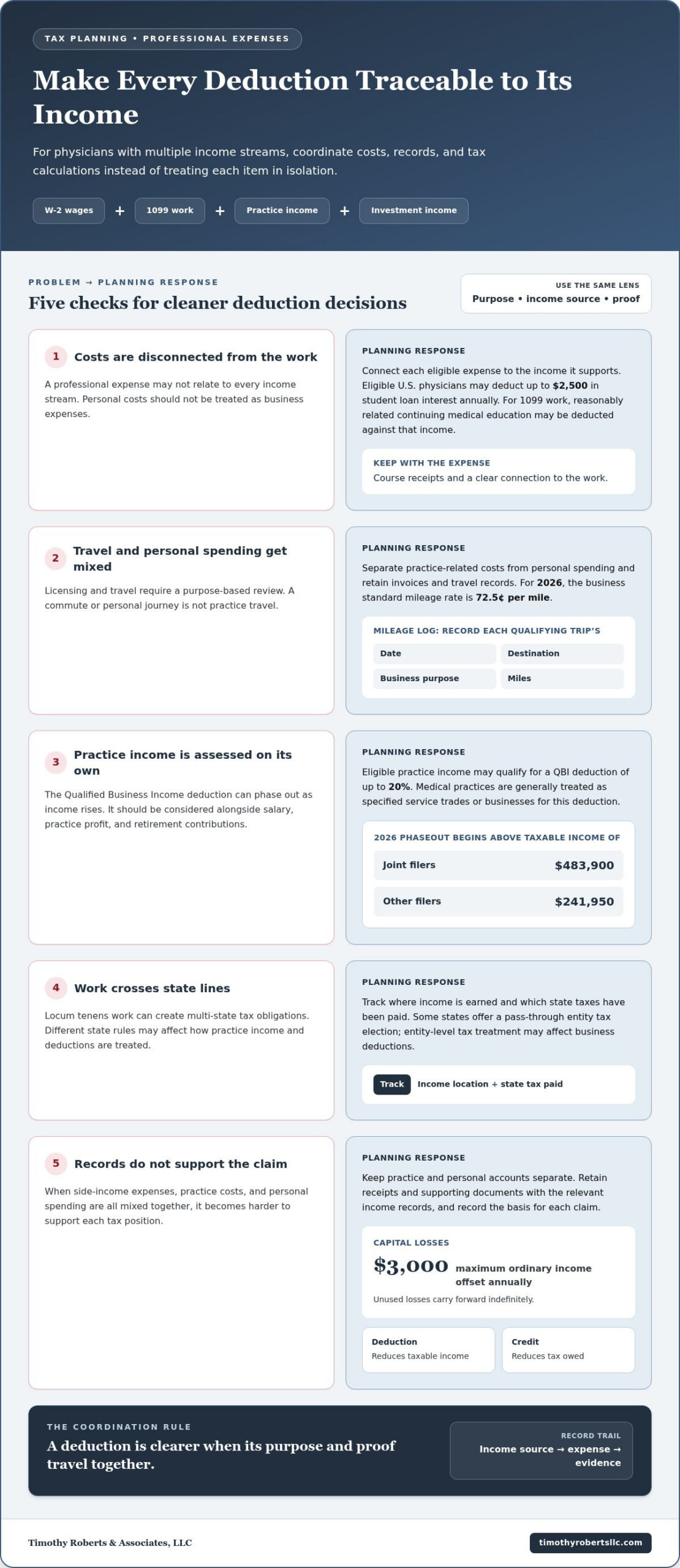
Start with the income stream tied to each cost. Eligible U.S. physicians may deduct up to $2,500 in student loan interest annually. For 1099 work, continuing medical education reasonably connected to that work may be deducted against its income. Keep course receipts and connect each expense to the work it supports.
Licensing and travel need the same purpose-based review. Separate practice-related costs from personal spending, then retain invoices and travel records. For 2026, the business standard mileage rate is 72.5 cents per mile. A mileage log should show the date, destination, business purpose, and miles for each qualifying trip. Don’t treat a commute or personal journey as practice travel.
The Qualified Business Income deduction may reduce taxable income for eligible practice income. Physicians may take a deduction for qualified business income of up to 20%, according to the Internal Revenue Service. Medical practices are generally treated as specified service trades or businesses for this deduction. For 2026, its phaseout begins above taxable income of $483,900 for joint filers and $241,950 for other filers. The deduction can phase out as income rises, so calculate it alongside salary, practice profit, and retirement contributions.
State and local rules matter when a physician works across state lines. Locum tenens work can create multi-state tax obligations, and some states offer a pass-through entity tax election. Track where income is earned and which state taxes have been paid. Entity-level tax treatment may affect business deductions.
For audit-ready records, keep separate accounts for practice and personal spending, plus receipts and support for side-income expenses. The Internal Revenue Service allows capital losses to offset up to $3,000 of ordinary income annually, with unused losses carried forward indefinitely. Distinguish deductions from credits: deductions reduce taxable income, while credits reduce tax owed. Record the basis for each claim and retain supporting documents with the relevant income records.
2. Retirement contributions across employer and self-employed plans
Begin with your workplace plan. For 2026, the employee contribution limit for 401(k) plans is $24,500, according to the Internal Revenue Service. The standard catch-up contribution limit for most participants age 50 and older is $8,000, according to the Internal Revenue Service. Eligible participants ages 60 through 63 may have a catch-up contribution limit of $11,250 if their plan allows it, according to the Internal Revenue Service.
Then map every plan tied to your work. A hospital job may offer a 401(k) or 403(b), while independent clinical or consulting income may support a self-employed plan. Don’t assume each account has a separate full employee contribution limit. Deferrals can interact across employer and self-employed plans, so list current contributions, employer matches, and plan types before setting new amounts.
Coordinate savings with near-term obligations. A physician balancing practice operating costs, student loan payments, and household reserves, for example, may choose a contribution pace that preserves needed cash. Compare the current tax benefit of pretax contributions with the value of keeping savings accessible. A retirement plan should fit the broader financial plan, not displace essential short-term goals.
Backdoor Roth contributions need a separate review. If you hold pretax funds in a traditional IRA, converting a nondeductible contribution may make part of the conversion taxable under the IRS pro-rata rule. Gather IRA statements and review all pretax balances before deciding. Employer-plan features and existing IRA assets can affect whether a Roth conversion fits your tax and retirement goals.
Use a simple coordination process: inventory each account, confirm contributions already made, then assess remaining capacity alongside cash needs and state tax effects. An advisor can help connect plan choices with your broader wealth strategy. For a more integrated view of future income and savings, retirement income planning can help align retirement assets with long-term priorities.
3. Tax planning for medical professionals with complex compensation
Build one income picture before making decisions. Tax strategies for doctors with multiple income sources should account for W-2 wages, 1099 medical or consulting income, and K-1 income from an entity. For 2026, the federal standard deduction is $32,200 for joint filers, $16,100 for single filers and married individuals filing separately, and $24,150 for heads of household. Self-employed physicians may face federal income tax brackets of 32% or higher.
For 1099 income, estimate taxable profit after eligible business expenses, then use that projection to plan estimated payments during the year. Update the estimate as earnings change instead of relying only on an employer’s withholding. With multiple employers, compare combined wages and withholding. Tax strategies for doctors with multiple income sources can include adjusting withholding at one job or setting aside funds for estimated payments.
Self-employment tax can apply to self-employed earnings, while additional Medicare tax may apply to combined wages and self-employment income. The Qualified Business Income deduction may also affect eligible practice income. Assess these items alongside W-2 withholding and entity distributions, so each income stream contributes to one coordinated tax estimate.
Review your plan after acquiring a partnership interest, purchasing a practice, or moving from residency to attending work. With S corporation income, establish a reasonable salary before taking distributions. Locum tenens work across state lines also calls for tracking where income is earned and any related state filing obligations. A career change can affect compensation, taxable income, and investment decisions.
Include student loan forgiveness in the same projection. Most income-driven repayment loan forgiveness becomes taxable beginning in 2026. For example, a $200,000 forgiven balance could result in a federal tax bill exceeding $70,000. Model the potential liability before forgiveness and coordinate reserves with other anticipated income and expenses.
4. Solo 401(k), backdoor Roth, and mega backdoor Roth strategies
For 1099 earnings, a Solo 401(k) can combine employee deferrals with employer profit-sharing contributions. The amount you can contribute depends on your compensation and participation in other workplace plans. Contributions must also fit compensation rules and coordinate with contributions to other workplace plans. Establish the plan before December 31 to contribute for that tax year.
A backdoor Roth IRA involves making a nondeductible traditional IRA contribution, then converting it to a Roth IRA. In one example, a newly attending physician contributes $7,000 before conversion. The key complication is the pro-rata rule: pretax funds in traditional, SEP, or SIMPLE IRAs can make part of the conversion taxable. Review all IRA balances before converting, and account for the tax impact in the plan.
A mega backdoor Roth uses after-tax contributions in an employer retirement plan, followed by a Roth conversion or rollover when the plan permits those features. Its potential benefit depends on plan design, available contribution room, and the timing of the conversion. Read the plan terms alongside existing 401(k) and 403(b) contributions so the structure fits your overall retirement savings.
Physicians with steady practice income may also evaluate a cash balance plan, a defined benefit plan designed around a future retirement benefit. Contributions can be substantial: cash balance plans can allow annual contributions of $150,000 or more. The right structure depends on income consistency, employee eligibility, plan expenses, and the physician’s time horizon. Weigh the larger tax deduction against required funding commitments and available capital.
Before choosing among these options, align plan contributions, IRA balances, and conversion timing in one tax plan. Explore tax planning strategies to coordinate retirement contributions with your broader financial goals.
Timothy Roberts & Associates: Retirement Income Planning
Timothy Roberts & Associates can help physicians connect retirement income decisions with the wider financial picture. When W-2 wages, practice income, and investment assets follow different paths, Retirement Income Planning can help organize how those resources may support future needs.
This planning can be especially relevant when income changes, practice ownership shifts, or retirement approaches. Investment Portfolio Management, Estate & Legacy Planning, and Risk Management & Insurance Analysis can also help address how assets, legacy priorities, and financial risks fit together. The focus is a coordinated plan that reflects your goals and circumstances, rather than treating each decision in isolation.
To discuss your financial planning needs, contact Timothy Roberts & Associates or visit the firm’s website.
Shape Your Next Financial Chapter
The next step is to make financial decisions serve a shared direction, not just the current tax year. A deliberate approach to tax strategies for doctors with multiple income sources can connect today’s choices with future priorities, from greater flexibility at work to the transition into retirement. Revisit your plan as professional responsibilities, family needs, and long-term ambitions evolve.
Use your next planning conversation to clarify what you want your income and assets to make possible. Which goals need attention now? Which decisions should stay flexible as your career develops? Clear answers can help turn complex financial choices into a more intentional path forward.
Timothy Roberts & Associates, LLC can help you consider how tax planning fits into your broader financial direction. Begin a planning conversation and take a considered step toward aligning your financial choices with the future you want to build.
Frequently Asked Questions
What makes physician taxes unique?
Physician taxes can involve several income types and reporting responsibilities at once. A doctor may receive employee wages, contractor payments, partnership income, and investment income, each with different records and withholding arrangements. Locum tenens work can also raise multi-state filing considerations. Start with a consolidated income ledger organized by payer, work location, and payment type, rather than relying on one employer’s tax documents alone.
Why is it important to have a CPA specializing in physicians?
A CPA familiar with physician compensation can help organize questions about employment, practice ownership, contractor work, and investment income. This context can make it easier to identify missing records and coordinate discussions about entity structure, retirement accounts, and state filings. Consider whether the professional’s experience matches your actual income and practice arrangements. A financial plan may also involve fiduciary advisors, who are legally bound to act in clients’ best interests.
How are W-2 physician income and 1099 medical income taxed differently?
W-2 wages are reported by an employer, which generally withholds taxes from paychecks. With 1099 work, the physician tracks business receipts and eligible expenses, then plans for the resulting tax obligations without relying on that employer withholding. For example, a doctor with hospital wages and consulting income should reconcile both streams before estimating total taxable income. Keep separate income records so contractor activity doesn’t disappear inside household spending.
Which business structures can physicians use for side income, and when does an S corporation reduce taxes?
Side income may be reported through an individually owned business, an LLC, or an S corporation election, depending on the circumstances. An S corporation may be worth analyzing when 1099 net income is consistent and potential employment-tax savings outweigh added payroll and administration costs. Around $150,000 in annual 1099 net income is often cited as a break-even point, but state taxes and setup costs affect the calculation.
Can doctors deduct CME, licensing, malpractice insurance, equipment, home office, and travel expenses?
Some expenses may qualify when they’re ordinary to the work, properly documented, and connected to business income. CME reasonably connected to 1099 work may be deducted against that income. Keep invoices and explain the business purpose of equipment, travel, or workspace costs; separate personal use from professional use. Qualifying equipment may have specific expensing or depreciation treatment, so record its purchase date, business use, and connection to practice activity.
How are locum tenens, telemedicine, consulting, speaking, and expert-witness income taxed?
The payer relationship and payment documents help determine how each engagement is reported. Locum tenens, consulting, speaking, and expert-witness work may be paid as employee wages or contractor income; telemedicine arrangements also depend on the specific work and payer relationship. Track each engagement, location, payer, and related expense separately. For locum work across state lines, include work locations in your records because multi-state tax obligations can arise.
This site is published for residents of the United States only. Not all of the products and services referenced on this site may be available in every state and through every advisor listed. The information in this material is not intended as tax or legal advice. Please consult legal or tax professionals for specific information regarding your individual situation. Securities offered through Cetera Financial Specialists LLC (doing insurance business in CA as CFGFS Insurance Agency), member FINRA/SIPC. Advisory services offered through Cetera Investment Advisers LLC. Cetera entities are under separate ownership from any other named entity. The firm’s fiduciary advisors are legally bound to act in clients’ best interests. “Your Interest is Our Only Interest.”
