

Oct
Financial checklist for preparing for a recession in 2026
A recession-ready plan begins with financial resilience, not a prediction about what the economy will do. This financial checklist for preparing for a recession in 2026 starts with a general target of three to six months of living expenses in easily accessible savings, then turns to insurance, investments, and retirement contributions. The aim is to understand what you could draw on, what protection you have, and which decisions still fit your goals.
It’s sensible to want a clear plan when markets or income feel uncertain. This guide shows you how to review liquid savings, assess insurance coverage, consider your investment strategy, and evaluate contributions to workplace retirement plans and IRAs. Each step is designed to help you identify practical adjustments without making major financial moves in response to headlines alone. Use the checklist to organize your next steps and spot where a coordinated view of your finances could help.
Key Takeaways
- Calculate which savings and liquid assets you could access quickly, then identify a practical way to build or replenish your reserve.
- Review insurance coverage and beneficiary designations to see whether they still align with your household’s needs.
- Assess your investment mix against your time horizon and risk tolerance before reacting to market swings.
- Check retirement contributions and account limits so your savings strategy remains aligned with your broader financial goals.
Assess emergency savings and liquid assets
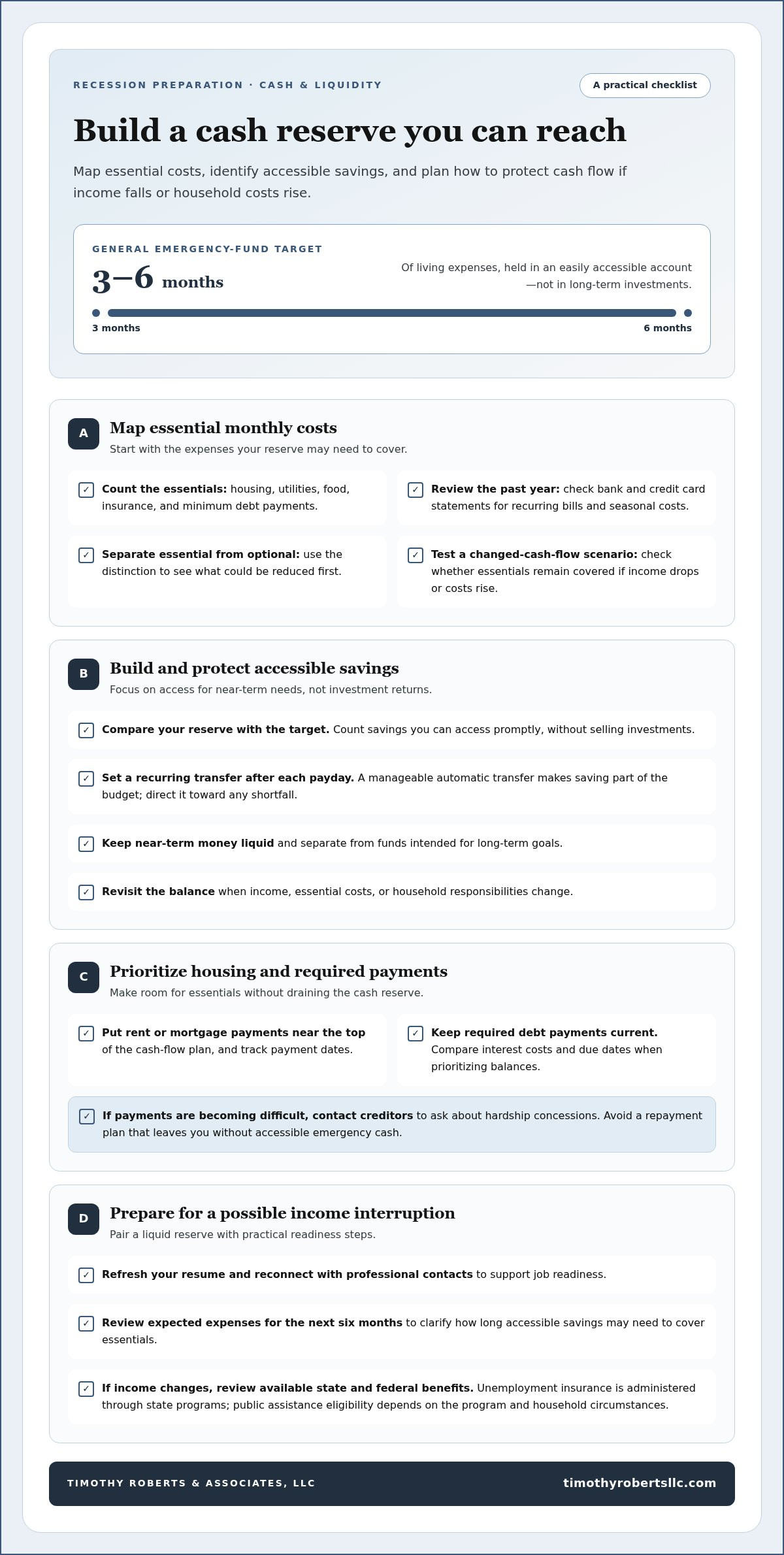
For a financial checklist for preparing for a recession in 2026, start by mapping cash you can access without selling investments. Treat recession risk, inflation, and unemployment as planning scenarios, not fixed outcomes. Test whether essential expenses remain covered if income falls or household costs rise.
A general emergency-fund target is three to six months of living expenses in an easily accessible account. Add up essential monthly costs and compare the total with savings you can access promptly. Include housing, utilities, food, insurance, and minimum debt payments.
Review bank and credit card statements from the past year to find recurring bills and seasonal costs. Separate essential spending from optional purchases, then schedule an automatic savings transfer after each payday. A manageable recurring transfer makes emergency savings a defined part of your budget.
Prioritize housing and keep required debt payments current. If you’re struggling to pay, contact creditors to ask about hardship concessions. Compare interest costs and due dates, but avoid a repayment plan that leaves you without accessible emergency cash. For those exploring structured financing or borrowing options to navigate temporary shortfalls, credit brokers such as I Need Cash can assist in comparing personal and homeowner loan solutions.
Prepare for a possible layoff by refreshing your resume, reconnecting with professional contacts, and reviewing expected expenses for the next six months. These steps support job readiness and help clarify how long liquid savings may need to cover essentials.
If you own a home or have a mortgage, put housing payments near the top of your cash-flow plan. Keeping rent or mortgage payments current can help you avoid foreclosure or eviction. Track payment dates and identify which expenses you could reduce first.
In the U.S., unemployment insurance is administered through state programs, while public assistance eligibility depends on the program and household circumstances. If your income changes, review available state and federal benefits in light of your employment, income, and household needs.
Build your emergency allocation around access, not investment returns. Keep money for near-term spending liquid and separate from long-term investments. Revisit the balance when income, essential costs, or household responsibilities change, and direct automatic transfers toward any shortfall.
Insurance coverage review
Recession risks vary by household. Retirees may rely on portfolio withdrawals, gig workers may face uneven bookings, and small-business owners may wait longer for customer payments. Review income sources, essential expenses, and when invoices and bills are due.
Review each insurance policy against the event it is meant to help cover. Record premiums, deductibles, coverage limits, exclusions, and renewal dates, then compare them with current household responsibilities and income sources. A policy suited to a one-income household, for example, may not fit if the household now depends on two incomes.
Check beneficiary designations on retirement accounts, life insurance, and investment accounts. A marriage, divorce, new child, or changed financial responsibility may make an old designation inconsistent with your current intentions. Employer-provided life insurance may cover only one year of salary, which is rarely enough for a family, so include it in your overall protection review.
For a useful cash-flow review, group expenses into essentials, flexible spending, and debt payments. Compare planned spending with recent account activity, then adjust categories that leave too little room for insurance premiums or savings. Include interest costs when prioritizing balances, and weigh the protection you would lose before reducing coverage.
Holiday spending deserves a separate check. Nearly 40% of shoppers take on debt during the holidays, and indebted shoppers average over $1,000. Set a spending limit before seasonal purchases begin. For a planned want, try a 30-day waiting period; use the pause to assess its impact on cash flow.
Turn financial goals into specific actions with dates: schedule a savings transfer, review a policy at renewal, or reduce a recurring expense. Compare progress with your household priorities, then adjust the plan as income or responsibilities change.
For a coordinated review of coverage and household exposure, consider Risk Management & Insurance Analysis as part of your recession preparation.
Review bank and credit card statements from the past year to assess your budget. Check credit reports for inaccuracies or unfamiliar accounts, and dispute errors with the credit bureau.
Staying invested through market downturns
Before a recession, compare your investments with your time horizon, income needs, and written asset-allocation targets. Keep cash for planned payments and near-term expenses separate from money intended for long-term retirement goals.
Whether to change your allocation or hold more cash depends on when you’ll need the money and how much volatility you can manage. Avoid a major shift based only on recession headlines. Identify the specific cash need or risk the adjustment is intended to address.
Review your 401(k), IRA, and other investments before changing contributions or selling holdings. Check account mix, fees, beneficiaries, and the investment choices available in each plan. A credit card balance or upcoming payment may affect your cash needs, but it doesn’t by itself determine an appropriate portfolio.
Use an investment policy statement to record your target allocation, time horizon, liquidity needs, and rebalancing rules. Note what would prompt a review, such as a change in income, retirement date, or planned withdrawal. This written framework helps distinguish a considered decision from a reaction to daily market moves.
Rebalancing brings a portfolio closer to its target after investments rise or fall by different amounts. Compare your current allocation with your policy, then decide whether trades or future contributions can restore the intended mix. Diversification spreads investments across holdings, but it cannot assure a profit or protect against loss in a declining market. Investments also carry market risk, including possible loss of principal.
Historical figures offer context, not a forecast. From 2006 to 2025, the S&P 500 Index had an annualized total return of 11.0%. A hypothetical investor who moved to cash after a market drop and missed its 10 best-performing days over that period would have had an annualized total return of 6.6%.
Missing just five of the S&P 500’s best market days from January 1, 1988, through December 31, 2025, could have reduced hypothetical long-term gains by roughly 38%. Use that example to weigh timing risk, not to assume future returns will match the past.
401(K), 403(b), and IRA retirement contributions
Review retirement contributions alongside take-home income, near-term expenses, and existing debt payments. For 2026, the employee contribution limit for a 401(k) is $24,500, according to the Internal Revenue Service. For 2026, U.S. IRA savers age 50 or older may make an additional $1,100 catch-up contribution, according to the Internal Revenue Service.
For a 2025 IRA contribution, the stated deadline is April 15, 2026, according to the Internal Revenue Service. Check which tax year your deposit applies to before contributing. This distinction helps keep contributions aligned with your tax strategy and prevents confusion when reviewing account statements.
With a 401(k) or 403(b), check the employer’s matching formula and plan rules. If your budget allows, consider contributing enough to receive the full available match. Then review the contribution amount in each paycheck and adjust it when income or essential expenses change. A match can be a meaningful part of workplace retirement savings.
Build a contribution strategy around your current circumstances, not a target that strains cash flow. If high-interest credit balances compete with retirement contributions, weigh payment obligations, liquidity needs, and long-term priorities. If debt consolidation is part of your relief strategy, loan-matching services like Personal Loans can help you explore competitive borrowing options to lower interest costs. Decide how much can go toward each goal, then revisit the allocation after a significant change in income or expenses.
Set a calendar reminder to review account contributions, beneficiaries, and investment choices during your annual financial check-in. Coordinate retirement decisions with other priorities, such as estate plans and upcoming expenses. A written plan helps you see whether contribution levels still support your intended retirement timeline.
For a tailored review of retirement contribution strategies and income goals, review your retirement planning options.
In the United States, the 2026 IRA contribution limit is $7,500. For 2026, U.S. IRA savers age 50 or older may make an additional $1,100 catch-up contribution, according to the Internal Revenue Service. U.S. 401(k) employee contributions for 2026 must be deducted by Dec. 31, 2026. The 2026 401(k) contribution limit is $32,500 for investors age 50 and older. Participants who turn age 60, 61, 62, or 63 during 2026 have a higher catch-up contribution limit of $11,250; U.S. retirement savers ages 60 through 63 can contribute up to $35,750 to a 401(k) in 2026, including catch-up contributions.
Timothy Roberts & Associates, LLC: Retirement Income Planning
Timothy Roberts & Associates, LLC provides Retirement Income Planning to help align retirement income decisions with investments, insurance, and long-term priorities. Consider this planning when assessing how savings and investment assets may support future withdrawals, especially if a downturn affects your plans or income needs.
Investment Portfolio Management can connect portfolio decisions with your time horizon and financial goals. Risk Management & Insurance Analysis brings coverage into the broader picture, while Estate & Legacy Planning considers how your plans reflect your wishes for the future. Reviewing these decisions together can show how they interact, rather than treating each account or policy in isolation.
If you’d like to discuss how these planning areas fit your circumstances, contact Timothy Roberts & Associates, LLC.
Turn preparation into a plan you can maintain
A financial checklist for preparing for a recession in 2026 is most useful when it becomes part of an ongoing decision-making process. Set a regular time to revisit your priorities, note what has changed, and make deliberate adjustments rather than reacting to each new headline. A written plan can keep near-term choices connected to the future you’re working toward.
Timothy Roberts & Associates, LLC offers Retirement Income Planning, Investment Portfolio Management, and Estate & Legacy Planning. These services can bring income decisions, portfolio strategy, and long-term intentions into a more coordinated view. A conversation can help you evaluate how these priorities fit together as your circumstances evolve.
Contact Timothy Roberts & Associates, LLC to discuss your financial plan. Thoughtful preparation can help you move forward with greater clarity and purpose.
Frequently Asked Questions
Which expenses should I cut to recession-proof a household budget?
Start with discretionary costs that offer little value, such as unused subscriptions, duplicate services, frequent takeout, or impulse purchases. Review recent transactions and mark each expense essential, useful, or optional. Reduce low-value items first, then direct the savings toward priority bills or emergency savings. Avoid cutting insurance or necessary maintenance without weighing the financial risks of losing that protection.
What government benefits and unemployment protections are available in the U.S. during a recession?
Unemployment insurance is administered through state programs. Public assistance eligibility depends on the program and your household circumstances, so review available state and federal benefits in light of your employment, income, and household needs.
