

Jul
Avoiding Emotional Investing Decisions: A Strategic Framework for Long-Term Wealth
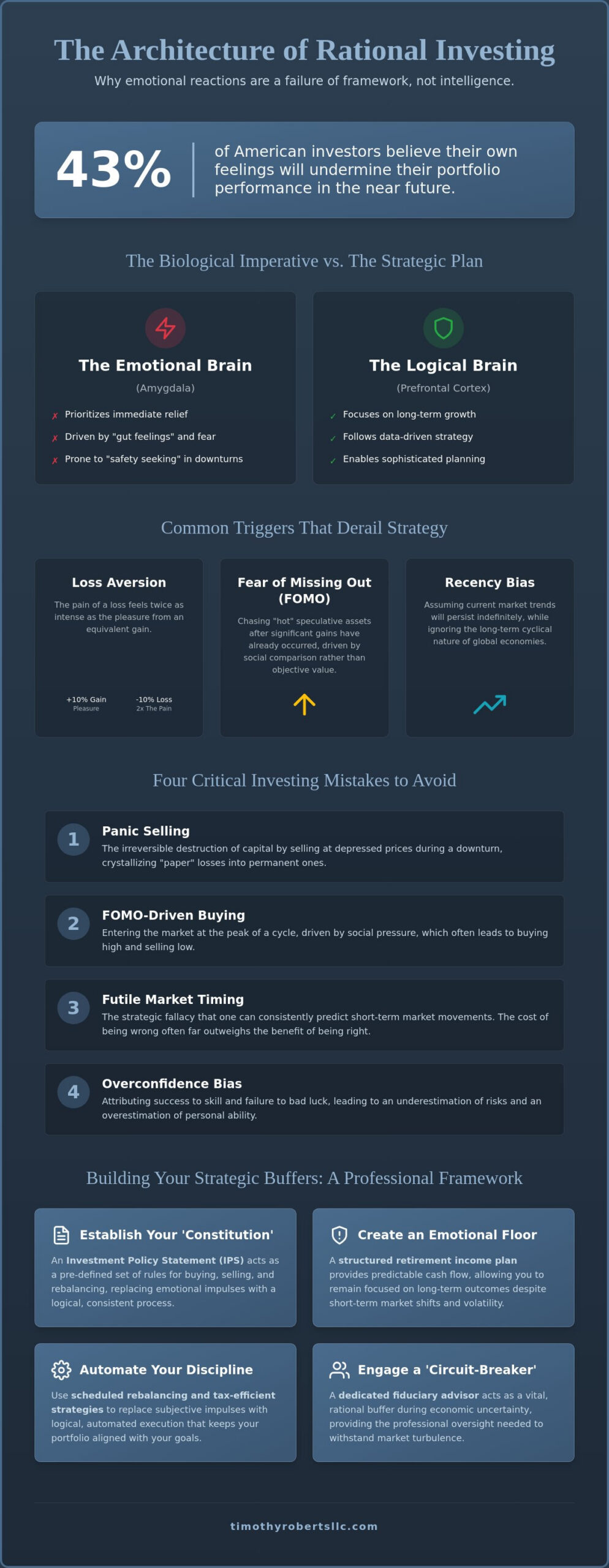
Emotional investing is not a failure of intelligence; it is a failure of architecture. While 43% of American investors believe their feelings will undermine their performance in 2026, the real challenge lies in avoiding emotional investing decisions when the biological impulse to react takes over. It is entirely understandable to feel a sense of paralysis when sticky inflation and shifting Federal Reserve signals dominate the news. You have likely felt the sting of regret after an impulsive sell or the quiet anxiety of doomscrolling through conflicting financial headlines. We recognize these pressures not as personal weaknesses, but as variables that require a sophisticated, strategic response.
This guide provides the blueprint for replacing reactive instinct with a professional-grade framework designed to protect your long-term wealth. By mastering the psychological triggers of the market, you can move toward a state of calm, logical portfolio management. We will examine the specific mechanisms used to shield wealth from impulsive reactions and discuss how a partnership with a dedicated fiduciary provides the rational buffer necessary to withstand modern market turbulence.
Key Takeaways
- Identify the biological triggers—such as loss aversion and FOMO—that lead to reactive choices rather than strategic wealth accumulation.
- Discover a professional-grade framework for avoiding emotional investing decisions by establishing a “constitutional” Investment Policy Statement.
- See how a structured retirement income plan creates an emotional floor, allowing you to remain focused on long-term outcomes despite market shifts.
- Learn to automate discipline through scheduled rebalancing and tax-efficient strategies that replace subjective impulses with logical execution.
- Understand the fiduciary advantage and how a dedicated advisor acts as a vital circuit-breaker during times of economic uncertainty.
The Psychology of Wealth: Why Our Brains Are Wired for Emotional Investing
Emotional investing is the tendency to let visceral reactions dictate financial moves, overriding the cold precision of a data-driven strategy. It’s the primary hurdle for those focused on avoiding emotional investing decisions in a landscape that often feels designed to provoke them. Market volatility is not a malfunction; it is a natural feature that triggers ancient survival instincts in the modern brain, often leading to choices that prioritize immediate relief over long-term growth.
Our biological heritage plays a significant role in how we perceive risk. Humans are naturally susceptible to “Loss Aversion,” a psychological phenomenon where the emotional pain of a 10% market drop feels twice as intense as the satisfaction of a 10% gain. This is frequently compounded by “Recency Bias,” a cognitive trap where investors assume current market trends will persist indefinitely, ignoring the cyclical nature of global economies. Exploring the psychology of emotional investing reveals that these biases are deeply ingrained, requiring a conscious effort to bypass.
To better understand the underlying mechanisms of these behaviors, watch this helpful video:
The Biological Imperative vs. The Strategic Plan
During market corrections, the amygdala, the brain’s fear center, often attempts to override the prefrontal cortex, which handles logical reasoning. This internal conflict explains why “gut feelings” are typically the greatest enemy of sophisticated investment portfolio management. When investors succumb to “Safety Seeking” by exiting the market during a downturn, they frequently miss the most critical days of the subsequent recovery. This reactive behavior doesn’t just lower returns; it fundamentally derails the upward progression of a carefully crafted wealth journey.
Common Triggers of Financial Anxiety
The modern media landscape doesn’t help. The 24-hour news cycle acts as a constant catalyst, amplifying perceived risks and turning minor fluctuations into existential threats. Within high-net-worth circles, the “FOMO” effect can lead to chasing speculative assets after significant gains have already occurred, driven by social comparison rather than objective value. In this context, cognitive dissonance represents the psychological struggle of maintaining a losing investment position to avoid the mental discomfort of acknowledging a strategic error.
Identifying the Five Critical Emotional Investing Mistakes to Avoid
While the biological triggers discussed previously set the stage for reactive behavior, the actual erosion of wealth occurs through specific, repeatable errors. Achieving long-term growth requires a clinical awareness of these patterns. Avoiding emotional investing decisions is less about suppressing feelings and more about recognizing when those feelings are leading you toward one of these five strategic pitfalls.
- Panic Selling: This is the irreversible destruction of capital. It occurs when temporary market downturns provoke a flight response, forcing an investor to sell at depressed prices and crystallize “paper” losses into permanent ones.
- Fear of Missing Out (FOMO): The impulse to chase “hot” sectors or speculative assets usually strikes after the most significant gains have already occurred. This leads to buying at the peak of a cycle, driven by social comparison rather than fundamental value.
- Market Timing: This is the strategic fallacy that one can consistently predict short-term entry and exit points. In reality, the cost of being wrong often far outweighs the benefit of being right.
- Overconfidence Bias: Investors often attribute successful gains to their own skill while dismissing losses as mere bad luck. This distortion blinds individuals to the actual risks present in their portfolio.
- Anchoring: This involves fixating on a specific past price point, such as the highest value a stock ever reached, rather than evaluating its current fundamental outlook.
Recognizing these patterns is the first step toward a more disciplined approach. For those seeking to move beyond reactive habits, a structured wealth management strategy can serve as the necessary intervention to maintain objectivity.
The High Cost of Reactive Trading
The impact of emotional churn extends far beyond simple loss of value. Historical data consistently shows a “Missing the Best Days” phenomenon; missing only a handful of the market’s strongest days over a 20-year period can significantly reduce total returns. Beyond the missed growth, frequent trading generates unnecessary transaction costs and significant tax liabilities. There is also a profound psychological toll. Investors who monitor their portfolios too frequently often experience heightened anxiety, which further fuels the cycle of reactive decision-making.
Anchoring and the Perfectionist Trap
Anchoring often manifests as the “Perfectionist” trap, where an investor refuses to sell a declining asset because they are waiting for it to “get back to even.” This mindset ignores the opportunity cost of holding a stagnant investment when those funds could be redeployed into a high-conviction, value-focused strategy. Transitioning from a price-focused mindset to one centered on fundamental value allows for more rational exits. The perfectionist often misses the ideal window for portfolio rebalancing because they are waiting for a perfect moment that the market rarely provides.
Strategic Buffers: How Comprehensive Planning Mitigates Emotional Risk
Planning is the architecture of peace. While many view investing as an isolated pursuit of returns, a truly resilient strategy incorporates multiple defensive layers to ensure stability. A comprehensive retirement income plan functions as an emotional floor, ensuring that your lifestyle needs are met regardless of short-term market gyrations. This structural certainty is the most effective tool for avoiding emotional investing decisions. When inflation remains “sticky” and interest rates hover near 3.75%, the precision of your withdrawal strategy becomes the difference between stability and stress.
Understanding the distinction between risk tolerance and risk capacity is vital for long-term success. Risk tolerance is a psychological measure of how much volatility you can stomach. Risk capacity is a mathematical reality of how much volatility your plan can actually survive without compromising your goals. Panic often occurs when these two variables are misaligned. By focusing on capacity, we shift the narrative from fear to functionality, allowing the portfolio to perform its intended role without constant interference.
Tax Planning as an Emotional Stabilizer
Sophisticated strategic tax advising serves as a silent shock absorber for your portfolio. During market contractions, tax-loss harvesting can turn a decline into a future tax benefit, providing a logical reason to remain invested. By reducing the “tax bite” on distributions, you preserve more of your core capital during lean years. This efficiency reduces the pressure to take excessive market risk to compensate for lost ground. The intersection of tax compliance and investment confidence creates a stable environment where growth can occur naturally and predictably.
Sequence of Returns: The Silent Retirement Threat
In the distribution phase of wealth, the order of your returns matters more than the mathematical average. Negative returns in the early years of retirement can have a disproportionate impact on the longevity of your assets. A “Bucket Strategy” mitigates this risk by segregating assets into short-term cash needs and long-term growth. This allows you to avoid selling depressed assets to fund your lifestyle, preserving your recovery potential. Additionally, estate planning provides a long-term perspective that survives market cycles. This generational focus shifts your attention away from daily fluctuations and toward the enduring impact of your legacy.
Implementation: Practical Frameworks for Rational Decision-Making
Theory alone cannot safeguard a portfolio. While understanding the psychological triggers of the market is essential, true resilience is found in the rigorous application of structural frameworks. These protocols act as a buffer between a sudden market shift and your response. By pre-determining your actions, you ensure that the logic of your long-term vision remains the primary driver of your wealth journey. This systematic approach is the most reliable method for avoiding emotional investing decisions when headlines become increasingly frantic.
A sophisticated strategy relies on clear exit and entry rules established during periods of relative calm. Utilizing Dollar-Cost Averaging (DCA) is one such intervention, effectively turning volatility into a purchasing advantage by lowering the average cost of acquisitions over time. Rather than attempting to guess the bottom of a cycle, a disciplined entry schedule ensures capital is deployed with precision. For those ready to move beyond reactive habits, establishing a personalized financial planning framework provides the necessary governance to maintain strategic integrity.
The Power of the Investment Policy Statement
The Investment Policy Statement (IPS) serves as the “Constitution” for your financial life. This premium document defines the specific risk limits, asset allocation targets, and rebalancing triggers that govern your portfolio. It is essentially a contract with your future self. When market uncertainty tempts you toward impulsive changes, the IPS provides a documented mandate to stay the course. This formal documentation creates organizational stability, transforming a collection of assets into a structured strategy that survives individual moments of doubt.
Automated Rebalancing: Buying Low by Design
Rebalancing is inherently counter-intuitive. It requires the discipline to sell portions of “winners” that have exceeded their target weight and redeploy that capital into “laggards” that are currently undervalued. This systematic process is the ultimate tool for buying low and selling high by design. Rather than relying on feeling-based adjustments, sophisticated investors set “Tolerance Bands.” These bands act as triggers, initiating an intervention only when an asset class drifts significantly from its intended equilibrium. This automated discipline ensures the portfolio remains aligned with its strategic intent without the interference of human bias.
The Fiduciary Advantage: Professional Oversight as Your Emotional Circuit-Breaker
The final and perhaps most critical component of a resilient wealth strategy is the human element. While frameworks and policy statements provide the rules, the fiduciary provides the discipline to follow them. A fiduciary carries a legal and ethical mandate to act exclusively in your best interest. This standard serves as the bedrock of trust, distinguishing a strategic partner from a mere product distributor. In moments of market extreme, this professional oversight acts as an emotional circuit-breaker, providing the rational distance necessary for avoiding emotional investing decisions when the biological impulse to react is at its peak.
A professional advisor functions as a behavioral coach, guiding you through the psychological fog of market volatility. While the 24-hour news cycle focuses on the turbulence of the hour, a visionary strategist maintains a 25-year perspective. This expanded view reframes market cycles not as existential threats, but as rhythmic shifts within a larger upward progression of wealth. Tailored strategies are inherently more resilient than off-the-shelf solutions. When a roadmap is built specifically for your unique legacy, the urge to compare your performance with generic indices or others’ portfolios diminishes, neutralizing the FOMO that often leads to strategic drift.
The Advisor as a Visionary Strategist
Moving beyond transactional advice requires a narrative of partnership and shared success. At Timothy Roberts & Associates, LLC, we focus on carefully crafted interventions that address the specific complexities of high-net-worth individuals. This isn’t about generic products; it’s about a deep, intellectual curiosity regarding your long-term goals. There is a profound peace of mind that comes from knowing a professional is monitoring the rhythmic shifts of the market on your behalf. This partnership allows you to focus on your personal and professional ambitions, confident that your wealth is being managed with both creative passion and business-minded rigor.
Taking the Next Step Toward Disciplined Growth
A sophisticated financial roadmap must be holistic, integrating every facet of your life into a single, cohesive vision. This includes balancing immediate needs with long-term aspirations, such as education funding and retirement income planning. Now is the ideal moment to evaluate the strength of your current emotional safety net. If your current strategy relies on willpower rather than a structured framework, your portfolio may be more vulnerable than you realize. To begin a more intentional journey and elevate your wealth strategy, schedule a consultation with Timothy Roberts & Associates, LLC to elevate your wealth strategy.
Cultivating a Legacy of Strategic Discipline
True wealth is not merely about the assets you accumulate; it’s about the discipline you maintain to preserve them. We’ve examined how biological triggers like loss aversion can be neutralized through a robust architecture of formal Investment Policy Statements and automated rebalancing. By shifting your focus from short-term fluctuations to a generational perspective, you transform market volatility from a source of anxiety into a landscape of opportunity. Achieving this level of clinical objectivity is the cornerstone of avoiding emotional investing decisions and ensuring your retirement plan remains resilient through every economic cycle.
At Timothy Roberts & Associates, LLC, we bring over 25 years of fiduciary expertise to every partnership. Our approach prioritizes comprehensive wealth and tax integration, resulting in personalized financial roadmaps tailored to the complexities of high-net-worth individuals. It’s time to move beyond reactive habits and embrace a strategy defined by intellectual curiosity and professional rigor. We invite you to Request a Strategic Consultation with Timothy Roberts & Associates, LLC and take the next step in your upward progression. Your financial future deserves the clarity and confidence of a visionary partner.
Frequently Asked Questions
What is the best way to stop checking my portfolio when the market is down?
The most effective method for reducing the urge to monitor daily fluctuations is to implement a predetermined reporting cadence. By committing to a quarterly or semi-annual review, you replace reactive surveillance with a structured evaluation of your progress. This transition from constant observation to periodic assessment creates the mental space necessary for maintaining a long-term perspective. It’s about trusting the architecture of your strategy rather than reacting to the noise of the hour.
Can emotional investing actually decrease my long-term returns?
Emotional investing often leads to a “behavior gap,” where an investor’s actual returns underperform the market due to poorly timed entries and exits. Chasing performance or selling during a correction crystallizes losses that might otherwise have been temporary. This reactive churn not only erodes capital but also generates unnecessary tax liabilities and transaction costs. Avoiding emotional investing decisions is essential for preserving the compounding power required to achieve your ultimate financial objectives.
How do I know if my investment decisions are based on logic or fear?
You can distinguish between rational strategy and emotional impulse by referencing your Investment Policy Statement. If a proposed move aligns with your documented risk limits and long-term asset allocation, it is likely logical. If the decision is a reaction to a recent headline or a sudden market drop that wasn’t planned for, fear is likely the driver. A professional roadmap serves as the objective standard against which all potential changes should be measured.
Is it ever okay to change my investment strategy during a market crash?
Strategic adjustments should ideally occur during periods of relative calm, not in the midst of market turbulence. Changing your approach during a crash is often a reaction to price movement rather than a shift in fundamental value. Unless your personal goals or time horizons have changed, staying the course is usually the superior path. If an adjustment is necessary, it should be a calculated rebalancing effort rather than a retreat from your established risk profile.
What role does a fiduciary play in preventing emotional mistakes?
A fiduciary acts as a vital circuit-breaker by providing an objective distance between your wealth and your immediate reactions. Because they have a legal obligation to your best interest, they offer advice unclouded by the emotional pressures that affect individual investors. They serve as a behavioral coach, reminding you of your visionary goals when market volatility tempts you toward impulsive choices. This partnership ensures that your wealth journey remains governed by logic and long-term intent.
How does diversification help with the emotional side of investing?
Diversification serves as a psychological stabilizer by ensuring that the decline of a single asset class doesn’t derail your entire portfolio. When your wealth is spread across uncorrelated categories, the overall volatility of your experience is reduced. This “smoothing” effect makes it easier to remain calm and disciplined during market shifts. By minimizing the frequency of extreme portfolio swings, diversification helps in avoiding emotional investing decisions and maintains your confidence in the plan’s durability. To explore how tangible assets like Westside Los Angeles property can support your goals, check out Ray Lyon Realty.
What is ‘Sequence of Returns Risk’ and why should I care?
Sequence of returns risk is the danger that negative market performance occurs early in your retirement withdrawal phase. Unlike the accumulation phase, where average returns matter most, the timing of returns in retirement can permanently deplete your capital. If you’re forced to sell depressed assets to fund your lifestyle, you lose the ability to participate in the eventual recovery. Managing this risk requires a sophisticated cash-flow strategy that separates immediate needs from long-term growth.
How can I create a plan that I actually stick to when things get volatile?
A resilient plan is built on automation and documented governance rather than willpower. By establishing clear rebalancing triggers and automated contributions, you remove the need for constant decision-making. Incorporating a “bucket strategy” for cash flow ensures your immediate needs are met, which reduces the anxiety that leads to panic. When your financial roadmap is tailored to your specific risk capacity, it becomes a source of stability rather than a cause for concern.
