

Sep
Balancing College Savings & Retirement in Michigan
The most profound legacy you can leave your children isn’t a paid-in-full tuition bill; it’s the certainty that you’ll never become their financial responsibility. For many high-achieving families, balancing college savings and retirement michigan feels like a zero-sum game where one priority must inevitably cannibalize the other. You likely feel the weight of rising tuition at premier state universities alongside the quiet anxiety of maintaining your lifestyle in the decades to follow. It’s a delicate tension between immediate parental devotion and long-term fiscal survival.
We understand that your goals aren’t competing; they’re simply awaiting a more sophisticated architecture. This guide reveals how to secure a premier retirement while funding an elite education through strategic, tax-efficient wealth coordination. By leveraging the 2026 Michigan 529 deduction limits and optimizing your 401(k) contributions, you can achieve mathematical viability for both milestones. We’ll establish a clear hierarchy for your next dollar, ensuring every cent works toward a future defined by growth rather than compromise.
Key Takeaways
- Learn why prioritizing your retirement security serves as a strategic gift to your children by ensuring you never become a financial burden in later years.
- Identify the precise hierarchy for your next investment dollar when balancing college savings and retirement michigan, beginning with employer-matched accounts and state-specific tax deductions.
- Compare the unique benefits of the Michigan Education Savings Program (MESP) and the Michigan Education Trust (MET) to determine the best hedge against rising tuition costs.
- Utilize flexible strategies like Roth IRA swing accounts and SECURE 2.0 rollovers to maintain liquidity and minimize the risk of over-funding education accounts.
- Discover how a unified wealth roadmap integrates year-round tax planning to maximize growth across both retirement and education portfolios simultaneously.
The Strategic Dilemma: Why Education and Retirement Must Be Coordinated
Securing a child’s future while preserving your own requires more than just disciplined saving; it demands an integrated strategy. Many families fall into the trap of viewing these as competing interests. However, the ‘oxygen mask’ philosophy suggests that your retirement security is actually the ultimate gift to your children. By ensuring you are financially independent in your later years, you remove the potential burden of care from their shoulders. This allows them to focus on their own wealth creation rather than subsidizing yours.
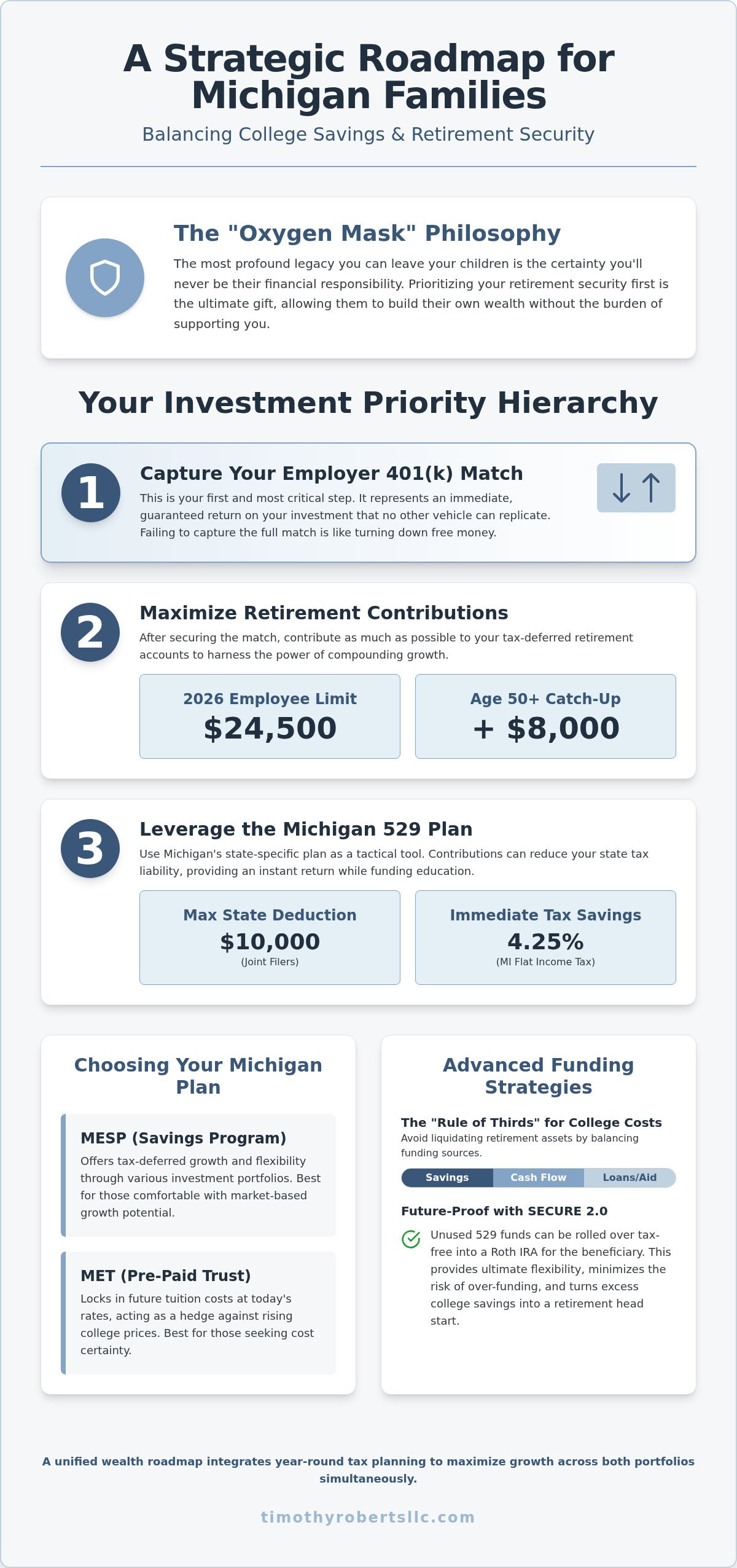
The 2026 economic environment makes this coordination even more vital. With 401(k) contribution limits reaching $24,500 and Michigan’s flat income tax rate at 4.25%, the math of balancing college savings and retirement michigan has shifted. Misallocating funds toward education at the expense of retirement compounding creates a massive opportunity cost. You can borrow for a degree, but no one will lend you money for your retirement. It’s a reality that requires a cold, analytical look at where your next dollar provides the most utility.
The Myth of the Binary Choice
Success isn’t about choosing one goal over the other. It’s about understanding the synergy between different vehicles. A modern 529 plan offers far more flexibility than most realize, especially with the ability to roll unused funds into a Roth IRA under SECURE 2.0. Over-funding an education account can be just as damaging as under-funding it if those dollars could have been working more effectively in a tax-deferred retirement account. We focus on finding the ‘just right’ amount that satisfies both aspirations without compromising the power of compounding interest.
Fiduciary Standards in Multi-Goal Planning
A fiduciary advisor provides an objective lens through which to view these trade-offs. Rather than making emotional decisions based on the sticker price of a university, we use rigorous, math-based projections to determine the most efficient path forward. This involves analyzing the interaction between Michigan state tax deductions and federal retirement incentives. Timothy Roberts & Associates, LLC is legally and ethically bound to act solely in your best interest, ensuring that every recommendation serves the long-term stability of your entire family estate. We don’t just pick products; we architect outcomes that withstand market volatility and shifting tax laws.
Establishing a Priority Hierarchy for Michigan Families
A strategic hierarchy transforms a chaotic collection of accounts into a cohesive wealth engine. When balancing college savings and retirement michigan, the order of operations determines the ultimate tax alpha of your portfolio. It’s not about which goal is more important emotionally; it’s about which dollar provides the highest mathematical advantage at any given moment. This requires moving beyond generic advice to a structured, five-step progression that respects both your timeline and the current tax code.
The Retirement Foundation
Your primary engine remains the employer-sponsored 401(k) or 403(b). For 2026, the employee contribution limit is $24,500. If you’re aged 50 or over, the $8,000 catch-up allows for a total of $32,500 in tax-deferred growth. Capturing the full employer match is an immediate, guaranteed return that no education vehicle can replicate. Before diverting a single dollar to a 529, you must verify your “Retirement Readiness Score” to ensure your baseline lifestyle is secure. This score serves as a diagnostic tool, confirming that your core assets are on track before you fund secondary objectives.
Once the match is secured, the next tactical move involves the Michigan state tax deduction. For joint filers, contributing up to $10,000 to a 529 plan yields an immediate 4.25% return through state tax savings. This isn’t just saving for tuition. It’s a deliberate tax planning strategy that reduces your current liability while building a tax-free reservoir for future educational expenses. Coordination between these accounts prevents “wealth leakage” where high-earners pay more in taxes than necessary due to poor asset location.
Education Funding as a Tactical Satellite
Education funding should orbit your retirement plan rather than colliding with it. We often recommend the “Rule of Thirds” for college costs: one-third from past savings, one-third from current cash flow, and one-third from low-interest loans or merit-based aid. This approach prevents parents from liquidating retirement assets prematurely, which can trigger unnecessary taxes and penalties. Assessing the “Bridge”—the period where retirement begins and college ends—is crucial for maintaining liquidity without sacrificing long-term growth.
Asset placement also dictates financial aid eligibility. Assets held in a parent’s name or a 529 generally have a lower impact on the Student Aid Index than assets held in a child’s name. By coordinating these placements with your Retirement Income Planning, you can preserve eligibility for aid while keeping your retirement trajectory intact. The goal is a unified legacy where the children are educated and the parents remain financially sovereign, ensuring that your wealth serves your family for generations.
Maximizing Michigan-Specific Education Funding Vehicles
Michigan provides a unique landscape for education funding that, when utilized correctly, enhances your overall wealth trajectory. The primary objective for high-earning households isn’t just saving for tuition; it’s maximizing the “tax alpha” available through state-specific incentives. For the 2026 tax year, Michigan residents can deduct up to $5,000 for single filers or $10,000 for joint filers in contributions to a 529 plan from their state taxable income. This deduction, paired with the state’s 4.25% flat tax rate, provides an immediate, risk-free return on your investment. While 2026 regulations now allow deductions for out-of-state plans, the local programs remain essential for structured growth.
The MESP Advantage for Portfolio Diversification
The Michigan Education Savings Program (MESP) functions as a sophisticated investment vehicle that mirrors the structure of a high-end retirement portfolio. Unlike rigid savings accounts, MESP offers a range of investment tracks, including age-based options that automatically de-risk as your child approaches their first semester. This level of customization allows you to align your education funding with your broader investment portfolio management goals. By utilizing MESP, you benefit from tax-deferred growth and tax-free withdrawals for qualified expenses, effectively shielding your gains from the friction of annual taxation. It’s a strategic intervention that transforms a standard savings goal into a high-functioning asset class.
MET: A Hedge Against Michigan Tuition Inflation
While MESP focuses on market growth, the Michigan Education Trust (MET) offers a different strategic advantage: price certainty. MET allows families to “pre-pay” tuition at today’s rates, providing a powerful hedge against the rising costs of Michigan’s public universities. With the average cost of in-state tuition at Michigan’s public universities reaching $17,105 for the 2025-2026 cycle, securing future credits can be a prudent move for conservative investors. MET funds are portable, allowing them to be used at out-of-state or private institutions, though the maximum benefit is traditionally realized within the state system. This “lock-in” effect provides a layer of professional stability to your long-term projections.
Choosing between MESP and MET, or utilizing a hybrid approach, is a critical component of balancing college savings and retirement michigan. High-earning households often find that MESP’s market exposure complements their long-term retirement assets, while MET provides a floor of security for educational costs. This coordination ensures that your college funding strategy acts as a protective layer for your retirement nest egg. By managing these vehicles with the same rigor as your 401(k), you prevent tuition spikes from draining your primary wealth-building engines.
Strategic Asset Coordination: Beyond the 529 Plan
True wealth coordination transcends the boundaries of traditional account silos. While the Michigan 529 plans discussed previously offer clear state tax advantages, relying on them as your sole education vehicle can create unnecessary rigidity. High-net-worth families often find that balancing college savings and retirement michigan requires a more versatile architecture. By integrating non-traditional assets into your funding strategy, you maintain the agility to pivot as your financial landscape or your child’s academic path evolves.
The Roth IRA as a Dual-Purpose Tool
The Roth IRA is often the secret weapon for Michigan professionals who want to hedge their bets. For 2026, the IRA contribution limit is $7,500. Because you contribute to a Roth with after-tax dollars, you can withdraw your original contributions at any time without taxes or penalties. This creates a “swing” account: if your retirement projections are ahead of schedule, those funds can cover a tuition bill. If college costs are lower than expected, the money remains in a tax-free environment for your golden years.
The impact on financial aid is another critical factor. Under current federal guidelines, assets held within a retirement account like a Roth IRA are generally excluded from the Student Aid Index calculation. In contrast, 529 plans are considered parental assets. For families navigating the threshold of aid eligibility, shifting assets into a Roth structure can be a sophisticated way to shield wealth while maintaining a college backup fund. This dual-purpose utility provides the calm confidence that your capital is never truly “trapped” in a single-use bucket.
The 529-to-Roth Rollover: Eliminating the ‘Overfunding’ Fear
The SECURE 2.0 Act introduced a transformative provision that significantly reduces the risk of overfunding a 529 plan. Families often worry that a child’s scholarship or a choice to skip graduate school will leave them with a taxable surplus. You can now roll over unused 529 assets into a Roth IRA for the beneficiary, subject to a $35,000 lifetime limit. This ensures that a successful academic outcome for your child directly contributes to their long-term financial progression rather than resulting in a tax penalty.
To qualify for a 529-to-Roth rollover, the account must have been maintained for at least 15 years, and the amount rolled over cannot include contributions made within the last five years. This rule rewards long-term planning and reinforces the idea that education funding is a generational journey. Beyond these qualified accounts, maintaining a taxable brokerage account provides the liquidity needed to bridge the gap between retirement and the final tuition payment. If you are ready to move beyond basic savings and build a truly integrated portfolio, discover how our Investment Portfolio Management can align these moving parts into a singular, high-functioning strategy.
Integrating Education into Your Retirement Income Roadmap
The transition from growing wealth to utilizing it is where many strategies falter. For Michigan families, the intersection of tuition payments and retirement milestones requires a sophisticated orchestration of cash flow. Timothy Roberts & Associates, LLC moves beyond the siloed approach of traditional firms, creating a Family Wealth Roadmap that treats your entire portfolio as a single, high-functioning system. This integrated view ensures that your year-round tax planning works to minimize the cost of both goals simultaneously, preventing one from eroding the success of the other. Balancing college savings and retirement michigan is not a stationary task; it’s a dynamic process that evolves as you move from the accumulation phase into the strategic distribution of your assets.
As your children enter their university years, the math of your portfolio changes. You’re no longer just projecting future growth; you’re managing the real-time harvesting of capital. This phase requires a visionary strategist who can align your retirement income needs with the specific timing of tuition deadlines. By coordinating these distributions, we help you avoid unnecessary tax triggers and preserve the longevity of your core retirement accounts. Our approach ensures that your legacy is defined by upward progression rather than financial compromise.
The Power of Professional Portfolio Management
Rebalancing a portfolio is a complex intervention when you’re managing two distinct time horizons. Your 401(k) may have a twenty-year runway, while your 529 plan might have a window of only twenty-four months. A unified approach to investment portfolio management allows us to manage market volatility across all account types in concert. We analyze the correlation between your education-specific assets and your broader retirement holdings to ensure your total risk profile remains within your comfort zone. This rhythmic rebalancing keeps your goals in sync, even when market conditions shift.
Creating Your 2026 Strategic Plan
A one-size-fits-all online calculator cannot account for the intricate tax brackets of a high-earning Michigan household. Sophisticated wealth coordination requires a personalized education funding strategy that reflects your unique family values and legacy goals. We invite you to move beyond generic assumptions and engage in a comprehensive review of your Michigan-based assets. Scheduling a consultation allows us to build the mathematical proof that both a premier education and a secure retirement are viable. Together, we can architect a plan that provides the calm confidence you need to lead your family toward a future of aspirational growth.
Architecting a Legacy of Financial Sovereignty
The path toward a secure future doesn’t require choosing between your child’s education and your own retirement peace of mind. By prioritizing a structured hierarchy and maximizing the 4.25% state tax alpha unique to our state, you can transform these competing goals into a single, high-functioning wealth engine. Successfully balancing college savings and retirement michigan is the result of intentional asset coordination rather than sheer saving volume. You’ve discovered how MESP benefits and Roth IRA flexibility create a safety net for both milestones, ensuring your capital remains agile and productive throughout your journey.
Securing these outcomes requires a partner who understands the intersection of personal ambition and rigorous fiscal strategy. With over 25 years of fiduciary experience and specialized Michigan tax planning expertise, Timothy Roberts & Associates, LLC provides the comprehensive wealth and estate management necessary to navigate these complexities. We invite you to Request a Strategic Consultation for Your Education and Retirement Plan to align your legacy with your lifestyle. Your progression toward aspirational growth begins with a single, deliberate step toward clarity and confidence.
Frequently Asked Questions
Is it better to save for retirement or college first in Michigan?
Prioritize retirement first because there are no loans for your golden years, whereas students can access grants and loans for their education. Securing your own financial independence prevents you from becoming a future burden to your children. Balancing college savings and retirement michigan requires ensuring your 401(k) match is captured before diverting funds to a 529. Once your foundation is stable, you can leverage Michigan’s state tax deductions for college contributions to enhance your overall wealth.
Can I use my 401(k) to pay for my child’s college tuition?
You can technically access 401(k) funds through loans or withdrawals, but it’s rarely the most strategic move. Withdrawals before age 59.5 usually trigger a 10% penalty plus ordinary income taxes, which significantly erodes your wealth. Loans must be repaid with after-tax dollars and may become due immediately if you leave your employer. We generally recommend keeping retirement assets intact to benefit from long-term compounding while using more flexible, education-specific vehicles for tuition costs.
What are the tax benefits of a Michigan 529 plan for 2026?
Michigan offers a flat 4.25% state income tax deduction on contributions, alongside federal tax-deferred growth. For 2026, you can use these funds for qualified higher education expenses or up to $20,000 per year for K-12 tuition. A significant update for 2026 allows Michigan residents to deduct contributions to out-of-state 529 plans as well. These incentives provide an immediate return on your investment while shielding your portfolio from annual capital gains taxes and dividend friction.
How much can I contribute to an MESP account and still get a tax deduction?
You can deduct up to $5,000 as a single filer or $10,000 for those filing jointly on your Michigan state tax return. While you can contribute more than these amounts, the deduction is capped at these limits per tax year. In 2026, the federal gift tax exclusion allows for contributions up to $19,000 per beneficiary without incurring gift taxes. Strategic superfunding allows a lump sum of $95,000 to be treated as five years of contributions for gift tax purposes.
What happens to my 529 plan if my child doesn’t go to college?
You maintain full control over the assets and have several strategic options. You can change the beneficiary to another qualified family member or keep the funds in the account for future graduate studies. Under the SECURE 2.0 Act, you can roll over up to $35,000 into a Roth IRA for the beneficiary, provided the account has existed for 15 years. Non-qualified withdrawals of earnings are subject to income tax and a 10% penalty on the growth.
Does a 529 plan affect my child’s eligibility for financial aid in Michigan?
Assets in a 529 plan owned by a parent have a relatively low impact on financial aid eligibility. These accounts are considered parental assets and are assessed at a maximum rate of 5.64% when calculating the Student Aid Index. This is significantly more favorable than assets held in the student’s name, which are assessed at 20%. Proper asset location is a key component in balancing college savings and retirement michigan without disqualifying your child from aid opportunities.
Can I roll over my 529 plan into a Roth IRA under the new rules?
Yes, the SECURE 2.0 Act allows for tax-free rollovers from a 529 plan to a Roth IRA for the same beneficiary. There is a lifetime limit of $35,000, and the rollover amount is subject to annual Roth IRA contribution limits, which are $7,500 for 2026. The 529 account must have been open for at least 15 years to qualify. This provision provides a valuable exit strategy, ensuring that unused education funds can still support your child’s long-term financial progression.
How does the Michigan Education Trust (MET) differ from the MESP?
The MET is a prepaid tuition plan that allows you to lock in today’s tuition rates for future use at Michigan public universities. In contrast, the MESP is an investment-based savings plan where your returns depend on market performance. While MET offers a hedge against tuition inflation, MESP provides greater flexibility for use at private or out-of-state institutions. Both plans offer the same state tax deduction, but they serve different roles within a sophisticated family wealth strategy.
