

Aug
Strategic Investment Portfolio Management: A Guide to Wealth Elevation
The true measure of a successful retirement isn’t found in a single account balance; it resides in the structural integrity of your entire financial architecture. Many investors spend decades accumulating assets only to find that the complexity of managing multiple accounts and the friction of hidden fees now threaten their peace of mind. You’ve worked hard to build a legacy, yet the fear of market volatility remains a persistent shadow over your savings. Seeking sophisticated investment management for retirees helps transform these disparate pieces into a singular, high-performance engine. It’s a shift from passive holding to active, strategic elevation.
You deserve a cohesive roadmap that prioritizes stability and honors your vision for the future. This guide explores the principles of fiduciary-led portfolio management, focusing on how professional oversight can reduce tax liability and optimize long-term growth. We’ll examine the critical role of aligned interests in an asset-based fee model and how a bespoke strategy can secure your financial legacy. By the end of this article, you’ll understand how to transition from the uncertainty of traditional brokerage models to a disciplined, tax-efficient framework designed for 2026 and beyond.
Key Takeaways
- Distinguish between tactical stock picking and strategic asset-based management to ensure your portfolio serves as a stable foundation for your lifestyle.
- Understand how specialized investment management for retirees detroit leverages a fiduciary standard to provide clarity and professional oversight for complex portfolios.
- Learn to balance risk and reward using Modern Portfolio Theory tailored to the specific economic conditions and market volatility of 2026.
- Master integrated tax-efficient strategies that protect your net returns and prevent unnecessary erosion of your long-term wealth.
- Align your financial future with a visionary strategist who treats wealth development as a journey of upward progression rather than a simple transaction.
The Architecture of Wealth: Understanding Strategic Portfolio Management
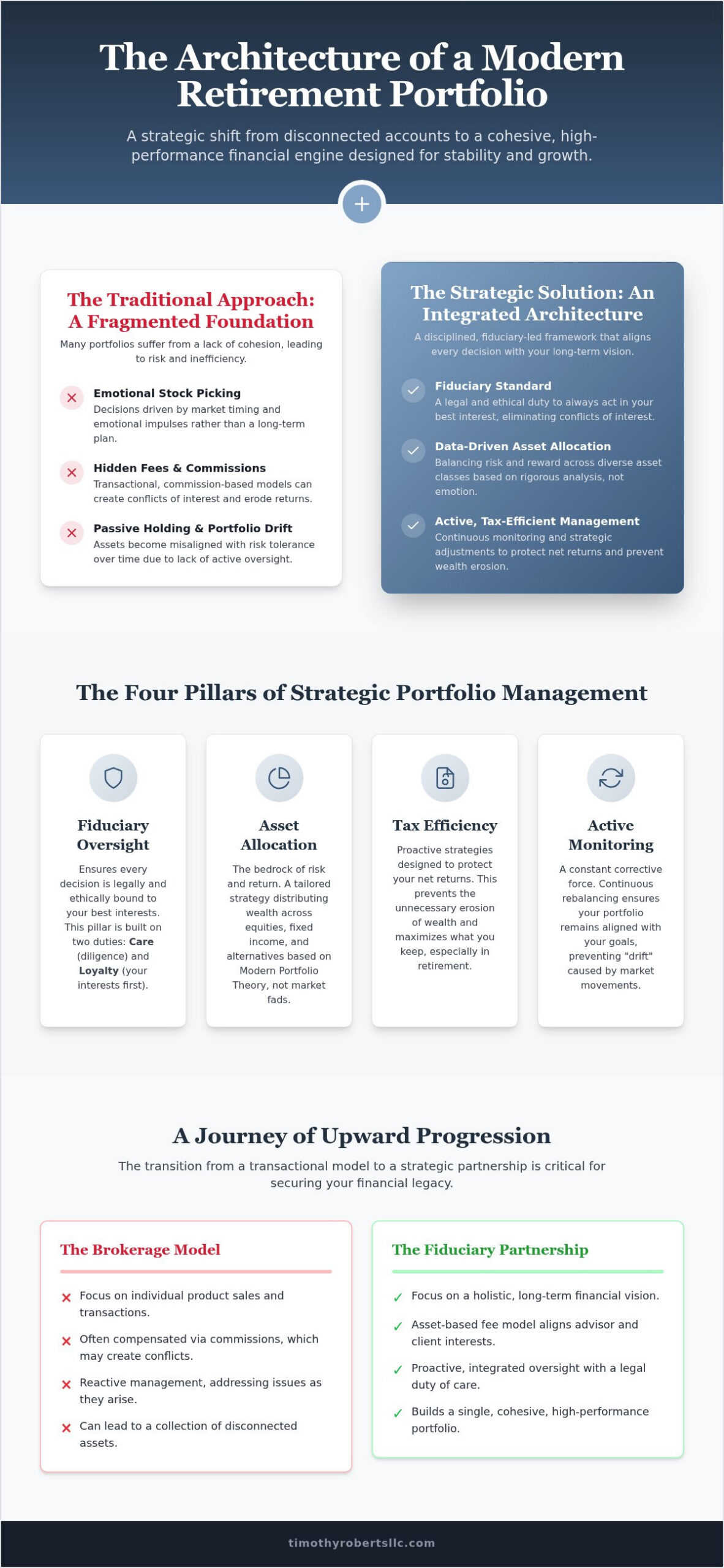
Wealth isn’t a static pile of capital; it’s a dynamic structure that requires constant refinement. True wealth management goes beyond the superficial allure of stock picking, which often relies on market timing and emotional impulses. Instead, strategic investment management for retirees detroit focuses on a fiduciary led process where every decision aligns with your long term vision. This approach treats your portfolio as a carefully crafted intervention, balancing the aesthetic desire for a meaningful legacy with the rigorous functionality of capital preservation.
Think of your strategy as a financial roadmap. It isn’t a rigid blueprint locked in a drawer, but a living document that evolves alongside market conditions and personal milestones. A professional Portfolio Manager acts as the architect of this journey, ensuring that your assets aren’t just sitting in accounts, but actively working toward your defined objectives.
To better understand how these strategic principles function in practice, watch this helpful video:
The Core Components of a Managed Portfolio
High end portfolio construction begins with asset allocation. This is the bedrock of your risk and return balance, determining how your wealth is distributed across equities, fixed income, and alternative investments. Diversification extends this principle by moving beyond simple sector exposure to capture opportunities in global markets. Without continuous monitoring, even the most robust portfolios can experience drift. This occurs when market movements push your holdings out of alignment with your specific risk tolerance. Fiduciary oversight acts as a constant corrective force, maintaining the structural integrity of your plan.
Why Institutional-Grade Management Matters
Managing complexity is a hallmark of high net worth retirement planning. For those seeking refined investment management for retirees detroit, institutional grade management provides access to research and market analysis that retail investors rarely see. This data driven execution replaces emotional reactions to volatility with calculated adjustments. For those with diverse asset classes, professional oversight ensures that every piece of the puzzle functions as a cohesive whole. It’s about moving from transactional interactions to a partnership rooted in shared success and upward progression.
The Fiduciary Standard in Investment Portfolio Management
Trust is the silent currency of wealth management. It’s the foundation upon which every strategic decision is built. For those evaluating investment management for retirees detroit, the fiduciary standard represents a critical legal and ethical mandate that prioritizes the client’s well-being above all else. This isn’t a mere marketing claim; it’s a structural requirement that distinguishes a visionary partner from a transactional broker. While traditional models might focus on individual product sales, a fiduciary approach looks at the synthesis of your entire financial life. It ensures that every intervention is carefully crafted to support your progressive journey toward financial independence.
The Legal Reality of the Fiduciary Duty
The fiduciary duty is composed of two primary pillars: the duty of care and the duty of loyalty. The duty of care mandates that an advisor acts with the specialized knowledge and diligence of a seasoned professional. The duty of loyalty requires the advisor to place your interests ahead of their own, effectively eliminating the hidden agendas that can plague commission-based models. In the regulatory environment of 2026, where the 1975 five-part test once again governs ERISA fiduciary status, working with a dedicated advisor ensures that your retirement accounts receive the highest level of professional scrutiny. This legal framework provides the stability necessary for a multi-decade financial roadmap, allowing you to move forward with calm confidence. Fiduciaries manage rebalancing and account monitoring based on data-driven execution rather than sales incentives, which preserves the integrity of your long-term strategy.
Transparency and Alignment of Interests
A strategic partnership thrives on transparency. Asset-based investment management fees provide this clarity by replacing opaque commission structures with a simple, percentage-based model. This shift toward fee-based advice has become the market standard in 2026, as investors demand greater accountability and a move away from proprietary product bias. When an advisor’s compensation is linked to the total value of the assets they manage, their interests are perfectly aligned with yours. There’s no incentive to recommend a specific product for a payout. Instead, the focus remains on long-term growth and capital preservation. This alignment fosters a narrative of shared success, where the advisor is as invested in the outcome as the client. It creates a space where creative passion and business-minded rigor intersect to protect your legacy. For those ready to experience this level of personalized stewardship, exploring wealth management can be the first step toward a more secure financial future.
Balancing Risk and Reward: Asset Allocation for Long-Term Growth
Strategic asset allocation isn’t about chasing the highest yield; it’s about the elegant orchestration of diverse asset classes to support a lifetime of income. While Modern Portfolio Theory remains a cornerstone of institutional finance, its application in the 2026 market requires a more nuanced touch. With persistent inflation impacting purchasing power and fluctuating interest rates creating a landscape of uncertainty, investment management for retirees detroit must move beyond static, off-the-shelf models. It requires a visionary strategist who understands how to synthesize growth with capital preservation.
The goal is to create a portfolio that feels both robust and responsive. This involves a calculated approach to risk that honors your personal legacy while navigating the practicalities of a shifting global economy. By treating asset allocation as a dynamic intervention rather than a set-and-forget transaction, you ensure your wealth continues its upward progression regardless of short-term market noise.
Determining Your True Risk Profile
Understanding risk requires a clear distinction between risk capacity and risk appetite. Your capacity is a cold, mathematical reality: it’s the specific amount of loss your financial roadmap can sustain without compromising your standard of living. In contrast, your appetite is psychological, reflecting how much volatility you can endure before anxiety leads to emotional decision-making. In 2026, a Q3 survey revealed that 25% of retirees identify rising costs as their primary concern, highlighting the need for a strategy that addresses both market fluctuations and inflationary pressure. Risk premium is the excess return required for taking on the volatility of diversified equities. Balancing these factors ensures that your investment management for retirees detroit remains aligned with your long-term stability and legacy goals.
The Mechanics of Portfolio Rebalancing
Drift is an inevitable byproduct of market movement. Over time, high-performing assets grow to represent a larger percentage of your portfolio than intended, while underperforming sectors shrink. This creates an unintended concentration that can quietly increase your exposure to risk. Systematic rebalancing restores the structural integrity of your plan. It’s the disciplined, business-minded act of selling high and buying low to maintain your target allocation. By automating this process, a professional advisor maintains emotional neutrality, ensuring that headlines don’t interfere with your journey. This rigorous oversight is essential for protecting generational wealth and ensuring your financial architecture remains sound for decades to come.
Tax-Efficient Strategies Within Your Investment Portfolio
Wealth isn’t just about what you earn. It’s about what stays in your pocket after the government takes its share. Over a 25-year retirement horizon, the cumulative impact of capital gains and income taxes can significantly erode your purchasing power. For those seeking refined investment management for retirees detroit, the integration of strategic tax advising into a broader portfolio strategy is essential. This isn’t a year-end afterthought; it’s a continuous, proactive process that treats tax mitigation as a core investment discipline. Professional oversight isn’t just about picking winners. It’s about minimizing the friction of taxation to ensure your financial architecture remains sound for decades to come.
Strategic portfolio management is an exercise in precision. It requires an expert craftsman who views tax efficiency as an integral component of the financial architecture. By aligning your investment choices with a proactive tax strategy, you transform a passive holding into a high-performance engine for wealth elevation.
Tactical Tax-Loss Harvesting
Market volatility, while often viewed with apprehension, presents a strategic opportunity for tax-loss harvesting. This sophisticated intervention involves intentionally realizing losses in certain positions to offset capital gains elsewhere in your portfolio. Efficiency is the priority. In 2026, navigating the Wash Sale rule remains a critical component of this discipline. You must ensure that you don’t purchase a substantially identical security within 30 days before or after the sale. This requires a business-minded rigor to maintain market exposure while capturing the tax benefit. It’s a method of turning short-term fluctuations into long-term growth advantages without disrupting your core allocation.
Asset Location vs. Asset Allocation
While asset allocation determines your risk, asset location determines your tax efficiency. Location matters. Placing tax-inefficient assets, such as high-yield bonds or actively managed funds, within sheltered accounts like a Roth IRA or 401k can protect your growth from immediate taxation. Conversely, tax-efficient assets like index funds are better suited for taxable brokerage accounts. In 2026, Michigan’s full phase-in of retirement income deductions allows single filers to deduct up to $67,610 of pension and retirement income. Optimizing your distributions across these various account types ensures a sustainable stream of income. Integrating these strategies reduces friction and creates a cohesive financial roadmap for high-net-worth individuals. To truly elevate your wealth, you should consider how tax planning strategies can be woven into your broader investment plan.
Elevating Your Strategy with Timothy Roberts & Associates, LLC
Timothy Roberts & Associates, LLC represents more than a financial service; it’s a specialized firm dedicated to organizational and personal evolution. With over 25 years of professional advisory experience, we’ve refined the art of managing complex financial roadmaps for high net worth individuals. We understand that your wealth is a reflection of your life’s work. It requires a level of stewardship that goes beyond generic solutions. By integrating comprehensive retirement income planning with sophisticated tax strategies, we create a unified framework for growth. This holistic approach ensures that your investment management for retirees detroit isn’t a series of isolated transactions, but a deliberate journey toward long term stability and legacy.
Our identity is rooted in the synthesis of individual creative vision and structured corporate capabilities. We move away from aggressive sales tactics, opting instead for a narrative of partnership and shared success. This deliberate pacing reinforces the idea that we take the time to understand and solve complex problems rather than rushing to generic conclusions. We don’t believe in off-the-shelf solutions because your financial needs are as unique as your personal history. Every intervention we propose is carefully crafted to support your progressive nature and long term goals.
A Visionary Approach to Wealth
Authentic wealth development requires an expert craftsman who can balance aesthetics with functionality. We treat your portfolio as a carefully constructed intervention, designed to withstand market volatility while capturing progressive growth opportunities. Personal attention is our hallmark. We believe that depth is more valuable than superficiality, which is why we limit our focus to those who value quality and high level thinking. By choosing a specialized firm, you transition from being an account number to becoming a partner in a multi generational legacy. It’s a shift from reactive management to visionary strategy. We view development as a journey rather than a simple transaction, guiding you through the practicalities of execution with steady, logical precision.
Next Steps: Your Strategic Consultation
The journey toward wealth elevation begins with a steady, logical conversation. During a comprehensive portfolio review, a fiduciary advisor will examine your current architecture to identify hidden fees, tax inefficiencies, and risks. We’ll discuss how to align your assets with the realities of 2026, ensuring your roadmap is both resilient and aspirational. The transition to a fiduciary led model is a seamless process designed to reduce friction and provide immediate clarity. If you’re ready to secure your financial future through professional oversight, we invite you to Schedule your strategic wealth consultation with Timothy Roberts & Associates, LLC. Together, we can build a cohesive roadmap that honors your past and secures your future.
Securing Your Financial Legacy Through Strategic Stewardship
Transitioning from simple asset accumulation to a professional, fiduciary led model is the pivotal transition in wealth elevation. By prioritizing the legal duty of loyalty and integrating sophisticated tax strategies, you protect your net returns from tax erosion and market volatility. This disciplined approach ensures your financial architecture remains resilient through 2026 and beyond. It’s a shift from transactional holdings to a life-long journey of upward progression, where every decision is a carefully crafted intervention for your future.
When you seek specialized investment management for retirees detroit, you aren’t just hiring a service; you’re entering a partnership dedicated to your personal vision. Timothy Roberts & Associates, LLC offers a synthesis of over 25 years of fiduciary expertise and integrated tax planning. Our asset based management model aligns our success with yours, providing the personal attention and business minded rigor your legacy deserves. Begin your journey toward strategic wealth elevation with Timothy Roberts & Associates, LLC. Your retirement should be a period of calm confidence and aspirational growth.
Frequently Asked Questions
What is the difference between a traditional investment advisor and a fiduciary?
A fiduciary is legally and ethically bound to act in your best interest at all times, whereas a traditional broker may only be held to a suitability standard. This distinction is the cornerstone of sophisticated investment management for retirees detroit. While a traditional advisor might receive commissions for specific product sales, a fiduciary operates under a duty of care that eliminates these conflicts. This ensures every strategic intervention is designed solely for your upward progression and long term stability.
How often should an investment portfolio be rebalanced for optimal performance?
Portfolio rebalancing should occur whenever market movements cause your asset allocation to drift significantly from its strategic targets, typically on a quarterly or semi annual basis. This disciplined process ensures your risk profile remains consistent with your original financial roadmap. By systematically selling high and buying low, you maintain the structural integrity of your wealth. Professional oversight allows for data driven execution that removes the emotional friction often associated with volatile market shifts in 2026.
What are the typical fees for asset-based investment management in 2026?
Asset based investment management fees are typically structured as a transparent percentage of the total assets under professional stewardship. In the 2026 market, many investors find this model preferable because it aligns the interests of the advisor with the growth of the portfolio. While exact percentages vary based on the complexity and size of the accounts, the model eliminates hidden commissions. This clarity fosters a partnership rooted in trust and shared aspirational success rather than transactional sales interactions.
Can professional portfolio management help reduce my annual tax liability?
Professional management integrates proactive tax planning strategies to minimize the impact of taxation on your net investment returns. This includes tactical interventions like tax loss harvesting and strategic asset location across taxable and sheltered accounts. By coordinating your portfolio with year round tax advising, you can significantly reduce friction and preserve more of your wealth for your legacy. This holistic approach is essential for high net worth individuals seeking to optimize their long term financial architecture and sustainable income.
How does risk management differ from simply choosing “safe” investments?
Risk management is a strategic synthesis of asset allocation and diversification designed to navigate volatility, while “safe” investments often focus solely on capital preservation at the expense of growth. True risk management acknowledges that inflation is a persistent threat to purchasing power in 2026. Instead of avoiding risk entirely, a visionary strategist calculates the risk capacity and appetite of the client. This ensures the portfolio remains robust enough to support a multi decade retirement journey without eroding your principal.
What happens during a professional portfolio review with a fiduciary firm?
A professional portfolio review involves a steady and logical analysis of your current financial architecture to identify inefficiencies and misalignments. Your fiduciary advisor will examine asset allocation, hidden fee structures, and tax exposure to ensure your holdings support your long term vision. This consultation serves as a diagnostic tool to determine if your current roadmap is resilient. It’s the first step in moving from a collection of disparate accounts to a cohesive, high performance strategy designed for stability.
Why is asset allocation considered more important than individual stock selection?
Academic research consistently demonstrates that asset allocation is the primary driver of long term portfolio performance and risk levels, far outweighing the impact of individual stock picking. By diversifying across various asset classes, you create a structural foundation that captures global market growth. This business minded approach focuses on the elegant orchestration of your entire wealth structure. It prevents the unintended concentration that often occurs when investors focus too narrowly on individual securities rather than their broader, strategic roadmap.
How do I transfer my existing brokerage accounts to a new fiduciary management firm?
Transferring existing brokerage accounts is a streamlined process typically handled through an automated transfer of assets system that requires minimal effort from the client. Your new fiduciary firm coordinates the transition to ensure your holdings move securely and efficiently into a managed framework. This shift allows for the immediate implementation of sophisticated investment management for retirees detroit. It’s a seamless transition that marks the beginning of a strategic partnership focused on your upward progression and long term financial peace.
