

Nov
Tax implications of a concentrated position in company stock
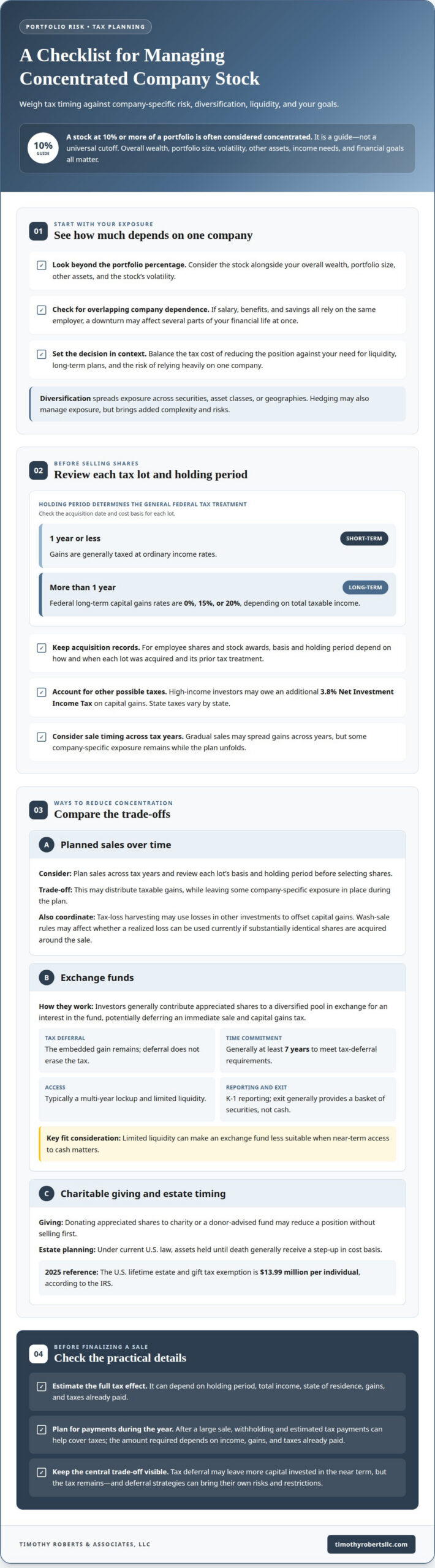
A low tax bill can still conceal a high portfolio risk. There’s no single percentage that makes a holding concentrated: a stock often represents 10% or more of a portfolio, but the investor’s overall wealth, circumstances, stock volatility, and portfolio size matter. The tax implications of a concentrated position in company stock also depend on when shares are sold. According to the IRS, assets held for one year or less are generally taxed at ordinary income rates, while assets held longer than one year generally qualify for long-term capital gains treatment, typically at lower rates.
Holding appreciated shares can defer a tax bill, but it also ties more of your financial future to one company. That tension is central to the decision: tax efficiency matters, but it should be weighed alongside diversification, liquidity, and your goals. This guide explains how concentrated positions are assessed, how holding periods affect capital gains, and what tax deferral may offer in relation to company-specific risk. You’ll have a clearer framework for weighing gradual diversification against the tax cost of selling.
Key Takeaways
- Assess concentration in the context of your overall wealth, portfolio size, and the stock’s volatility; no single percentage defines it for everyone.
- Review each share lot’s holding period and cost basis to understand how the timing of a sale may affect capital gains taxes.
- Compare the potential tax deferral of exchange funds with their lockups, limited liquidity, and reporting complexity before weighing them against other diversification approaches.
- Balance the tax cost of reducing a position against the risk of relying heavily on one company, your need for liquidity, and your long-term plans.
What counts as a concentrated stock position?
A holding often counts as concentrated when one stock represents 10% or more of a portfolio, but that threshold is a guide, not a universal rule. A single stock worth 10% may present different exposure in a diversified portfolio than in a portfolio dominated by that company’s shares. Stock volatility, other assets, income needs, and financial goals all shape the assessment. The tax implications of a concentrated position in company stock therefore involve more than the gain on a future sale.
A concentrated position ties investment risk to one company’s fortunes. If your salary, benefits, and savings all depend on the same employer, a downturn can affect several parts of your financial life at once. Diversification spreads exposure across securities, asset classes, or geographies. Hedging may also help manage exposure, but it brings added complexity and risks. A strategy might pair planned sales over time with a review of individual tax lots, prioritizing shares with losses or smaller gains where appropriate.
Equity exchange funds offer another route to diversification without an immediate sale. They are typically structured as limited partnerships, and investors generally contribute appreciated shares in exchange for an interest in a diversified pool. They may defer taxes, but often involve a multi-year lockup, limited liquidity, and K-1 tax reporting. On exit, investors generally receive a basket of securities rather than cash. Those features can make an exchange fund less suitable when near-term liquidity matters.
Donating appreciated shares to charity or a donor-advised fund may reduce a position without selling first. Estate planning can also affect timing: under current U.S. law, assets held until death generally receive a step-up in cost basis. For 2025, the U.S. lifetime estate and gift tax exemption is $13.99 million per individual, according to the Internal Revenue Service.
Wash-sale rules may affect whether a realized loss can be used currently if you acquire substantially identical shares around the time of the sale. After a large sale, withholding and estimated tax payments can help cover taxes during the year. The amount required depends on your income, gains, and taxes already paid.
What’s the difference between short-term and long-term capital gains tax rates?
The holding period affects how a realized gain is taxed, while the timing of a sale can change your total taxable income for the year. For concentrated shares, these rules make tax planning part of a broader risk-reduction strategy.
Short-Term and Long-Term Gain Rates
In the United States, gains on assets held for one year or less are generally taxed as ordinary income, according to the Internal Revenue Service. Assets held longer than one year generally qualify for long-term treatment. The federal long-term capital gains tax rates are 0%, 15%, or 20%, depending on an individual’s total taxable income, according to the Internal Revenue Service.
High-income investors may also owe an additional 3.8% Net Investment Income Tax on capital gains, according to the Internal Revenue Service. State taxes vary by state, so a sale’s combined tax effect depends on the investor’s residence and income. Short-term gains can face a different federal rate from long-term gains, making the date of each sale consequential.
Share Sales and Tax Timing
Gradual sales spread gains across tax years instead of realizing the gain on the entire position at once. For example, you could plan annual sales and review each lot’s basis and holding period before choosing which shares to sell. This may distribute taxable gains, but some company-specific exposure remains while the plan unfolds.
For employee shares and stock awards, cost basis and holding period depend on how and when each lot was acquired. Keep acquisition records with the basis reported for each lot, since the award type and its prior tax treatment may affect the calculation. The sale date determines whether a lot meets the long-term holding period.
Tax-loss harvesting realizes losses in other investments to offset capital gains, reducing the net gain subject to tax. Coordinate those sales with the concentrated-stock plan so that loss use, timing, and remaining exposure are considered together. A tax-planning perspective can help organize those connected decisions.
How much does deferring capital gains tax actually save?
Deferring tax can leave more capital invested in the near term, but it does not erase the tax. The potential benefit depends on the strategy and holding period, as well as the risks you accept.
Exchange Funds and Tax Deferral
An exchange fund allows investors to contribute appreciated shares to a pooled vehicle in return for an interest in a diversified portfolio, potentially deferring an immediate sale and its capital gains tax. Deferral may leave more proceeds invested, but the embedded gain remains. Investors generally need to stay in the fund for at least seven years to meet tax-deferral requirements.
Exchange funds are typically limited partnerships, and investors may receive K-1 tax reporting. They generally impose a multi-year lockup and offer limited liquidity; exiting usually means receiving a basket of securities rather than cash. The trade-off is important: potential tax efficiency comes with restricted access to proceeds and continued investment risk.
Net Investment Income Tax on Stock Gains
The Net Investment Income Tax can add 3.8% to capital gains tax for high-income U.S. investors, according to the Internal Revenue Service. A gain from selling company shares may therefore face this additional tax alongside the applicable capital gains rate. The combined impact depends on the investor’s income and realized gains.
Deferring a sale may postpone when a gain is realized, but it doesn’t automatically remove the Net Investment Income Tax. A charitable remainder trust offers a different structure: appreciated stock may be donated while providing an income stream, and the trust can have a term of up to 20 years.
Compare that approach with an exchange fund’s lockup and eventual securities distribution. In one illustration, deferring tax on a 20% gain for 10 years, while earning a 7.5% annual return, adds about 4% in total value, or 0.4% per year. That potential benefit depends on the assumed return and time horizon; it must be weighed against the risk of holding the shares and the strategy’s constraints.
Company-specific risk and long-term underperformance
A concentrated holding ties portfolio wealth closely to one company’s performance. From 1980 to 2020, 66% of stocks trailed the Russell 3000. A broad market can rise while an individual company’s equity falls, leaving a concentrated investor exposed to a different outcome than a diversified portfolio.
Losses can also be severe. Goldman Sachs research found that, from 1986 to 2022, the median Russell 3000 stock had a 31% chance of losing more than 30% in one year. In that analysis, 36% of Russell 3000 stocks suffered permanent impairment, defined as losing more than 75% and failing to recover to half their original value.
Single-stock exposure can reach beyond an investment account. If an investor’s job, compensation, and savings all depend on one employer, a company setback may affect income and equity at once. Enron’s 2001 bankruptcy illustrated this overlap: employees with concentrated company stock risked both their jobs and life savings. Portfolio concentration can therefore amplify financial strain during a difficult period.
Long-term market results also show how uneven stock returns can be. From 1926 to 2016, the top 4% of U.S. stocks accounted for all net wealth creation, while 42.6% of individual stocks outperformed one-month Treasury bills over their lifetimes. These findings show why a single company’s past success cannot establish its future contribution to wealth.
A practical review compares the position with your other assets, employment exposure, spending needs, and time horizon. Then map each share lot’s cost basis and unrealized gain. A planned reduction may prioritize lots at a loss or with smaller gains, while tax-loss harvesting may help offset realized gains. Compare the tax liability from selling with the potential cost of remaining concentrated: deferring capital gains tax leaves company-specific risk in place.
Discuss a portfolio strategy that considers both diversification and the tax consequences of reducing exposure.
Timothy Roberts & Associates
Timothy Roberts & Associates helps investors consider concentrated company stock within a broader financial strategy. When deciding whether to sell, hold, or diversify, weigh potential capital gains taxes alongside company-specific exposure, liquidity needs, and long-term goals.
Investment Portfolio Management can help align a stock position with your other assets and risk tolerance. Tax Planning Strategies can help inform the timing and tax impact of sales, while Estate & Legacy Planning can address how appreciated shares fit into future wealth-transfer goals. If your compensation and savings depend on the same employer, Risk Management & Insurance Analysis can help assess those overlapping financial exposures.
Consider a coordinated review if a large holding affects your retirement plans, planned spending, or estate decisions. Contact Timothy Roberts & Associates to discuss your situation.
Make Your Next Decision Deliberate
A concentrated position needs a plan that can evolve with your life, not just the market. Set clear priorities for what the stock should support, such as future spending, family goals, or financial flexibility. Then identify events that would prompt a fresh review, including a change in employment, retirement timing, or personal goals.
This approach creates a steadier decision process. Rather than reacting to every price movement, you can revisit your strategy when circumstances meaningfully change and consider how the tax implications of a concentrated position in company stock fit your wider financial picture. A coordinated perspective can connect investment decisions with retirement income and legacy priorities.
Contact Timothy Roberts & Associates, LLC to discuss a thoughtful next step for your company stock and broader financial plans. With a considered framework in place, you can move forward with greater clarity and purpose.
Frequently Asked Questions
Can I reduce a concentrated position without selling everything at once?
Yes. Phased sales can reduce exposure over time while allowing you to coordinate share selections with cash needs and tax years. For example, you might prioritize shares with smaller embedded gains, then reassess the remaining position as circumstances change. Shares you have not sold remain exposed to company performance, so the pace should reflect both tax considerations and your risk tolerance.
Does concentration risk matter even if I believe strongly in the company?
Yes. Confidence in a company does not remove the possibility of an unexpected business setback or changing market conditions. Consider how a sharp decline could affect your spending plans, savings, and ability to meet financial goals, not just your view of the company’s prospects. A useful test is whether your broader plan still works if the stock falls at the same time your employment income is affected.
How does equity compensation add to concentration risk?
Equity compensation can increase your exposure because shares, options, or awards tie part of your future wealth to your employer. Your salary may depend on the same company, creating overlapping financial risks. Incentive stock options also add a tax-planning consideration: exercising them may trigger alternative minimum tax even if regular tax is not due at exercise. Track awards alongside the shares you already own to understand your combined exposure.
Is it always better to hold appreciated stock to avoid capital gains tax?
No. Avoiding a current tax bill may preserve more proceeds today, but it also keeps your wealth tied to the stock. Compare the potential tax cost of selling with the effect a decline could have on your financial plans. If charitable giving is one of your goals, donating appreciated shares may be another option to consider. The right choice depends on how tax, risk, liquidity, and legacy priorities fit together.
Should I sell company stock if I’m an executive with trading restrictions?
Not without accounting for the restrictions that apply to your trading. A 10b5-1 plan can let eligible insiders schedule share sales in advance, subject to strict guidelines. The decision should coordinate permitted sale timing with your diversification goals, tax position, and company-related obligations. A prearranged approach can provide structure, but it must operate within the rules applicable to your role and circumstances.
What are the three main objectives when managing a concentrated stock portfolio?
The main objectives are to reduce company-specific risk, manage or defer capital gains taxes, and maintain liquidity for spending and estate goals. These priorities can conflict. Selling shares may reduce exposure and create cash, but it can also realize gains. A sound plan makes these trade-offs clear, then adjusts the pace and method of diversification as your needs and financial priorities evolve.
