

May
The Strategic Tax Implications of Your Investment Portfolio for 2026
What if the most significant threat to your 2026 wealth isn’t a volatile market, but the silent, compounding friction of tax drag? Most high-net-worth investors spend decades refining their asset allocation, yet they often underestimate how the tax implications of your investment portfolio can quietly erode their real-world gains. It’s a common anxiety to realize that without a deliberate strategy, a significant portion of your hard-earned growth belongs to the IRS rather than your family legacy.
You deserve a more intentional approach to wealth preservation. We’ll show you how to master the complex intersection of taxation and investment growth to protect your assets from unnecessary leakage. This guide provides a tax-efficient roadmap for the 2026 fiscal landscape under the “One Big Beautiful Bill Act,” covering everything from the increased $40,400 SALT deduction cap to optimizing your $24,500 401k contribution limits for maximum after-tax impact.
Key Takeaways
- Identify the structural friction of tax drag and its capacity to significantly diminish your long-term wealth trajectory if left unaddressed.
- Decode the specific mechanics the IRS uses to categorize income to better manage the tax implications of your investment portfolio.
- Optimize the architecture of your wealth by mastering asset location strategies that prioritize growth-oriented investments in your most efficient accounts.
- Leverage proactive interventions like tax-loss harvesting to convert market volatility into a strategic tool for liability reduction.
- Understand the necessity of a fiduciary synthesis where tax planning strategies and investment management operate as a single, cohesive discipline.
The Silent Erosion: Understanding Tax Drag on Investment Growth
Tax drag is a quiet thief. It represents the measurable delta between your gross market performance and the actual, spendable wealth that remains after the IRS takes its share. While most investors fixate on quarterly benchmarks, the seasoned strategist understands that tax inefficiency compounds just as surely as interest. Over a 30-year journey toward retirement, a seemingly minor annual tax leakage can result in hundreds of thousands of dollars in lost opportunity cost.
The 2026 fiscal environment demands a departure from passive observation. With the “One Big Beautiful Bill Act” solidifying the current tax landscape, the focus must shift from the vanity of gross returns to the reality of net retention. Understanding the tax implications of your investment portfolio is no longer an optional exercise for the affluent. It’s a fundamental requirement for wealth preservation.
To better understand this concept, watch this helpful video:
The Impact of Federal Tax Rates on Portfolio Performance
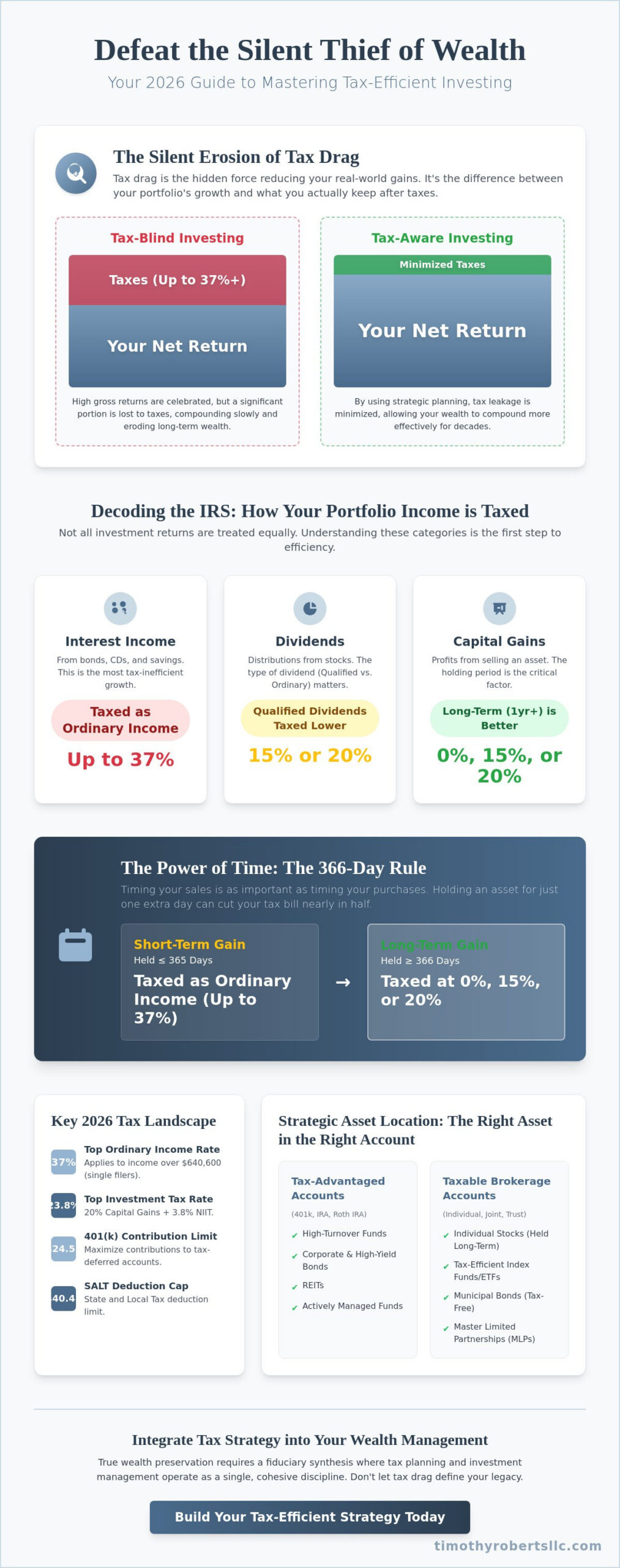
Federal rates act as the primary filter for your investment success. In 2026, ordinary income rates reach as high as 37% for single filers earning over $640,600. Conversely, long-term holdings benefit from preferential treatment. To navigate this, one must understand the nuances of Capital Gains Tax in the U.S., where rates are capped at 20% for high earners. When you add the 3.8% Net Investment Income Tax (NIIT) into the equation, the total tax bite on dividends and gains can exceed 23.8%, making bracket management a critical component of your broader strategy.
Tax-Aware vs. Tax-Blind Investing
Chasing high gross yields without a tax-adjusted lens is a common pitfall. A tax-blind investor might celebrate a high-coupon corporate bond, only to see nearly 40% of that income vanish into federal and state coffers. A fiduciary advisor, however, evaluates every asset through a lens of tax-efficiency. Consider two identical portfolios earning a 7% annual return. If Portfolio A is managed without regard for the tax implications of your investment portfolio, while Portfolio B utilizes strategic tax planning strategies, the difference in terminal wealth after 20 years can be staggering. Portfolio B doesn’t just grow. It endures.
Decoding the Mechanics: How the IRS Views Your Portfolio Income
Understanding the tax implications of your investment portfolio requires a shift in perspective. It’s about recognizing that interest income from bonds or certificates of deposit (CDs) is often the most expensive form of portfolio growth. The IRS treats this income as ordinary income; it’s subject to your highest marginal tax rate. For a high earner in the 37% bracket, more than a third of every interest payment is surrendered immediately. This makes taxable accounts a challenging home for fixed income. These assets are often better suited for retirement accounts where growth is deferred or tax-free.
Dividends offer a more nuanced landscape. While ordinary dividends are taxed at those same high income rates, qualified dividends benefit from preferential treatment. In 2026, most qualified dividends are taxed at 15% or 20% depending on your income level. This distinction is a cornerstone of sophisticated tax planning strategies. It allows you to capture corporate growth while keeping a larger share of the distribution. By intentionally selecting dividend-paying stocks that meet the holding period requirements, you can significantly lower the annual tax burden on your cash flow.
The 366-Day Rule: Managing Holding Periods Strategically
Time is the most effective tool for managing the tax implications of your investment portfolio. The IRS draws a sharp line at the one-year mark. Assets held for 365 days or less are subject to short-term capital gains taxes. These mirror your ordinary income rates. Selling on day 366, however, shifts the asset into the long-term category. For an investor in the top brackets, waiting that single extra day can reduce the tax liability on that gain by nearly half. Strategic selling isn’t just about market timing. It’s about tax timing.
Mutual Fund Capital Gain Distributions
Many investors face a tax surprise in December when mutual funds distribute capital gains. Even if you didn’t sell a single share, the fund manager’s internal trading activity can create a taxable event for you. This is why active management within a mutual fund structure often leads to lower after-tax returns compared to Exchange-Traded Funds (ETFs). According to research from the Brookings Institution on investment taxation, the structural differences between these vehicles significantly impact realized wealth. ETFs generally offer greater efficiency by avoiding the forced distributions common in mutual funds.
Accurate cost basis tracking is the final piece of this mechanical puzzle. Without a precise record of your original investment, you risk overpaying on your gains. Professional investment portfolio management ensures every dollar of basis is accounted for. This prevents the IRS from taking more than its legal share. Understanding these mechanics is the first step toward transforming your portfolio from a tax burden into a streamlined engine for growth.
Strategic Asset Location: Placing Investments for Maximum Efficiency
Asset allocation dictates your risk and reward. Asset location, however, dictates how much of that reward you actually keep. While allocation is the selection of the “what,” location is the strategic determination of the “where.” By viewing your accounts as a single, unified ecosystem, you can optimize the spatial strategy of your wealth. This prevents the unnecessary tax drag discussed earlier from eroding your terminal value. The tax implications of your investment portfolio are often a direct result of placing the right asset in the wrong type of account.
A sophisticated architecture separates assets by their tax personality. Taxable brokerage accounts are the ideal home for growth-oriented equities and long-term capital gains assets. These benefit from lower rates and the ability to control the timing of realization. Conversely, tax-deferred accounts like a 401k or Traditional IRA should house high-turnover strategies or investments that generate heavy ordinary income. Finally, your tax-free Roth accounts represent your most precious financial real estate. These should be reserved for your highest-growth potential assets, ensuring that their eventual appreciation is entirely shielded from the IRS.
A Framework for Account Prioritization
Wealth development is an upward progression. It moves from simple accumulation to a complex journey of distribution and legacy preservation. Maintaining this trajectory requires a disciplined funding hierarchy. Prioritizing Roth contributions and health savings accounts often provides the greatest long-term flexibility. Within this framework, Investment Portfolio Management serves as the regulatory force. It ensures that as you rebalance your holdings to manage risk, you do so across accounts to avoid triggering taxable events in your brokerage holdings. This coordination transforms a collection of accounts into a cohesive wealth engine.
Asset Location for Bonds and Fixed Income
Fixed income requires a surgical approach to placement. High-yield corporate bonds and Real Estate Investment Trusts (REITs) are notoriously tax-inefficient, as their distributions are typically taxed at top ordinary income rates. These are best sequestered within tax-deferred shells. Municipal bonds, however, offer a unique advantage in taxable accounts due to their federal tax-exempt status. In 2026, with the SALT deduction cap set at $40,400, the relative value of tax-exempt income has shifted for many high-earners. Coordinating with professional Tax Advising allows you to calibrate this balance. This ensures your fixed-income strategy provides stability without creating an unintended tax liability. This level of intentionality is what distinguishes a managed portfolio from a mere collection of investments.
Proactive Management: Advanced Strategies to Mitigate Tax Liabilities
The tax implications of your investment portfolio are often viewed as a static consequence of growth. In reality, they are a dynamic variable that can be influenced through deliberate orchestration. Proactive management moves beyond the simple selection of assets. It involves a series of carefully timed interventions designed to neutralize tax drag before it can compound. By treating tax efficiency as a year-round discipline, you transform market volatility from a source of anxiety into a strategic tool for wealth preservation.
The Mechanics of Tax-Loss Harvesting
Tax-loss harvesting is the process of realizing investment losses to offset capital gains. This strategy allows you to capture market declines as a tangible tax asset. Beyond offsetting gains, you can use up to $3,000 of realized losses to reduce your ordinary taxable income each year. Any remaining losses don’t vanish; they carry forward indefinitely. This creates a “tax bank” that you can draw upon in future years to shield significant appreciation. To maintain your market exposure, the proceeds from these sales are typically reinvested in similar, but not identical, securities. This requires strict adherence to the Wash Sale Rule, which prohibits repurchasing the same asset within a 30-day window before or after the sale.
Roth Conversions and Tax Bracket Management
Wealth development is a journey of upward progression that eventually reaches the distribution phase. The “gap years”—the period between retirement and the start of Required Minimum Distributions (RMDs)—offer a unique window for strategic Roth conversions. By intentionally accelerating taxes at today’s known rates, you can shield future growth from potentially higher rates later in life. This maneuver is a cornerstone of sophisticated Retirement Income Planning. It provides you with greater control over your provisional income and can significantly reduce the tax burden on your heirs. Under current rules, Roth accounts are a vital component of Estate Planning, as they bypass the 10-year distribution rule for certain beneficiaries, allowing for tax-free legacy transfers.
For those focused on philanthropy, Qualified Charitable Distributions (QCDs) provide a highly efficient path for legacy giving. This strategy allows individuals over age 70.5 to transfer funds directly from an IRA to a qualified charity. Because the distribution never enters your adjusted gross income, it provides a tax benefit even if you don’t itemize. If you are ready to move from a passive tax stance to an active strategy, it is time to explore the benefits of professional tax-efficient wealth management. These interventions ensure that your portfolio remains a streamlined engine for growth rather than a source of unnecessary liability.
The Fiduciary Synthesis: Integrating Tax Strategy into Wealth Management
True wealth elevation isn’t a product of isolated decisions. It’s the result of a deliberate synthesis. Many high-net-worth individuals treat tax preparation as a reactive, seasonal chore, yet the most successful investors view it as a structural design element. Managing the tax implications of your investment portfolio requires a visionary approach where tax advising and portfolio management operate in total harmony. This integration ensures that your growth isn’t just theoretical; it’s realized, protected, and positioned for upward progression.
A fiduciary partner provides the intellectual curiosity and business-minded rigor necessary to solve complex financial problems. Generic advice often fails to account for the nuances of your specific tax bracket or your long-term estate goals. By moving beyond off-the-shelf solutions, we create carefully crafted interventions that reflect your individual vision. This proactive stance allows us to prepare your wealth for future legislative shifts and the eventual sunset of current tax provisions, ensuring your strategy remains robust regardless of the political climate.
Coordinating Tax and Investment Professionals
The most sophisticated financial plans often encounter friction when tax and investment professionals work in silos. A CPA might focus on the previous year’s liabilities, while an advisor focuses on future market returns. Without a bridge between these disciplines, you risk missed opportunities for tax-loss harvesting or inefficient asset location. Timothy Roberts & Associates, LLC serves as the central architect of your financial life. We synthesize the personal and the professional, creating a single, strategic roadmap that eliminates conflicting advice and streamlines your path to success.
Your Next Steps for a Tax-Efficient 2026
The 2026 fiscal landscape rewards those who act with intention. A passive approach to the tax implications of your investment portfolio is no longer sustainable for those who value quality and depth. Your journey toward a more efficient structure begins with a meticulous audit of your current holdings. This process identifies immediate opportunities to relocate high-tax assets and optimize your contribution levels for the current retirement plan limits.
We invite you to experience a partnership built on trust and high-level expertise. By aligning your portfolio with a sophisticated tax strategy, you gain greater control over your future liabilities and secure the legacy you’ve worked to build. Schedule a consultation today to begin the comprehensive evolution of your wealth management strategy.
Designing a Future of Tax-Efficient Growth
Wealth isn’t merely measured by the growth on a screen. It’s measured by the assets you successfully retain and transfer. We’ve explored how structural tax drag can quietly erode decades of progress and how strategic asset location acts as a primary defense. By mastering the tax implications of your investment portfolio, you shift from a reactive posture to one of visionary control. This transformation ensures that your 2026 strategy is built on a foundation of business-minded rigor and intentional design.
At Timothy Roberts & Associates, LLC, we bring over 25 years of fiduciary wealth management expertise to every partnership. Our integrated tax preparation and investment advisory services provide the depth required for high-net-worth individuals to thrive in a complex regulatory environment. We don’t offer off-the-shelf solutions. Instead, we craft carefully calibrated interventions for your unique financial life.
Elevate your wealth strategy with a comprehensive tax-efficient portfolio review.
Your journey toward a more intentional financial legacy starts with a single, strategic decision. It’s time to align your vision with a roadmap that prioritizes your long-term success. Let’s build that future together.
Frequently Asked Questions
How are capital gains taxes calculated on an investment portfolio?
Capital gains are calculated by subtracting your original cost basis from the realized sale price of an asset. For the 2026 tax year, the IRS categorizes these gains based on your holding period. Short-term gains on assets held for one year or less are taxed at ordinary income rates. Long-term gains benefit from preferential rates of 0%, 15%, or 20%. High earners must also factor in the 3.8% Net Investment Income Tax when assessing the tax implications of your investment portfolio.
What is the difference between ordinary and qualified dividends for tax purposes?
The primary difference lies in the tax rate applied to the distribution. Ordinary dividends are taxed at your standard marginal income tax rate, which can reach 37% for high earners in 2026. Qualified dividends are taxed at lower long-term capital gains rates. To qualify for this lower rate, you must hold the underlying stock for more than 60 days during the 121-day period surrounding the ex-dividend date. This distinction is a vital element of tax-efficient wealth management.
What is a wash sale, and how can I avoid it while tax-loss harvesting?
A wash sale occurs when you sell a security at a loss and repurchase it or a substantially identical security within a 30-day window before or after the sale. If you trigger this rule, the IRS disallows the loss deduction for the current year. To avoid this while tax-loss harvesting, you must wait at least 31 days to repurchase the same asset. Alternatively, you can purchase a similar but not identical security to maintain your market exposure without violating IRS regulations.
Should I prioritize tax-deferred or tax-free accounts for my investments?
Prioritization depends on your current marginal tax rate relative to your expected future rate. Tax-deferred accounts like Traditional 401ks offer immediate tax deductions, while tax-free Roth accounts provide long-term growth shielded from future rate increases. For most high-growth assets, the Roth structure is preferred to maximize the compounding effect of tax-free distributions. A balanced approach often involves diversifying across both structures to manage the tax implications of your investment portfolio during the distribution phase of your life.
How does tax-loss harvesting work when I have both gains and losses?
Tax-loss harvesting works by netting your total realized losses against your total realized gains for the year. If your losses exceed your gains, you can use the excess to offset up to $3,000 of your ordinary income. Any remaining losses don’t vanish; they carry forward to future tax years indefinitely. This strategy allows you to build a tax bank that can neutralize future appreciation, ensuring your portfolio remains a streamlined engine for growth rather than a source of liability.
Are municipal bonds always tax-free at the federal level?
Municipal bonds are generally exempt from federal income tax, though they are not entirely free from tax considerations. Interest from certain private activity bonds may trigger the Alternative Minimum Tax (AMT). For 2026, the AMT exemption is $90,100 for single filers and $140,200 for married couples. Additionally, while federal tax is avoided, you may still owe state taxes if you purchase bonds issued by a state other than your own. Strategic selection is required to ensure these assets provide their intended benefit.
How do Required Minimum Distributions (RMDs) affect my portfolio’s tax efficiency?
RMDs decrease tax efficiency by forcing taxable distributions that may push you into a higher marginal bracket. Starting at age 73 or 75, you must withdraw specific amounts from tax-deferred accounts, which are taxed as ordinary income. These forced withdrawals can also trigger higher Medicare premiums or increase the taxation of Social Security benefits. Proactive strategies, such as early Roth conversions or Qualified Charitable Distributions, are essential to mitigate the impact of RMDs on your long-term wealth trajectory.
Can I use investment losses to lower my regular income tax bill?
You can use investment losses to reduce your regular income tax bill by up to $3,000 per year. This occurs after you have used your losses to offset all realized capital gains for the year. This provides a direct reduction of your taxable income at your highest marginal rate. Losses exceeding this $3,000 threshold are preserved and carried forward to subsequent tax years. This ensures no strategic value is lost, allowing you to maintain a disciplined approach to wealth preservation over time.

