

May
Strategic Charitable Giving Strategies for Tax Benefits: A 2026 Guide for High-Net-Worth Investors
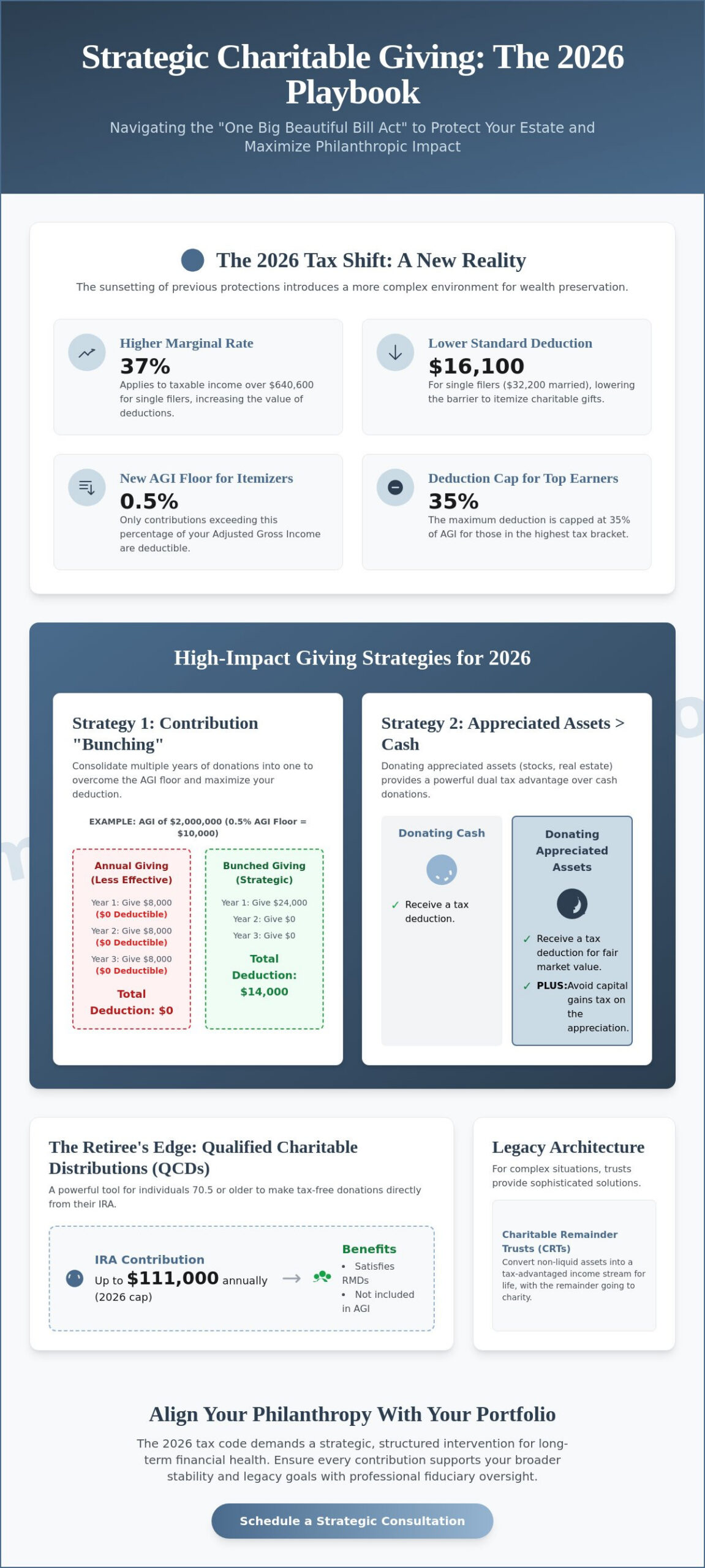
In 2026, your generosity is no longer just a reflection of your values; it’s a primary lever for protecting your estate from the highest tax brackets in a decade. With the implementation of the One Big Beautiful Bill Act, traditional charitable giving strategies for tax benefits require a fundamental shift in perspective to remain effective. You likely recognize that the sunsetting of previous tax protections has created a more complex environment for wealth preservation. The new 0.5% AGI floor for itemizers and the 35% deduction cap for top earners mean that yesterday’s donation habits could lead to significant missed opportunities today.
Discover how to optimize your philanthropic impact while significantly reducing your tax liability through sophisticated 2026 giving frameworks. We will examine the strategic bunching of contributions to overcome new deduction thresholds and the elevated role of Qualified Charitable Distributions, now capped at $111,000. This guide provides the clarity needed to choose between complex trust vehicles and IRA transfers, ensuring your wealth supports meaningful causes while moving efficiently to the next generation. It’s time to treat your philanthropy as a structured intervention for long-term financial health.
Key Takeaways
- Leverage the hierarchy of giving by prioritizing appreciated assets over cash to mitigate capital gains and optimize your deduction potential.
- Master the use of Qualified Charitable Distributions to satisfy annual mandates while insulating your adjusted gross income from unnecessary tax spikes.
- Implement sophisticated charitable giving strategies for tax benefits that bridge your current tax planning with a durable, multi-generational legacy.
- Evaluate the structural nuances of Charitable Remainder Trusts to convert non-liquid assets into a consistent, tax-advantaged income stream for life.
- Align your philanthropic intent with professional fiduciary oversight to ensure every contribution supports your broader portfolio stability and long-term cash flow needs.
Navigating the 2026 Tax Landscape: Why Charitable Giving is Strategic
Philanthropy has evolved beyond simple altruism into a cornerstone of sophisticated wealth management. For the high-net-worth investor, charitable giving strategies for tax benefits serve as a deliberate intervention against the rising tide of tax liabilities. This shift is driven by the realization that your estate’s growth is often tethered to how effectively you can offset taxable income. By understanding the historical context of charitable contribution deductions in the United States, you can better appreciate why the current legislative environment demands a more analytical approach to your annual giving. It’s no longer a passive year-end activity but a structural tool for wealth preservation.
To better understand the mechanics of gift timing and how it impacts your bottom line, watch this helpful video on the power of consolidating your contributions:
The TCJA Sunset and Your 2026 Filing
The expiration of the Tax Cuts and Jobs Act provisions marks a return to a more aggressive tax environment. With the implementation of the One Big Beautiful Bill Act on January 1, 2026, marginal tax rates have adjusted upward, with the top 37% rate now applying to taxable income over $640,600 for single filers. This change significantly increases the value of every dollar deducted. Simultaneously, the standard deduction has decreased to $16,100 for individuals and $32,200 for married couples filing jointly. This reduction effectively lowers the barrier to itemization, making charitable gifts a primary tool for reclaiming control over your taxable exposure and mitigating the “tax torpedo” often encountered during the transition into retirement.
Itemization Thresholds: The New Decision Matrix
Success in 2026 requires navigating the new 0.5% Adjusted Gross Income (AGI) floor for itemizers. For an investor with an AGI of $2,000,000, only contributions exceeding $10,000 provide a federal tax benefit. This new floor, combined with the 35% deduction cap for those in the highest bracket, necessitates a “bunching” strategy. By consolidating multiple years of giving into a single calendar year, you can far exceed the itemization threshold and maximize your effective deduction. Executing this requires precise coordination with your tax advising ann arbor partner to ensure your philanthropic goals align with your broader portfolio’s liquidity and long-term risk profile. This isn’t just about giving; it’s about the architectural integrity of your financial legacy.
High-Impact Strategies: Moving Beyond Cash Donations
While cash remains the most common form of altruism, it is frequently the least efficient tool in a high-net-worth individual’s arsenal. Sophisticated charitable giving strategies for tax benefits prioritize the transfer of appreciated assets over liquid currency. This approach creates a dual advantage: a deduction based on fair market value and the complete elimination of capital gains tax on the appreciation. When you donate a highly appreciated security, you remove the tax liability from your balance sheet without triggering a sale. This allows you to rebalance your holdings while the charity receives the full value of the asset. Adhering to IRS rules on charitable deductions ensures these transfers are executed with the necessary precision to withstand regulatory scrutiny.
One advanced technique for portfolio optimization is the “Part-Gift, Part-Sale” strategy. This involves selling a portion of an asset to recoup your initial investment while donating the remaining appreciated portion to a qualified organization. It’s a surgical way to reduce exposure to a specific sector or concentrated stock position without the friction of a full tax bill. This method transforms a simple act of giving into a deliberate rebalancing event that protects your long-term wealth.
The Power of Appreciated Securities
Selecting the right candidate for donation requires a deep dive into your cost basis and long-term growth projections. Direct stock transfers are particularly effective for assets held for more than one year that have seen substantial growth. By integrating these gifts with your investment portfolio management detroit, you can strategically exit positions that might otherwise carry a heavy tax burden. This method is often superior to selling the asset and donating the cash proceeds. Selling first would require you to pay tax on the gain before the gift is made, reducing the total impact of your contribution.
Donor-Advised Funds: Your Private Foundation Alternative
A Donor-Advised Fund (DAF) acts as a centralized hub for your philanthropic activity, offering the administrative ease of a public charity with the strategic control of a private foundation. In 2026, contributing to a DAF allows for an immediate tax deduction, even if you don’t intend to distribute the funds to specific charities until future years. This is especially useful during high-income years when you need to maximize deductions to offset the 35% cap on itemized benefits. Under 2026 regulations, cash contributions to DAFs are limited to 60% of AGI, while appreciated assets are capped at 30%. Maintaining fiduciary oversight ensures that these assets continue to grow tax-free within the fund, magnifying your eventual impact. For a tailored review of how these vehicles fit your current plan, you can explore our wealth management solutions.
The Retiree Advantage: Qualified Charitable Distributions (QCDs)
For the affluent retiree, the intersection of altruism and cash flow management finds its most potent expression in the Qualified Charitable Distribution (QCD). While we previously examined the benefits of donor-advised funds and appreciated securities, the QCD offers a unique structural advantage: it bypasses the tax return entirely. By executing a direct transfer from your IRA to a qualified 501(c)(3) organization, you effectively remove that income from your tax liability before it ever touches your bank account. This makes it one of the most resilient charitable giving strategies for tax benefits available in 2026, particularly for those who no longer find it advantageous to itemize their deductions. It’s a frictionless transfer that turns a mandatory obligation into a meaningful legacy.
The primary allure of the QCD lies in its status as an “invisible deduction.” Since the distribution is excluded from your Adjusted Gross Income (AGI), you receive the full tax benefit of the gift even if you claim the 2026 standard deduction of $16,100 for single filers or $32,200 for married couples. It’s a surgical strike against taxable income that doesn’t rely on the complex itemization math or the new 0.5% AGI floor that now impacts other forms of giving. This exclusion is often superior to a standard deduction because it lowers the baseline for various income-based calculations throughout your financial profile.
Optimizing RMDs and AGI
Lowering your AGI isn’t just about federal income tax; it’s a strategic move to protect your retirement liquidity. A lower AGI can reduce your exposure to Medicare Part B and Part D surcharges, commonly known as IRMAA. By using a QCD to satisfy your Required Minimum Distribution (RMD), you prevent that mandatory withdrawal from inflating your income and triggering these higher premiums. This coordination is a core component of a sophisticated retirement income planning ann arbor framework, where we treat every distribution as a variable in a larger tax-efficiency equation. It’s about ensuring your mandatory withdrawals serve your philanthropic intent rather than just increasing your tax exposure.
Rules and Limits for the 2026 Tax Year
To maintain compliance, you must adhere to the specific thresholds established for the 2026 tax year. The maximum annual QCD limit has been adjusted for inflation to $111,000 per individual. Additionally, the 2025 OBBBA legislation permits a one-time QCD of up to $55,000 to a split-interest entity, such as a charitable remainder trust, providing a unique bridge between immediate giving and long-term legacy planning. You must be at least 70.5 years old at the time of the transfer to qualify. We recommend initiating these transfers early in the fiscal year to ensure they are properly credited against your RMD and to avoid the administrative congestion that often occurs in late December. Proper documentation is essential; ensure you receive a written acknowledgment from the charity that no goods or services were received in exchange for the gift.
Legacy Architecture: Charitable Remainder and Lead Trusts
True wealth preservation requires moving beyond annual tax cycles to build a durable structural framework. By integrating philanthropy into a strategic legacy, you transform charitable intent into a sophisticated estate planning tool. These charitable giving strategies for tax benefits utilize irrevocable trusts to shield assets from federal estate tax while providing for your family and your chosen causes. In a 2026 environment where the gift and estate tax exemption is established at $15 million for individuals and $30 million for married couples, these vehicles are essential for those seeking to transfer substantial wealth. They serve as a primary defense against the 40% tax penalty on assets that exceed these permanent thresholds.
Charitable Remainder Trusts (CRTs) for Income Generation
A Charitable Remainder Trust allows you to donate assets to a trust that pays you an income for a set term or for life. The remaining assets then pass to your designated charity. This is a powerful intervention for diversifying out of a highly concentrated, appreciated stock position. By transferring the stock to the CRT, the trust can sell the asset without an immediate capital gains tax hit, reinvesting the full proceeds to generate a higher yield. You must choose between a Charitable Remainder Annuity Trust (CRAT) for a fixed annual payment or a Charitable Remainder Unitrust (CRUT) for variable income that scales with the trust’s performance. As of early 2026, the Section 7520 rate stands at approximately 4.6%. This figure is critical; it dictates the present value of your charitable deduction and determines the minimum remainder interest required by the IRS.
Charitable Lead Trusts (CLTs) for Wealth Transfer
While the CRT provides for the donor first, the Charitable Lead Trust reverses this sequence by supporting the charity for a specific term before passing the remaining assets to your heirs. This functions as a “discounted” wealth transfer tool. Because the charity receives the “lead” interest, the taxable value of the gift to your children is significantly reduced. A Grantor CLT can offer immediate income tax relief in high-earnings years, while a Non-Grantor CLT removes the assets and their future appreciation from your taxable estate entirely. Selecting the right term of years is a matter of precision. Longer terms increase the gift tax leverage, allowing you to pass more value to the next generation with minimal tax friction. It’s a calculated journey of upward progression for your family’s balance sheet.
Designing these structures requires a deep understanding of your long-term liquidity needs and your vision for the future. We invite you to refine your approach with our estate and legacy planning advisors to ensure your trust architecture is as resilient as it is impactful.
Fiduciary Oversight: Aligning Purpose with Portfolio
Effective philanthropy requires more than just intent; it demands rigorous orchestration. As we’ve explored through the lenses of asset transfers and legacy trusts, the most successful charitable giving strategies for tax benefits aren’t isolated events. They are integrated components of a broader financial architecture. When you treat your philanthropic intent as a variable within a larger wealth management strategy, you create a synergy that transcends simple donation. This approach ensures that your generosity doesn’t inadvertently disrupt your long-term risk tolerance or create unexpected liquidity constraints. It’s about moving from reactive, year-end checks to a proactive, year-round model of wealth evolution.
At Timothy Roberts & Associates, LLC, we act as a fiduciary partner in this journey. We recognize that your financial life is not a collection of off-the-shelf solutions but a carefully crafted narrative. Our role is to provide the intellectual curiosity and business-minded rigor necessary to solve complex problems, ensuring that every gift you make is calibrated for maximum impact on both the recipient and your own balance sheet. Precision matters when navigating the 2026 tax environment, and a dedicated partner ensures no detail is overlooked.
The Intersection of Aesthetics and Functionality in Giving
Your financial legacy should be as meticulously balanced as a high-end gallery. We view the intersection of aesthetics and functionality as the point where your personal values meet structured corporate capabilities. A rhythmic giving plan mirrors your values by aligning the timing of your contributions with the natural ebbs and flows of your income. For example, using a high-income year to “bunch” contributions into a donor-advised fund allows you to maintain a steady cadence of grants to your favorite causes while front-loading the tax relief. This isn’t just a transaction; it’s a journey of upward progression that treats development as a continuous process rather than a static goal.
Selecting a Strategic Partner for Your Philanthropy
Choosing the right advisor is a critical decision for any high-net-worth investor. You need a visionary strategist who understands the specific nuances of the Michigan tax landscape while maintaining a global perspective on wealth preservation. When evaluating your current advisory relationship, ask how they are specifically adjusting your 2026 charitable strategy to account for the new 0.5% AGI floor and the 35% deduction cap. A comprehensive roadmap must synthesize your estate and legacy planning with your annual tax planning strategies. Timothy Roberts & Associates, LLC focuses on building these multi-disciplinary frameworks, ensuring that your charitable interventions are as resilient as they are impactful. By bridging individual creative vision with professional stability, we help you build a legacy that stands the test of time.
Architecting Your 2026 Philanthropic Legacy
The 2026 tax landscape demands a departure from traditional, reactive philanthropy. By transitioning from simple cash donations to the strategic transfer of appreciated securities and the targeted use of Qualified Charitable Distributions, you transform a moral imperative into a structural asset. These sophisticated charitable giving strategies for tax benefits ensure your impact is maximized while your tax liability is meticulously managed. Whether you’re utilizing the income generation of a Charitable Remainder Trust or the generational wealth transfer of a Lead Trust, your legacy deserves a framework as intentional as the wealth you’ve built.
Securing your financial future while supporting the causes you value requires a multi-disciplinary approach that synthesizes tax, estate, and investment goals. With over 25 years of strategic wealth management expertise, our fiduciary advisors focus on creating a personalized wealth architecture tailored to your unique evolution. We invite you to partner with a fiduciary strategist to elevate your 2026 giving plan. Your journey toward a more impactful and efficient legacy begins with a single, deliberate step toward professional alignment. It’s time to ensure your generosity works as hard as your portfolio.
Frequently Asked Questions
How do charitable giving strategies change with the 2026 tax law sunset?
The expiration of previous tax provisions increases the strategic value of itemization as marginal tax rates rise. Because the top federal rate returns to 37% and the standard deduction decreases, your charitable giving strategies for tax benefits must account for the new 0.5% AGI floor and the 35% cap on the value of itemized deductions. These shifts require more precise timing and the use of sophisticated vehicles to maintain the same level of tax efficiency as in previous years.
Can I still claim a tax deduction for charitable giving if I take the standard deduction?
You can claim a specific “above-the-line” deduction for cash donations even if you don’t itemize. In 2026, single filers can deduct up to $1,000 and married couples filing jointly can deduct up to $2,000 for cash gifts to qualified charities. It’s important to remember that contributions to donor-advised funds don’t qualify for this specific non-itemizer deduction, making direct cash gifts the primary path for this benefit.
What is the most tax-efficient asset to donate to charity in 2026?
Long-term appreciated securities remain the most effective assets for high-net-worth donors. By transferring stocks or ETFs held for more than one year directly to a charity, you eliminate the capital gains tax you’d owe upon a sale and receive a deduction for the asset’s full fair market value. This dual benefit makes asset-based giving far superior to cash donations for those with highly appreciated portfolios.
How does a Donor-Advised Fund (DAF) differ from a Private Foundation?
A Donor-Advised Fund provides the administrative ease and lower cost of a public charity, while a Private Foundation offers maximum control with significantly higher overhead. DAFs allow for an immediate tax deduction and tax-free growth without the complex reporting or minimum payout requirements of a foundation. For many investors, a DAF serves as a more agile tool for executing personalized charitable giving strategies for tax benefits.
What is the maximum amount I can contribute via a QCD in 2026?
The maximum Qualified Charitable Distribution limit is $111,000 per individual for the 2026 tax year. This inflation-adjusted threshold allows retirees aged 70.5 and older to transfer funds directly from their IRA to a qualified charity. These distributions satisfy Required Minimum Distribution mandates without increasing your Adjusted Gross Income, which helps protect you from higher Medicare premiums.
Can a Charitable Remainder Trust (CRT) help me avoid capital gains tax?
A Charitable Remainder Trust allows you to defer or eliminate immediate capital gains tax when selling highly appreciated assets. When you transfer an asset to a CRT, the trust can sell it tax-free and reinvest the entire proceeds to generate an income stream for you or your heirs. You only pay taxes on the income distributions you receive, while the remaining assets eventually support your chosen charitable causes.
What happens if I donate more than the IRS AGI limit in a single year?
Excess charitable contributions that exceed the annual Adjusted Gross Income limits aren’t lost; they can be carried forward for up to five years. This carry-forward rule applies to both cash gifts, which are capped at 60% of AGI, and appreciated asset gifts, which are capped at 30% of AGI. This allows you to execute large, impactful gifts during high-income years while spreading the tax benefits over a longer horizon.
How do I document non-cash charitable contributions for the IRS?
Proper documentation is essential to survive an audit and varies based on the gift’s value. You must obtain a contemporaneous written acknowledgment from the charity for any gift over $250. For non-cash contributions exceeding $500, you’re required to file IRS Form 8283, and assets valued over $5,000 generally require a qualified appraisal from a certified professional to substantiate the deduction.
