

May
Strategic Tax Advising for Investors: Maximizing After-Tax Wealth in 2026
Your tax preparer is likely costing you far more than their annual fee. While they focus on the rearview mirror of April 15th, your wealth is quietly eroding under the weight of unmanaged tax drag. Most investors accept this friction as inevitable, but true wealth preservation requires a more sophisticated lens. You deserve a partner who treats tax liability as a controllable investment risk rather than a fixed cost of doing business. Strategic tax advising for investors shifts the focus from simple compliance to intentional wealth architecture.
We understand the frustration of a disconnected financial life where your CPA looks backward and your advisor only looks forward. This gap creates missed opportunities, especially as we navigate the permanent shifts brought by the One Big Beautiful Bill Act. Discover how an integrated approach transforms your portfolio from a collection of assets into a tax-efficient engine for long-term growth. This article previews the essential strategies for 2026, from maximizing the new $24,500 401k contribution limits to aligning your estate and legacy planning with current exemptions. It’s time to replace fragmented advice with a unified strategy that lowers your lifetime tax liability and secures your financial future.
Key Takeaways
- Stop measuring success by gross returns. Learn how tax drag quietly erodes your wealth over time and why net-after-tax results are the only metric that truly matters for your legacy.
- Move beyond the “autopsy” of annual tax filing. Discover how strategic tax advising for investors transforms tax liability from a surprise expense into a manageable investment risk.
- Master advanced portfolio techniques. We explore how systematic tax-loss harvesting and municipal bonds create a more resilient, tax-sensitive fixed-income strategy.
- Navigate critical lifecycle milestones. Understand how to optimize the “tax bridge” before Social Security and maximize Roth conversions during your peak accumulation years.
- Build a unified wealth architecture. See why a fiduciary advisor must integrate tax planning strategies directly into your investment portfolio management to ensure sustainable progression.
The Silent Erosion: How Taxes Impact Long-Term Investment Returns
Think of your investment portfolio as a high-performance engine. You spend considerable time tuning the asset allocation and vetting the underlying securities. Yet, without strategic tax advising for investors, a significant portion of your power is lost to friction. This friction is tax drag. It represents the portion of your potential return that the government claims before you can reinvest it. Most people view the IRS as a distant entity they settle with every spring. In reality, the government is a non-voting partner in your portfolio, holding a claim on your growth that fluctuates based on your strategic choices.
Gross returns are a vanity metric. A portfolio that grows by 10% but loses 3% to taxes is effectively underperforming a more modest 8% return that is structured for tax efficiency. As we enter 2026, the landscape has changed. The One Big Beautiful Bill Act has made many individual tax provisions permanent, providing a stable foundation for long-term wealth architecture. However, with the top tax bracket remaining at 37% for single filers earning over $640,600, the cost of a backward-looking strategy remains high. Failing to account for these thresholds can trigger unexpected liabilities that stall your financial progression.
To better understand how these variables influence your net wealth, watch this helpful video:
Quantifying the Cost of Inefficient Investing
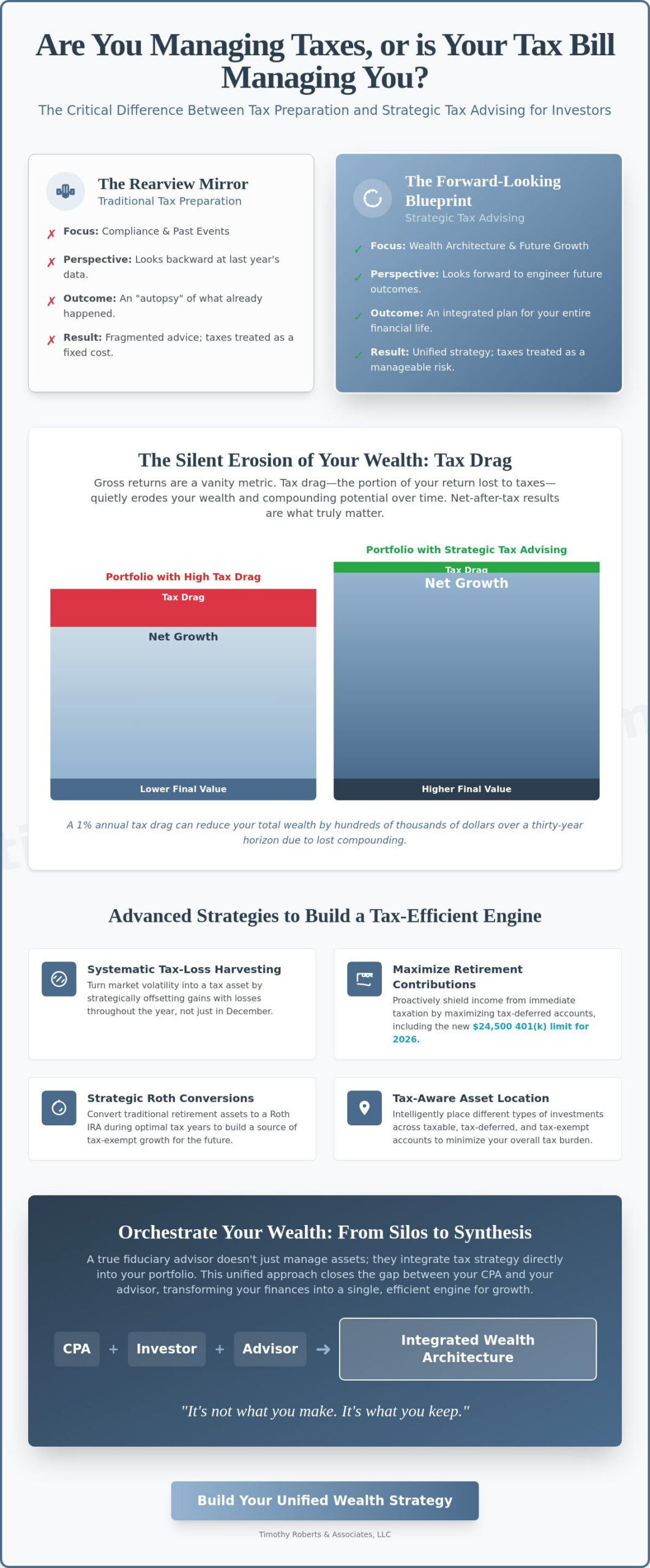
The math of inefficiency is staggering. A 1% annual tax drag can reduce your total wealth by hundreds of thousands of dollars over a thirty-year horizon. This loss isn’t just a one-time fee; it is the loss of future compounding on those dollars. High-income earners face specific hurdles, such as the 3.8% Net Investment Income Tax (NIIT). For these individuals, tax advising for investors focuses on the critical difference between tax-deferred accounts and tax-exempt growth. With 401(k) employee contribution limits rising to $24,500 in 2026, the opportunity to shield income from immediate taxation is expanding, but it requires a proactive rather than reactive approach.
The Fiduciary Duty of Tax-Awareness
A true fiduciary doesn’t just look at what you make. They look at what you keep. Every trade carries a tax consequence that must be weighed against the potential gain. Many investors are blindsided by accidental capital gains distributions from mutual funds, where they owe taxes on gains they didn’t even realize. Sophisticated strategies like tax-loss harvesting allow you to turn market volatility into a tax asset by offsetting realized gains with losses. Evaluating advisor performance on a net-of-tax basis ensures your portfolio is an engine for growth, not just a collection of assets. This synthesis of investment portfolio management and tax planning strategies is what distinguishes a visionary strategist from a simple asset manager.
Beyond Basic Deductions: Advanced Tax-Aware Investment Strategies
Execution is the hallmark of a sophisticated portfolio. While basic tax preparation focuses on past actions, advanced tax advising for investors involves the deliberate engineering of future outcomes. This requires a shift from passive holding to active management of tax liabilities. Systematic tax-loss harvesting, for instance, should not be a year-end scramble. Instead, it is a disciplined, year-round process of capturing losses to offset gains, effectively creating a tax asset that can be carried forward. Understanding the nuances of investment income, as detailed in IRS Publication 550, is essential for maintaining this balance.
For high-net-worth individuals, municipal bonds often serve as a cornerstone of a tax-sensitive fixed-income strategy. These instruments provide federal tax-exempt interest, which is particularly valuable for those in the 37% bracket. Beyond traditional fixed income, specialized vehicles like Qualified Opportunity Zones (QOZs) offer a powerful method for deferring and potentially reducing capital gains taxes on highly appreciated assets. When combined with charitable lead or remainder trusts, these tools transform simple wealth into a structured legacy. This level of tax planning strategies ensures that your financial evolution remains unburdened by unnecessary friction.
Asset Location vs. Asset Allocation
Asset allocation determines your risk; asset location determines your net return. It is a common mistake to place high-dividend stocks or REITs in a standard brokerage account where they are taxed annually at ordinary rates. A strategic architect places these yield-heavy assets in tax-deferred accounts like a 401(k) or IRA. Conversely, assets with high growth potential and low turnover are better suited for taxable accounts or Roth IRAs. This hierarchy ensures that every dollar is positioned where it can compound most efficiently based on its specific tax characteristics.
Strategic Withdrawal Sequencing
The order in which you access your funds during retirement can drastically alter your lifetime tax bill. Many investors fall victim to the “Pro-Rata” rule, which can complicate IRA distributions by mixing pre-tax and after-tax dollars. A sophisticated withdrawal sequence typically prioritizes taxable accounts first, followed by tax-deferred, and finally tax-free Roth assets. This intentional timing helps manage tax bracket creep, preventing a spike in income from pushing you into a higher marginal rate or triggering increased Medicare premiums. Success in this phase requires foresight and a deep understanding of how current distributions impact future tax obligations.
Tax Preparation vs. Strategic Tax Advising: Understanding the Critical Difference
Most investors mistake compliance for strategy. Tax preparation is essentially an autopsy. It is the meticulous recording of historical data to satisfy the IRS that your reporting is accurate for the previous year. While necessary, this backward-looking exercise does nothing to improve your net worth. Strategic tax advising for investors, by contrast, is architecture. It’s a forward-looking partnership where every financial decision is evaluated for its future tax impact before the transaction occurs. If you only speak to your tax professional in the spring, you aren’t planning; you’re simply reporting the results of a plan you didn’t know you had.
The disconnect often becomes visible when you receive your 1099-B in February. By the time a traditional CPA reviews your capital gains and losses, the window for meaningful action has closed. They can tell you what you owe, but they cannot go back in time to harvest a loss or restructure a distribution. A year-round advisory calendar ensures that your investment portfolio management and tax planning strategies move in lockstep. This proactive approach treats your tax return as a reflection of a well-executed strategy rather than a surprise bill that arrives once a year.
The Reactive Trap: Why April 15th is Too Late
The calendar is the greatest enemy of the unadvised investor. Most significant tax-saving moves must be executed by December 31st to be effective for that tax year. Traditional accounting firms often suffer from “tax season” tunnel vision, focusing entirely on high-volume filing from January through April. This leaves little room for the deep, strategic thinking required to navigate complex regulatory changes. Proactive advising prevents tax surprises by modeling scenarios throughout the year. This allows for intentional shifts in income or deductions while the clock is still on your side.
Bridging the Communication Gap
Wealth erosion often happens in the silence between your financial advisor and your tax preparer. Timothy Roberts & Associates, LLC acts as the Chief Financial Officer of your household, bridging this gap to ensure a unified strategy. We coordinate directly with your existing tax professionals to create a seamless data flow between your tax-advantaged accounts and your annual returns. This synthesis of creative vision and business rigor ensures that your investment portfolio management isn’t happening in a vacuum. By integrating these disciplines, we transform fragmented advice into a cohesive roadmap for upward progression.
Tax Milestones for the Modern Investor’s Lifecycle
Tax advising for investors must evolve as you move through different stages of wealth creation and preservation. In the accumulation phase, the primary objective is to maximize the efficiency of every dollar earned. For 2026, the employee contribution limit for 401(k) plans has increased to $24,500, with catch-up contributions for those over 50 reaching $8,000. High-income earners should pay close attention to the “Rothification” trend. Starting this year, catch-up contributions for high earners in employer plans must be made on a Roth basis. This shift requires a meticulously balanced approach to ensure you aren’t over-concentrating in a single tax bucket.
The transition into the distribution phase introduces a new set of variables that can impact your net income. Strategic portfolio management must account for Required Minimum Distributions (RMDs) and the potential for increased Medicare Part B premiums, often referred to as IRMAA. These surcharges are triggered by your modified adjusted gross income from two years prior, meaning a large capital gain today could increase your healthcare costs in the future. A forward-looking strategist treats these milestones as foreseeable events rather than unexpected expenses, allowing for intentional income timing that preserves your purchasing power.
Navigating the ‘Tax Valley’ in Early Retirement
The Tax Valley is the specific window of time between your retirement date and the commencement of Required Minimum Distributions. This period represents a unique tactical opportunity for high-net-worth households. Because your earned income has ceased but RMDs haven’t yet begun, you may find yourself in a lower tax bracket than ever before. This is the optimal time to perform strategic Roth conversions. By moving assets from a traditional IRA to a Roth IRA during these low-income years, you effectively “lock in” current tax rates and eliminate future tax liability on that capital. The SECURE Act 2.0 has extended this window by pushing back the RMD starting age, providing more time for these high-impact interventions.
Estate and Legacy Tax Considerations
The final phase of a successful financial journey is the transition of wealth to the next generation. Professional estate planning ensures that your legacy is defined by your impact rather than your tax bill. In 2026, the federal estate and gift tax exemption has been set at $15 million per individual, offering a significant opportunity for tax-free transfers. One of the most critical tools in this phase is the “step-up in basis,” which allows heirs to inherit brokerage accounts at their current market value, effectively erasing decades of capital gains. Combining this with philanthropic strategies, such as charitable remainder trusts, can further reduce your taxable estate while supporting the causes you value most. If you’re ready to align your legacy with a proactive strategy, explore our integrated approach to wealth management.
Orchestrating Your Wealth: The Case for Integrated Tax and Investment Advisory
True financial evolution is an orchestration, not a series of isolated transactions. At Timothy Roberts & Associates, LLC, we view your portfolio as a dynamic ecosystem where creative vision meets business rigor. This synthesis allows us to move beyond the fragmented advice common in traditional firms. By adopting a “Tax-First” philosophy, we ensure that every investment decision is filtered through its potential impact on your net wealth. Effective tax advising for investors isn’t a secondary consideration; it’s the primary framework through which we build and protect your legacy.
Adopting an asset-based management model with integrated tax oversight provides a level of clarity that off-the-shelf solutions cannot match. Instead of managing a collection of independent accounts, we curate a polished, intentional roadmap that accounts for the nuances of your professional and personal life. This approach replaces financial clutter with a streamlined strategy designed for upward progression. We treat your capital with the respect it deserves, ensuring that the work of a lifetime isn’t eroded by preventable tax friction. By aligning your personal ambitions with structured corporate capabilities, we create a human-led, results-driven identity for your wealth.
The Fiduciary Advantage
Our commitment to your success is rooted in a fiduciary duty that prioritizes your best interests above all else. This means rejecting generic products in favor of personalized financial strategies. We leverage over 25 years of experience to solve the complex tax-investment puzzles that high-net-worth households often face. Our investment portfolio management philosophy is built on the belief that a portfolio should be as unique as the individual it serves. This dedication to depth over superficiality ensures that your wealth is positioned to thrive in the shifting regulatory climate of 2026.
Your Next Steps Toward Tax Efficiency
The journey toward a more efficient financial life begins with a thorough assessment of your current landscape. During an initial consultation, we focus on identifying the “low-hanging fruit.” These are the immediate opportunities to reduce tax drag that are often overlooked by backward-looking preparers. Our process doesn’t end with a single plan; it involves continuous monitoring and proactive adaptation. As legislative changes occur, we refine your strategy to maintain its efficacy. If you’re ready to transform your portfolio into a tax-efficient engine for growth, we invite you to Request a Strategic Tax and Investment Consultation. This is the first step in moving from a passive collection of assets to a meticulously crafted wealth engine.
Securing Your Legacy Through Intentional Architecture
Your wealth is a journey of upward progression. It shouldn’t be stalled by the friction of unmanaged tax drag. By shifting from reactive reporting to proactive architecture, you transform your portfolio into a resilient engine for growth. This intentional approach ensures that every distribution and every trade serves your long-term vision rather than just a compliance requirement. True tax advising for investors is about more than just numbers; it’s about the confidence that comes from a unified financial strategy.
The complexity of the 2026 tax landscape demands more than just a seasonal check-in. It requires a dedicated partner who treats tax liability as a controllable investment risk. Timothy Roberts & Associates, LLC brings over 25 years of fiduciary wealth management experience to this challenge. Our integrated team synthesizes tax preparation and investment advisory into a single, cohesive strategy tailored to the unique needs of high-net-worth households. We don’t offer off-the-shelf solutions; we provide carefully crafted interventions that align with your specific ambitions.
Don’t let your financial future be defined by fragmented advice. Take the first step toward a polished, intentional wealth roadmap. Schedule a Strategic Tax and Investment Consultation with Timothy Roberts & Associates, LLC today. You have the power to master your tax outcomes and secure the legacy you’ve worked so hard to build.
Frequently Asked Questions
What is the difference between a tax preparer and a tax advisor?
A tax preparer focuses on historical compliance and the accurate filing of returns based on events that have already occurred. In contrast, tax advising for investors is a forward looking discipline that treats tax liability as a controllable investment risk. While the preparer records the results of your past year, the advisor builds the strategic architecture to optimize your future net wealth.
Can a financial advisor give specific tax advice?
Most traditional advisors provide only general information and include disclaimers due to regulatory constraints. However, a firm that integrates investment portfolio management with tax planning strategies can provide specific, actionable guidance. This unified approach ensures that every trade and distribution is evaluated for its tax impact before the transaction is executed, providing a seamless financial experience.
How does tax-loss harvesting actually save me money?
Tax loss harvesting involves selling underperforming assets to realize a loss, which you then use to offset capital gains realized elsewhere in your portfolio. If your total losses exceed your gains, you can use up to $3,000 to offset ordinary income. This strategy lowers your immediate tax bill and allows those saved dollars to remain invested and compound over time.
What is asset location and why does it matter for my portfolio?
Asset location is the intentional placement of specific investments into the account types that offer the most favorable tax treatment. For example, placing high dividend stocks in tax deferred accounts protects that yield from annual taxation. While asset allocation manages your risk profile, asset location is the primary driver for maximizing your net, after tax returns over the long term.
How will the 2026 tax law changes affect my investments?
The 2026 landscape is shaped by the permanence of many provisions from the One Big Beautiful Bill Act, including updated brackets and contribution limits. For instance, the employee 401(k) limit has risen to $24,500, and high earners must navigate the 37% top bracket for income over $640,600. These confirmed thresholds require precise income timing to avoid bracket creep and minimize surtaxes on investment income.
Is integrated tax advising only for high-net-worth investors?
While high net worth households often face the most complex puzzles, integrated tax advising for investors provides significant value for anyone seeking to preserve capital. The compounding effect of reducing tax drag by even a small percentage can lead to substantially higher wealth over a thirty year horizon. It is a strategic necessity for those who value personal attention and high level expertise.
How do you coordinate with my current CPA?
We serve as the Chief Financial Officer of your household, ensuring a unified data flow between your investment accounts and your tax professional. Our team coordinates directly with your CPA to provide the necessary documentation and forward looking projections they need for accurate filing. This partnership eliminates the communication gap that often leads to missed opportunities or unexpected tax surprises.
What are the tax implications of rebalancing my investment portfolio?
Rebalancing requires selling assets that have appreciated, which can trigger capital gains taxes in taxable brokerage accounts. A tax aware strategist manages this by prioritizing rebalancing within tax advantaged accounts or using new contributions to buy underrepresented assets. This disciplined method maintains your target risk level without creating unnecessary tax friction that could otherwise erode your portfolio’s growth potential.
