

Jun
The Strategic Role of a Financial Advisor in Estate Planning for Michigan Families
What if your meticulously drafted trust remains an empty vessel because your brokerage accounts were never properly titled to fund it? It’s a sophisticated risk that many Michigan families overlook, assuming that a signature on a legal document is the final step in securing a legacy. You likely value the peace of mind that comes with a completed estate plan, yet the disconnect between legal counsel and financial management often creates a quiet vulnerability where assets can slip through the cracks of technicality.
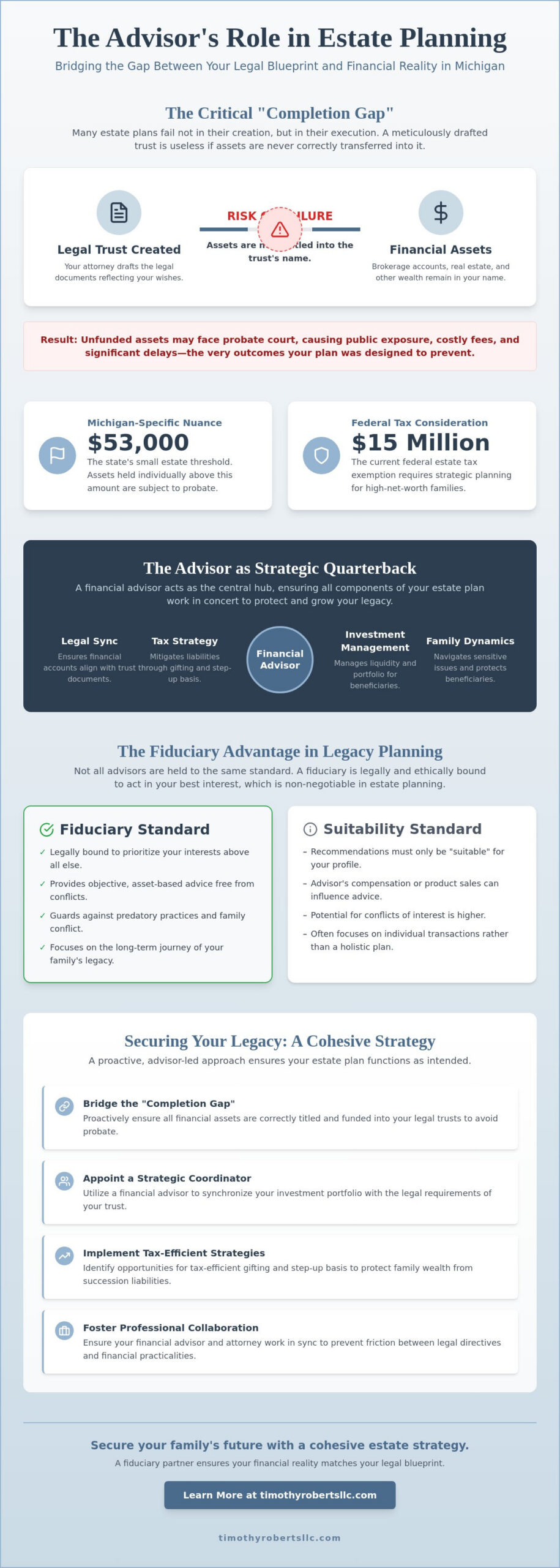
The strategic role of a financial advisor in estate planning michigan is to bridge this gap, ensuring that your vision moves from the attorney’s desk to the active orchestration of your wealth. By aligning your investment portfolio with your legal intent, a fiduciary partner helps you navigate the permanent $15 million federal exemption and the nuances of Michigan’s $53,000 small estate threshold with precision. We will examine how professional oversight of trust funding and strategic tax mitigation creates a cohesive strategy where every financial piece matches your legal blueprint, securing your family’s future against unnecessary probate delays and administrative friction.
Key Takeaways
- Learn how to bridge the “completion gap” where most estate plans fail by ensuring your financial assets are correctly aligned with your legal documents.
- Discover the pivotal role of a financial advisor in estate planning michigan as the strategic coordinator who synchronizes your investment portfolio with your trust requirements.
- Identify tax-efficient gifting strategies and step-up basis opportunities that protect your family’s wealth from unnecessary succession liabilities.
- Explore how a collaborative model between your advisor and attorney prevents friction when legal directives meet the practicalities of investment liquidity.
- Understand why a fiduciary approach is vital for the ongoing evolution of your legacy, treating estate management as a journey rather than a one-time transaction.
The Financial Advisor as Strategic Quarterback in Estate Management
Estate planning is often viewed as a static legal requirement, but for families seeking true legacy preservation, it’s an ongoing orchestration of diverse interests. A visionary advisor serves as the central hub, connecting the disparate spokes of legal documentation, tax strategy, and investment management. To establish a baseline, one might ask, What is Estate Planning? at its core; it’s the arrangement of your affairs to ensure your wishes are honored and your heirs are protected. Without a coordinator to synchronize these elements, even the most sophisticated documents can fail during the execution phase.
The role of a financial advisor in estate planning michigan is to act as a strategic quarterback, ensuring that the legal blueprint provided by your attorney is actually executable within your financial reality. This involves identifying life triggers, such as a business sale, a change in Michigan’s tax laws, or a shift in family dynamics, before they escalate into administrative crises. By maintaining a high-level view of your entire financial ecosystem, the advisor ensures that every move supports your long-term evolution.
To better understand how these pieces fit together within the local landscape, watch this helpful video:
The Fiduciary Advantage in Legacy Planning
The distinction between a fiduciary advisor and one held only to a suitability standard is the cornerstone of trust in legacy management. A fiduciary is legally and ethically bound to prioritize your interests above all else, including their own compensation or product sales. This standard is vital when the role of a financial advisor in estate planning michigan involves protecting vulnerable beneficiaries or managing complex wealth transfers. If your legacy includes providing for a loved one with disabilities, you can learn more about Special Needs Financial Consultation to ensure their care is sustained for two lifetimes. Fiduciary oversight provides an objective, asset-based perspective that guards against predatory financial practices and ensures that your estate remains a vehicle for your family’s upward progression rather than a source of conflict.
Synthesizing Personal Vision with Corporate Capabilities
High-net-worth families often possess a creative vision for their legacy that exceeds the bounds of standard legal forms. Bridging the gap between these personal aspirations and structured financial execution requires a partner who understands both the art of the family narrative and the rigor of corporate capabilities. We move beyond disconnected transactions to create a narrative of partnership. This approach positions the advisor as a high-end partner for family evolution, where customized interventions are designed to reflect your unique values. It’s a journey of intentional growth, ensuring that your financial structure is as resilient and sophisticated as the legacy you’ve built.
Closing the Completion Gap: From Legal Documents to Funded Reality
A signed trust is a sophisticated blueprint, but it isn’t a finished structure. For many Michigan families, the transition from legal documentation to a funded reality is where the legacy journey falters. Industry professionals frequently observe a significant completion gap, noting that a high percentage of estate plans fail because the assets were never properly transferred into the trust. This implementation failure triggers the very probate process the plan was designed to avoid. The role of a financial advisor in estate planning michigan is to close this gap through meticulous execution and funding oversight, ensuring your vision moves from paper to practice.
Unfunded assets are a primary driver of administrative friction. If an asset remains in an individual’s name and exceeds the Michigan small estate threshold, which is $53,000 for dates of death in 2026, it must pass through probate court. This process is often slow, public, and costly. By acting as a strategic partner, a fiduciary advisor ensures that your financial architecture is fully populated, protecting your heirs from the technicalities that often derail even the most expensive legal plans.
The Mechanics of Asset Re-titling
Asset re-titling is a deliberate process of aligning your brokerage accounts, private equity holdings, and closely held business interests with your trust’s specific directives. It isn’t a one-time event but a discipline of continuous monitoring. As you acquire new properties or open new investment accounts, each must be titled correctly from day one. We provide step-by-step guidance to ensure that your financial institutions recognize your trust as the owner, preventing assets from “falling out” of the plan. This level of oversight transforms a static document into a living strategy for upward progression.
Coordinating Beneficiary Logic Across Portfolios
A common point of friction occurs when an outdated 401(k) or life insurance designation contradicts the instructions in a will. Consider the technical difference between “per stirpes” and “per capita” designations; a single misunderstanding here can redirect substantial wealth away from your intended heirs. Your investment portfolio management Detroit must mirror your estate documents to prevent these administrative tragedies. We’ve seen cases where a single forgotten beneficiary form from a decades-old account derailed an entire legacy strategy. Secure your family’s future by integrating your financial execution with our estate and legacy planning expertise, ensuring your vision is backed by a funded reality.
Navigating Michigan-Specific Regulations and Tax Nuances
Michigan’s regulatory landscape is a precise environment where general financial advice often fails to meet the needs of high-net-worth families. While the state does not impose a separate inheritance or estate tax, the mechanical execution of wealth transfer is governed by specific statutes that require expert orchestration. The role of a financial advisor in estate planning michigan is to navigate these local nuances, ensuring that state-level tools like “Lady Bird” deeds and transfer-on-death (TOD) orders are utilized to bypass the probate process entirely. This is especially critical for those engaging in estate planning Farmington Hills, where property holdings often represent a significant portion of a family’s legacy and require sophisticated title management.
The 2024 UPOAA and Your Financial Agency
The implementation of the Michigan Uniform Power of Attorney Act (UPOAA) on July 1, 2024, fundamentally changed the relationship between clients, their agents, and their financial institutions. This act was designed to streamline the acceptance of durable powers of attorney, reducing the administrative friction that previously occurred when banks or brokerage firms refused to recognize older documents. It provides a clearer framework for your financial “boss” to act on your behalf, while simultaneously enhancing protections against elder financial abuse. A visionary advisor reviews your current documents to ensure they meet these new statutory requirements, preventing a situation where your financial agency is questioned during a moment of crisis. This proactive compliance is a hallmark of a partnership focused on long-term stability.
Strategic Tax Mitigation for Michigan Heirs
Effective wealth transfer is as much about what you keep as what you give. By coordinating with tax advising Ann Arbor, we help families utilize the “step-up in basis” to virtually eliminate capital gains tax on inherited assets. This is a powerful intervention for portfolios with significant appreciation. We also address the “widow’s penalty,” where a surviving spouse may find themselves in a higher tax bracket with a lower standard deduction, and manage Income in Respect of a Decedent (IRD) taxes on retirement accounts. Our approach includes:
- Strategic Gifting: Leveraging the 2026 annual federal gift tax exclusion of $19,000 per recipient to reduce the taxable estate.
- Probate Avoidance: Monitoring the Michigan small estate threshold, set at $53,000 for 2026, to ensure assets are positioned to avoid court intervention.
- Legacy Evolution: Treating tax planning not as a series of yearly filings, but as a journey of upward progression for the next generation.
By synthesizing these state-specific tax strategies with your personal creative vision, we ensure that your legacy remains intact. The role of a financial advisor in estate planning michigan is to act as the expert craftsman who refines these technical details into a seamless, high-end financial structure.
The Collaborative Model: How Advisors and Attorneys Must Sync
True legacy preservation requires more than just legal documents; it demands a synchronized effort between distinct disciplines. We utilize a Hub-and-Spoke framework where the financial advisor serves as the central coordinator. While the attorney drafts the structural blueprint, the role of a financial advisor in estate planning michigan is to verify that the investment strategy can actually fund that vision. The role of a financial advisor in estate planning michigan also involves identifying common points of friction, such as when legal directives contradict the practicalities of investment liquidity, before they become legal hurdles. A unified professional front doesn’t just manage assets; it prevents the internal family conflict and potential litigation that arise from ambiguous or unfunded mandates.
The estate planning triad is completed by the CPA, who ensures year-round tax compliance and monitors the impact of gifting strategies. This collaborative model transforms a series of disconnected transactions into a narrative of shared success. By bridging individual creative vision with structured corporate capabilities, your professional team provides a level of stability that an anonymous, siloed firm simply cannot match. This deliberate pacing reinforces the idea that we take the time to solve complex problems rather than rushing to generic conclusions.
Building the Elite Professional Team
High-net-worth families require a specialized partnership. When selecting an estate planning attorney, prioritize those who value transparency and proactive communication with your financial strategist. We advocate for the “Triad Meeting,” a collaborative session where the advisor, attorney, and client sit in one room to finalize the strategy. This ensures that everyone is moving toward the same goal of upward progression. It also avoids duplicate fees by clearly defining who is responsible for task allocation, such as trust funding or beneficiary audits. Professional stability is born from this type of intentional organization.
Liquidity Analysis and Estate Solvency
A plan is only as strong as its cash flow during a crisis. We perform a rigorous liquidity analysis to ensure your estate has sufficient capital to cover taxes, debts, and administrative costs without forcing the sale of prized assets or family businesses. The advisor’s role is to calculate the “net legacy” after all expenses, providing a clear vision of the final wealth transfer. Strategic tools used in this phase include:
- Life Insurance Analysis: Using death benefits as a strategic tool for estate equalization among heirs.
- Asset Allocation: Ensuring sufficient liquid reserves are available for immediate post-death expenses.
- Tax Efficiency: Coordinating with tax planners to minimize the impact of final income tax returns.
Ensure your professional team is working in harmony by engaging with our Estate & Legacy Planning experts today.
Securing the Legacy: The Timothy Roberts Fiduciary Approach
Estate planning is often treated as a box to be checked, a static transaction that concludes once the final signature is dry. For high-net-worth families, this reductive approach is fundamentally insufficient. True legacy preservation requires a journey of intentional, upward progression. Off-the-shelf wills and generic templates fail because they don’t account for the intricate layers of a family’s evolving financial ecosystem or their unique creative vision. The role of a financial advisor in estate planning michigan is to transform these legal structures into a dynamic, managed legacy that adapts as your life and the regulatory environment change.
A visionary strategist understands that wealth is not just a collection of assets but a vehicle for family evolution. We move beyond the transactional nature of traditional planning to provide a narrative of partnership and shared success. This involves a commitment to long-term stewardship, where the advisor acts as a multi-generational partner, bridging the gap between the original wealth creator and the heirs who will carry the legacy forward. By treating estate management as a living strategy, we ensure that your financial architecture remains as sophisticated and resilient as the business or career you’ve built.
Beyond Transactions: A Partnership for Evolution
Our approach seamlessly integrates retirement income planning Ann Arbor with your broader legacy goals. This ensures that your lifestyle requirements today don’t inadvertently compromise the wealth transfer of tomorrow. We bring a sense of calm confidence to the process, helping you navigate complex family dynamics and the technicalities of wealth transfer with a steady hand. By synthesizing your creative passion for your family’s future with our rigorous, business-minded oversight, we create a partnership that values intellectual depth over superficial solutions. We aren’t just managing accounts; we’re acting as expert craftsmen for your family’s financial future.
Implementation and Oversight
A legacy strategy is only effective if it’s consistently verified against reality. The role of a financial advisor in estate planning michigan includes a meticulous annual review of your roadmap to ensure that trust funding remains complete and beneficiary designations haven’t become obsolete. We provide the professional oversight necessary to maintain a cohesive strategy where every financial piece matches your legal blueprint. Our ongoing implementation checklist includes:
- Funding Verification: Confirming that all newly acquired assets are correctly titled in the name of your trust.
- Beneficiary Audit: Reviewing alignment across all 401(k), IRA, and insurance accounts to prevent probate triggers.
- Regulatory Compliance: Assessing the impact of Michigan-specific updates, such as the 2026 small estate threshold adjustments.
- Gifting Strategy Review: Evaluating annual gifts against the 2026 federal exclusion of $19,000 per recipient.
Moving from a static plan to a dynamic, managed legacy requires a high-end partner who understands that development is a journey, not a transaction. We invite you to engage in a sophisticated, strategic consultation to review your current roadmap and ensure your legacy is positioned for continued growth.
Orchestrating Your Enduring Legacy
A legacy isn’t merely a destination; it’s a journey of upward progression that requires constant stewardship and professional synchronization. We’ve examined how the role of a financial advisor in estate planning michigan serves as the vital link between a legal blueprint and a fully funded, executable reality. By bridging the gap between your creative vision and technical tax compliance, a fiduciary partner ensures that your assets are positioned for maximum impact and minimal administrative friction. Whether you’re navigating the nuances of the 2024 UPOAA or optimizing a step-up in basis for your heirs, the difference lies in the details of implementation.
Timothy Roberts & Associates, LLC brings over 25 years of fiduciary wealth management experience to this sophisticated orchestration. Our specialized expertise in Michigan-specific regulations and the comprehensive integration of tax planning ensures your strategy remains resilient. We invite you to move beyond static documents toward a dynamic, managed legacy. Request a strategic legacy consultation with Timothy Roberts & Associates, LLC to begin crafting a future that honors your achievements and protects your family’s evolution. Your vision deserves a strategy as intentional as the life you’ve built.
Frequently Asked Questions
What is the role of a financial advisor in estate planning compared to an attorney?
An estate attorney focuses on the creation of the legal framework, such as drafting wills and trusts, while the role of a financial advisor in estate planning michigan is to execute the strategy. We ensure that your investment portfolio and asset titles align with those legal documents. This partnership prevents the common failure where a trust exists on paper but remains unfunded in reality, bridging the gap between legal intent and financial execution.
Do I need to update my estate plan because of the 2024 Michigan Uniform Power of Attorney Act?
You should review your current documents to ensure compliance with the Michigan Uniform Power of Attorney Act, which became effective on July 1, 2024. This statute streamlines how financial institutions accept your power of attorney and enhances protections against elder financial abuse. An updated document ensures that your designated agent can manage your assets without the administrative friction often encountered with older, non-compliant forms during a crisis.
How does a financial advisor help avoid probate in Michigan?
We help you avoid probate by meticulously monitoring asset titles and utilizing Michigan-specific tools like “Lady Bird” deeds or transfer-on-death orders. For 2026, the Michigan small estate threshold is $53,000; any asset exceeding this that isn’t properly titled or designated will trigger probate court intervention. Our ongoing oversight ensures that your assets bypass this public and often costly court process, allowing for a seamless transition of wealth to your heirs.
Can a financial advisor help with trust funding and asset re-titling?
Yes, we provide the technical oversight required to move assets from individual names into your revocable living trust. This process, known as trust funding, is where most estate plans fail. We act as the strategic bridge between your legal directives and your financial institutions, ensuring that every brokerage account and business interest is correctly titled to reflect your trust’s ownership from the very first day of the plan’s implementation.
What are the tax benefits of involving a financial advisor in my legacy plan?
The primary tax benefit is the sophisticated coordination of a “step-up in basis,” which can virtually eliminate capital gains tax for your heirs on highly appreciated assets. We also manage strategic gifting within the 2026 federal exclusion of $19,000 per recipient to reduce your taxable estate. This proactive tax advising ensures that your legacy isn’t eroded by unnecessary succession liabilities or the “widow’s penalty” that often occurs in higher tax brackets.
How often should my financial advisor and estate attorney meet?
Your professional team should coordinate during the initial plan creation and again whenever a significant life event or regulatory change occurs. We advocate for a “Triad Meeting” involving the advisor, attorney, and client to ensure a unified strategy. This level of collaboration prevents conflicting advice and ensures that your financial execution consistently supports the legal structure your attorney has built, maintaining professional stability for your family’s future.
What happens if my beneficiary designations don’t match my will?
Beneficiary designations on retirement accounts and life insurance policies typically override the instructions in your will. If your 401(k) designation is outdated, those assets will go to the named individual regardless of what your trust or will specifies. The role of a financial advisor in estate planning michigan includes regular beneficiary audits to prevent these administrative tragedies and ensure your wealth reaches its intended destination through a cohesive legacy strategy.
