

Jun
Strategic Financial Planning for Blended Families: Orchestrating Legacy and Harmony
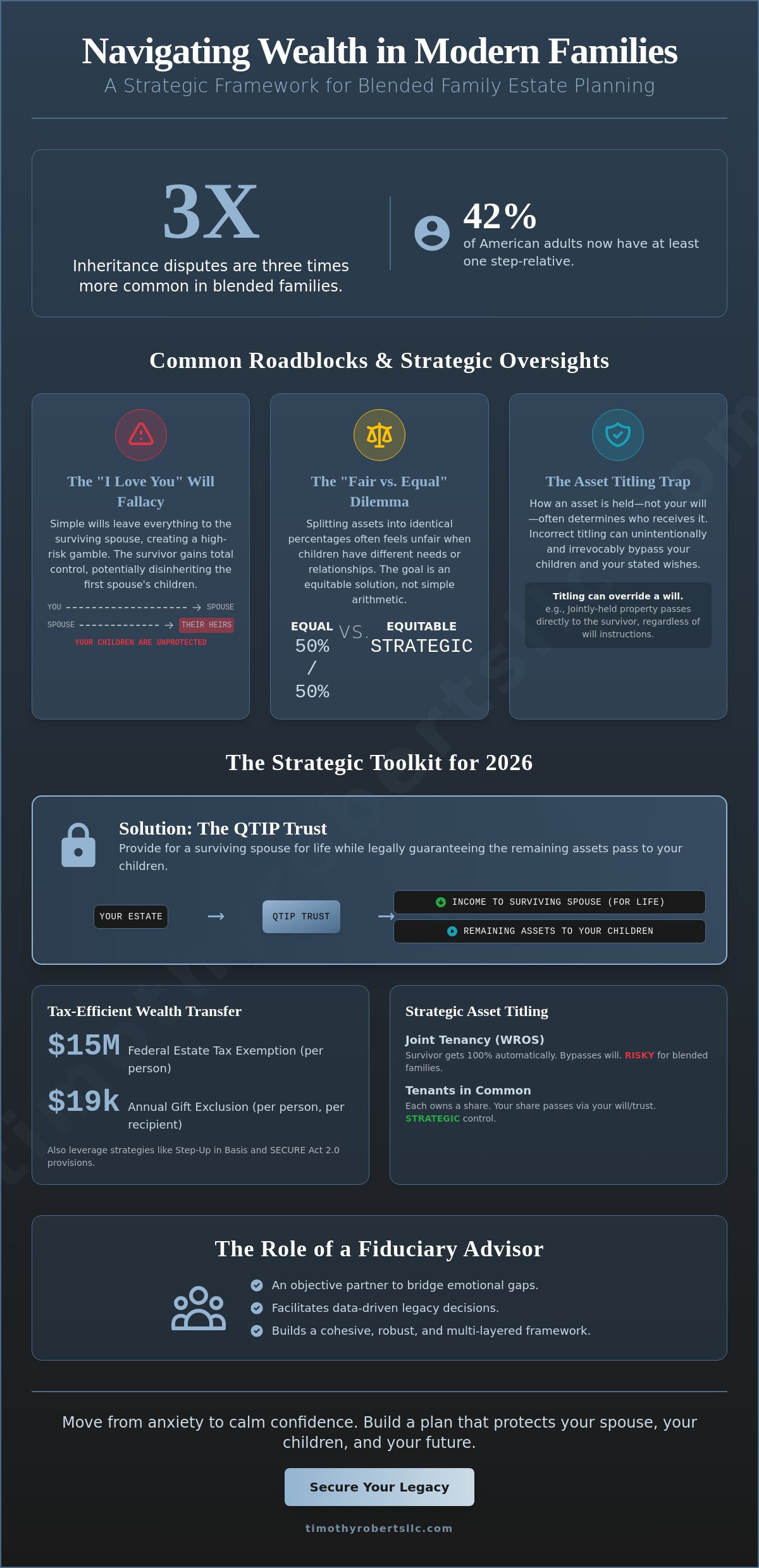
Inheritance disputes are reportedly three times more common in blended families than in non-blended households. This statistic reflects the profound anxiety many feel when trying to balance the security of a current spouse with the legacy of children from a previous marriage. Sophisticated financial planning for blended families isn’t merely a legal necessity. It’s a strategic orchestration of competing interests into a single, unified vision for your future.
You’ve worked hard to build your wealth, and it’s natural to worry that complex family dynamics or shifting tax laws might lead to unintentional disinheritance or future infighting. We’re here to help you move from anxiety toward a state of calm confidence. This article provides a strategic framework designed to protect your spouse, your children, and your long-term goals. We’ll examine the essential tools for 2026, from maximizing the $15 million federal estate tax exemption to utilizing the $19,000 annual gift exclusion, ensuring you minimize tax liabilities while treating every family member with equity and care.
Key Takeaways
- Master the technical nuances of asset titling to bypass the complexities of probate and secure immediate liquidity for your loved ones.
- Explore the strategic implementation of QTIP trusts to provide for a surviving spouse while safeguarding the ultimate inheritance of biological children.
- Leverage tax-efficient wealth transfer strategies, including the step-up in basis and SECURE Act 2.0 provisions, to minimize liabilities across generations.
- Develop a cohesive roadmap for financial planning for blended families that replaces traditional, insufficient estate documents with a robust, multi-layered framework.
- Position a fiduciary advisor as an objective partner to bridge emotional gaps and facilitate data-driven legacy decisions within the family unit.
The Strategic Complexity of Blended Family Financial Planning
The financial landscape for the modern family has shifted fundamentally. According to Pew Research Center data from January 2026, 42% of American adults now have at least one step-relative. This reality demands a move away from the standard templates of the past. Effective financial planning for blended families requires an architect’s precision, as traditional documents often buckle under the weight of competing emotional and legal interests. It is no longer enough to rely on generic solutions; instead, we must craft a bespoke strategy that reflects the unique geometry of your family unit.
Simple reciprocal wills, often called “I love you” wills, frequently fail in complex family structures. These documents typically leave everything to the surviving spouse with the hope that they will eventually provide for all children. This approach creates a significant vulnerability. Once the first spouse passes, the survivor gains total control over the assets and may, intentionally or not, redirect that wealth toward their own biological heirs or a future partner. Relying on good intentions rather than structured legal protections is a high-risk gamble with your family’s harmony.
To better understand how these common oversights can impact your legacy, watch this helpful video regarding the mistakes that often disrupt blended family structures:
The Evolution of Modern Family Wealth
Legacy planning is no longer a linear transfer from one generation to the next. Increased longevity means adult children might not receive an inheritance until they are in their 60s, while a surviving second spouse may require decades of financial support. Balancing these overlapping timelines requires comprehensive estate planning that accounts for multi-layered needs. Proactive intervention is vital. You should refine your strategy before major milestones, such as a child’s marriage or a spouse’s retirement, introduce new variables into your financial ecosystem.
Identifying Strategic Friction Points
The most significant hurdle is the “Fair vs. Equal” debate. Treating every family member equally by splitting assets into identical percentages often feels unfair when children have vastly different needs or histories with the family. Strategic financial planning for blended families acknowledges these nuances, seeking equitable solutions rather than simple arithmetic. We must also account for statutory elective shares, which are legal protections that prevent a spouse from being entirely disinherited, potentially overriding your stated wishes if your plan is not robust. Unintentional disinheritance is a primary risk factor for step-families, occurring when assets flow to a surviving spouse and never reach the children of the first marriage due to poor titling or outdated beneficiary designations.
Orchestrating Cash Flow and Asset Titling for Modern Families
Asset titling serves as the invisible architecture of your financial life. While many focus on the total value of their portfolio, the specific manner in which those assets are held determines who actually receives them. For those engaged in financial planning for blended families, this technical detail often represents the difference between a secure legacy and a legal dispute. Proper titling ensures liquidity for a surviving spouse while preventing the unintentional bypass of biological children.
Choosing between Joint Tenancy and Tenants in Common is a strategic decision rather than a clerical one. Joint Tenancy with Right of Survivorship offers the benefit of immediate transfer, allowing the survivor to avoid probate. However, this structure automatically grants the surviving spouse full ownership, potentially leaving the first spouse’s children with no legal claim to the property. Conversely, holding assets as Tenants in Common allows each partner to direct their portion to their respective heirs, though it requires more deliberate coordination with your broader estate strategy.
Maintaining clear boundaries between pre-marital and marital assets is essential for preserving a legacy. Mixing these funds can lead to legal commingling, which often results in the loss of separate property status. A disciplined approach to cash flow management allows you to support your shared lifestyle while protecting the assets intended for your biological children. Aligning these granular details is part of building a cohesive wealth management strategy.
Asset Titling as a Defensive Strategy
The Right of Survivorship can be a double-edged sword. If you bring significant equity into a second marriage, titling your home jointly might inadvertently disinherit your children. Strategic planning involves balancing these risks. We often recommend coordinating these decisions with your retirement income planning to ensure that the lifestyle you’ve built remains sustainable for everyone involved. This ensures that cash flow needs don’t force the liquidation of assets meant for the next generation.
Coordinating Beneficiary Designations
It’s a common misconception that a will governs all assets. In reality, beneficiary designations on life insurance and retirement accounts override any instructions in a trust or will. This makes the distinction between per stirpes and per capita critical. A per stirpes designation ensures that if a child predeceases you, their share flows to their own children, preserving the family branch. You must review your retirement account beneficiaries after every major life event to ensure your designations reflect your current intentions. Without this regular audit, your hard-earned wealth may flow to an ex-spouse or bypass your children entirely.
Legacy Architecture: Protecting Biological Children and Spousal Interests
Designing a legacy for a complex family unit requires more than just goodwill. It demands a structural framework that accounts for the delicate balance between providing for a surviving spouse and preserving the inheritance of biological children. While previous sections focused on the immediate concerns of asset titling and cash flow, legacy architecture looks toward the horizon. It utilizes sophisticated legal instruments to ensure your wealth serves your specific vision rather than falling victim to the default rules of probate or statutory elective shares.
A Qualified Terminable Interest Property (QTIP) trust stands as a cornerstone of sophisticated financial planning for blended families. This vehicle allows you to provide a lifetime of income for your surviving spouse while maintaining control over the ultimate distribution of the principal. Upon the death of the second spouse, the remaining assets flow directly to your designated beneficiaries, such as your children from a prior marriage. This dual-purpose strategy eliminates the risk that a surviving spouse might inadvertently or intentionally redirect family wealth elsewhere.
Advanced Trust Structures
For high-net-worth couples, a Spousal Lifetime Access Trust (SLAT) offers a compelling avenue to utilize the 2026 federal estate tax exemption of $15 million per individual. By gifting assets into an irrevocable trust for a spouse, you remove future appreciation from your taxable estate while maintaining indirect access to the funds if needed. These interventions are a vital component of strategic legacy planning, as they protect the family’s upward progression. We also frequently employ “Bloodline Trusts” to ensure that once assets reach your children, they remain protected from potential future ex-spouses or creditors, keeping wealth within the family lineage.
The Power of Life Insurance in Blended Planning
Life insurance serves as a powerful tool for inheritance equalization, particularly when a significant portion of the estate is tied up in a primary residence or a closely held business. You might choose to leave the family home to your current spouse to ensure their stability, while using a life insurance death benefit to provide an equivalent inheritance for your biological children. This prevents the need to liquidate sentimental or complex assets during a time of grief.
By housing a policy within an Irrevocable Life Insurance Trust (ILIT), you effectively remove the death benefit from your taxable estate while ensuring immediate, tax-free liquidity for your heirs. This structure is particularly effective for managing the 40% top federal estate tax rate that remains in effect for 2026. It transforms a simple insurance policy into a strategic asset that facilitates harmony by ensuring every family member feels equitably treated without depleting the core estate.
Tax-Efficient Wealth Transfer in Multi-Generational Scenarios
Wealth transfer is rarely a linear event. In the context of financial planning for blended families, it becomes a multi-dimensional puzzle where tax liabilities can erode a legacy if not managed with precision. Balancing the needs of a surviving spouse with the expectations of children from a prior marriage requires a deep understanding of the 2026 tax landscape. By coordinating tax advising with your broader financial goals, you can navigate these complexities while preserving the core of your estate.
The federal estate tax exemption for 2026 stands at $15 million per individual, or $30 million for a married couple. While these figures are generous, they don’t eliminate the need for strategic gifting. Utilizing the annual gift tax exclusion of $19,000 per recipient, or $38,000 for married couples, allows you to reduce your future taxable estate systematically. This proactive approach facilitates the upward progression of your heirs’ wealth without exhausting your lifetime exemption. It is a method of transferring value that supports immediate family needs while protecting long-term interests from the top 40% federal estate tax rate.
Maximizing the Step-Up in Basis
Retaining highly appreciated assets until death offers a significant tax advantage known as the step-up in basis. This provision resets the asset’s cost basis to its fair market value at the time of your passing, effectively eliminating the capital gains tax liability for your heirs. For those in a second marriage, deciding which assets to gift now and which to hold until death is a critical strategic choice. Gifting during your lifetime removes the asset from your estate but forces the recipient to take your original, lower cost basis. In community property states, a double step-up may occur, resetting the basis for the entire asset upon the death of the first spouse; this provides a powerful tool for preserving wealth for the next generation.
The New Era of Inherited IRAs
The SECURE Act 2.0 has fundamentally altered the timeline for inherited retirement accounts. Most non-spouse beneficiaries, including biological children and step-children, must now fully distribute the assets of an inherited IRA within 10 years of the original owner’s death. This condensed timeframe can push heirs into higher tax brackets, such as the 35% or 37% brackets for income exceeding $498,600 or $768,600 respectively. Managing this income spike requires professional investment portfolio management to optimize distributions and minimize the overall tax drag on the inheritance. If you are ready to secure your family’s future, we invite you to explore our Strategic Wealth Management services to ensure your legacy remains intact.
Engaging a Fiduciary for Comprehensive Family Wealth Management
The technical instruments of wealth management, including the trusts, tax-efficient transfers, and strategic titling discussed earlier, require a skilled conductor to ensure they perform in harmony. Engaging a fiduciary is a non-negotiable step for those navigating the nuances of financial planning for blended families. Unlike brokers who may only offer suitable products, a fiduciary is legally bound to act in your absolute best interest. This distinction is critical when balancing the competing needs of multiple generations and ensuring that your legacy remains a source of unity rather than division.
A visionary advisor acts as a strategic mediator, stripping away the emotional weight of inheritance discussions and replacing it with objective data. This partnership moves your family away from a “legal document” mindset, where plans sit dormant in a binder, toward a “living strategy” that evolves alongside your life. By treating development as a journey rather than a transaction, we ensure that your financial roadmap remains responsive to the inevitable shifts in family dynamics and regulatory environments.
The Fiduciary Advantage in Family Mediation
A fiduciary’s legal obligation builds a foundation of trust that is often missing in complex family structures. When an advisor educates adult children about the family’s wealth strategy, they do so from a position of neutral authority. This transparency helps mitigate the fear of family infighting by providing clear, data-driven explanations for inheritance decisions. We position ourselves as the architect of your family’s financial future, ensuring that every intervention is purposeful and aligned with your shared goals for upward progression.
Executing Your Visionary Strategy
Creating a personalized roadmap involves more than just selecting investments; it requires the seamless integration of tax planning, estate goals, and retirement income strategies into a single, cohesive vision. This process is not a one-time event but a rhythmic cycle of fiduciary oversight. Regular strategic interventions allow us to audit your plan as family dynamics shift, such as the birth of a grandchild or a change in a step-child’s status. This deliberate pacing reinforces the idea that we take the time to solve complex problems rather than rushing to generic conclusions.
The journey toward multi-generational harmony is complex, but you don’t have to navigate it alone. Partner with a fiduciary strategist to secure your family’s legacy.
Orchestrating Your Multi-Generational Future
A legacy is not a static destination; it’s a living system that requires constant refinement and strategic foresight. We’ve explored how technical precision in asset titling and the implementation of sophisticated trust structures can bridge the gap between spousal security and biological inheritance. By navigating the nuances of the SECURE Act 2.0 and maximizing tax-efficient transfers, you transform potential financial friction into a cohesive narrative of family harmony.
Effective financial planning for blended families demands a partner who understands that your family architecture is unique. Our firm provides over 25 years of fiduciary expertise, delivering sophisticated multi-generational tax and estate strategies through a lens of partnership. We move beyond off-the-shelf solutions to create personalized roadmaps tailored to your specific needs. Elevate your family’s wealth strategy with a comprehensive financial plan.
You have the power to define how your story continues. By taking proactive steps today, you ensure that your legacy remains a source of strength and stability for every member of your family, now and for generations to come.
Frequently Asked Questions
What is the biggest mistake blended families make in financial planning?
The most pervasive mistake is relying on simple reciprocal wills that lack structured protections for biological children. This often leads to unintentional disinheritance when the surviving spouse gains total control over marital assets. Sophisticated financial planning for blended families must replace these generic documents with instruments like QTIP trusts to ensure your wealth reaches its intended destination without relying on a survivor’s future goodwill.
Can my spouse legally disinherit my children if I die first?
A surviving spouse can legally disinherit your children if they receive assets outright or through joint tenancy with right of survivorship. Once the survivor owns the property, they have the absolute authority to designate their own heirs or a new partner as the beneficiary. You must utilize irrevocable trusts or specific beneficiary designations to prevent this outcome and protect your children’s legacy from future changes in your spouse’s estate plan.
How does a QTIP trust work for blended families?
A Qualified Terminable Interest Property (QTIP) trust provides your surviving spouse with a lifetime of income while preserving the underlying principal for your biological children. It allows you to maintain control over the final distribution of your wealth even after you pass away. This structure ensures your spouse is supported during their lifetime without compromising the multi-generational transfer of your core estate assets to your biological heirs.
Do I need to update my 401(k) beneficiary if I have a prenuptial agreement?
You must update your 401(k) beneficiary designations regardless of your prenuptial agreement because federal ERISA laws generally prioritize the surviving spouse. A prenuptial agreement is a contract between spouses, but it does not automatically bind the plan administrator of a retirement account. Failing to secure a written spousal waiver after the marriage ceremony can result in your retirement assets bypassing your intended heirs entirely despite your legal agreements.
How can I ensure my biological children receive their inheritance without causing conflict with my spouse?
Inheritance equalization is the most effective way to provide for children while avoiding conflict with a surviving spouse. By using life insurance death benefits to provide an immediate inheritance for children, you can leave the primary residence or other lifestyle assets to your spouse. This strategy treats everyone equitably without forcing the liquidation of shared property or creating a sense of competition between family members during a time of grief.
What happens to our shared home if one of us passes away in a blended family?
The fate of your shared home depends entirely on how the property is titled at the time of death. If held as Joint Tenants with Right of Survivorship, the home passes automatically to the surviving spouse, potentially bypassing your children. Titling the property as Tenants in Common allows you to direct your specific share into a trust, ensuring your spouse can live there while your equity eventually flows to your biological heirs.
Is life insurance a good way to provide for children from a previous marriage?
Life insurance is an exceptional tool for financial planning for blended families because it creates immediate, tax-free liquidity for children from a previous marriage. It allows you to provide a significant legacy without depleting the assets your current spouse relies on for retirement income. When placed in an Irrevocable Life Insurance Trust (ILIT), the proceeds are also removed from your taxable estate, maximizing the value transferred to the next generation.
How often should a blended family review their financial plan?
You should review your blended family financial plan every two to three years or immediately following a significant life event. Births, marriages, divorces, or changes in tax legislation, such as the 2026 estate tax exemption shifts, can render your current strategy obsolete. Regular audits ensure that your asset titling and beneficiary designations remain perfectly aligned with your evolving family architecture and long-term vision for upward progression.
