

Jun
Financial Advisor for Family Wealth Management: A Strategic Guide for 2026
It’s natural to feel a sense of quiet anxiety regarding tax erosion or whether the next generation is truly prepared for the weight of their inheritance. You deserve a roadmap that offers more than off-the-shelf solutions, providing instead a curated approach that balances today’s liquidity with tomorrow’s legacy. This guide will show you how a fiduciary-led strategy integrates sophisticated tax planning and private market allocations to secure your family’s future. We’ll examine the $15 million individual estate tax exemption for 2026 and the intentional steps required to move from fragmented advice to total financial clarity.
Key Takeaways
- Understand why modern family wealth management requires a holistic view of your total balance sheet rather than fragmented, isolated investment advice.
- Identify the critical differences between fee-only fiduciary standards and commission-based models when selecting a financial advisor for family wealth management.
- Explore how integrating strategic tax advising with portfolio management creates a shield against wealth erosion and enhances long-term liquidity.
- Transition from standard legal documentation to a robust legacy plan that focuses on the financial readiness and values of the next generation.
- Discover the four pillars of a sophisticated wealth strategy that balance high-level investment oversight with meticulously crafted estate planning.
What is Family Wealth Management in the 2026 Economy?
Family wealth management has moved far beyond the traditional boundaries of simple stock picking or bond laddering. In the 2026 economy, it’s a holistic discipline that treats your family’s financial life as a single, integrated ecosystem. This approach recognizes that an investment portfolio doesn’t exist in a vacuum; it’s inextricably linked to tax liabilities, estate structures, and multi-generational objectives. A sophisticated financial advisor for family wealth management serves as more than a money manager. They’re a visionary strategist who orchestrates your total balance sheet to ensure every asset, from private equity to real estate, works in concert toward a unified purpose.
The shift from reactive asset management to proactive wealth elevation is a hallmark of this new era. Instead of merely responding to market fluctuations, a strategic partner anticipates regulatory changes and economic shifts before they impact your liquidity. This level of oversight requires a blend of creative passion and business-minded rigor, moving away from off-the-shelf solutions toward meticulously crafted interventions that protect and grow your capital.
To better understand the scale and purpose of professional wealth structures, watch this helpful video:
The Evolution from Portfolio Management to Wealth Strategy
In a volatile market, simply selecting high-performing stocks is no longer sufficient to preserve multi-generational wealth. Modern stewardship requires continuous fiduciary oversight and a willingness to rebalance portfolios based on global macro-economic trends rather than short-term noise. Family wealth management is a synthesized approach that harmonizes immediate financial stability with a family’s long-term aspirational growth. This evolution prioritizes the protection of purchasing power against inflation and tax erosion, ensuring that the wealth you’ve built remains a tool for progress rather than a source of stress.
Why Families Require a Unified Financial Roadmap
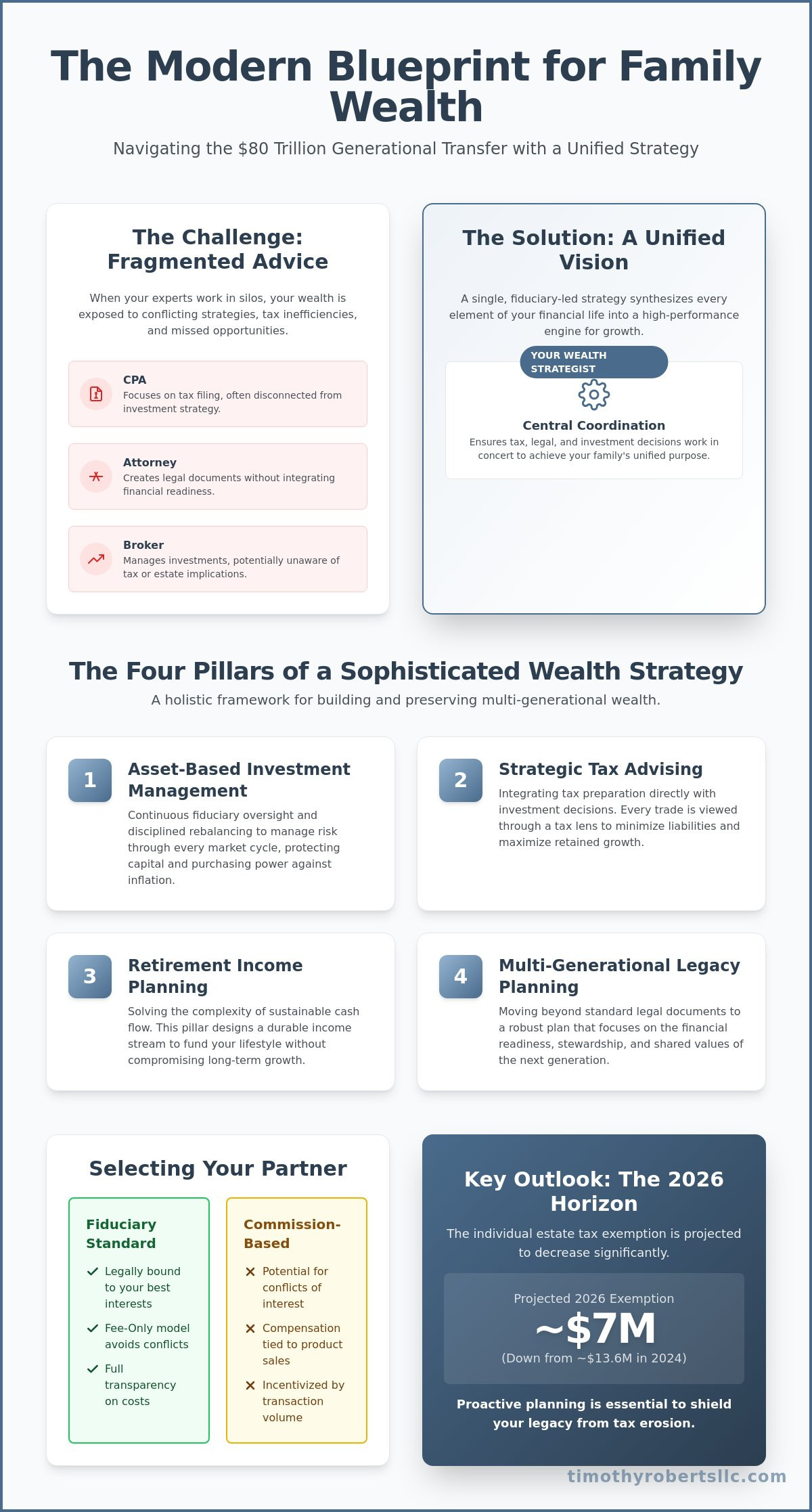
The most significant danger to family stability is siloed advice. When your CPA, attorney, and broker operate in isolation, their strategies often conflict, leading to missed opportunities and unnecessary tax exposure. A central financial advisor for family wealth management acts as the architect of your financial future, ensuring that every professional’s work aligns with your overarching goals. This unified roadmap is essential for managing complex transitions, such as the $80 trillion generational transfer currently underway. By understanding What is a Family Office? and applying its principles, families can align their risk tolerance with a legacy plan that is both functional and enduring. It’s about creating a narrative of shared success where your personal creative vision meets structured corporate capabilities.
The Four Pillars of a Sophisticated Family Wealth Strategy
Building an enduring financial architecture requires more than high-level vision. It demands the practical execution of a strategic decision-making framework where every choice reinforces the others. Most families possess the components of wealth but lack the cohesive structure necessary to protect it against the complexities of the 2026 economy. A financial advisor for family wealth management ensures these four pillars aren’t just present, but perfectly aligned.
- Asset-Based Investment Management: This involves continuous fiduciary oversight and disciplined rebalancing. It’s a commitment to managing risk through every market cycle rather than chasing short-term performance.
- Strategic Tax Advising: This pillar integrates tax preparation directly with investment decisions. By viewing every trade through a tax lens, families can significantly minimize liabilities and retain more of their growth.
- Retirement Income Planning: This discipline solves the complexity of sustainable cash flow. It ensures that your lifestyle remains supported while the underlying capital continues to serve your long-term goals.
- Legacy and Estate Coordination: Protecting assets for future generations requires meticulous coordination. This pillar secures the corpus of your wealth against erosion and ensures a seamless transfer of both assets and values.
Integrating Tax Planning with Investment Management
Taxation is often the single largest expense a family faces, yet it’s frequently managed as an afterthought during tax season. High-performance stewardship requires year-round tax advising in Ann Arbor to maximize net-of-tax returns. When your advisor understands both your portfolio’s composition and the details of your tax return, they can implement sophisticated strategies like tax-loss harvesting and charitable giving at the most opportune moments. This integrated approach is vital in 2026, especially as families navigate the top 37% marginal income tax rate and the $16,100 standard deduction for single filers.
Retirement Income: The Foundation of Family Stability
The transition from the accumulation phase to the distribution phase is a critical pivot point that requires a specialized roadmap. Managing the sequence of returns risk is essential to ensure you don’t outlive your assets. A cohesive plan incorporates the strategic management of 401k, Roth IRA, and SEP IRA accounts to create a tax-efficient income stream. Effective retirement income planning balances immediate liquidity needs with the growth required to outpace inflation. If you’re ready to move from fragmented advice to a unified strategy, a personalized wealth roadmap review can provide the clarity you need to move forward with confidence.
Selecting a Fiduciary Partner: Fee-Only vs. Commission
The choice of a professional partner is the most consequential decision in your journey toward long-term stability. It’s about more than just numbers; it’s about the integrity of the advice you receive. A financial advisor for family wealth management who operates under a fiduciary standard has a legal and ethical obligation to put your interests first. This isn’t a mere marketing claim. It’s a structural requirement that eliminates the conflict of interest inherent in commission-based models. In an era where smaller financial entities must meet the June 3, 2026, compliance deadline for amended Regulation S-P, selecting a partner who prioritizes transparency and rigorous data protection is non-negotiable.
Commission-based brokers often face the temptation to recommend products that pay them the highest fee. In contrast, fee-only advisors charge a transparent, asset-based fee or a fixed fee for specific projects. This ensures that their success is directly tied to the growth and stability of your family’s balance sheet. When they succeed, you succeed. Some families consider the “do-it-yourself” route to save on costs. While modern tools provide access to data, they don’t provide the expert craftsmanship required to navigate complex tax codes or multi-generational dynamics. High-end wealth management is a specialized intervention, not a commodity. It justifies its cost by preventing the expensive errors that often occur when disparate financial pieces aren’t meticulously coordinated.
The Transparency of Asset-Based and Fixed-Fee Models
Fee-only structures align the advisor’s incentives with your family’s long-term prosperity. Unlike commission models, where “hidden” costs in insurance or mutual funds can erode wealth over decades, asset-based fees are clear and predictable. Fixed-fee financial planning provides additional clarity for project-based needs, such as estate coordination or education funding strategies. When vetting a financial advisor for family wealth management, ask directly: “Are you a 100% fee-only fiduciary at all times?” If the answer involves “dual registration” or commissions, their interests may not be fully aligned with yours.
Vetting Your Advisor: Key Questions for Families
A sophisticated partner should demonstrate a history of professional stability and a “partnership” mindset. Inquire about their experience with complex family dynamics and whether they offer integrated tax preparation and compliance. Since the top marginal income tax rate for 2026 remains at 37% for high earners, having an advisor who can synthesize tax advising with portfolio management is a significant advantage. Look for a visionary strategist who treats development as a journey rather than a simple transaction. The goal is to find a craftsman who understands that your family’s wealth is a tool for upward progression, requiring personal attention and high-level expertise.
Navigating Legacy Planning and Multi-Generational Transfer
A true legacy is more than a collection of legal signatures stored in a binder. It’s a meticulously crafted narrative of your family’s values, achievements, and future aspirations. While many view estate planning as a static event, a sophisticated financial advisor for family wealth management treats it as a living strategy. This approach ensures that the transition of wealth is a catalyst for upward progression rather than a source of family friction. As an estimated $80 trillion begins to shift between generations, the focus must move beyond the transfer of assets to the transfer of financial wisdom and responsibility.
Risk management serves as the essential shield for this journey. Through deep insurance analysis, families can protect their corpus against unforeseen liabilities that might otherwise derail a multi-generational plan. This isn’t about selling products; it’s about a strategic synthesis of protection and growth. By preparing the next generation for the weight of their inheritance, you ensure that the wealth you’ve built remains a tool for positive impact. This educational component is often what distinguishes a visionary strategist from a traditional broker.
Strategic Education Funding and 529 Plans
Investing in the next generation’s intellectual capital is a primary goal for most affluent families, yet it shouldn’t jeopardize the parents’ own financial independence. Balancing 529 plans with high-level retirement goals requires a nuanced understanding of cash flow and tax implications. A specialized partner evaluates various investment options to ensure that education funding strategies align with your broader portfolio. This ensures that you can provide for your children’s future while maintaining the stability of your own retirement roadmap.
Protecting Assets through Estate Coordination
The 2026 lifetime estate and gift tax exemption has reached $15 million per individual, or $30 million for married couples. This permanent change provides a significant opportunity for those who act with intentionality. However, effective stewardship requires more than just meeting thresholds. It involves using trusts and annual gift tax exclusions, currently $19,000 per recipient, to facilitate a seamless wealth transfer. By engaging in proactive estate planning, you can minimize tax erosion and ensure your assets are distributed according to your precise vision. If you’re ready to secure your family’s future with a partner who understands the intersection of aesthetics and functionality, explore our legacy coordination services today.
Elevating Your Wealth Strategy with Timothy Roberts & Associates
True financial stewardship requires a partner who views your family’s evolution as a lifelong journey rather than a series of transactions. Timothy Roberts & Associates brings a 25-year history of fiduciary excellence to the table, positioning our firm as a high-end partner for your family’s financial progression. We recognize that sophisticated wealth management is an intersection of aesthetics and functionality. By serving as a visionary strategist, we provide the personal attention and high-level expertise necessary to solve complex problems with intentionality. Our national reach allows us to bring this specialized approach to families across the country who value quality and business-minded rigor.
The unique benefit of our firm lies in the meticulous synthesis of tax preparation and investment management. Most professionals operate in silos, but we provide a unified client brain that informs every decision. This integrated approach ensures that your portfolio isn’t just growing; it’s doing so in the most tax-efficient manner possible. As a financial advisor for family wealth management, we move away from aggressive sales tactics toward a narrative of partnership and shared success. It’s about providing the calm confidence you need to focus on your family’s aspirations while we handle the practicalities of execution.
A Partnership Built on Trust and Expertise
Our firm prioritizes depth over superficiality in every financial plan we craft. We understand that your needs aren’t off-the-shelf, so our solutions shouldn’t be either. This human-led, results-driven identity distinguishes us from larger, more anonymous entities that favor volume over value. We act as expert craftsmen, carefully shaping a strategy that reflects your individual creative vision and structured corporate capabilities. This commitment to professional stability and intellectual curiosity ensures that your family’s roadmap remains resilient through every economic cycle.
Next Steps: Your Comprehensive Wealth Review
Moving from a high-level vision to practical execution requires a deliberate and logical process. During an initial strategy session, we take the time to understand the nuances of your family dynamics and your long-term legacy goals. We’ll assess your current roadmap, identify potential gaps in your tax or estate strategy, and begin the work of aligning your assets with your values. This is an invitation to experience a different kind of advisory relationship, one rooted in strategic depth and personal attention. You can schedule a consultation to elevate your family wealth strategy and begin the journey toward a more secure and intentional financial future.
Orchestrating Your Financial Evolution with Intentionality
Transitioning from fragmented professional advice to a unified wealth strategy isn’t just a financial necessity; it’s an act of leadership for your family. Success in the 2026 economy requires more than just reactive portfolio management. It demands a meticulous synthesis of investment strategy, tax optimization, and proactive legacy planning. By selecting a financial advisor for family wealth management who operates as a true fiduciary, you ensure every decision is filtered through the lens of your long-term stability and aspirational growth. This approach moves beyond the simple preservation of capital to the active cultivation of a lasting legacy.
Timothy Roberts & Associates offers over 25 years of fiduciary experience, providing a sophisticated approach that integrates tax preparation directly with investment oversight. Our personalized financial roadmaps are crafted to protect your corpus and prepare the next generation for the weight of inherited wealth. It’s time to move toward a future defined by calm confidence rather than quiet anxiety. Partner with a fiduciary to elevate your family’s financial future. Your journey of upward progression begins with a single, deliberate step toward expert stewardship.
Frequently Asked Questions
What is the difference between a financial planner and a wealth manager?
Wealth management is a more comprehensive discipline that oversees a family’s entire balance sheet, including taxes, investments, and estate coordination. Financial planning often focuses on specific milestones like retirement or education funding. A financial advisor for family wealth management synthesizes these individual goals into a single, high-level strategic roadmap that prioritizes long-term stability and growth.
Do I need a fiduciary for my family’s wealth management?
Working with a fiduciary is a non-negotiable requirement for families seeking transparent and objective advice. Fiduciaries have a legal and ethical obligation to put your interests first at all times, which eliminates the conflicts of interest found in commission-based models. This standard ensures that every recommendation is made with the sole intention of advancing your family’s upward progression.
How much does a financial advisor for family wealth management cost?
The cost of professional stewardship depends on the complexity of your family’s financial picture and the specific service model used. Most sophisticated firms utilize an asset-based fee or a fixed-fee structure for specialized projects like estate coordination. These models provide clarity and ensure that the advisor’s success is directly aligned with the growth and protection of your wealth.
Can a wealth manager help with my family’s tax preparation?
Yes, high-end wealth management firms often integrate tax advising and preparation with investment oversight. This year-round coordination allows for sophisticated strategies like tax-loss harvesting and charitable giving to be executed at the most opportune moments. Having a single partner who understands both your portfolio and your tax return minimizes wealth erosion and simplifies your professional life.
How often should our family meet with our financial advisor?
Most families benefit from formal strategic reviews on a quarterly or semi-annual basis, though communication should remain fluid as life events occur. These meetings are essential for rebalancing portfolios and ensuring your roadmap stays aligned with evolving family dynamics. Regular dialogue transforms the advisory relationship from a simple transaction into a deeply strategic partnership built on shared success.
What is the minimum asset level for professional wealth management?
Minimum requirements vary across the industry, but professional wealth management is typically tailored for families with complex needs that justify high-level expertise. These services are designed for the upper affluent and high-net-worth segments where personalized attention is required. It’s about finding a partner who offers the intellectual curiosity and craftsmanship necessary to solve intricate financial problems.
How does legacy planning differ from a basic will?
A basic will is a legal document that dictates the distribution of assets, while legacy planning is a living strategy for multi-generational stability. It incorporates education funding, values-based giving, and the financial readiness of the next generation. Legacy planning ensures that your wealth remains a tool for progress, adapting to changes in tax laws like the 2026 estate tax exemption.
Can an advisor help with both my business and my personal family wealth?
A visionary strategist understands that business interests and personal wealth are often inextricably linked. A firm like MRA Advisory Group can provide comprehensive oversight for retirement plans like 401k or SEP IRA accounts while simultaneously managing personal estate and tax planning strategies. This holistic approach creates a unified financial roadmap that protects your professional achievements while securing your family’s future.
