

May
Financial Planning for High-Net-Worth Individuals: A Strategic Guide to Wealth Elevation
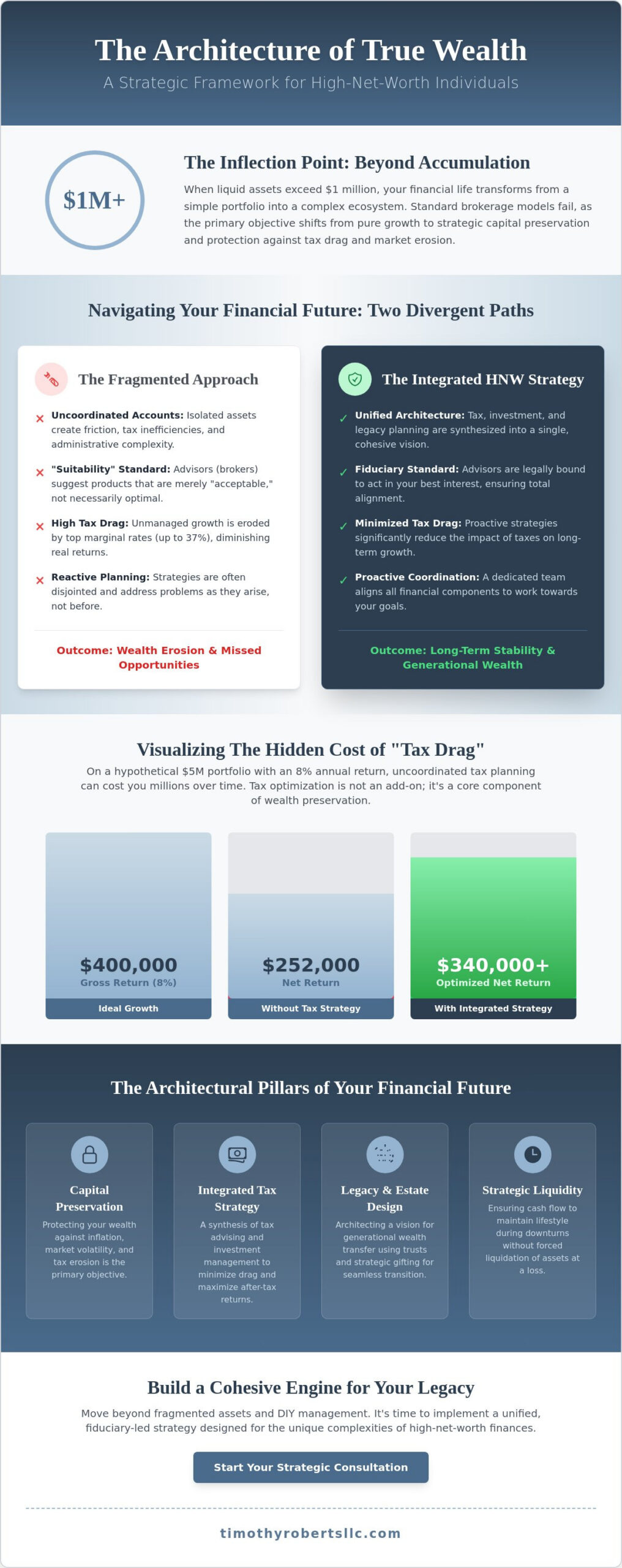
True wealth elevation isn’t found in the simple accumulation of assets; it’s achieved through the meticulous architectural synthesis of fiduciary oversight and tax optimization. For those managing significant capital, the primary challenge isn’t just growth. It’s the friction created by uncoordinated income streams and the weight of a 37% top marginal tax rate. Comprehensive financial planning for high net worth individuals requires moving beyond off-the-shelf solutions toward a bespoke strategy that treats every dollar as a legacy component. You likely recognize that without a unified vision, even the most robust portfolio can suffer from unnecessary tax drag and administrative complexity.
This guide provides the strategic framework you need to master wealth preservation and transition with precision. We’ll examine how to leverage the $30 million joint estate tax exemption and the latest SECURE 2.0 retirement provisions to protect your family’s future. From sophisticated investment portfolio management to the nuances of generational wealth transfer, you’ll discover how to transform fragmented assets into a cohesive engine for long-term stability and aspirational growth.
Key Takeaways
- Learn why liquid assets exceeding $1M require a specialized strategic framework that prioritizes capital preservation and protection against market erosion.
- Understand the critical distinction between professional “best effort” and the fiduciary standard to ensure your advisors are legally bound to your best interests.
- Discover how integrating tax advising with investment portfolio management creates a specialized form of financial planning for high net worth individuals that minimizes tax drag.
- Explore the architectural coordination of legacy planning, using trusts and strategic gifting to ensure a seamless wealth transfer while maintaining privacy and control.
- Identify the benefits of a unified advisory model where tax strategies and long-term investment goals are synthesized to eliminate costly communication gaps.
Defining High-Net-Worth Financial Planning: Beyond Simple Asset Management
Effective financial planning for high net worth individuals begins at a distinct inflection point. This usually occurs when liquid investable assets exceed $1 million. At this stage, your financial life stops being a series of isolated accounts and becomes a complex ecosystem. Traditional brokerage models often fail here because they focus on selling individual products rather than architecting a unified strategy. Consulting a Wealth Management Overview reveals that this discipline transcends simple investment advice; it requires the synthesis of tax strategy, risk mitigation, and legacy coordination into a single, visionary framework.
To better understand how these strategies differ from standard retail investing, watch this helpful video:
The Evolution of Wealth Complexity
As assets grow, the “complexity inflection point” transforms DIY management from a hobby into a liability. You aren’t just managing a stock portfolio anymore. You’re balancing private business interests, which may benefit from the flexible capital solutions offered by Legacy Funding Advisors, alongside diversified real estate holdings and multi-generational trust structures. These disparate elements often pull in different directions, creating friction that erodes your total return. High-net-worth financial planning is the multi-disciplinary coordination of a family’s diverse assets and long-term aspirations into a single, cohesive strategy. Without a strategist to align these moving parts, you risk “leakage” through uncoordinated tax decisions or redundant insurance coverage.
Preservation as a Primary Objective
The shift from asset accumulation to capital preservation is a psychological and tactical hurdle. When you’ve reached a certain level of success, the goal is no longer just “more.” It’s about protecting what you’ve built against the silent erosions of inflation and the 37% top marginal tax rate. We call this “tax drag,” and it can significantly diminish your long-term purchasing power if left unmanaged.
Strategic liquidity plays a vital role here. You need enough cash flow to maintain your lifestyle during market downturns without being forced to liquidate assets at a loss. Paradoxically, sticking to “safe” investments like cash or long-term bonds can be the riskiest move in a high-inflation environment. These assets often fail to keep pace with the rising cost of luxury goods and services, leading to a slow decline in real wealth. A sophisticated plan ensures your capital remains productive while staying resilient against external volatility.
This resilience extends to the physical architecture of your wealth; ensuring the structural integrity of real estate holdings through specialists like Transition Roofing is a critical, often overlooked component of a comprehensive preservation strategy. Maintaining these tangible assets ensures they continue to serve as a stable foundation for your long-term financial ecosystem.
The Fiduciary Standard: Ensuring Strategic Alignment and Trust
Trust isn’t a nebulous concept in elite wealth management; it’s a legal safeguard. For those seeking financial planning for high net worth individuals, the distinction between a broker’s “suitability” standard and a fiduciary’s “duty of care” is paramount. A broker might suggest a product that is merely acceptable for your situation, while a fiduciary is legally bound to act solely in your best interest. This structural alignment ensures that every strategic intervention is designed to protect your capital rather than generate a commission. Understanding the Fiduciary Standard is the first step in moving away from transactional sales and toward a narrative of shared success.
Traditional models often hide conflicts of interest behind complex fee schedules. When an advisor’s compensation is tied to specific investment products, their objectivity is naturally compromised. In contrast, asset-based investment management aligns the advisor’s success directly with your own. As your portfolio grows, the firm prospers; if the portfolio suffers, so does the advisor’s revenue. This creates a rhythmic partnership where the advisor acts as a craftsman, meticulously tailoring strategies to your specific organizational evolution and private goals.
Transparency in Fee Structures
Sophisticated investors understand that “free” advice is often the most expensive. Hidden commissions and high expense ratios can quietly erode a significant portion of your annual returns. By opting for a transparent, asset-based fee structure, you gain clarity on exactly what you’re paying for: high-level thinking, proactive tax advising, and constant portfolio oversight. This transparency is a hallmark of elite financial planning for high net worth individuals, where value is measured by the quality of the strategic intervention rather than the volume of trades. It prioritizes the health of the financial ecosystem over the sale of off-the-shelf solutions.
The Fiduciary as a Strategic Partner
A fiduciary relationship is not static. It requires continuous monitoring and rebalancing to ensure your wealth strategy remains aligned with shifting market conditions and personal milestones. This evolution demands a partner who understands the intersection of your professional capabilities and your private creative vision. Fiduciary oversight transforms financial planning from a transaction into a journey of upward progression. If you’re ready to move beyond generic advice, exploring a customized wealth strategy can provide the intellectual rigor your portfolio deserves.
The Synthesis of Tax Strategy and Investment Management
High-net-worth wealth preservation relies on a fundamental truth: it’s not what you earn, but what you keep. Most traditional advisors treat tax preparation and investment management as separate silos. This disconnect creates a communication gap that often results in missed opportunities for tax-loss harvesting or inefficient asset placement. In the context of financial planning for high net worth individuals, these two disciplines must be synthesized into a single, proactive strategy. By integrating year-round tax compliance with portfolio oversight, you eliminate the friction that occurs when an investment decision is made without considering its immediate tax liability.
With the top federal income tax rate reaching 37% for taxable income over $768,600 for married couples in 2026, the impact of tax drag is substantial. Every transaction within a diversified portfolio should be viewed through a lens of tax sensitivity. This isn’t just about year-end filing; it’s about a continuous architectural intervention that optimizes every dollar for long-term growth. A visionary strategist ensures that your investment moves are always in sync with regulatory shifts, protecting your portfolio from unnecessary tax exposure.
Asset Location and Tax Efficiency
Strategic asset location is a cornerstone of a polished wealth strategy. It involves the deliberate placement of high-income-producing assets into tax-advantaged accounts while keeping high-growth, capital-gain-oriented assets in taxable accounts. Utilizing structures like SEP IRAs or Roth IRAs provides a critical advantage in this area. For 2026, the maximum employee contribution to a 401(k) plan is $24,500, with an additional $8,000 catch-up for those 50 and older. Leveraging these limits requires more than just participation; it requires a vision that aligns retirement plan distributions with your broader estate goals. Professional tax advising serves as a proactive shield, ensuring these vehicles are used to their full potential to mitigate wealth erosion.
Mitigating Capital Gains and Liabilities
Managing capital gains requires a level of craftsmanship that goes beyond simple rebalancing. For high-income earners in 2026, tax-loss harvesting remains a vital tool to offset gains and reduce taxable income. This strategy is particularly effective when navigating concentrated stock positions or preparing for a significant business exit. These events often trigger substantial liabilities that can derail an otherwise sound financial plan. Navigating the evolving federal tax codes, including the permanent 20% deduction for pass-through businesses under the One Big Beautiful Bill Act, demands professional compliance. This steady, logical approach to tax planning ensures that your portfolio remains an engine for growth rather than a source of tax-related stress.
Legacy and Estate Coordination: Architecting a Vision
Estate planning is the architectural culmination of a life’s work. It bridges your individual creative vision with structured corporate capabilities to ensure your wealth serves a purpose beyond your tenure. For many, this process is the most personal aspect of financial planning for high net worth individuals. It requires a visionary strategist who can coordinate disparate legal structures into a unified legacy. Trusts play a central role here, offering a level of privacy, protection, and control that simple wills cannot achieve. They allow you to dictate not just who receives your assets, but how and when those assets are utilized, protecting beneficiaries from their own inexperience or external liabilities.
Strategic charitable giving serves as another vital tool in this architectural framework. By aligning your philanthropic goals with tax optimization strategies, you can reduce the size of your taxable estate while supporting the causes that define your values. This synthesis of personal passion and professional management ensures that your legacy is both impactful and efficient. Preparing the next generation is equally critical. It involves more than just transferring capital; it requires the intentional transition of the values and wisdom necessary to steward that capital. This steady, logical guidance helps heirs understand the responsibilities that come with significant wealth.
Wealth Transfer Complexities
The landscape of wealth transfer is shifting significantly as we move through 2026. With the federal estate and gift tax exemption currently at $15 million per individual and $30 million for married couples, families have a historic opportunity to move assets out of their taxable estates. Utilizing the annual gift tax exclusion, which remains at $19,000 per recipient, allows for the steady, incremental transfer of wealth without depleting your lifetime exemption. Professional estate planning ensures your legacy remains an intentional intervention rather than a series of reactive choices. This strategic foresight minimizes probate delays and protects your family from the 40% federal estate tax rate on assets exceeding these exemption limits.
Risk Management and Asset Protection
A robust estate plan must also account for the unforeseen. Evaluating risk management and insurance analysis is a non-negotiable component of a comprehensive wealth strategy. It’s about protecting assets from litigation, professional liability, or sudden economic shifts that could jeopardize your financial ecosystem. This intersection of aesthetics and functionality ensures that your plan is as resilient as it is elegant. By layering specialized insurance structures with protective trust language, you create a shield around your family’s future. If you seek to elevate your current strategy into a cohesive vision, consider how an integrated wealth management partnership can align your legacy with your long-term goals.
Navigating the Evolution of Wealth with Timothy Roberts & Associates, LLC
Timothy Roberts & Associates, LLC operates on the belief that wealth is a dynamic journey, not a static destination. For over 25 years, our firm has provided the fiduciary craftsmanship necessary to guide families through complex organizational evolutions. Unlike anonymous institutional entities where clients are often treated as mere data points, we prioritize personal attention and intellectual curiosity. Our methodology centers on the synthesis of investment management and proactive tax strategy to create a seamless client experience. This integrated approach ensures that every financial decision is made with a deep understanding of both market potential and tax efficiency. This is the hallmark of effective financial planning for high net worth individuals.
Crafting Your Financial Roadmap
The process begins by architecting a personalized roadmap that aligns your liquid assets with your long-term aspirations. This includes the development of a comprehensive retirement income plan designed to weather the complexities of 2026 and beyond. Whether we’re optimizing your 401(k) contributions or managing the nuances of a $30 million joint estate exemption, our focus remains on upward progression. We maintain a steady, logical rhythm of advisory, providing continuous monitoring and rebalancing as market conditions shift. This proactive oversight prevents the tax drag and administrative friction discussed earlier. It isn’t a simple transaction; it’s a partnership focused on shared success and the realization of your creative vision.
The Next Step in Your Wealth Journey
Moving from a high-level vision to the practicalities of professional execution requires a partner who values depth over superficiality. Our fiduciary commitment at Timothy Roberts & Associates, LLC serves as the foundation of your long-term financial stability, ensuring that our interests are always structurally aligned with your own. We take the time to understand the complex problems inherent in significant wealth, offering carefully crafted interventions rather than generic conclusions. This deliberate pacing reinforces trust and allows for the precise execution of sophisticated strategies. The result is a financial ecosystem that feels polished, intentional, and resilient against economic shifts. We invite you to experience a sophisticated, intentional approach to wealth that transforms your financial potential into a lasting legacy.
Securing Your Strategic Legacy
True wealth elevation requires moving beyond the fragmented management of accounts toward a unified, visionary strategy. You’ve seen how the fiduciary standard provides a structural safeguard and why the synthesis of tax advising with investment management is essential to mitigate tax drag. These aren’t just technical adjustments; they’re the essential components of a deliberate journey toward long-term stability and a meaningful legacy. By aligning your portfolio with both market potential and regulatory shifts, you ensure your capital remains a productive engine for growth.
Comprehensive financial planning for high net worth individuals demands a partner who understands the intersection of personal vision and corporate rigor. With over 25 years of fiduciary expertise, Timothy Roberts & Associates, LLC provides the integrated tax and investment management necessary to protect your financial ecosystem. We believe in personalized legacy craftsmanship that treats your success as a shared evolution. Partner with Timothy Roberts & Associates, LLC for a sophisticated approach to your wealth strategy. Your path to upward progression is an intentional choice; let’s build a future that reflects the depth of your achievements.
Frequently Asked Questions
What is considered high-net-worth for financial planning purposes?
High-net-worth status generally begins when an individual holds $1 million or more in liquid investable assets. This threshold is significant because it marks the point where your financial life requires a specialized strategic framework rather than generic retail solutions. While total net worth includes all assets, financial planning for high net worth individuals focuses on the sophisticated management of liquid capital to ensure long-term stability and aspirational growth.
How do tax strategies differ for high-net-worth individuals compared to the average investor?
Tax strategies for the wealthy shift from simple deductions to complex structural optimization. For those in the 37% top marginal bracket, managing “tax drag” through precise asset location and tax-loss harvesting is vital. Unlike the average investor, high-net-worth individuals must coordinate their investment decisions with year-round tax advising to protect their purchasing power against inflation and evolving federal codes.
Why is a fiduciary advisor essential for managing significant wealth?
A fiduciary advisor is essential because they’re legally bound to act solely in your best interest at all times. This standard eliminates the common conflicts of interest found in commission-based brokerage models. For those with significant assets, this alignment ensures that every strategic intervention is designed to elevate your wealth rather than generate transaction fees for the firm.
How often should a high-net-worth financial plan be reviewed?
We recommend a high-level strategic review at least annually, with quarterly check-ins to monitor portfolio performance and rebalancing needs. Immediate adjustments are necessary when life milestones occur or when tax laws shift, such as the 2026 adjustments to estate exemptions. This steady, logical rhythm ensures your financial roadmap remains aligned with your evolving goals and the current economic climate.
What are the most effective ways to minimize estate taxes in 2026?
In 2026, the most effective strategies involve utilizing the $15 million individual or $30 million joint federal estate tax exemption. You can also leverage the $19,000 annual gift tax exclusion per recipient to move assets out of your taxable estate incrementally. Implementing sophisticated trust structures as part of your estate and legacy planning provides additional layers of privacy and control over the wealth transfer process.
Can high-net-worth financial planning help with business succession?
Financial planning for high net worth individuals is a critical component of successful business succession. While we don’t draft legal documents, we provide the strategic coordination necessary to ensure your business transition aligns with your retirement income plan and estate goals. This involves evaluating the tax implications of a sale or transfer and protecting your personal wealth from business-related risks.
What is the role of alternative investments in a HNW portfolio?
Alternative investments serve as a specialized tool for diversification and risk management within a larger wealth strategy. These assets often have a low correlation with public stock and bond markets, providing a buffer during periods of high volatility. In a polished portfolio, alternatives are used to enhance returns and provide unique income streams that traditional products often cannot offer.
How does philanthropy integrate into a comprehensive financial plan?
Philanthropy is integrated as a strategic tool for both legacy building and tax optimization. By utilizing charitable gifting strategies, you can reduce the size of your taxable estate while supporting causes that reflect your personal values. This synthesis of philanthropic vision and professional wealth management ensures your contributions are as impactful as they are tax-efficient.
