

May
Finding a Trustworthy Financial Planner: A Strategic Guide to Fiduciary Excellence
What if the greatest risk to your wealth isn’t a market downturn, but a partner whose incentives are quietly misaligned with your own? For many, finding a trustworthy financial planner feels like searching for a needle in a field of sales commissions and conflicting advice. It’s a high-stakes endeavor where the cost of a mistake isn’t just a fee; it’s the erosion of your long-term legacy. You deserve a relationship defined by intellectual rigor rather than transactional convenience.
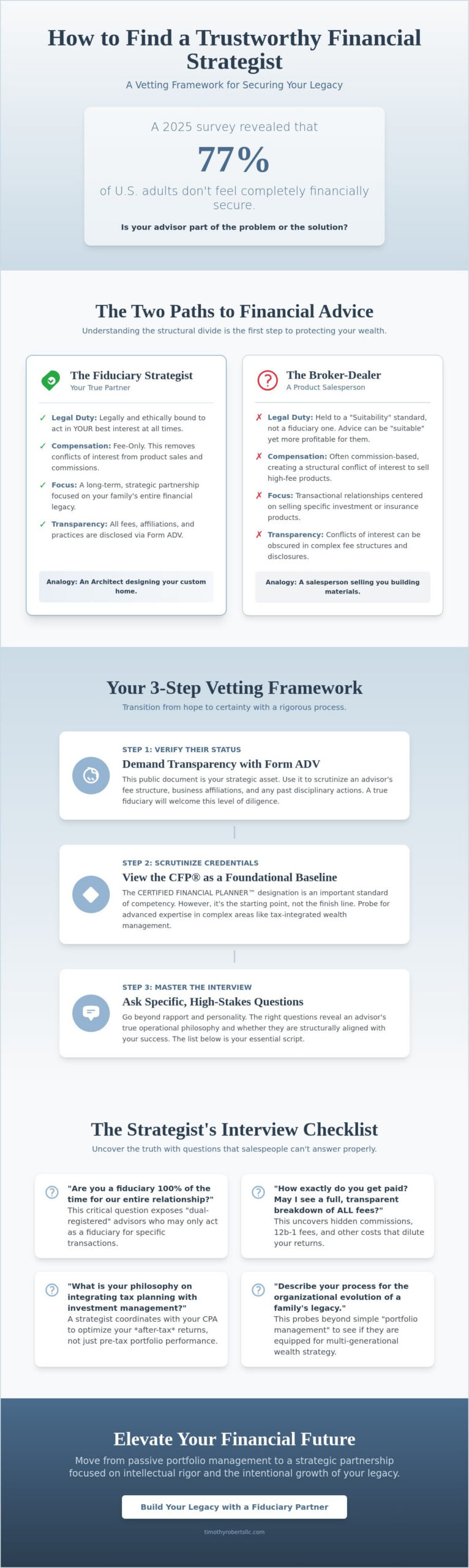
You’ve likely felt the frustration of generic portfolios that ignore your specific tax situation or hidden fees that quietly dilute your returns. It’s a common sentiment, as 77% of U.S. adults reported they don’t feel completely financially secure in a 2025 survey. This guide provides the rigorous standards and specific vetting criteria required to identify a partner who prioritizes strategic evolution over short-term gains. We’ll explore the critical shift toward fiduciary excellence, the importance of tax-efficiency coordination, and the framework you need to secure genuine peace of mind regarding your retirement security.
Key Takeaways
- Identify the structural divide between a broker-dealer and a fiduciary strategist to ensure your advisor is legally bound to your best interests at all times.
- Learn a rigorous vetting framework for finding a trustworthy financial planner who prioritizes tax-integrated wealth management over generic investment products.
- Discover why the CFP® designation should be viewed as a foundational baseline for competency rather than the final measure of a strategist’s capabilities.
- Master the specific, high-stakes questions that reveal whether an advisor operates as a fiduciary for the entire relationship or only during specific transactions.
- Transition from passive portfolio management to a strategic partnership focused on the organizational evolution of your family’s long-term legacy.
The Search for Authenticity: Why Finding a Trustworthy Financial Planner is Paramount
The journey toward financial clarity often begins with a fundamental realization: the marketplace is crowded with salespeople masquerading as strategists. The primary challenge in finding a trustworthy financial planner is navigating the divide between transactional brokers and true fiduciary partners. Large institutions often cultivate a sales-first culture where “free” or “low-cost” advice serves as a gateway to high-commission products. These off-the-shelf solutions frequently lack the strategic depth required to manage complex wealth. A truly trustworthy planner is a professional legally bound to your best interests, prioritizing your long-term legacy over their own short-term transactions.
To better understand the structural necessity of this relationship, watch this helpful video:
The Emotional vs. Structural Components of Trust
Relying on a “good personality” is a dangerous metric for selecting a financial partner. While rapport matters, trust should be a structural byproduct of professional alignment rather than an emotional response to charisma. A sophisticated advisory relationship thrives on intellectual curiosity and a commitment to fiduciary duty. This legal standard acts as a safeguard, ensuring that your advisor’s incentives are perfectly mirrored with your own. It’s the difference between a simple transaction and a carefully crafted intervention designed for your unique circumstances. True partnership requires a blend of creative passion and business-minded rigor that goes beyond mere management.
The Stakes of the Selection Process
The consequences of your choice are profound. A single strategic error in areas like tax planning strategies or retirement income planning can compromise multi-generational wealth. In 2026, the SEC’s Division of Examinations has sharpened its focus on fiduciary duty and compliance programs, signaling a year that demands higher levels of advisor transparency. Statistics from 2025 show that 77% of U.S. adults don’t feel completely financially secure, highlighting the urgency of finding a partner who understands the intersection of aesthetics and functionality. You need a strategist who treats your wealth development as a journey of upward progression, ensuring your roadmap is both resilient and intentional.
Decoding the Fiduciary Standard: Transparency as a Strategic Asset
The fiduciary standard represents a legal and ethical bedrock. It’s a non-negotiable commitment to put your interests ahead of the firm’s bottom line. This distinction is vital when finding a trustworthy financial planner. While many professionals claim to act in your interest, Registered Investment Advisers (RIAs) are legally mandated to do so at all times. In contrast, broker-dealers may only be held to a suitability standard. This lower bar allows for higher-commission products as long as they are “suitable” for your profile, creating a structural conflict of interest that can compromise your long-term legacy.
Transparency acts as a strategic asset in your vetting process. You can verify an advisor’s integrity through the Form ADV. This public record details fee structures, business affiliations, and any past disciplinary actions. It’s a critical step for those seeking a partner with business-minded rigor. You should also utilize a refined set of questions to ask a financial advisor to ensure their operational philosophy matches your expectations for clarity. Fee-only models provide the cleanest alignment. By avoiding commissions, the advisor remains a neutral craftsman, removing the temptation to recommend high-cost products that don’t serve your growth.
Asset-Based vs. Fixed-Fee: Choosing Your Alignment
Choosing the right fee structure is about long-term incentive alignment. Asset-Based Investment Management pairs the advisor’s growth with your own. It’s a dynamic model where professional success is tied directly to the performance and health of your portfolio. Conversely, a Fixed-Fee Financial Plan offers a flat-rate approach for specific, complex interventions. Both models require a diligent review of the ‘Hidden Fee’ checklist. You must look for 12b-1 fees, surrender charges, and internal fund expenses that can quietly erode your wealth. This level of transparency is central to a high-end wealth management partnership built on shared success.
The RIA Advantage: Why Structural Independence Matters
Structural independence allows for a more personalized, craftsman-like approach to wealth. Independent RIAs aren’t bound by corporate ‘shelf-space’ requirements or proprietary product quotas. They have the freedom to select best-in-class investments from across the global market. This independence ensures that your portfolio is a carefully crafted intervention rather than a generic solution. This bespoke approach is essential when finding a trustworthy financial planner who values depth over superficiality. Beyond this, the use of third-party custodians ensures your assets are held by a separate, reputable institution. This separation of duties provides a layer of security and professional stability that mirrors a high-end consultancy.
Vetting for Excellence: Beyond the Basic Credentials
Identifying a true partner requires looking past the letters after a name. While a CFP® designation is a non-negotiable baseline, it represents the start of a conversation, not the conclusion. The process of finding a trustworthy financial planner involves evaluating a professional’s comprehensive experience and ethical standing. As of early 2026, the CFP Board has clarified that competency for independent practice is demonstrated through the rigorous completion of education, examination, experience, and ethics requirements. Passing the exam is merely the entry point. You need a strategist who has navigated 25 or more years of market cycles, possessing a level of professional stability that cannot be taught in a classroom. Finding a trustworthy financial planner means seeking an expert craftsman who has seen the euphoria of bubbles and the despair of crashes, developing a rhythmic approach to risk that protects your long-term legacy.
Look for a partner who values depth over superficiality. Evaluate their intellectual capital by determining if the advisor publishes original strategic thought. This intellectual curiosity is a hallmark of a visionary strategist who isn’t just executing off-the-shelf solutions. It suggests a brand that takes the time to understand and solve complex problems rather than rushing to generic conclusions. A reliable business advisor treats wealth development as a journey, synthesizing personal vision with structured corporate capabilities.
The Hallmarks of a Strategic Specialist
High-end wealth management is never a siloed effort. It requires an advisor who understands Strategic Tax Advising as a core component of portfolio health. Most firms stop at investment picking, which is a tactical activity. A true partner focuses on comprehensive wealth architecture, where every move is calculated for its impact on your net return. This mindset is equally critical when approaching Estate & Legacy Planning. A visionary strategist doesn’t just manage assets; they organize your family’s evolution across generations.
Identifying Red Flags in the First Meeting
The first interaction is a diagnostic opportunity. If you encounter any of these behaviors, the relationship likely lacks the intellectual rigor required for sophisticated financial planning:
- The Product Pitch Trap: Recommending specific investments or insurance before reviewing your tax return or estate plan.
- Vague Fee Disclosures: Hesitating to provide a clear, documented fee schedule for all services.
- The Market Beater Promise: Claiming guaranteed outperformance, which is a strategic impossibility and a sign of intellectual dishonesty.
A reliable advisor focuses on the tangible impact of risk management and tax efficiency rather than chasing ephemeral market highs. They prioritize a partnership built on transparency and rigor over the frantic pursuit of short-term gains.
The Strategist’s Interview: Critical Questions for Your Potential Partner
The interview process is the ultimate diagnostic for finding a trustworthy financial planner. It’s where the abstract concept of fiduciary duty meets the practical reality of professional execution. You aren’t simply looking for correct answers; you’re looking for a depth of reasoning that reflects a partner’s intellectual curiosity and strategic conviction. A visionary strategist welcomes these inquiries as an opportunity to demonstrate the rigor they bring to your family’s organizational evolution.
- Fiduciary Status: Are you a fiduciary for our entire relationship, or just during certain transactions? Dually registered advisors often shift between fiduciary and suitability standards, which can create hidden conflicts.
- Tax Coordination: How do you coordinate my investment strategy with my tax liabilities? A plan that ignores the friction of taxation is inherently flawed.
- Distribution Methodology: What is your specific methodology for retirement income distribution? Transitioning from wealth accumulation to sustainable income requires a carefully crafted intervention.
- Compensation Structure: How are you compensated, and do you receive any third-party incentives? Transparency here is the bedrock of trust.
- Firm Continuity: What is your succession plan for your firm? Your legacy requires a partner whose professional stability extends beyond a single individual’s career.
Interpreting the Answers: A Qualitative Framework
The quality of an answer is found in its nuance. Rehearsed compliance often sounds like a script; strategic conviction sounds like a philosophy. A trustworthy advisor won’t hesitate to challenge your assumptions or tell you “no” when a proposed course of action threatens your long-term security. They prioritize the integrity of the roadmap over the comfort of a pleasant conversation. When finding a trustworthy financial planner, look for an expert craftsman who uses parallel phrasing and clear, logical explanations to demystify complex problems.
The ‘Fit’ Factor: Assessing the Partnership Potential
Professional alignment is about more than just technical skill. It’s about the rhythm of the interaction. A high-end consultancy should feel spacious and deliberate, providing the time necessary to understand the intricacies of your life. If the communication feels frantic or transactional, it’s a sign that you are just another account in a generic portfolio. Personal attention from the lead advisor is a premium differentiator that ensures your creative vision is synthesized with structured corporate capabilities. If you’re ready to move beyond management toward a narrative of shared success, explore how a sophisticated wealth management strategy can elevate your financial future.
Elevating Your Financial Future: The Partnership Approach
Finding a trustworthy financial planner is the catalyst for a fundamental transformation in how you view your wealth. It marks the transition from being a passive seeker of advice to becoming an active partner in growth. This shift moves your assets away from simple management and toward a state of organizational evolution. A meticulously balanced, tax-efficient roadmap provides more than just performance; it offers the profound peace of mind that comes from knowing every variable is being accounted for with professional stability. You deserve a strategy that treats your financial life as a journey of upward progression rather than a series of disconnected transactions.
Boutique firms possess a level of intellectual curiosity that larger, more anonymous entities often struggle to maintain. While massive institutions prioritize volume and standardized products, a specialized firm focuses on carefully crafted interventions. This allows for a deeper exploration of your specific needs, bridging individual creative vision with structured corporate capabilities. It ensures that your financial life isn’t just another account in a database. Instead, it becomes a unique project requiring personal attention and high-level expertise from a visionary strategist who values depth over superficiality.
The Timothy Roberts & Associates Philosophy
Our approach is rooted in a 25-year legacy of fiduciary oversight and personalized financial strategies. We believe that a successful plan must bridge the gap between aesthetics and functionality. Your goals represent the aesthetic vision for your life, while the math of portfolio construction and tax planning provides the functional foundation. By synthesizing your personal creative vision with our business-minded rigor, we create a roadmap that is as intentional in its design as it is robust in its execution. This synthesis is the signature trait of our firm, distinguishing our human-led identity from larger, more generic competitors.
Beginning the Journey Toward Clarity
True clarity begins with a comprehensive initial analysis rather than a generic consultation. We take the time to understand the complex problems you face, particularly when it involves Retirement Income Planning. Our team approaches your wealth as a strategic journey, ensuring that your legacy is protected through every phase of life. If you value depth over superficiality and are ready for a relationship built on transparency and rigor, the next step is clear. We invite you to schedule a strategic consultation with our fiduciary team to begin the process of finding a trustworthy financial planner who views your success as their own.
Securing a Future Defined by Strategic Rigor
Authenticity in wealth management isn’t found in a marketing brochure; it’s forged through a legal commitment to the fiduciary standard. By prioritizing structural transparency and vetting for deep intellectual capital, you move beyond the limitations of generic advice. Finding a trustworthy financial planner is about identifying a partner who synthesizes your personal vision with the technical precision of tax-integrated wealth management. This alignment ensures that every decision serves your upward progression rather than a broker’s commission.
At Timothy Roberts & Associates, we offer more than 25 years of fiduciary experience and specialized expertise in Retirement Income Planning. A financial roadmap should be a crafted intervention, not an off-the-shelf solution. Secure your financial legacy with a fiduciary partner who understands strategic rigor. You’ve worked hard to build your wealth; now it’s time to ensure its preservation through a partnership built on shared success and visionary leadership. Your journey toward financial clarity and organizational evolution starts with a single, intentional step.
Frequently Asked Questions
What is the difference between a fiduciary and a financial advisor?
A fiduciary is a professional held to a legal and ethical standard that requires them to put your interests above their own at all times. While “financial advisor” is a broad, generic title that anyone in the industry can use, a fiduciary must adhere to a specific standard of care. This means they cannot recommend products based on higher commissions if a lower-cost, better-aligned option exists. It’s a structural commitment to transparency that forms the bedrock of a sophisticated advisory relationship.
How do I know if my current financial planner is truly trustworthy?
You can verify a planner’s integrity by reviewing their Form ADV and checking for a clean disciplinary record on the SEC’s Investment Adviser Public Disclosure website. A trustworthy partner will provide a written fiduciary oath and clear, documented fee schedules without hesitation. If your advisor focuses more on product sales than tax-integrated strategy, it may indicate a lack of professional alignment. Finding a trustworthy financial planner requires looking for this level of radical transparency in every interaction.
Are fee-only financial planners always better than commission-based ones?
Fee-only planners are compensated directly by their clients, which eliminates the inherent conflicts of interest found in commission-based models. This structure ensures that the strategist’s advice is never influenced by third-party incentives or product sales quotas. While every professional relationship is unique, the fee-only model provides a cleaner narrative of shared success. It allows the advisor to act as a neutral craftsman, focusing entirely on the organizational evolution of your wealth.
What credentials should I look for when finding a trustworthy financial planner?
The Certified Financial Planner (CFP®) designation is the foundational baseline for competency in the industry. As of the second quarter of 2026, the CFP Board has reinforced that this certification requires the completion of education, examination, experience, and ethics requirements. For more complex needs, look for specialists with the CIMA® or CFA® designations. These titles signal a high level of intellectual curiosity and expertise in investment portfolio management and sophisticated wealth architecture.
How much does a fiduciary financial planner typically cost?
Compensation structures vary based on the complexity of the intervention. Industry data from May 2026 indicates that typical fees based on assets under management (AUM) range from 0.50% to 1.50% annually, depending on the size of the portfolio. Alternatively, flat annual fees for comprehensive planning often range from $2,000 to $9,000. Some firms may offer hourly rates between $200 and $500 or project-based pricing for specific one-time financial plans.
Can a financial planner help with my tax preparation and strategy?
A sophisticated planner integrates tax planning strategies into your broader wealth roadmap to minimize long-term liabilities. While many firms provide high-level tax advising and coordinate with your CPA, they often focus on the strategic intersection of investments and tax efficiency rather than the physical filing of returns. This coordination ensures that your retirement income planning is not quietly eroded by unnecessary tax friction. It’s a progressive approach that treats tax efficiency as a core component of your legacy.
What is an RIA, and why does it matter for my security?
An RIA, or Registered Investment Adviser, is a firm regulated by the SEC or state authorities and is legally mandated to act as a fiduciary. This regulatory status matters because it ensures that the firm’s compliance programs are regularly examined for fiduciary conduct and cybersecurity rigor. RIAs typically use independent, third-party custodians to hold client assets. This separation of duties provides a critical layer of professional stability and asset security for your family’s wealth.
How often should I meet with my financial planner to ensure we are aligned?
Most high-end partnerships require a formal strategic review at least twice a year to account for market shifts and personal life changes. However, the communication rhythm should be steady and logical rather than frantic. You should expect a proactive partner who initiates contact whenever a regulatory change or market event requires a crafted intervention. This ongoing dialogue ensures that your roadmap remains meticulously balanced and focused on your journey of upward progression.
