

May
Integrating Financial Planning with Your Estate Plan: A Strategic Framework for 2026
A perfectly drafted will is a hollow vessel if your investment portfolio isn’t speaking the same language. You’ve likely spent years building a significant portfolio, yet the fear of wealth erosion through probate fees or uncoordinated tax strategies remains a persistent concern. It’s a common frustration to see a brilliant financial strategy undermined by a legacy plan that hasn’t kept pace with your growth. By integrating financial planning with your estate plan, you transform these separate components into a unified engine for wealth preservation.
You’ll learn how to synchronize your investment architecture and fiduciary oversight into a roadmap that ensures a private, seamless transfer of assets. We’ll examine the strategic landscape of 2026, including the permanent $15 million federal exemption and the vital importance of state-level thresholds like New York’s $7.35 million limit. This article provides the blueprint to minimize tax liabilities for your heirs and ensure that every dollar you’ve earned continues to serve your family’s unique vision and long-term security.
Key Takeaways
- Understand the “Will Paradox” and why relying solely on a Will guarantees the probate process you’re likely trying to avoid.
- Discover how integrating financial planning with your estate plan ensures that asset titling and beneficiary designations properly supersede your written instructions.
- Learn to utilize trust structures as sophisticated financial vehicles that maintain asset continuity and bypass court intervention during family transitions.
- Explore strategies to preserve family privacy and protect heirs from public scrutiny by bypassing the transparent nature of the probate court.
- Recognize the role of strategic fiduciary oversight in orchestrating a seamless transition where every investment serves your ultimate legacy goals.
The Architecture of Integration: Why Financial and Estate Plans Must Converge
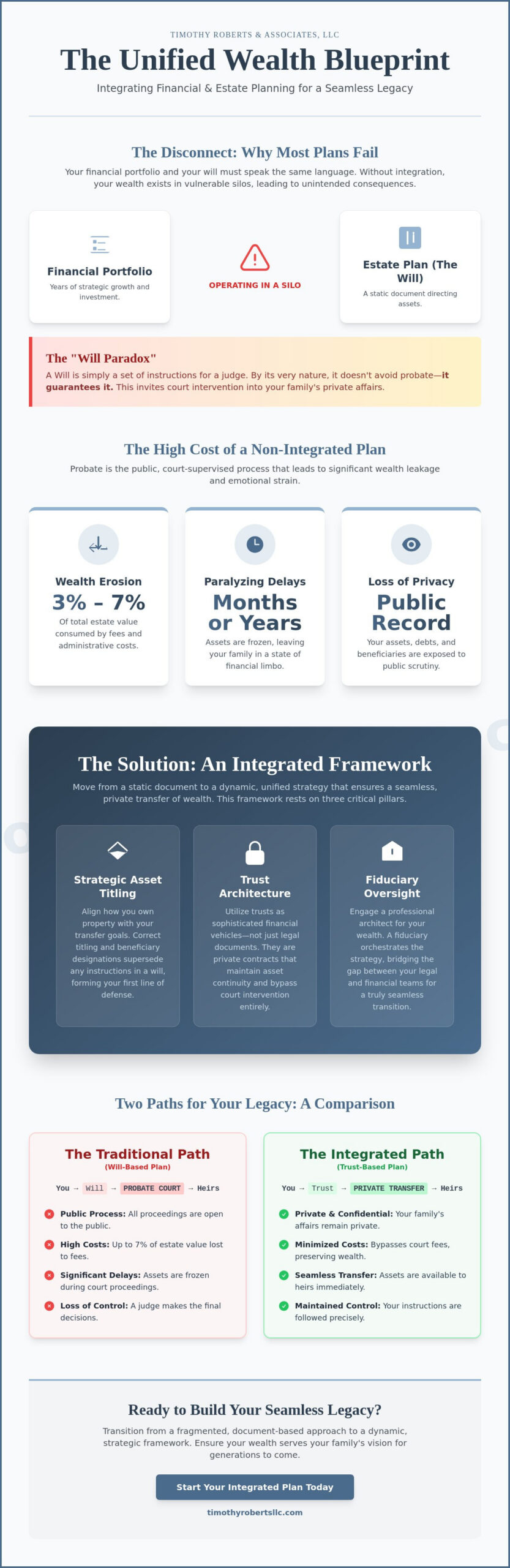
True wealth management is more than the sum of its parts; it’s the fluid transition of assets across generations. When you prioritize integrating financial planning with your estate plan, you bridge the gap between current lifestyle needs and future legacy goals. This isn’t a mere administrative task. It’s a strategic synchronization of your investment architecture, tax strategy, and fiduciary oversight. Without this convergence, your wealth exists in silos. These silos create vulnerabilities, leading to a strategic loss of control where your financial advisors and estate attorneys operate without a shared map. This integrated framework rests on three critical pillars:
- Asset Titling: Ensuring how you own property matches your transfer goals.
- Trust Architecture: Using private contracts to maintain continuity and privacy.
- Fiduciary Oversight: Professional management that bridges the gap between legal and financial silos.
Many high-net-worth individuals rely on a Will as their primary legacy document, yet they’re often surprised to learn about the “Will Paradox.” A Will is essentially a set of instructions addressed to a judge. By its very nature, it guarantees the probate process rather than avoiding it. It’s a public invitation for the court to oversee your private affairs, often leading to delays that contradict your desire for a swift, private transfer.
To better understand this concept, watch this helpful video:
The Silent Erosion of Non-Integrated Plans
Probate is the public, court-supervised process that validates a Will and oversees the distribution of assets. It’s often a source of significant wealth leakage. While costs vary by jurisdiction, probate fees and administrative delays can consume between 3% to 7% of an estate’s total value. Beyond the financial cost, the emotional toll on heirs is substantial. Assets are frequently frozen during court proceedings, leaving families in a state of financial limbo during an already difficult transition. Understanding these core concepts in estate planning is the first step toward building a more resilient, private strategy that bypasses the public eye.
Moving from “Document-Fix” to “Strategic-Framework”
A static document is a snapshot in time, but your financial life is dynamic. The “document-fix” approach focuses on checking boxes and filing papers. In contrast, a visionary strategist views wealth management as an evolving framework. A fiduciary advisor acts as the architect of this integration, ensuring that your investment portfolio management aligns perfectly with your legacy intent. The ultimate goal is a seamless flow. We work to ensure the right assets reach the right people at the right time with minimal friction. This level of coordination is why probate avoidance is a core component of retirement income planning. It ensures your lifestyle and your legacy remain in perfect harmony, moving away from fragmented tactics toward a narrative of shared success.
Strategic Asset Titling: Aligning Your Investment Portfolio with Legacy Intent
Asset titling represents the first line of defense in a sophisticated legacy strategy. It is the operational reality of your wealth, dictating exactly how ownership transfers at the moment of transition. Many investors focus heavily on the language of their legal documents while overlooking the administrative settings of their actual accounts. This oversight creates a dangerous disconnect. Within the legal framework of estate planning, there is a clear hierarchy of asset transfer: beneficiary forms and account titles almost always supersede the instructions in a Will.
If a brokerage account carries a specific beneficiary designation that contradicts your Will, the financial institution is legally bound to follow the account form. These “conflicting designations” can derail even the most meticulously drafted plans, leading to assets ending up with unintended parties or being locked in litigation. Integrating financial planning with your estate plan requires a comprehensive “Titling Audit.” This rigorous review ensures that every investment account, insurance policy, and real estate deed aligns perfectly with your master legacy plan.
A proactive approach to wealth management involves more than just selecting high-performing assets; it requires orchestrating how those assets are held to prevent administrative friction and unintended legal consequences.
The Power of POD, TOD, and JTWROS
Transfer on Death (TOD) and Payable on Death (POD) designations are elegant tools for creating immediate liquidity for heirs. They allow assets to pass directly to beneficiaries without the delays of a court-supervised process. Similarly, Joint Tenancy with Rights of Survivorship (JTWROS) provides a seamless bypass for probate between co-owners. However, adding heirs to titles prematurely carries significant risk. It exposes your hard-earned assets to the heirs’ personal creditors, legal judgments, or divorce settlements. Professional oversight ensures you utilize these tools to enhance liquidity without compromising asset protection.
Beneficiary Designations as a Tax Strategy
Strategic titling is also a vital tax mitigation tool. Naming a trust as a beneficiary for specific assets can provide granular control over the timing and nature of distributions. This is particularly relevant under the SECURE Act, which requires most non-spouse beneficiaries of inherited IRAs to empty the accounts within 10 years. Improper titling can inadvertently trigger immediate tax liabilities for beneficiaries, forcing a lump-sum distribution that pushes them into a higher tax bracket. Properly integrating financial planning with your estate plan ensures that beneficiary choices are synchronized with your broader tax planning to preserve the tax-deferred growth of your legacy.
Trust Structures as Financial Vehicles: Beyond Simple Document Drafting
A trust is not merely a static folder of legal papers; it is a dynamic financial vehicle designed for operational continuity. While a Will serves as a set of instructions for a judge, a Revocable Living Trust functions as a private contract that governs your assets in real-time. When you’re integrating financial planning with your estate plan, the trust acts as the central hub for your wealth. It provides a sophisticated architecture that allows for the seamless management of complex assets, including closely-held business interests or multi-state real estate portfolios. This level of strategic depth is essential for those seeking estate planning in Farmington Hills, where elevating legacy structures is a priority for preserving generational wealth.
The Successor Trustee plays a pivotal role in this framework. Unlike an executor who must wait for court authorization, a Successor Trustee steps in immediately to maintain the rhythm of your financial life. They ensure that bills are paid, investment strategies are executed, and distributions are made without the jarring interruption of court intervention. This continuity is vital for maintaining the momentum of your long-term financial strategy during periods of family transition.
Revocable vs. Irrevocable: The Control vs. Protection Trade-off
The choice between trust types is a study in strategic trade-offs. A Revocable Living Trust offers maximum flexibility; you retain total control over the assets and can modify the terms at any time. However, as wealth grows, many high-net-worth individuals transition toward irrevocable structures. These vehicles offer enhanced asset protection and powerful tax-mitigation capabilities, effectively removing assets from your taxable estate. We take a craftsman approach to this transition, customizing trust language to reflect your unique family values and specific legacy goals. This ensures the trust isn’t just a legal shield, but a reflection of your personal vision for the future.
Funding the Trust: The Critical Implementation Phase
The most sophisticated trust document is useless if it remains an empty vessel. Funding is the critical implementation phase where your physical assets are officially retitled in the name of the trust. This is where many plans fail, leaving assets exposed to the very probate process they were meant to avoid. Integrating financial planning with your estate plan requires a disciplined checklist for retitling:
- Brokerage and investment accounts.
- Real property deeds and land contracts.
- Closely-held business stock and membership interests.
- Personal property and high-value collectibles.
To ensure no asset is left behind, we utilize a “Pour-Over Will” as a strategic safety net. This document captures any assets accidentally left in your individual name and “pours” them into the trust at the time of passing. While this may still involve a brief court touchpoint, it ensures your master trust instructions ultimately govern the distribution of your entire estate.
The Privacy Advantage: Mitigating Tax Erosion and Public Scrutiny
Wealth is often built in private, yet the traditional probate process is an inherently public affair. When a Will enters probate, it becomes a matter of public record. This means anyone, from curious neighbors to predatory solicitors, can view the inventory of your assets and the specific terms of your distributions. This transparency creates a vulnerability that many high-net-worth families find unacceptable. By integrating financial planning with your estate plan, you shift the mechanism of transfer from a court-supervised process to a private contract. This transition ensures that your family’s financial footprint remains invisible to the public eye, maintaining the confidentiality you’ve prioritized throughout your life.
Beyond privacy, the strategic coordination of asset distribution is a powerful tool for mitigating tax erosion. A primary focus of this integration is preserving the “Step-up in Basis.” When assets pass through a properly structured estate, their cost basis is adjusted to the fair market value at the time of the owner’s death. This adjustment can virtually eliminate capital gains taxes for heirs on decades of appreciation. Achieving this requires precise strategic tax advising to ensure that asset titling and investment choices don’t inadvertently trigger premature tax events that bypass this benefit.
Securing Legacy Anonymity for the Family
Trust-based transfers offer a level of legacy anonymity that a Will simply cannot provide. Because a trust is a private agreement, family dynamics, wealth levels, and specific inheritance amounts stay within the family circle. This lack of public disclosure serves as a security measure, protecting heirs from unwanted attention and solicitation during a time of transition. Maintaining this barrier between your private wealth and public curiosity protects the dignity of the family during transition, allowing for a focus on continuity rather than defense.
Tactical Tax Coordination
The legislative environment of 2026 provides a unique window for proactive planning. Following the law passed in July 2025, the federal estate and gift tax exemption is now a permanent $15 million per person, or $30 million for married couples. This stability allows for more aggressive long-term strategies without the looming fear of a sunset provision. However, state-level nuances remain critical. For instance, New York’s exemption sits at $7.35 million, and exceeding that by more than 5% can result in the loss of the entire exclusion. We utilize year-round tax planning to minimize the “administrative tax” of probate and legal fees, while maximizing tools like the $19,000 annual gift exclusion. For those with philanthropic goals, we identify charitable giving strategies that provide immediate income tax benefits while serving your ultimate legacy purpose.
To ensure your wealth preservation strategy is as resilient as it is private, it’s essential to secure your legacy roadmap through a unified financial and estate framework.
Orchestrating the Evolution: The Role of Fiduciary Oversight in Legacy Continuity
A sophisticated legacy is never a static destination; it is a continuous progression. While earlier sections explored the mechanics of trusts and titling, the true strength of your strategy lies in its orchestration. A fiduciary advisor serves as the conductor of this evolution, ensuring that your legal, tax, and financial silos remain in perfect synchronization. Without this centralized oversight, even the most robust plans can fracture. By integrating financial planning with your estate plan, you move away from fragmented, one-off documents toward a narrative of partnership and shared success. This proactive approach ensures that as your wealth grows in complexity, your legacy architecture expands to meet it.
Continuity is the ultimate goal of wealth management. It’s why probate avoidance is recognized as a core component of retirement income planning. When your income strategy and your legacy goals share the same roadmap, you eliminate the friction that often plagues family transitions. This alignment ensures that the assets providing your current lifestyle are the same ones preserved for the next generation, protected from the erosion of court delays and public scrutiny.
The Fiduciary Advantage in Multi-Generational Wealth
The fiduciary standard of care is a non-negotiable requirement for coordinating complex legacy transfers. Unlike traditional brokerage models, a fiduciary has a legal and ethical obligation to act solely in your best interest. This distinction is vital when managing the risks of “siloed planning.” In many cases, a financial advisor and an estate attorney fail to communicate regarding significant asset changes. This lack of coordination can lead to outdated beneficiary designations or unfunded trusts. Professional fiduciary oversight provides the necessary intervention, ensuring that every account update is reflected in your legal framework. We maintain a rhythmic review process, confirming that your designations remain current with evolving regulations and your personal vision.
Adapting to Life’s Transitions
A visionary strategist understands that life is dynamic. A plan drafted five years ago may no longer reflect your current family dynamics or the shifting legislative landscape. We recommend a biennial review to adapt your roadmap to significant life changes, such as births, marriages, or the sale of a business. These “trigger events” require more than just a document update; they demand a strategic recalibration of your entire financial engine.
The stability provided by the July 2025 legislation, which established a permanent $15 million federal exemption, offers a unique opportunity for long-term planning. However, navigating the nuances of these provisions requires ongoing professional guidance. We help you stay ahead of the curve, ensuring your strategy remains as resilient as the wealth you’ve built. Partner with us to secure your strategic legacy today and transform your individual success into a lasting family heritage.
Securing Your Strategic Legacy Roadmap
True legacy preservation is found in the deliberate synchronization of asset titling, trust architecture, and fiduciary oversight. By moving beyond a simple folder of legal documents and integrating financial planning with your estate plan, you create a resilient framework that protects your family from the public scrutiny of probate and the silent erosion of uncoordinated taxes. This unified roadmap ensures that your investment portfolio management and legacy intent remain in perfect harmony, even as regulations evolve.
With over 25 years of fiduciary expertise, we specialize in crafting high-end interventions that bridge the gap between individual vision and structured wealth management. Our approach combines integrated strategy with sophisticated tax planning, providing a national reach balanced by personalized, high-touch service. We invite you to Schedule a Strategic Legacy Coordination Review to refine your vision and ensure your assets continue their upward progression across generations. Your success deserves a partnership that values depth over superficiality, guiding you toward a future of shared success and lasting impact.
Frequently Asked Questions
Is a Will enough to avoid the probate court process?
A Will is not a tool for probate avoidance; it is the primary document that guides the court through the probate process. It acts as a public set of instructions for a judge to validate your wishes and oversee the distribution of your assets. To bypass court intervention and maintain family privacy, you must utilize trust structures or strategic asset titling that transfers ownership outside of the probate estate.
How does integrating financial planning with an estate plan reduce taxes?
Integration reduces taxes by aligning your investment architecture with current legislative thresholds to maximize wealth preservation. By integrating financial planning with your estate plan, you can synchronize your annual gift exclusions, currently $19,000 per person, with long-term trust funding. This coordination ensures that your income tax strategies and the permanent $15 million federal exemption work in tandem to minimize the tax burden on your heirs.
What is the difference between a revocable and irrevocable trust?
The distinction lies in the balance between operational control and asset protection. A revocable trust offers maximum flexibility, allowing you to modify terms or reclaim assets during your lifetime. An irrevocable trust generally cannot be changed once established, but it provides superior protection from creditors and effectively removes assets from your taxable estate. Choosing between them requires a craftsman-like approach to your specific legacy goals.
How often should I update my beneficiary designations?
You should review and potentially update your beneficiary designations at least every two years or immediately following major life events. Marriages, births, or deaths in the family are critical trigger points that necessitate a strategic update. Regular biennial audits ensure that your account-level designations don’t create conflicting instructions with your broader legacy roadmap, maintaining the integrity of your unified financial engine.
Can I avoid probate without using a trust?
You can bypass probate for specific accounts through strategic asset titling like Transfer on Death (TOD), Payable on Death (POD), or Joint Tenancy with Rights of Survivorship (JTWROS). These designations allow assets to pass directly to beneficiaries by operation of law. While effective for individual accounts, these tools lack the sophisticated control, contingency planning, and tax-mitigation power provided by a comprehensive trust structure within a larger framework.
What happens to my investment accounts if I die without an estate plan?
If you die without a plan, your investment accounts are governed by state intestacy laws and the full probate process. This means a court determines the distribution of your wealth based on a rigid legal formula rather than your personal wishes. This process often results in administrative delays, higher legal fees, and a public inventory of your assets that can expose your family to unwanted scrutiny.
What is a “Step-up in Basis” and why does it matter for my heirs?
A “Step-up in Basis” resets the cost basis of an inherited asset to its fair market value at the date of death. This adjustment is vital because it allows your heirs to sell inherited investments immediately without paying capital gains tax on the appreciation that occurred during your lifetime. It is a powerful wealth preservation tool that requires precise coordination between your investment management and legacy planning.
How does the 2026 tax law change affect my integrated estate plan?
The July 2025 legislation provided significant stability by making the $15 million federal estate tax exemption permanent. This allows for more confident long-term integrating financial planning with your estate plan without the fear of a sunset provision. However, state-level nuances, such as New York’s $7.35 million threshold or Pennsylvania’s 4.5% inheritance tax for children, remain critical factors that require ongoing fiduciary oversight and strategic adjustment.
