

Jun
Saving for College vs. Saving for Retirement: A Strategic Fiduciary Perspective for 2026
What if the most profound gift you can provide your child isn’t a debt-free degree, but the absolute certainty that they will never need to support you financially? It’s a provocative reframe for parents who feel the persistent, heavy tug of legacy. When navigating the delicate balance of saving for college vs saving for retirement, it’s easy to fall into the trap of binary thinking. You shouldn’t have to choose between your child’s education and your own dignity in later life.
We understand the quiet anxiety that stems from rising tuition costs and the complexity of modern tax-advantaged accounts. It’s natural to feel a sense of guilt when prioritizing your 401k over a 529 plan; however, a strategic fiduciary perspective reveals that your retirement security is the foundation that enables sustainable education funding, not a competitor to it. Discover how to architect a financial roadmap that secures your future while empowering the next generation. This guide provides a clear hierarchy for your contributions and a tax-efficient withdrawal strategy tailored for the 2026 landscape. We will examine how recent legislative optimizations can transform these competing pressures into a singular, cohesive strategy for generational growth.
Key Takeaways
- Understand the “Oxygen Mask” principle, recognizing that securing your retirement foundation is the most significant financial gift you can provide to the next generation.
- Evaluate the strategic versatility of dual-purpose vehicles, such as the Roth IRA, to maintain liquidity and tax efficiency across both education and legacy goals.
- Navigate the complex trade-offs of saving for college vs saving for retirement by identifying which milestones offer external financing options and which require absolute personal capital.
- Learn to architect a tiered contribution hierarchy that prioritizes employer-matching benefits and establishes a retirement “floor” before expanding into education funding.
- Discover how a bespoke fiduciary approach replaces generic products with a customized intervention designed to synthesize your family’s aspirational growth with technical financial rigor.
The Financial Tug-of-War: Balancing Parental Duty with Personal Security
The internal conflict between providing for a child’s education and securing one’s own future often feels like a zero-sum game. For many families, the perceived choice between saving for college vs saving for retirement is fraught with guilt and urgency. However, viewing these goals as mutually exclusive is a strategic error. A visionary approach treats them as integrated components of a single, sophisticated wealth progression strategy rather than a binary trade-off. We must move away from the frantic pursuit of individual milestones and toward a narrative of partnership and shared success.
To better understand how to prioritize these competing demands, watch this helpful video:
A sophisticated financial roadmap recognizes that the “American Dream” has evolved. It is no longer just about ownership or a single degree. It is about maintaining agility in a volatile economy. By aligning your personal security with your parental aspirations, you create a stable environment where your children can thrive without the looming shadow of future financial dependence on them.
The 2026 Landscape of Higher Education Costs
Higher education costs in 2026 continue to outpace general inflation, frequently rising at rates that challenge traditional savings models. While the ROI of prestige institutions remains high in specialized sectors, the economic landscape is shifting toward more flexible, modular education paths. Parents often look toward the 529 plan as a primary vehicle to combat these rising costs. This tool offers significant tax advantages, yet it must be deployed within a broader framework that accounts for market volatility and shifting institutional aid policies. Relying on outdated cost projections can derail even the most well-intentioned savings plan.
The Longevity Risk: Why Retirement Planning is Non-Negotiable
Advancing medical technology and improved wellness standards mean that a 2026 retirement could easily span three decades. This creates a genuine longevity risk where the cost of living in later years becomes the primary threat to a family’s financial stability. Relying on the fallback of “working longer” is a precarious strategy. Health changes or shifts in the corporate landscape can render that plan obsolete overnight. It’s a risk that requires a carefully crafted intervention rather than a hopeful assumption.
Prioritizing your own financial independence is a strategic gift to your children. By ensuring you never become a financial liability to them in your later years, you offer a level of security that a paid-off tuition bill cannot match. When analyzing the trade-offs of saving for college vs saving for retirement, remember that while students have access to various funding sources, there are no scholarships for retirement. Your personal stability is the bedrock upon which their future is built.
The Fiduciary Mandate: Why Retirement Must Take Precedence
A fiduciary perspective demands a rigorous adherence to structural priorities over emotional impulses. While the desire to fund a child’s education is rooted in commendable parental care, the objective reality is that your retirement security serves as the ultimate safeguard for the entire family unit. This is often described as the “Oxygen Mask” principle. You must secure your own financial foundation before you can effectively assist those who depend on you. Without a robust retirement plan, you risk becoming a financial burden to the very children you wish to empower.
When analyzing the tension of saving for college vs saving for retirement, we must evaluate the landscape of available leverage. Education can be financed through a variety of structured instruments, but retirement offers no such flexibility. Professional investment portfolio management helps families navigate these trade-offs by applying a strategic lens to asset allocation, ensuring that short-term goals don’t compromise long-term stability.
The Loan Gap: Borrowing for Education vs. Borrowing for Life
In 2026, the contrast between education funding and retirement credit is stark. Students have access to federal loans with income-driven repayment plans and subsidized interest rates, alongside a private loan market that remains highly liquid for those attending accredited institutions. Conversely, borrowing for retirement typically involves high-risk maneuvers like reverse mortgages or 401k loans. These options often erode equity or trigger significant tax penalties, creating a precarious situation in your later years. The Loan Gap is the fundamental reality that while you can borrow for a degree, you cannot borrow for a life of dignity and independence in retirement.
The Mathematical Reality of Compounding Interest
Time is the most valuable asset in any wealth progression strategy. The difference in growth potential between an 18-year college horizon and a 40-year retirement horizon is astronomical. Missing just five years of retirement contributions early in your career doesn’t just reduce your balance; it creates a deficit that often requires 15 years of aggressive catch-up contributions to rectify. For instance, with the 2026 401(k) employee contribution limit set at $24,500, the opportunity cost of redirected funds is immense. Front-loading retirement accounts allows compounding to do the heavy lifting, providing the intellectual and financial space to address education funding later with greater confidence and less risk.
Fiduciary oversight is essential here to mitigate the emotional bias that often leads parents to underfund their futures. When balancing the demands of saving for college vs saving for retirement, applying a cold, analytical rigor to your financial roadmap ensures your decisions are based on data rather than guilt. This strategic intervention transforms your savings from a series of stressful transactions into a polished, intentional journey toward multi-generational success.
Strategic Vehicles: A Comparative Analysis of Funding Options
The transition from a high-level philosophy to practical execution requires an intimate knowledge of the financial instruments at your disposal. Selecting the right vehicle isn’t merely about tax avoidance; it’s about maintaining agility in a shifting economic landscape. When navigating the complexities of saving for college vs saving for retirement, high-net-worth families must look beyond generic advice to find tools that offer both structural stability and tactical flexibility.
The 529 Plan: Efficiency and Limitations
The 529 plan remains a primary instrument for education funding due to its tax-free growth and withdrawal structure for qualified expenses. In 2026, the utility of these accounts has expanded significantly. Individuals can now contribute up to $19,000 per beneficiary without gift tax implications, while married couples can leverage $38,000 annually. Perhaps the most sophisticated update is the provision allowing a lifetime maximum of $35,000 in unused 529 funds to be rolled over into a Roth IRA for the beneficiary. This rollover capability mitigates the historical fear of overfunding, provided the account has been open for at least 15 years.
The Roth IRA: The Ultimate Strategic Intervention
For the visionary strategist, the Roth IRA serves as a powerful dual-purpose vehicle. Because contributions to a Roth IRA are made with after-tax dollars, those principal amounts can be withdrawn at any time, for any reason, without taxes or penalties. This creates a secondary liquidity pool that can fund tuition if needed, while the earnings continue to grow tax-free for your future. The “Double-Duty” Roth strategy allows mid-career professionals to treat the account as a retirement anchor while maintaining a secondary, penalty-free liquidity pool for tuition if necessary. In 2026, with contribution limits at $7,500, this vehicle is essential for those who value multi-generational wealth progression.
Flexible Wealth: The Role of Tax-Efficient Brokerage Accounts
While specialized accounts offer tax perks, taxable brokerage accounts provide the “no-strings-attached” capital necessary for a truly customized lifestyle. These assets aren’t restricted to qualified education expenses, making them ideal for covering non-tuition costs like off-campus housing or international travel. By integrating tax planning strategies such as tax-loss harvesting into your annual review, you can offset gains and lower your overall liability. This level of flexibility is often the missing piece in standard retirement products, allowing you to pivot as your family’s needs evolve without triggering the restrictive penalties associated with traditional retirement or education plans.
Custodial accounts like UTMAs or UGMAs offer another path, yet they require caution. These assets belong to the minor, which can significantly impact financial aid eligibility, as they are weighted more heavily than parental assets in federal aid formulas. A fiduciary approach balances these technical nuances to ensure that your choice of vehicle supports your broader legacy goals rather than creating unintended obstacles.
Designing Your Integrated Funding Strategy
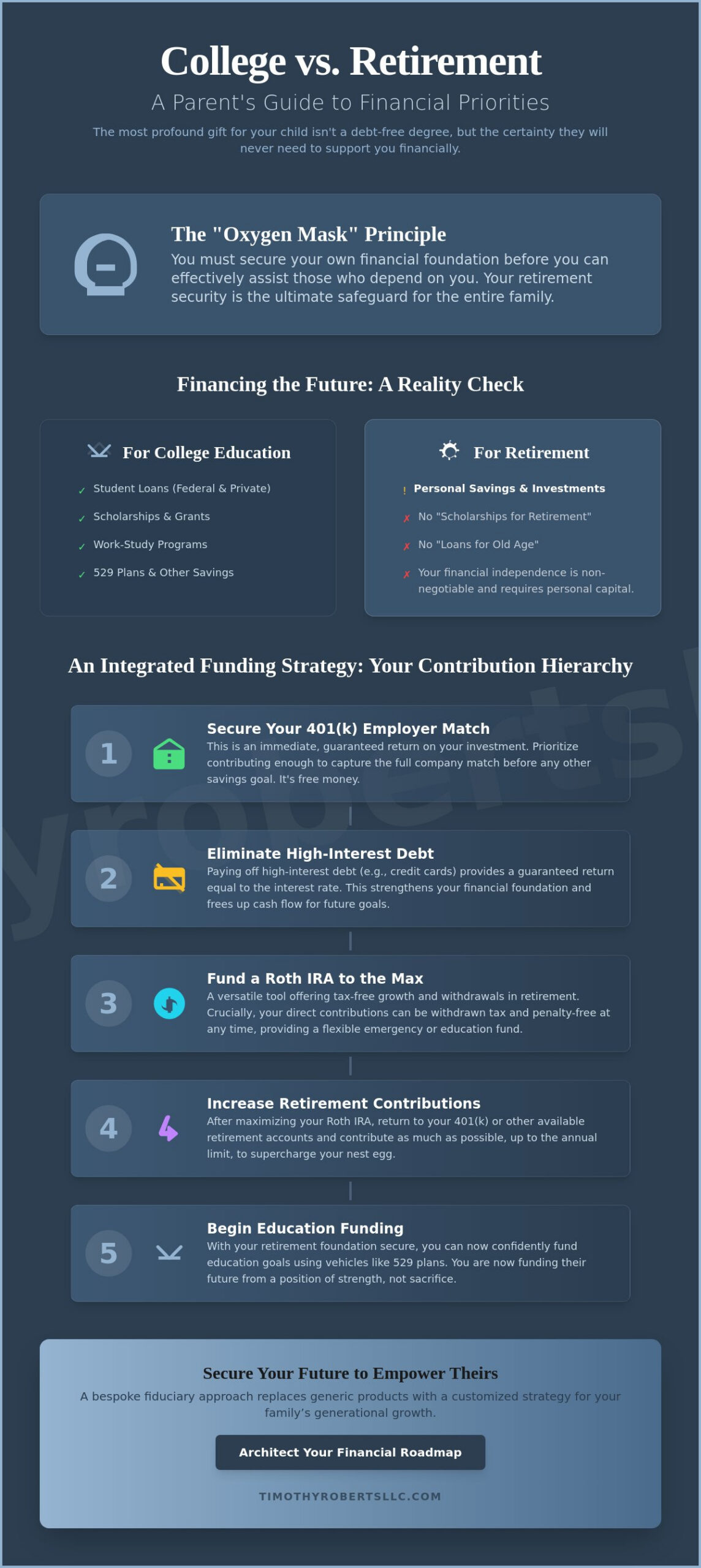
The debate surrounding saving for college vs saving for retirement is often presented as a binary choice; however, a sophisticated financial roadmap treats these as parallel tracks that inform and strengthen one another. Moving away from an “either/or” mentality allows you to architect a strategy that prioritizes long-term stability without sacrificing your child’s educational aspirations. This integration requires a disciplined sequence of contributions, ensuring that every dollar is deployed with maximum efficiency and intentionality.
Establishing a baseline retirement “floor” is the first strategic intervention. By utilizing rigorous fiduciary projections, we identify the exact capital required to maintain your desired lifestyle throughout a thirty-year retirement. Once this foundation is secure, surplus cash flow can be directed toward education-specific vehicles. This tiered approach transforms a stressful tug-of-war into a steady, logical progression toward multi-generational wealth. Partner with a professional to develop education funding strategies that protect your personal legacy while empowering the next generation.
The “Oxygen Mask” Contribution Hierarchy
A visionary strategist follows a precise order of operations to capture every available tax advantage and employer incentive. The hierarchy begins with maximizing your 401(k) or 403(b) employer match, as this represents an immediate, guaranteed return on investment. Following this, the focus shifts to the Roth IRA, which provides a unique blend of tax-free growth and penalty-free principal liquidity for tuition. Only after these retirement anchors are established should you pivot to the 529 plan to capture state tax credits and dedicated education growth. Finally, taxable brokerage accounts serve as the “flex” layer, providing the unrestricted capital necessary for costs that fall outside of traditional qualified expenses.
Leveraging Financial Aid Without Sabotaging Your Assets
A common pain point for high-earning families is the fear that diligent saving will disqualify them from financial aid. In the 2026 landscape, understanding the FAFSA treatment of various accounts is essential for asset protection. Retirement accounts, including IRAs and 401(k)s, are generally excluded from the federal aid formula, making them a “safe” harbor for wealth. Conversely, 529 plans owned by parents are assessed at a much lower rate than assets held directly in a student’s name. By synthesizing your tax planning strategies with aid eligibility rules, you can maintain a robust portfolio while still positioning your child for institutional grants or scholarships. This level of customization ensures that your success doesn’t become a barrier to your child’s opportunities, creating a human-led, results-driven identity for your family’s financial future.
Partnering for Progression: The Timothy Roberts & Associates, LLC Approach
The journey toward multi-generational prosperity isn’t a simple transaction; it’s a meticulously crafted evolution. At Timothy Roberts & Associates, LLC, we move away from the aggressive sales tactics common in the financial industry, opting instead for a narrative of partnership and shared success. When navigating the sophisticated nuances of saving for college vs saving for retirement, you deserve a partner who values depth over superficiality. Our fiduciary advisors act as visionary strategists, synthesizing your personal creative vision with our structured corporate capabilities to architect a future that feels both polished and intentional.
We believe that true wealth management requires an expert craftsman’s touch. Off-the-shelf retirement products often fail to account for the intricate tax profiles and aspirational growth goals of high-net-worth families. Our approach focuses on carefully crafted interventions that align your immediate parental duties with your long-term personal security. This integrated approach ensures that the tension between saving for college vs saving for retirement is resolved through optimization rather than sacrifice.
Custom Interventions for Complex Wealth
Our firm prioritizes Investment Portfolio Management that’s tailored to your specific tax profile and risk tolerance. We don’t just set a strategy; we engage in continuous monitoring and rebalancing to ensure your assets remain aligned with your dual goals. This includes a deep dive into Tax Advising to ensure that every contribution and withdrawal is executed with maximum efficiency. By integrating Education Funding Strategies into your broader financial roadmap, we create a stable environment where your children’s education and your retirement floor are equally protected.
Beyond the Spreadsheet: Intentional Legacy Planning
A truly strategic fiduciary perspective looks beyond the numbers to the human impact of wealth. We assist families in crafting a narrative of financial responsibility, treating the funding of education as a vital chapter in a comprehensive Estate & Legacy Planning strategy. This isn’t just about paying tuition; it’s about teaching the next generation the value of structured corporate capabilities and personal creative vision. We help you coordinate your estate so that your legacy remains a source of empowerment rather than a source of confusion.
The progression toward your goals should feel steady and logical, guided by a reliable business advisor who takes the time to understand complex problems. If you’re ready to move from a transactional mindset to a deeply strategic partnership, we invite you to take the next step in your financial journey. Schedule a strategy session for your education and retirement goals and discover how our bespoke interventions can secure your family’s future for 2026 and beyond.
Architecting a Legacy of Financial Independence
The journey toward multi-generational stability requires a departure from binary thinking. This strategic framework demonstrates that the tension inherent in saving for college vs saving for retirement is best resolved through a tiered contribution hierarchy and the use of versatile, dual-purpose vehicles. By prioritizing your own retirement “floor,” you provide your children with the most enduring gift possible: the absolute certainty of your lifelong financial independence. This intentional alignment ensures that educational aspirations don’t compromise your long-term security.
Navigating these complex tax-advantaged accounts and shifting regulations requires more than a generic solution. It demands a carefully crafted intervention. With over 25 years of fiduciary experience and specialized expertise in Retirement Income Planning, our firm provides national coverage with a deeply personalized touch. We synthesize your creative vision with our technical rigor to build a roadmap as unique as your family’s ambitions. Request a Comprehensive Financial Planning Consultation to begin architecting your bespoke wealth management strategy. Your path to upward progression starts with a single, intentional step toward shared success.
Frequently Asked Questions
Can I use my 401(k) to pay for my child’s college tuition?
You can technically access 401(k) funds through loans or hardship withdrawals, but this is rarely the most strategic intervention. Loans must be repaid with interest, and withdrawals often trigger immediate tax liabilities and potential penalties. Prioritizing your retirement floor ensures you don’t compromise long-term growth for a short-term liquidity need. It’s often more efficient to explore structured education funding strategies that preserve your qualified retirement assets.
Is it better to pay off student loans or save for retirement first?
Prioritizing retirement is generally the superior move, especially when an employer match is available. Capturing that match provides an immediate return that typically outpaces student loan interest rates. When evaluating saving for college vs saving for retirement, remember that retirement accounts benefit from longer compounding horizons. Maintaining this focus prevents a deficit that becomes increasingly difficult to rectify as you approach your target retirement date.
How much should I have in my retirement fund before I start a 529 plan?
You should establish a retirement floor based on fiduciary projections that account for your desired lifestyle and longevity risk. In 2026, ensure you’re at least maximizing your employer match and ideally hitting the $24,500 401(k) employee contribution limit. Once your trajectory for personal independence is secure, you can confidently allocate surplus cash flow toward a 529 plan without jeopardizing your future security.
What happens to my 529 plan if my child receives a full scholarship?
If your child earns a scholarship, you can withdraw an equivalent amount from the 529 plan penalty-free, though you’ll pay income tax on the earnings. Alternatively, you can change the beneficiary to another family member or utilize the 2026 rollover provision. This allows you to move up to $35,000 in unused funds into a Roth IRA for the beneficiary, provided the account has been open for at least 15 years.
Does a Roth IRA count against you for financial aid (FAFSA)?
The principal value of a Roth IRA is generally excluded from the FAFSA asset calculation, as it’s a qualified retirement account. This makes it a sophisticated tool for families balancing saving for college vs saving for retirement. While the account value is protected, be aware that withdrawals used for tuition may be counted as untaxed income on subsequent aid applications, potentially impacting future eligibility for institutional grants.
Should I prioritize my retirement if I started saving late in life?
Late starters must prioritize retirement with absolute focus because there are no scholarships or loans available for your later years. Utilize the 2026 catch-up contribution limits, which allow individuals aged 50 and older to add an extra $8,000 to their 401(k). Securing your foundation is the most significant gift you can give your children, as it prevents you from becoming a financial burden during their peak earning years.
How do I balance saving for multiple children’s college funds and my own retirement?
Apply a tiered hierarchy that treats your retirement as the non-negotiable foundation. Once your retirement contributions are maximized, prioritize education funding for the child closest to college age while maintaining a baseline for younger siblings. This sequence allows you to manage multiple timelines with agility. A custom wealth management strategy can help synthesize these competing dates into a single, cohesive roadmap for your family’s upward progression.
What is the “529-to-Roth IRA” rollover rule for 2026?
The 2026 rules permit a lifetime maximum rollover of $35,000 from a 529 plan to the beneficiary’s Roth IRA. To qualify, the 529 account must have been open for at least 15 years, and the funds being moved must have been in the account for at least five years. This provision transforms the 529 plan into a dual-purpose vehicle, mitigating the risk of overfunding and supporting the next generation’s long-term wealth.
