

May
What Is a Fiduciary Duty in Finance? Defining the Standard of Financial Stewardship
Your wealth deserves more than just suitable advice; it requires an unwavering commitment to your best interests. While many investors assume their advisors are always on their side, the reality of the industry is often clouded by complex fee structures and conflicting incentives. Understanding what is a fiduciary duty in finance is the first step toward securing a partnership built on transparency rather than transactions. It’s the essential difference between a salesperson and a true steward of your financial legacy.
It’s natural to feel uncertain when distinguishing between financial professionals, especially as regulatory standards like the 1975 ERISA definition continue to evolve. You deserve to know that every recommendation, from investment portfolio management to tax planning strategies, is crafted without the shadow of a hidden commission. This guide explores the legal and ethical framework of fiduciary obligations, offering you a clear roadmap to conflict-free guidance. We’ll examine how these standards protect your assets and provide a strategic framework for evaluating your financial partnerships with absolute confidence.
Key Takeaways
- Understand what is a fiduciary duty in finance as the industry’s gold standard, ensuring your advisor is legally bound to prioritize your best interests above all else.
- Identify the critical distinction between fiduciary and suitability standards to ensure your wealth strategy is truly optimized rather than merely “appropriate.”
- Discover how the duties of loyalty and care provide a protective framework against hidden fees and undisclosed conflicts of interest.
- Learn how fiduciary oversight directly influences long-term success in retirement income planning and sophisticated tax planning strategies.
- Establish a clear framework for selecting a conflict-free partner who views your financial evolution as a journey of shared success.
Defining Fiduciary Duty: The Gold Standard of Financial Integrity
In the architecture of wealth management, a Fiduciary relationship stands as the most rigorous legal and ethical commitment an advisor can undertake. It is a bond that transcends simple service. When exploring what is a fiduciary duty in finance, one must look beyond the surface level of advice and recognize it as a mandate to prioritize the client’s welfare above all else. Unlike transactional banking, where products are often sold based on quotas or commissions, a fiduciary acts as a dedicated advocate. This standard ensures every intervention is a step toward your specific vision of success, rather than a firm’s bottom line.
To better understand how this standard functions in practice, watch this concise breakdown:
The Legal Origin and Necessity of Fiduciary Standards
The roots of this obligation lie deep within trust law and the fundamental principles of agency. The law intervenes in these relationships because of a natural imbalance of expertise. A client must rely on an advisor’s specialized knowledge to manage complex assets, creating a vulnerability that the law seeks to protect. As of May 2026, the regulatory environment has shifted back to the 1975 five-part test for ERISA fiduciaries, emphasizing that consistency and professional reliance are key to this legal designation. This standard ensures those managing your wealth are held accountable for the profound impact their decisions have on your legacy. It transforms the relationship from a series of transactions into a narrative of stewardship.
Why ‘Best Interest’ Is the Minimum Requirement for Success
Placing a client’s interest first is not a suggestion. It is a requirement that demands meticulous diligence and professional rigor. This best interest standard requires an advisor to evaluate risk, timing, and personal goals before making any recommendation. It moves the conversation away from what is merely allowable toward what is truly optimal for your unique circumstances. This legally mandated partnership offers a level of emotional security that a commission-based salesperson cannot provide. Fiduciary duty is a profound commitment to client-centric evolution that transforms wealth management into a shared journey of upward progression.
- Loyalty: The advisor must put your interests before their own at all times.
- Transparency: All potential conflicts of interest must be disclosed clearly and immediately.
- Diligence: Every recommendation must be based on thorough research and professional skill.
The Five Pillars of Fiduciary Responsibility in Wealth Management
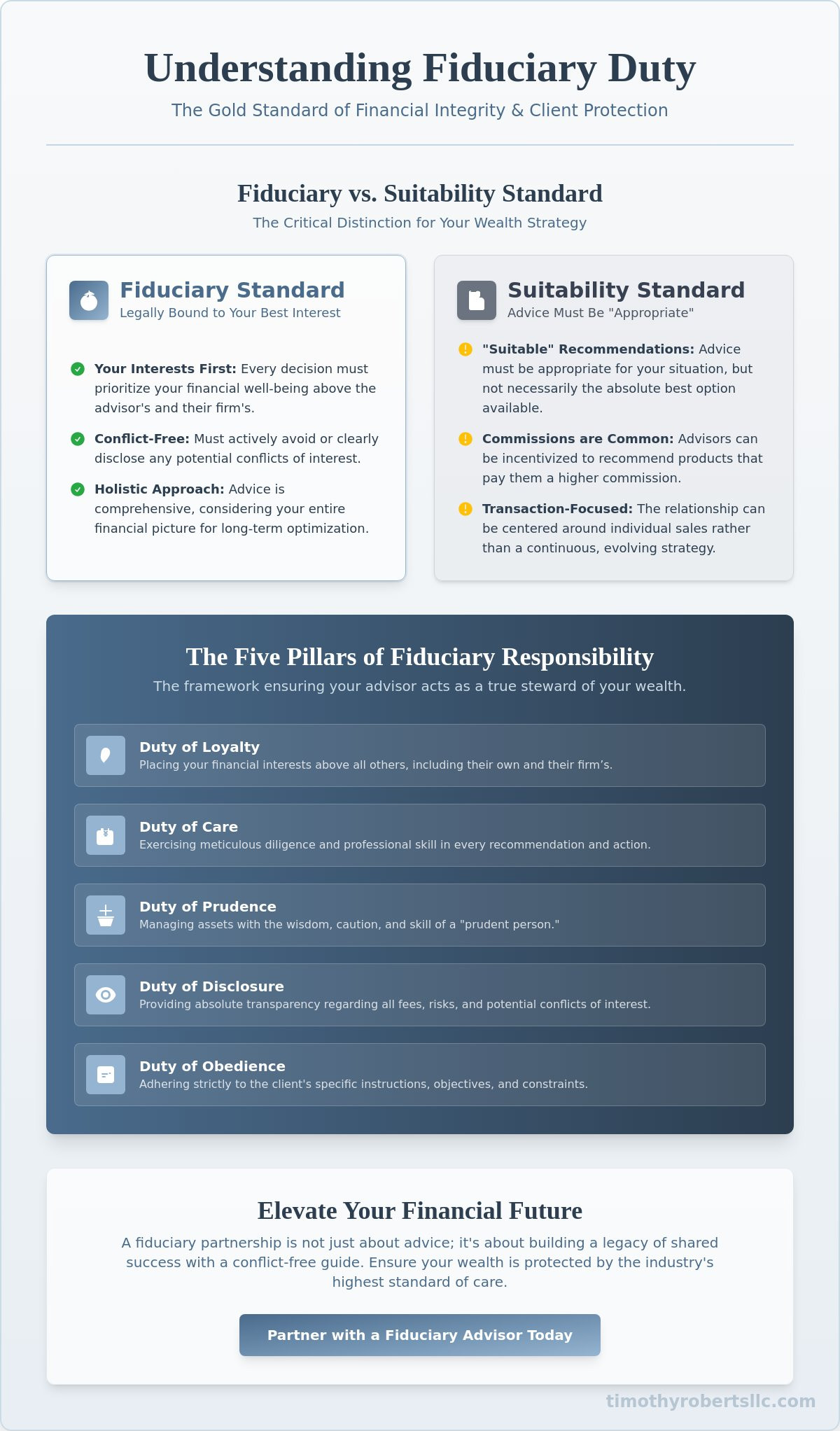
A fiduciary relationship is not a singular promise; it is a structural framework designed to uphold the highest standards of financial stewardship. To fully grasp what is a fiduciary duty in finance, one must understand the five pillars that define this professional mandate. These pillars act as the structural integrity of your financial plan, ensuring that every strategic intervention is aligned with your long-term evolution. They move the advisor-client relationship from a simple service model into a sophisticated partnership characterized by intellectual curiosity and business-minded rigor.
- Duty of Loyalty: Placing your interests above all others, including the firm’s own gains.
- Duty of Care: Exercising meticulous diligence and professional skill in every recommendation.
- Duty of Prudence: Managing assets with the wisdom and caution of a “prudent person.”
- Duty of Disclosure: Providing absolute transparency regarding fees, risks, and administrative costs.
- Duty of Obedience: Adhering strictly to the specific roadmap and constraints you establish.
Duty of Loyalty: Eliminating Conflicts of Interest
The duty of loyalty is the cornerstone of trust. In traditional wealth management, commissions on specific products can often compromise the integrity of advice, creating a subtle but significant bias. A fiduciary remains loyal by disclosing and, where possible, eliminating these conflicts entirely. This often manifests in a fee-only structure, where compensation is tied to your success rather than product sales. What is a fiduciary? It is an expert who views your capital as a shared responsibility, ensuring that “hidden” incentives never dictate your strategy. This level of wealth management focuses on your upward progression through conflict-free guidance.
Duty of Care and Prudence: The Craftsman’s Approach to Investing
Fiduciary duty mandates more than just good intentions; it requires the skill of a master craftsman. The duty of care involves continuous monitoring and the rhythmic rebalancing of portfolios to stay aligned with shifting market realities. It rejects the “set and forget” mentality of off-the-shelf solutions. Instead, it relies on evidence-based strategies and rigorous research to fulfill the duty of prudence. This means your assets are managed with the same meticulous attention an expert would apply to their own legacy. It replaces the uncertainty of guessing with the stability of strategic intervention. Each decision is a calculated step toward organizational and personal evolution, rooted in data rather than speculation.
Fiduciary vs. Suitability Standards: Navigating the Advisor Landscape
The most pervasive misconception in wealth management is the belief that every professional holding the title of “advisor” is legally bound to act in your best interest. This is simply not the case. In reality, the industry is split between two vastly different legal benchmarks. Understanding what is a fiduciary duty in finance requires a clear-eyed comparison with the Suitability Standard, a lower bar of conduct that often governs traditional brokerage relationships. While a fiduciary is committed to your upward progression, a suitability-based broker is merely required to ensure a recommendation is “appropriate” for your situation at the moment of sale.
This distinction is not merely academic; it has tangible consequences for your capital. Under a suitability model, an advisor might recommend a high-commission product that meets your basic needs even if a lower-cost, more efficient alternative exists. This “product pushing” can lead to a portfolio cluttered with expensive mutual funds or insurance products that serve the firm’s bottom line more than your own. Over a decades-long horizon, these unnecessary fees can significantly erode the stability of your retirement, transforming what should have been growth into a quiet drain on your legacy.
The Broker vs. Fiduciary Advisor Distinction
The legal benchmarks for these roles are fundamentally opposed. A fiduciary must adhere to the “Best Interest” standard, while a broker follows the “Suitability” rule. A significant challenge for investors is the “Two Hat” problem, where certain professionals switch between these standards depending on the specific transaction. This creates a landscape of shifting loyalties that can be difficult to discern. To protect your interests, you must look for professionals who provide a written fiduciary oath and a clear Form ADV. As noted by the University of Miami School of Law, defining these duties is essential for containing risk and ensuring that stewardship remains the priority in every intervention.
How the Standard Affects Your Investment Portfolio
Your approach to investment portfolio management changes fundamentally when viewed through a fiduciary lens. A fiduciary focuses on minimizing internal costs, such as expense ratios and transaction fees, because they understand that every dollar saved is a dollar that continues to compound. In contrast, a suitability-based model might ignore these “invisible” costs if the product itself is deemed suitable. To evaluate a potential partner, consider this checklist of questions:
- Are you a fiduciary for all the services you provide to me?
- Do you receive any commissions or third-party payments for the products you recommend?
- Can you provide a written statement confirming your fiduciary status?
- How do you manage and disclose potential conflicts of interest?
By demanding these answers, you move away from the uncertainty of transactional advice toward a partnership rooted in professional stability and shared success.
The Strategic Impact of Fiduciary Oversight on Retirement Outcomes
Fiduciary duty is often discussed as a protective shield, yet its true value lies in its role as a catalyst for long-term growth. When you look beyond the legalities to understand what is a fiduciary duty in finance, you find a dynamic strategic advantage that directly influences the longevity of your wealth. A fiduciary doesn’t merely manage assets; they orchestrate a comprehensive roadmap where every decision is stress-tested against your ultimate goals. This level of stewardship is particularly critical in retirement income planning, where the transition from accumulation to distribution requires a visionary approach to risk and cash flow.
In 2026, with 401(k) contribution limits rising to $24,500 and IRA limits reaching $7,500, the complexity of maximizing these vehicles demands professional rigor. A fiduciary advisor views these regulatory updates as opportunities for strategic intervention. They ensure that your participation in retirement plans, from Roth IRAs to SEP IRAs, is optimized for your specific tax bracket and timeline. This proactive stance transforms a static portfolio into a resilient income engine, protecting your lifestyle against the erosive effects of inflation and market volatility.
Tax Planning and Fiduciary Duty
A true fiduciary recognizes that what you keep is just as important as what you earn. This is why sophisticated tax advising is treated as a core obligation rather than a secondary service. By integrating tax planning strategies into the foundational investment strategy, a fiduciary works to maximize your net-of-tax income. This includes the meticulous selection of tax-efficient investment vehicles and the strategic timing of asset sales to minimize liabilities. For high-net-worth estates, this level of tax compliance acts as a vital safeguard, ensuring that wealth isn’t unnecessarily depleted by avoidable obligations during the transfer process.
Estate and Legacy Planning: A Fiduciary Perspective
The fiduciary’s mandate extends beyond your own lifetime. It encompasses the protection of multi-generational wealth through disciplined estate planning coordination. A fiduciary ensures your legacy roadmap is professionally structured and aligned with your broader wealth management goals. They manage the transition of assets with a craftsman’s attention to detail, protecting the interests of your beneficiaries during complex transfers. This holistic oversight provides the professional stability required to navigate the personal and corporate capabilities of a modern estate. If you are ready to elevate your wealth strategy through conflict-free stewardship, explore our approach to fiduciary wealth management.
Elevating Your Financial Future with Fiduciary Partnership
Realizing your long-term vision requires more than a mere service provider; it demands a partner who views your upward progression as their own benchmark for success. Understanding what is a fiduciary duty in finance allows you to move beyond the noise of transactional sales and into a relationship defined by shared outcomes. This standard is the essential architecture of a high-performance wealth strategy, ensuring that every decision is a deliberate step toward your personal and organizational evolution. When you finally define what is a fiduciary duty in finance for your own household, you gain a framework for evaluating every future partnership with absolute clarity.
The Timothy Roberts & Associates Approach to Stewardship
With over 25 years of experience in sophisticated wealth and tax solutions, Timothy Roberts & Associates has cultivated a standard of stewardship that blends intellectual curiosity with professional stability. We reject the concept of off-the-shelf products. Our process involves creating a meticulously balanced financial roadmap that synthesizes your individual creative vision with structured corporate capabilities. This craftsman’s approach ensures that your investment portfolio management and tax planning strategies are not just functional, but truly progressive interventions tailored to your risk profile.
Our commitment to the fiduciary standard is mirrored in our asset-based management model. This structure creates a steady and logical alignment of interests. By tying our success directly to the growth of your assets, we eliminate the friction of hidden commissions and product-based incentives. It is a polished and intentional way to manage wealth, where the firm takes the time to understand and solve complex problems rather than rushing to generic conclusions. This deliberate pacing reinforces the trust necessary for a high-end partnership, moving away from aggressive sales tactics toward a narrative of shared success.
Securing Your Strategic Legacy
Navigating the complexities of market volatility and the shifting landscape of 2026 tax laws requires more than just diligence. It requires a visionary strategist who can provide calm confidence during periods of transition. A fiduciary partner acts as a reliable business advisor, ensuring that your estate & legacy planning remains resilient in the face of change. This partnership offers the peace of mind that comes from knowing your capital is being managed with the highest level of professional rigor and ethical integrity.
If you are uncertain about the legal standard governing your current financial relationship, now is the time for a strategic audit. Reviewing your advisor’s Form ADV and requesting a written fiduciary oath are critical steps in confirming your interests are protected. To ensure your wealth strategy is built on a foundation of conflict-free stewardship, schedule a consultation with our fiduciary advisors today. Let us help you transform your financial development into a journey of intentional growth and shared success.
Securing Your Legacy Through Strategic Stewardship
A resilient wealth strategy requires more than just performance; it demands the structural integrity of a conflict-free partnership. Understanding what is a fiduciary duty in finance serves as the foundation for this security, ensuring that every strategic intervention is aligned with your best interests. By prioritizing the gold standard of financial integrity, you protect your capital from the erosion of hidden fees and biased advice. You move away from transactional relationships toward a narrative of shared success and upward progression.
Timothy Roberts & Associates, LLC brings over 25 years of fiduciary advisory experience to your wealth roadmap. Our approach provides a comprehensive integration of wealth management and tax strategy, ensuring that your financial evolution is both aesthetic and functional. Through our asset-based fee model, we maintain total interest alignment, acting as a visionary strategist for your long-term goals. Partner with a Fiduciary Strategist at Timothy Roberts & Associates, LLC today to begin your journey toward a more intentional financial future. Your legacy deserves the meticulous care of a master craftsman.
Frequently Asked Questions
Is every financial advisor a fiduciary?
No. Many professionals use the title “financial advisor” but are only held to the suitability standard. This lower benchmark only requires that an investment be appropriate for your situation, not necessarily the best or least expensive option. True fiduciaries are often Registered Investment Advisers who are legally mandated to prioritize your interests at all times. You should always ask for a written confirmation of an advisor’s legal status before beginning a partnership.
What happens if a fiduciary breaches their duty?
A breach of fiduciary duty can lead to legal action, significant regulatory fines, and the permanent loss of professional licenses. Clients have the right to seek restitution for financial losses caused by self-dealing, undisclosed conflicts, or professional negligence. Because this is a legally binding obligation, fiduciaries are held to a much higher level of accountability than brokers who operate under a simple sales agreement or suitability standard.
Do fiduciary advisors charge higher fees than brokers?
Not necessarily. While a broker might seem less expensive because they don’t charge a visible advisory fee, they often earn hidden commissions from the products they sell. These internal costs can be significantly higher than the transparent, asset-based fees of a fiduciary. A fiduciary’s focus on cost-efficiency and minimizing expense ratios often leads to lower total expenses and better net returns over the long term.
How can I verify if my advisor is a fiduciary?
You should request a written fiduciary oath and review the advisor’s Form ADV filed with the SEC or state regulators. This public document discloses their fee structure, specific services, and any potential conflicts of interest. Checking for professional credentials like the Certified Financial Planner designation also helps. These professionals must adhere to a strict fiduciary code of conduct as part of their certification requirements.
What is the difference between fee-only and fee-based fiduciaries?
Fee-only fiduciaries are paid exclusively by their clients, which eliminates the bias of third-party commissions. Fee-based fiduciaries may charge a flat fee for planning but can also earn commissions on certain investment or insurance products. Understanding what is a fiduciary duty in finance requires recognizing that fee-only structures offer the cleanest alignment of interests. This model ensures your advisor’s success is tied solely to your own upward progression.
Does fiduciary duty apply to tax preparation and estate planning?
Yes. When these services are integrated into a comprehensive wealth management plan, the fiduciary standard ensures every recommendation is made in your best interest. Whether managing tax planning strategies or coordinating a multi-generational legacy, a fiduciary must exercise meticulous care and professional skill. This holistic oversight protects your net worth from avoidable liabilities and ensures your roadmap remains aligned with your long-term organizational and personal goals.
Can a fiduciary sell me insurance products?
A fiduciary can provide risk management and insurance analysis, but they must disclose any compensation they receive. If they earn a commission on a specific policy, they are legally required to prove that the product is the best possible option for your specific needs. Many fiduciaries prefer to recommend commission-free insurance solutions to maintain their commitment to conflict-free advice and professional stability. This transparency is a hallmark of the fiduciary relationship.
Why is the fiduciary standard important for retirement planning?
The fiduciary standard is vital because retirement planning involves long-term decisions that are highly sensitive to compounding fees and conflicts. With 401(k) and IRA contribution limits increasing for 2026, you need an advisor who manages these complexities with intellectual curiosity and rigor. Understanding what is a fiduciary duty in finance ensures your retirement income planning is built on a foundation of stewardship rather than hidden sales quotas or firm-driven incentives.
