

Jun
Using Life Insurance to Pay for College: A Strategic Fiduciary Perspective for 2026
The traditional 529 plan, widely considered the default choice for education savings, can paradoxically become a source of financial friction if your child’s future takes an unexpected turn. You likely share the concern that these rigid accounts might trigger unnecessary penalties or increase your tax exposure when life doesn’t follow a linear path. It’s a valid apprehension for families who prioritize strategic agility over off-the-shelf solutions. Using life insurance to pay for college offers a more fluid alternative, functioning as a sophisticated volatility buffer that remains invisible on the FAFSA while securing your family’s legacy.
In this guide, you’ll learn how to leverage permanent life insurance as a high-level tool for education funding and multi-generational wealth transfer. We will analyze the 2026 regulatory landscape, comparing the cash value accumulation of custom-designed policies against traditional brokerage accounts. By the end of this article, you’ll understand how to structure a dual-purpose vehicle that provides both immediate liquidity for tuition and a foundation for long-term financial evolution. We’ll move beyond generic advice to explore the business-minded rigor required to transform a risk management tool into a cornerstone of your family’s upward progression.
Key Takeaways
- Discover why strategic wealth owners are moving beyond the rigid boundaries of 529 plans to embrace more versatile funding architectures.
- Learn the mechanics of using life insurance to pay for college, focusing on how policy loans create a volatility buffer during market fluctuations.
- Uncover the “invisible asset” advantage where permanent life insurance cash values don’t impact FAFSA eligibility or financial aid calculations.
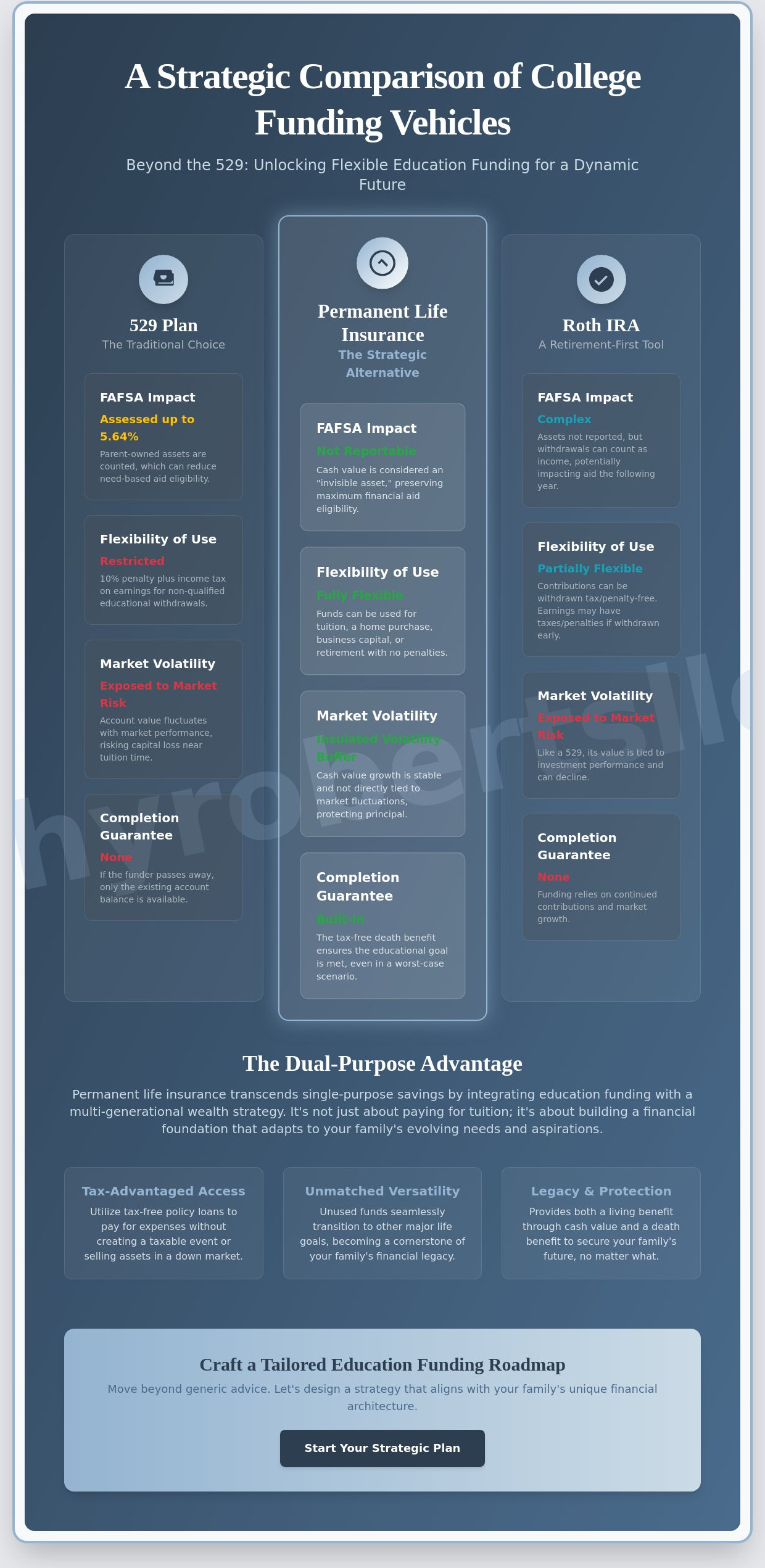
- Evaluate a comparative analysis of 529 plans, Roth IRAs, and life insurance to determine the optimal tax-advantaged vehicle for your family’s 2026 goals.
- Gain insights into integrating education funding with estate planning to facilitate a seamless, multi-generational transfer of wealth and values.
Beyond the 529: Why Strategic Wealth Owners Consider Life Insurance for Education
High-net-worth families often find that traditional savings vehicles lack the architectural flexibility required for complex financial lives. While 529 plans are the standard, they often act as a locked-in asset that punishes pivots in a child’s educational journey. Using life insurance to pay for college introduces a level of strategic agility that traditional accounts simply cannot match, transforming a risk management tool into a multi-generational asset. This approach moves beyond simple savings, positioning permanent life insurance as a sophisticated intervention for families who value both protection and capital growth.
To better understand this concept, watch this helpful video:
The Limitations of Traditional Education Accounts
The 529 plan’s primary weakness lies in its rigidity. If your child receives a full scholarship or chooses a non-traditional path, non-qualified withdrawals of earnings trigger a 10% penalty alongside ordinary income taxes. This creates a significant liability for families who may inadvertently overfund these accounts. Additionally, 529 assets owned by parents are assessed at up to 5.64% in the federal financial aid formula. While this percentage seems small, it can meaningfully reduce eligibility for aid compared to assets that the FAFSA formula ignores entirely. For the visionary strategist, these constraints represent a lack of control over personal capital.
The Strategic Advantage of Permanent Life Insurance
Permanent life insurance offers tax-deferred growth that mirrors the compounding benefits of high-end retirement accounts. Central to this strategy is understanding What is Cash Value in Life Insurance? as it functions as a private reserve of liquidity. Unlike 529 plans, the cash value within a life insurance policy is considered an invisible asset; it’s not currently reportable on the FAFSA, which preserves your child’s eligibility for need-based aid. This dual-purpose tool ensures that if the funds aren’t needed for tuition, they can seamlessly transition into a deposit for a first home or a capital injection for a new business venture. During periods of market contraction, the stable cash value serves as a volatility buffer that allows equity portfolios time to recover while tuition remains funded. This strategy replaces the “use it or lose it” mentality of traditional accounts with a narrative of continuous upward progression and legacy building.
The Mechanics of Cash Value: Turning Protection into an Educational Asset
Permanent life insurance functions as a living asset. Every premium payment contributes to the policy’s equity, creating a reservoir of capital that grows over time. This architectural design allows for the accumulation of cash value, which serves as a private source of liquidity. Unlike term insurance, which only provides a benefit upon death, permanent policies offer a living benefit that can be strategically deployed. Using life insurance to pay for college turns a standard risk management tool into a high-performance funding vehicle.
The strategy includes a unique completion guarantee. If the primary earner passes away before the child reaches university age, the death benefit provides an immediate, tax-free infusion of capital. This ensures the educational goal is met regardless of life’s unpredictability. For those utilizing participating whole life policies, annual dividends can further accelerate this growth. These dividends can be reinvested to purchase paid-up additions, increasing both the cash value and the total death benefit without additional out-of-pocket costs.
Accessing Funds: Loans vs. Withdrawals
Accessing your capital requires a nuanced understanding of policy mechanics. You can withdraw funds up to your cost basis tax-free; however, the most sophisticated strategy often involves policy loans. By borrowing against the cash value rather than withdrawing it, your underlying capital continues to compound within the policy. This creates a volatility buffer. If the market experiences a downturn when tuition is due, you can access policy loans instead of liquidating depressed investment assets. It’s a method of self-financing that preserves your long-term growth trajectory. Refining these strategies requires a strategic financial planning approach that aligns insurance with your broader wealth management goals.
The FAFSA Advantage: Maximizing Financial Aid Eligibility
One of the most compelling reasons for using life insurance to pay for college is its treatment under the federal financial aid formula. The FAFSA currently excludes the cash value of life insurance policies from its asset test. In contrast, 529 plans owned by parents are assessed at a rate of 5.64%, which can directly reduce the amount of aid a student receives. By shifting assets into a non-reportable insurance vehicle, families can effectively lower their Expected Family Contribution. This strategic timing is essential for high-net-worth families who wish to preserve eligibility for need-based aid while maintaining significant liquid reserves.
Strategic Comparison: Life Insurance vs. 529 Plans vs. Roth IRAs
Selecting the optimal vehicle for education funding requires a fiduciary perspective that transcends simple savings. It isn’t about identifying a singular “best” account; it’s about orchestrating a symphony of tax-advantaged tools. For 2026, the landscape involves balancing the state-level perks of 529 plans, the stealth flexibility of Roth IRAs, and the robust capital accumulation of permanent life insurance. Using life insurance to pay for college serves as the anchor in this arrangement, providing a level of certainty that market-dependent accounts cannot guarantee.
The Roth IRA often functions as a secondary education fund because you can withdraw original contributions tax-free at any time. For 2026, contribution limits sit at $7,500 for individuals under 50 and $8,600 for those 50 and older. However, high-earning families often face phase-outs. If your Modified Adjusted Gross Income falls between $242,000 and $252,000 as a married couple, your ability to contribute directly is restricted. This is where the uncapped nature of life insurance premium structures becomes a vital alternative for high-net-worth households.
The 529 vs. Life Insurance Decision Matrix
- Contribution Limits: 529 plans allow for “superfunding” up to $95,000 in a single year for 2026, while life insurance capacity is determined by the policy’s design and death benefit.
- Tax Treatment: 529s offer potential state tax deductions, but life insurance provides federal tax-free access to cash value through structured loans.
- Asset Assessment: 529 plans are parental assets on the FAFSA, whereas life insurance cash value remains an invisible asset.
A “Waterfall Strategy” is often the most effective approach. This involves funding the Roth IRA to its limit if eligible, then contributing to a 529 plan up to the state tax deduction threshold. Any remaining capital is then directed toward using life insurance to pay for college to capture the benefits of non-reportable growth and multi-generational wealth transfer.
SECURE 2.0 and the New 529 Flexibility
The SECURE 2.0 Act introduced a provision allowing a lifetime maximum of $35,000 to be rolled over from a 529 plan to a Roth IRA for the beneficiary. While this reduces the “penalty trap” for unused funds, the restrictions are tight. The account must have been open for at least 15 years, and the rollovers are subject to annual Roth contribution limits. This makes it a slow, long-term remedy rather than an immediate solution for overfunding. Life insurance remains the superior choice for flexibility because it doesn’t require a 15-year waiting period to repurpose capital. Coordinating these complex rollovers and premium payments requires sophisticated tax advising in Ann Arbor to ensure your strategy remains compliant and efficient.
The Fiduciary Edge: Integrating Life Insurance into a Multi-Generational Estate Strategy
A visionary strategist views education funding not as an isolated expense, but as a pivotal component of a broader wealth transfer architecture. When you move beyond the immediate need for tuition, you discover that using life insurance to pay for college serves as a powerful mechanism for taxable estate reduction. This approach allows families across the United States to shift significant capital out of their personal balance sheet, ensuring that their upward progression remains unburdened by future tax liabilities. It is a sophisticated intervention that aligns current educational goals with a long-term legacy of shared success.
Estate Tax Mitigation and Wealth Transfer
By placing permanent life insurance within an Irrevocable Life Insurance Trust (ILIT), you can effectively remove both the growing cash value and the eventual death benefit from your gross estate. This structure allows you to maintain control over the educational outcome without the assets being counted toward your federal estate tax exemptions. The insurance death benefit provides immediate liquidity to pay estate taxes, ensuring your heirs don’t have to liquidate family businesses or real estate to satisfy the IRS. This strategic design protects the integrity of your strategic estate planning roadmap, turning a simple funding need into a cornerstone of your family’s financial stability.
The Multi-Generational Legacy
For high-net-worth families, the concept of “superfunding” is a critical consideration for 2026. While 529 plans allow a lump-sum contribution of up to $95,000 per beneficiary without triggering gift taxes, permanent life insurance offers a more flexible premium structure for moving even larger sums into a protected environment. Grandparents can leverage this to bypass Generation-Skipping Transfer (GST) taxes, funding the education of grandchildren while preserving the parents’ retirement accounts. It’s a method of establishing a “Family Bank” that remains solvent across multiple generations, providing a perpetual source of capital for education and entrepreneurial ventures.
Integrating these insurance structures with your investment portfolio management ensures that your liquid assets and insurance equity work in tandem. This holistic perspective prevents the common mistake of treating insurance as a siloed product. Instead, it becomes a dynamic asset class that supports your family’s journey toward aspirational growth. To ensure your strategy captures every available advantage, Timothy Roberts & Associates, LLC invites you to schedule a fiduciary review of your wealth transfer plan today.
Crafting a Tailored Education Funding Roadmap with Timothy Roberts & Associates, LLC
Implementing a sophisticated financial strategy requires more than just selecting a product; it demands a partnership with a fiduciary who understands the intersection of aesthetics and functionality in wealth management. A fiduciary approach is essential when using life insurance to pay for college because the legal and tax frameworks governing these policies are intricate and constantly evolving. Timothy Roberts & Associates, LLC moves away from the transactional nature of generic financial services, opting instead for a narrative of partnership and shared success. We treat your family’s development as a journey, ensuring that every intervention is intentional and aligned with your long-term vision across the United States.
Our process begins by integrating your educational goals into a broader framework of retirement income planning. This prevents the common pitfall of sacrificing your future security for a child’s tuition. By viewing these objectives through a single, strategic lens, we can build a volatility buffer that protects your lifestyle while funding a legacy. We meticulously balance short, punchy tactical moves with long-term descriptive planning to provide both depth and context to your financial roadmap, regardless of where you reside in the US.
Bespoke Advisory vs. Product Sales
We don’t believe in off-the-shelf solutions. Instead, we evaluate the entire spectrum of available vehicles, including 529 plans, Roth IRAs, and permanent life insurance, to identify the optimal mix for your specific needs. This objective analysis is part of our commitment to providing education funding strategies that account for federal tax nuances and diverse regional opportunities. Our team provides ongoing monitoring of legislative shifts, such as the nuances of the SECURE 2.0 Act, to ensure your assets remain protected against regulatory volatility. This deliberate pacing reinforces our role as a specialized advisor who takes the time to solve complex problems rather than rushing to generic conclusions.
Secure Your Family’s Educational Future
The peace of mind that comes from a professionally managed plan allows you to focus on the personal side of your family’s growth. We customize your portfolio to match your unique risk tolerance, ensuring that the transition from capital accumulation to tuition distribution is seamless and steady. Using life insurance to pay for college is just one component of a human-led, results-driven identity that distinguishes Timothy Roberts & Associates, LLC. We invite you to move beyond the fragmented advice of traditional institutions and embrace a visionary strategy that values depth over superficiality. Contact our team today to begin your strategic consultation and start your journey toward a secure and aspirational educational legacy.
Architecting a Legacy of Shared Success
Strategic education funding requires a shift from reactive saving to intentional wealth architecture. You’ve seen how permanent life insurance serves as a sophisticated volatility buffer, providing tax-advantaged liquidity that bypasses the FAFSA asset test. By integrating these policies into a broader estate plan, you transform a simple funding goal into a dynamic engine for multi-generational wealth transfer. Using life insurance to pay for college ensures that your family’s upward progression remains steady, regardless of market shifts or legislative changes. It’s a method of securing your child’s future while reinforcing your own financial stability.
Timothy Roberts & Associates, LLC brings over 25 years of fiduciary wealth management expertise to these complex decisions. We specialize in high-net-worth tax and estate integration, offering a national reach combined with a deeply personalized, strategic approach. Our firm is dedicated to the craft of bespoke financial planning, moving beyond off-the-shelf products to create carefully crafted interventions for your family’s unique needs. We invite you to Schedule a Strategic Consultation with our Fiduciary Advisors today. Your journey toward a more flexible and robust educational legacy begins with a single, intentional step.
Strategic Insights: Frequently Asked Questions
Is using life insurance for college better than a 529 plan?
The choice depends entirely on your priority for flexibility versus immediate tax deductions. While 529 plans offer state tax benefits, they are rigid and carry penalties for non-educational use. Using life insurance to pay for college provides a versatile alternative that functions as a volatility buffer. It allows you to repurpose funds for any life event without the 10% penalty associated with 529 accounts, ensuring your capital remains an agile asset.
How does life insurance cash value affect FAFSA and financial aid?
Life insurance cash value is currently treated as an invisible asset in the federal financial aid formula. Unlike 529 plans, which are assessed at up to 5.64% as parental assets, insurance values aren’t reportable on the FAFSA. This strategic exclusion can significantly increase your child’s eligibility for need-based aid. It’s a sophisticated method for high-net-worth families to maintain significant liquid reserves while optimizing their student’s financial aid profile.
Can I take a tax-free loan from my life insurance to pay for tuition?
You can generally access your policy’s cash value through tax-free loans because the IRS doesn’t classify these as income. This mechanism allows you to borrow against your own equity rather than a traditional bank. By using life insurance to pay for college through structured loans, your underlying capital continues to compound within the policy. It’s a self-financing strategy that preserves your long-term growth trajectory even while you’re funding tuition.
What type of life insurance is best for saving for college?
Permanent life insurance, specifically whole life or indexed universal life, is the standard vehicle for this strategy. These policies provide the essential cash value accumulation and death benefit protection required for a completion guarantee. Whole life is often favored for its guaranteed growth and potential for annual dividends. This creates a stable, predictable reservoir of capital that acts as a foundation for your family’s multi-generational wealth transfer goals.
What happens if I use my life insurance for something other than college?
You enjoy absolute flexibility with no penalties or restricted use cases. If your child receives a full scholarship or chooses an alternative career path, the funds remain within your control. You can redirect the capital toward a business startup, a home down payment, or supplemental retirement income. This adaptability reflects a visionary strategy where your financial interventions are never trapped by the narrow definitions of qualified educational expenses.
Are there limits on how much I can contribute to life insurance for education?
Contribution limits are primarily dictated by the policy’s structure and the Modified Endowment Contract (MEC) rules. Unlike the annual gift tax exclusion limits for 529 plans, life insurance can often accommodate much larger capital injections if the policy is architected correctly. As long as the premiums don’t exceed the MEC threshold, you can build a substantial educational fund. This requires a bespoke design to ensure the policy maintains its tax-advantaged status.
Is it too late to start a life insurance policy for my child’s college fund?
Time is the most critical element for cash value accumulation, so starting when a child is young is ideal. If your child is already in high school, the window for significant growth is narrow, and other vehicles might be more appropriate. However, the immediate death benefit still provides a completion guarantee that other accounts lack. A fiduciary review can determine if the timeframe allows for a meaningful accumulation of liquid capital.
How do the fees of life insurance compare to 529 plan management fees?
Life insurance typically carries higher front-end costs, including mortality charges and administrative fees, compared to the low expense ratios of 529 plans. However, these costs fund the death benefit and the unique tax-free loan provisions. The value of insurance isn’t found in low fees, but in the strategic benefits of asset protection and financial aid invisibility. It’s a premium solution for those who value long-term flexibility over short-term cost minimization.
