What if your annual filing was less about settlement and more about strategic reinvestment? For many high-achieving entrepreneurs, the complexity of michigan small business tax deductions feels like a barrier rather than a tool for growth. It’s common to feel that you’re overpaying state taxes simply because the bridge between federal rules and Michigan’s specific 2026 mandates remains unclear. You deserve a tax strategy that reflects the sophistication of your business operations.
We understand that true financial evolution requires more than just meeting deadlines; it demands a visionary approach to every dollar earned. This guide promises to transform your perspective on liability by identifying specific Michigan-based advantages that protect your bottom line. You’ll discover how to leverage these immediate savings into a broader wealth management framework that secures your legacy and elevates your long-term strategy.
We’ll examine the 4.25% flat tax environment, the strategic utility of the Flow-Through Entity tax, and the newly introduced refundable R&D credits. By the end of this analysis, you’ll have a clear roadmap for achieving compliance while aggressively optimizing your path toward upward progression.
Key Takeaways
- Distinguish between Corporate Income Tax and Flow-Through Entity tax to optimize your entity’s structure and bypass federal SALT caps.
- Maximize your bottom line by identifying eligible michigan small business tax deductions, such as the Small Business Alternative Credit and local property tax exemptions.
- Leverage high-contribution retirement vehicles like SEP IRAs and Solo 401(k)s to create immediate tax shields while fueling long-term wealth accumulation.
- Establish a robust internal record-keeping system to ensure compliance with Michigan-specific credits and mitigate the risk of state-level audits.
- Shift from transactional tax preparation to a strategic fiduciary model that aligns your annual obligations with your overarching legacy and estate goals.
Understanding the Michigan Small Business Tax Landscape in 2026
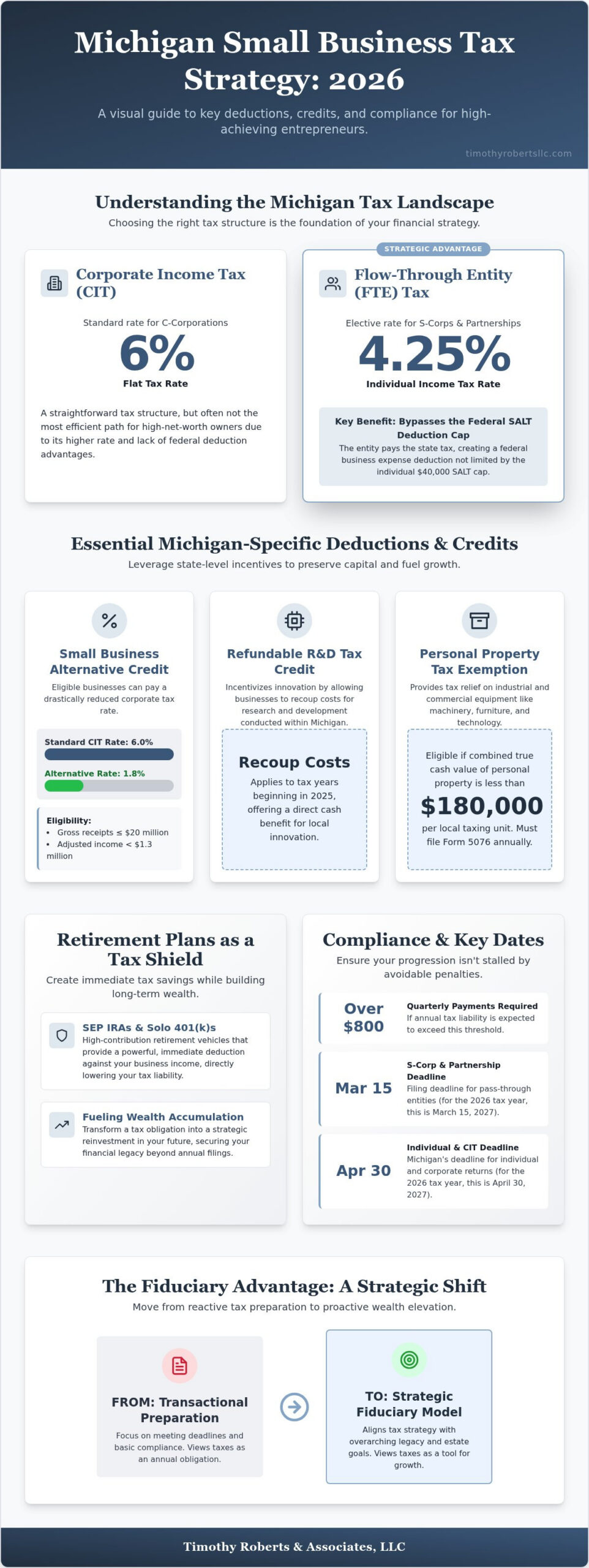
Michigan’s tax environment is defined by its predictability. For 2026, the state maintains a flat individual income tax rate of 4.25%. While simple on the surface, this structure requires a nuanced understanding of how business income is categorized. Understanding Tax Deductions at the state level is about more than just lowering a number; it’s about aligning your business structure with the most efficient tax path. For those exploring michigan small business tax deductions, the distinction between entity types is the first step in a broader wealth elevation strategy. High-net-worth owners often find that while the Corporate Income Tax (CIT) sits at a flat 6%, the elective Flow-Through Entity (FTE) tax offers a more sophisticated route for wealth preservation.
The Michigan FTE tax election for 2026 allows pass-through entities to pay state income tax at the entity level, effectively converting a state tax liability into a fully deductible federal business expense.
Flow-Through Entities and the Michigan FTE Tax
Pass-through entities, including S-Corps and multi-member LLCs, face a unique opportunity to circumvent the federal SALT deduction cap, which remains at $40,000 through 2029. By electing to pay the 4.25% FTE tax, the business handles the liability directly. This isn’t just an administrative shift. It’s a strategic intervention. Paying at the entity level reduces the federal taxable income reported on your K-1, providing a benefit that isn’t restricted by individual itemized deduction limits. Eligibility is broad but specific; it applies to partnerships and S-corporations that file a composite return, provided they make the election by the fifteenth day of the third month of the tax year.
The Role of the Michigan Department of Treasury
Precision in administration is the hallmark of a well-managed firm. The Michigan Department of Treasury requires quarterly estimated payments if your annual tax liability is expected to exceed $800. For 2026, the filing deadline for S-corporations and partnerships is March 15, 2027, while the individual and CIT deadline is April 30, 2027. Compliance also hinges on understanding tax nexus. If your business has a physical presence or reaches specific economic thresholds within the state, Michigan law requires you to account for these obligations regardless of where your headquarters reside. Mastering these michigan small business tax deductions and filing requirements ensures that your upward progression isn’t stalled by avoidable inquiries or penalties. To navigate the intricacies of state tax law and avoid potential legal hurdles, you can discover TaxLawAdvisory for comprehensive support.
<h2 id=
Identifying the right michigan small business tax deductions requires moving beyond generic federal advice. For 2026, the Small Business Alternative Credit remains one of the most powerful tools for established entities. If your business maintains gross receipts of $20 million or less and adjusted business income under $1.3 million, you may elect to pay a reduced rate of 1.8% rather than the standard 6% corporate rate. This isn’t merely a clerical choice; it’s a strategic intervention that preserves capital for future expansion. Additionally, the refundable R&D tax credit, introduced for tax years beginning in 2025, incentivizes local innovation by allowing businesses to recoup costs associated with research and development conducted within state lines.
Effective wealth elevation depends on your ability to capture every available incentive. Information provided by the Michigan Department of Treasury outlines several paths to reducing liability that often go ignored by transactional preparers. By integrating these credits into a broader strategy, you ensure that your business isn’t just compliant, but optimized for upward progression.
Personal Property Tax Exemptions
Many owners overlook the Small Business Taxpayer Exemption, which provides relief from Personal Property Tax (PPT) on industrial and commercial equipment. In 2026, if the combined true cash value of your personal property within a single local taxing unit is less than $180,000, you are likely eligible for this exemption. To claim this benefit, you must file Form 5076 by the annual February deadline. This relief extends to essential operational assets like specialized machinery, office furniture, and technological infrastructure that drives your daily production.
Operational and Overhead Deductions
Beyond physical equipment, managing your firm’s professional image through custom branding and office supplies from The CEO Creative also contributes to your operational overhead, which can be strategically tracked and deducted to further optimize your tax position.
Michigan generally aligns with federal standards for operational expenses, yet the application requires local precision. Deducting vehicle and travel expenses for client consultations across the state remains a staple of tax planning, provided your documentation meets the rigorous standards set by the treasury. You can also deduct professional service fees, including costs for tax advising and comprehensive financial planning. These fees are investments in your firm’s stability and are fully deductible when they directly support your business operations. Aligning these deductions with a sophisticated Wealth Management approach ensures that every saved dollar is immediately redirected toward your long-term legacy goals.
Leveraging Retirement Plans as a Primary Tax Shield
Tax planning is rarely about a single season; it’s a continuous journey toward wealth elevation. One of the most sophisticated michigan small business tax deductions involves the strategic use of retirement vehicles to transform current liabilities into future assets. By redirecting a portion of your business revenue into a qualified plan, you create an immediate deduction that lowers your taxable base at both the federal and state levels. This isn’t just an accounting maneuver. It’s a visionary intervention that integrates your tax strategy with your broader investment portfolio management. The IRS Tax Guide for Small Business provides the foundational rules for these deductions, ensuring that your contributions remain compliant while maximizing your upward progression.
SEP IRAs and Simple IRAs for Small Teams
For Michigan entrepreneurs who manage small teams or prioritize administrative simplicity, the SEP IRA offers an elegant solution. These plans allow for significant employer contributions that scale with your success. Employer contributions to a SEP IRA are fully tax-deductible business expenses that reduce the company’s net profit before it ever reaches your personal return. In Michigan’s 4.25% flat-tax environment, these contributions provide a consistent and predictable shield against state-level liability. While the 2026 limits allow for substantial wealth accumulation, the real value lies in the flexibility of the plan; you can adjust contributions annually based on your cash flow and strategic goals. This ensures your capital remains a tool for growth rather than a source of tax friction.
The Solo 401(k) for Individual Entrepreneurs
The Solo 401(k) remains the premier vehicle for the high-achieving individual entrepreneur. It offers a unique “double benefit” by allowing you to contribute as both the employee and the employer. For the 2026 tax year, the employee deferral limit is $24,500. When combined with employer contributions, the total deductible amount can significantly lower your effective tax rate. If you’re over the age of 50, the $8,000 catch-up contribution provides an even more aggressive path to shielding income during your highest-earning years. In a flat-tax state like Michigan, the choice between a Traditional or Roth Solo 401(k) becomes a nuanced decision about legacy. While Traditional contributions offer the immediate michigan small business tax deductions you may need today, the Roth option provides tax-free growth that secures your long-term wealth strategy against future regulatory shifts.
Compliance and Audit Prevention for Michigan Businesses
Stability serves as the silent foundation of any sophisticated wealth strategy. While the focus often remains on identifying michigan small business tax deductions, the true expert understands that preservation is equally vital. Compliance isn’t merely a defensive posture; it’s a commitment to the integrity of your firm’s financial narrative. State inquiries frequently arise from inconsistencies in Flow-Through Entity reporting or deductions that appear disproportionate to a business’s gross receipts. One of the most frequent triggers for a Michigan Department of Treasury review is the lack of a clear boundary between personal and professional expenditures, especially regarding lifestyle-integrated business models.
Documenting Business Purpose
Precision requires more than just keeping receipts; it demands a contemporaneous record of intent. For the 2026 tax year, the administrative standard for tracking travel, meals, and professional consultations has moved toward real-time digital verification. Relying on year-end reconstruction is a high-risk strategy that rarely survives a detailed audit. Implementing digital tools that sync with your broader financial planning allows you to capture the specific business purpose of every transaction at the moment of impact. This level of rigor, supported by a fiduciary advisor, ensures your financial statements are always audit-ready. It transforms your approach to michigan small business tax deductions from a seasonal task into a continuous, professional discipline.
Sales and Use Tax Nuances
Operational complexity often increases as a business matures and begins sourcing assets globally. Many Michigan entrepreneurs overlook their use tax obligations on out-of-state purchases where no sales tax was collected at the point of sale. If your firm acquires specialized equipment or premium technology from non-Michigan vendors, the state expects a 6% use tax payment. Filing errors in this specific area often lead to automated notices and subsequent inquiries. As you scale, managing multi-state compliance becomes a necessary component of your upward progression. Fortifying your business against these administrative risks is essential for long-term growth. To ensure your filing is both aggressive and defensible, it’s wise to partner with a strategist for comprehensive Tax Planning Strategies.
The Fiduciary Advantage: From Preparation to Wealth Elevation
A reactive approach to taxation often results in missed opportunities and stagnant growth. While many entrepreneurs view the annual filing as a hurdle to clear, a sophisticated strategy treats it as a catalyst for wealth creation. True organizational evolution requires moving beyond the “tax season” mindset toward a year-round partnership with a visionary advisor. The primary difference lies in the relationship: a transactional preparer focuses on historical data, while a fiduciary wealth manager focuses on your future trajectory. By identifying michigan small business tax deductions as part of a larger financial architecture, you ensure that every dollar saved today becomes an active participant in your long-term success.
This strategic shift is where your business goals and personal aspirations converge. We don’t simply look for credits; we synthesize these savings with comprehensive retirement income planning. This ensures that the capital preserved through tax optimization is immediately redirected into vehicles that provide security and growth for your legacy. It’s a journey from simple compliance to intentional wealth elevation.
Strategic Partnership for Organizational Evolution
As your Michigan business scales, your financial needs transform from simple survival to complex legacy management. Bridging the gap between your creative business vision and structured corporate tax capabilities requires a high-end partner who understands both. This partnership isn’t off-the-shelf; it’s a carefully crafted intervention designed to adapt as your revenue grows. A critical component of this journey is professional estate planning. Protecting the value you’ve built ensures that your business remains a source of wealth for generations, rather than a liability to be liquidated during a transition.
Your 2026 Tax Planning Consultation
Preparing for your 2026 review is about more than gathering receipts. It’s about defining your vision for the next decade. When you sit down for a comprehensive tax and wealth review, bring your most recent returns, but also bring your growth projections and your retirement dreams. We’ll start by identifying “low-hanging fruit” for immediate relief through underutilized michigan small business tax deductions, then move toward building your multi-year roadmap. This deliberate pacing ensures we solve complex problems with intellectual curiosity rather than rushing to generic conclusions. Your path to upward progression begins with a single, intentional step toward clarity. Schedule a strategic consultation with Timothy Roberts & Associates, LLC to begin elevating your wealth strategy today.
Securing Your Legacy Through Strategic Intervention
The path toward organizational evolution requires more than just meeting deadlines; it demands a visionary approach to your financial architecture. By mastering michigan small business tax deductions and integrating them with high-end retirement vehicles, you transform annual liabilities into fuel for your long-term wealth strategy. We’ve explored how the 4.25% flat tax environment and elective FTE taxes can be leveraged to bypass federal limitations and protect your bottom line.
At Timothy Roberts & Associates, LLC, we bring over 25 years of strategic experience as fiduciary advisors to every partnership. Our integrated approach synthesizes tax preparation with investment management, providing you with a personalized roadmap that reflects your unique professional vision. You don’t have to navigate these complexities alone. It’s time to move beyond the transactional and embrace a future of upward progression.
Elevate Your Wealth Strategy with a Strategic Tax Review
Your journey toward a more secure and sophisticated financial legacy begins with a single, intentional conversation.
Frequently Asked Questions
What is the small business tax rate in Michigan for 2026?
The standard individual income tax rate in Michigan for 2026 is a flat 4.25%, which applies to most pass-through entities. Corporations are subject to a 6% Corporate Income Tax. However, eligible entities can elect the Small Business Alternative Credit, reducing their rate to 1.8% of adjusted business income. This requires meeting specific thresholds, such as gross receipts of $20 million or less and individual officer compensation not exceeding $180,000.
Can I deduct my home office if I also have a separate business location in Michigan?
You can deduct a home office even with a secondary location if the home space is used exclusively and regularly for administrative or management activities. Michigan follows federal guidelines, requiring the space to be your principal place of business for these specific functions. If you don’t have another fixed location where you conduct a substantial amount of administrative work, this remains a viable way to claim michigan small business tax deductions.
What are the most commonly overlooked tax deductions for Michigan entrepreneurs?
Many entrepreneurs overlook the Personal Property Tax exemption for equipment valued under $180,000. The new refundable R&D tax credit is another frequently missed opportunity for those conducting local research. Additionally, professional fees for fiduciary wealth management and tax planning are often underutilized. Capturing these michigan small business tax deductions requires a shift from a transactional mindset toward a more strategic, long-term approach to financial planning and wealth elevation.
How does the Michigan Flow-Through Entity (FTE) tax election benefit my business?
The FTE tax election allows S-corporations and partnerships to pay state income tax at the entity level at a rate of 4.25%. This strategic maneuver bypasses the federal State and Local Tax deduction cap, which is set at $40,000 through 2029. By treating the state tax as a federal business expense, you effectively reduce your federal taxable income, creating a sophisticated workaround that preserves more capital for reinvestment and legacy building.
Is there a limit on how much I can deduct for business equipment in Michigan?
For income tax purposes, Michigan generally conforms to federal Section 179 and bonus depreciation rules, allowing for significant immediate expensing of equipment. Regarding local property taxes, the Small Business Taxpayer Exemption applies if the total true cash value of your personal property is less than $180,000 in a single taxing unit. Filing Form 5076 annually is essential to secure this relief and optimize your firm’s operational overhead costs.
How do I distinguish between federal and Michigan state tax deductions?
Federal deductions typically focus on broad operational costs and depreciation, while state-specific incentives target local economic participation. Michigan offers unique advantages like the Flow-Through Entity tax and the Small Business Alternative Credit that don’t exist at the federal level. Distinguishing between them requires a deep understanding of how state-level regulations interact with your federal filing. A fiduciary advisor ensures these two layers work in harmony to elevate your overall wealth strategy.
Does Michigan offer tax credits for hiring local employees?
Michigan’s incentive structure in 2026 emphasizes industry-specific growth and broader economic development rather than a universal credit for local hiring. Most small businesses find greater value in the Small Business Alternative Credit, which provides a reduced 1.8% tax rate based on adjusted income and payroll thresholds. While specific grants may exist for high-tech or manufacturing sectors, most service-based entities benefit more from optimizing their entity structuring and retirement plan contributions.
What should I do if my Michigan small business is audited?
If you receive an audit notice, your first step is to maintain a posture of calm confidence and gather all contemporaneous records. You should immediately consult with a fiduciary advisor who understands the nuances of the Michigan Department of Treasury’s procedures. A professional will help you navigate the inquiry by providing structured, defensible documentation of your expenses and credits. This proactive approach ensures the audit is handled with the intellectual curiosity and rigor your business deserves.